Hammerhead Shark

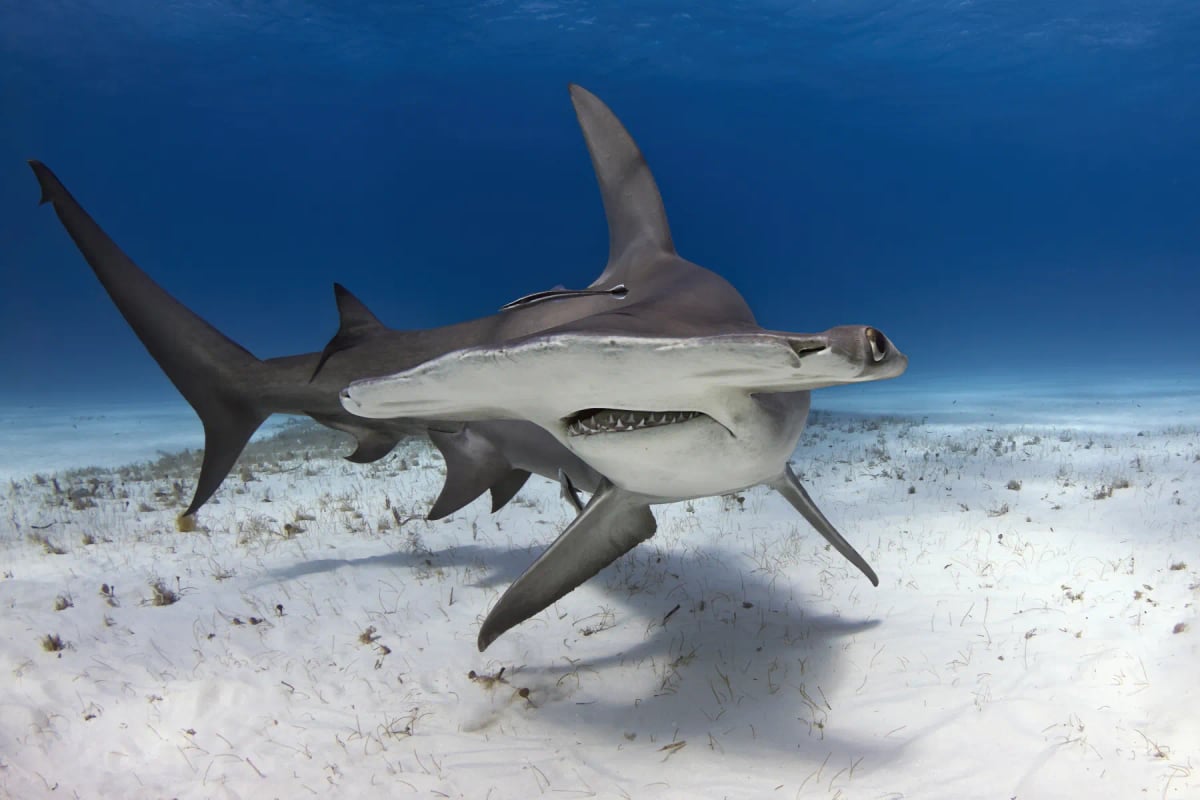
The Hammerhead Shark (Sphyrna spp.) is recognized by its flattened hammer shaped head and wide set eyes, which enhance vision and sensory perception. Found in tropical and subtropical seas, it feeds on rays, fish, and cephalopods. Hammerheads often swim in schools, but many species are now Critically Endangered due to overfishing and fin trade.
Habitat and distribution
Hammerhead sharks are found in warm tropical and subtropical oceans across much of the world, from the Atlantic and Pacific to the Indian Ocean. They tend to favor coastal waters, spending time near continental shelves, seamounts, coral reefs, and the waters around oceanic islands. Some species, such as the great hammerhead, also venture into lagoons and deeper offshore zones. Juveniles often seek out shallow coastal nursery areas where food is plentiful and large predators are less common. Seasonal migrations are well documented in several species, which travel toward cooler latitudes during summer months before returning to warmer waters. This broad but uneven distribution means hammerheads appear along coastlines on nearly every continent, yet their numbers in many of these regions have dropped sharply over recent decades.
Diet
Few ocean predators are as well equipped for hunting as the hammerhead shark. Its wide, flattened head is packed with sensory organs called ampullae of Lorenzini, which pick up the faint electrical fields produced by animals hiding beneath the sand. Stingrays are a particular favorite, and researchers have found large numbers of stingray barbs embedded in the mouths of great hammerheads, suggesting they hunt these prey items regularly and with little ill effect. Beyond rays, hammerheads feed on bony fish, squid, octopus, and crustaceans. The placement of their eyes at opposite ends of the head gives them a wide field of vision, helping them track fast prey in open water. Hunting often takes place in the early morning and at dusk, when prey is most active near the reef.
Behavior
One of the most striking things about hammerhead sharks is their habit of gathering in large groups during the day. Schools of scalloped hammerheads numbering in the hundreds have been recorded at seamounts in the Pacific, including sites around the Galápagos Islands and Cocos Island. Scientists believe these daytime aggregations may be linked to navigation, mating, or simply the presence of cooler, oxygen-rich water currents the sharks prefer to rest in. At night, most individuals break away from the group to hunt alone. Although hammerheads can grow to impressive sizes, they are not considered a major threat to people and tend to move away when divers approach. Attacks on humans are rare and are almost always linked to provocation or mistaken identity in murky water.

Conservation
The situation facing hammerhead sharks is serious. The scalloped hammerhead and the great hammerhead are both listed as En peligro crítico on the IUCN Red List, while other species in the group are assessed as Endangered or Vulnerable. The main pressures are overfishing, both targeted and as bycatch in commercial longline and gillnet fisheries, and persistent demand for shark fins used in shark fin soup. Because hammerheads reproduce slowly, giving birth to small litters after a gestation period of around nine to twelve months, populations cannot recover quickly once they decline. International protections under CITES now restrict the fin trade for several species, and a growing number of countries have established shark sanctuaries or banned finning. Even so, enforcement remains a challenge across the wide ocean areas these sharks call home.
Technical factsheet
Where it is found
The Hammerhead Shark can be found in places such as:
Frequently Asked Questions
What do hammerhead sharks eat?
Hammerhead sharks eat stingrays, bony fish, squid, octopus, and crustaceans. Stingrays are a clear favorite. The sensory organs packed into their wide, flat head can detect the electrical fields of prey hiding under the sand, making hammerheads exceptionally good at finding animals that other predators would simply miss. Most hunting takes place in the early morning or at dusk.
Why does the hammerhead shark have such a wide, flat head?
That distinctive head serves two big purposes. First, it spreads out thousands of sensory organs called ampullae of Lorenzini, giving the shark an almost unbeatable ability to detect hidden prey. Second, having eyes placed far apart at each end of the head provides a wide field of vision, helping it track fast prey in open water. The shape may also help with sharp turns while swimming.
Where do hammerhead sharks live?
Hammerhead sharks live in warm tropical and subtropical oceans around the world, including the Atlantic, Pacific, and Indian Oceans. They are most often found near coastlines, coral reefs, seamounts, and oceanic islands. Some species move into deeper offshore waters, while juveniles tend to stay in shallow coastal areas. Several species migrate toward cooler latitudes during summer and return to warmer waters afterward.
Are hammerhead sharks dangerous to humans?
Hammerhead sharks are not considered a serious threat to people. Attacks on humans are very rare and are almost always connected to accidental encounters in murky water or to provocation. In fact, these sharks tend to swim away when divers get close. Their diet focuses on rays and fish, not humans. Most people who dive in areas where hammerheads live do so safely and without incident.
Why do hammerhead sharks swim in schools?
Hammerhead sharks, especially scalloped hammerheads, gather in large groups during the day at seamounts and underwater ridges. Schools of hundreds have been recorded near the Galápagos Islands and Cocos Island. Scientists think these gatherings may be connected to navigation, mating opportunities, or a preference for cooler, oxygen-rich currents in those spots. At night, the sharks spread out and hunt on their own.
Are hammerhead sharks endangered?
Yes, several species are in serious trouble. The great hammerhead and scalloped hammerhead are both listed as Critically Endangered by the IUCN. The main causes are overfishing, bycatch in commercial fisheries, and the demand for shark fins used in shark fin soup. Because hammerheads reproduce slowly and have small litters, their populations take a very long time to recover once they have been reduced.
How big can hammerhead sharks get?
Size varies quite a bit across the different species. The great hammerhead is the largest, capable of reaching around 6 meters in length and weighing over 450 kilograms. Smaller species, like the bonnethead, rarely grow beyond 1.5 meters. Most hammerheads that people encounter while diving fall somewhere in between. Females tend to grow larger than males, which is common among sharks in general.