Amazon Milk Frog
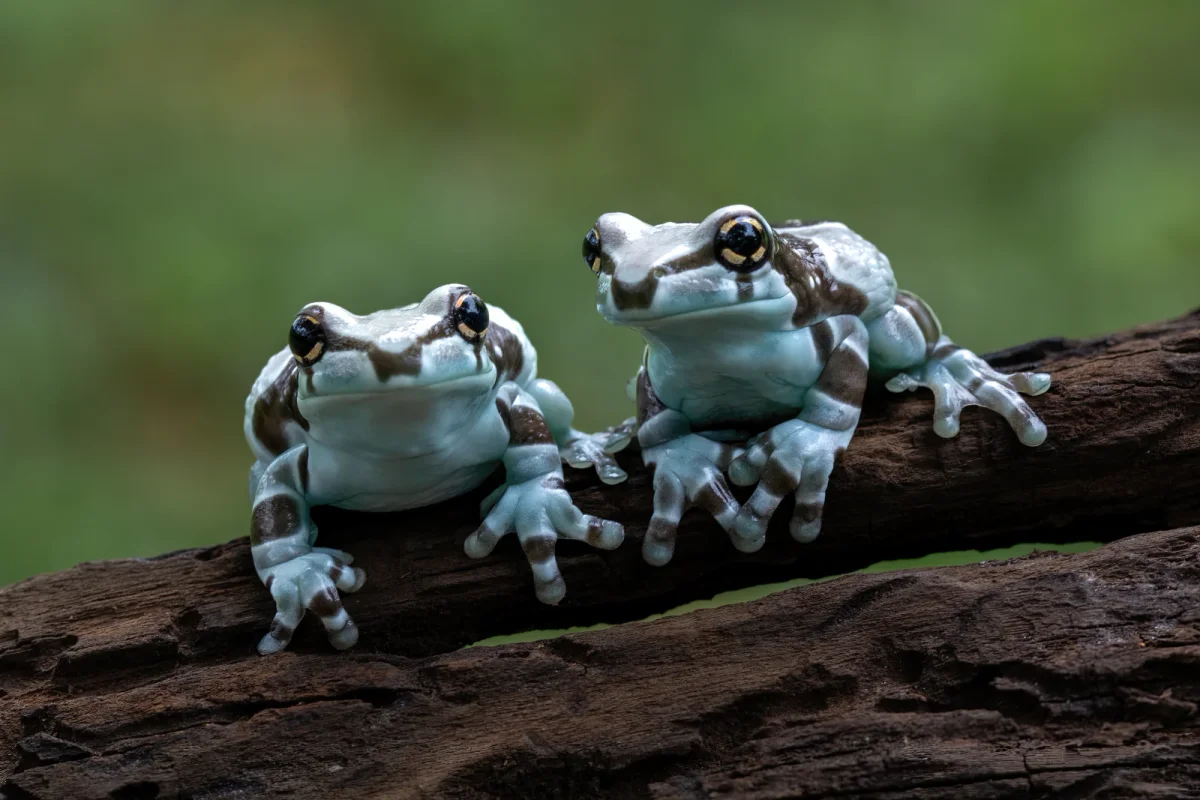
The Amazon milk frog (Trachycephalus resinifictrix), also called the Mission golden eyed tree frog, is a large tree frog of the rainforests of the eastern Amazon and the Guianas. Adults measure about 6.5 to 10 centimeters, with females clearly larger than males. They are pale gray or light brown with dark brown bands, have large sticky toe pads and golden eyes crossed by a dark pattern, and their skin becomes bumpier with age. The name milk frog comes from the sticky, milky fluid its skin releases when it feels threatened. It lives high in the canopy of tall forest, is active at night and almost never comes down to the ground. It breeds in water that collects inside hollow trees, sometimes more than 30 meters up, where males call, females lay their eggs and the tadpoles grow. It is widely kept in captivity, but in the wild it is heard far more often than seen. The IUCN lists it as Least Concern.
Name and Discovery
The Amazon milk frog was described in 1907 by the Swiss naturalist Emil Goeldi, who worked at the natural history museum in Belém, in the Brazilian state of Pará. He named it Hyla resinifictrix, which means resin maker. The specimens came from the Maracanã River, at the mission of São Antônio do Prata, and that mission is the origin of its other English name, the Mission golden eyed tree frog. Goeldi was struck by its unusual breeding habits. Drawing on the accounts of the local Tembé people, he wrote that the frog coated the inside of tree holes with resin so they would hold water, an idea later scientists doubted. Today the species belongs to the genus Trachycephalus, a group of large tree frogs whose skin produces sticky secretions, often called milk frogs. In 2013 researchers described a very similar species, Trachycephalus cunauaru, and showed that many frogs once called resinifictrix in the central and western Amazon belong to it instead.
Size and Appearance
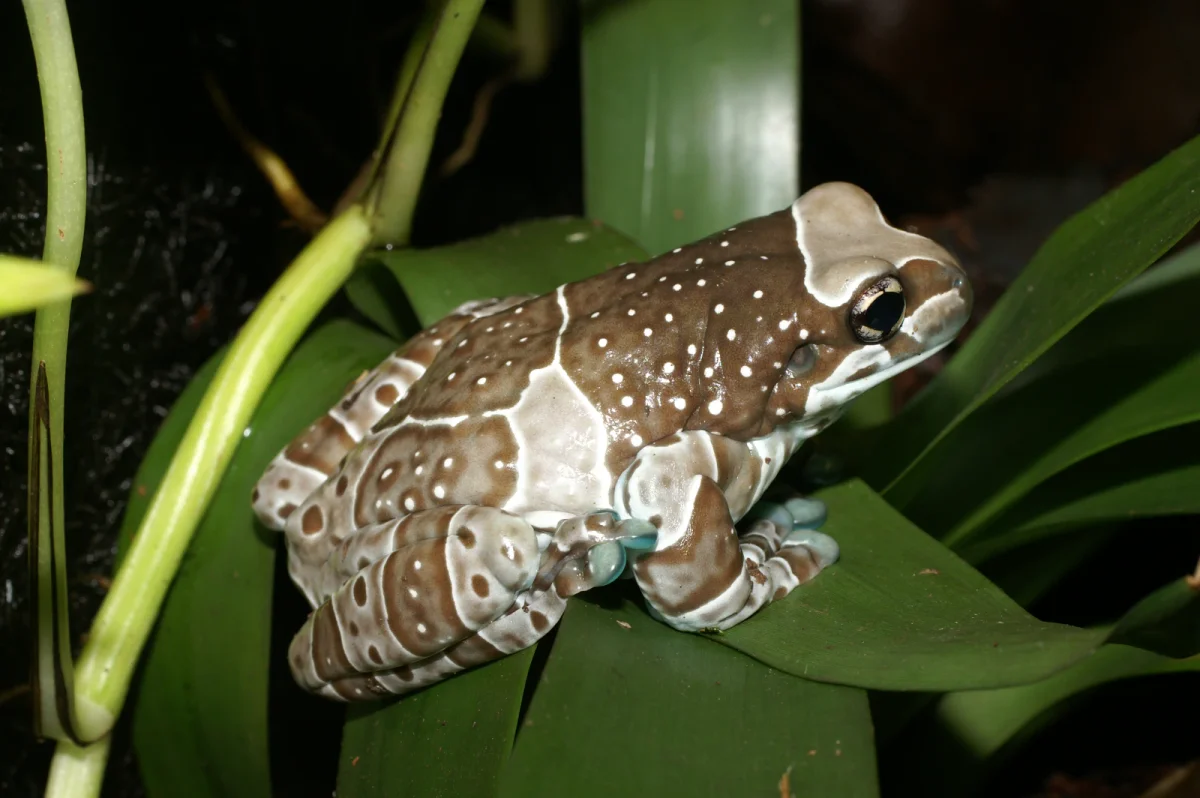
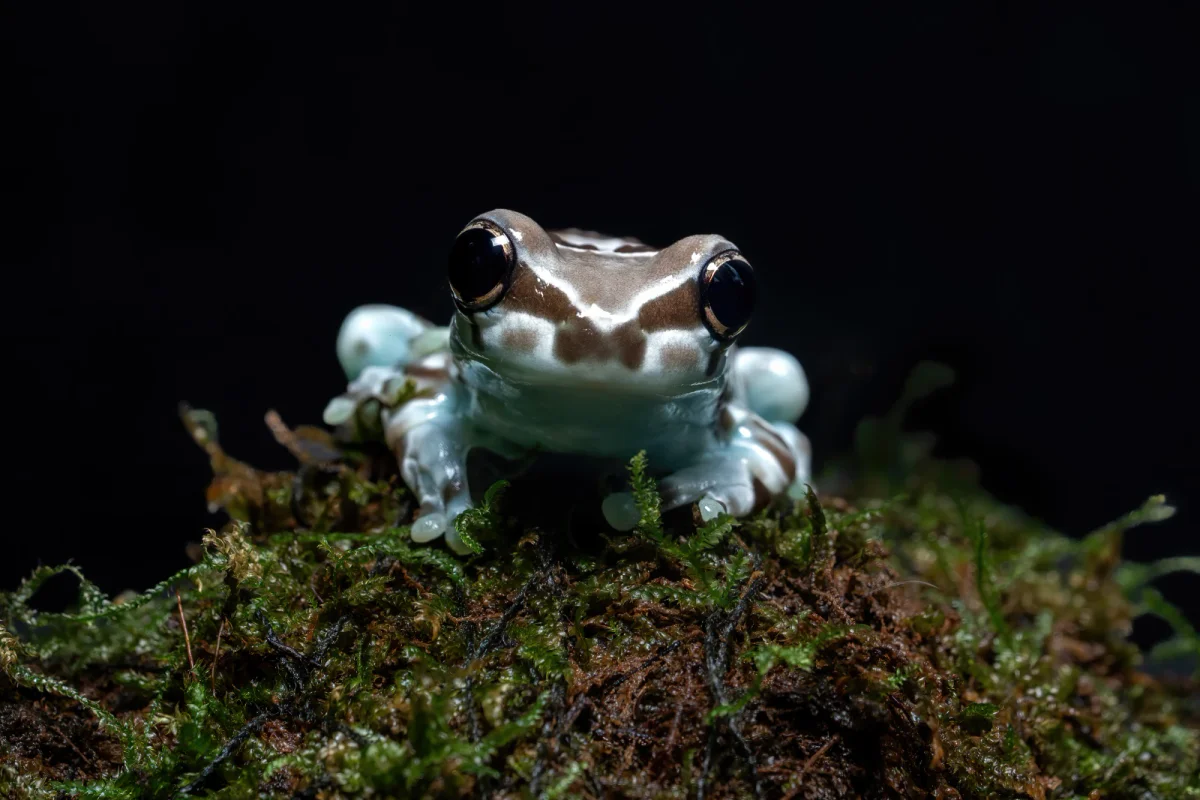
The Amazon milk frog is a large, sturdy tree frog. Adults usually measure about 6.5 to 10 centimeters from snout to vent, and females are clearly bigger than males: in one study, females measured 86 to 100 millimeters and males 65 to 77 millimeters. The background color is pale gray, whitish or light brown, crossed by broad dark brown bands on the back and legs. Young frogs have sharper, cleaner contrast between the light and dark areas, and the pattern becomes softer as they grow. With age the skin also turns rougher and bumpier, and some adults show small pale spots. The eyes are large and golden, with a dark cross shaped pattern on the iris, a feature behind the name golden eyed tree frog. Like other tree frogs, it has wide, sticky pads at the tips of its fingers and toes, which let it climb smooth trunks and cling to leaves. The fingers and toes are partly webbed, and the head is broad, with a short, rounded snout.
Habitat and Range
As currently understood, the Amazon milk frog lives in the eastern Amazon of Brazil, in the states of Amazonas and Pará, and north into the Guianas, in Guyana, Suriname and French Guiana. It may also live in the Brazilian states of Amapá and Roraima, and its presence in Venezuela is uncertain. Older sources give a much wider range, including Colombia, Ecuador, Peru and Bolivia, but many of those frogs are now considered to be Trachycephalus cunauaru or other relatives. It is a lowland species. Its home is tall, mature terra firme rainforest, the forest that grows on higher ground and does not flood with the rivers. There it lives in the upper layers of the forest, often in the canopy. What it needs most are large old trees with hollows that fill with rainwater, because these are the only places where it breeds. Where the big trees are cut down, the frog loses both its shelter and its nurseries.
Life in the Canopy
The Amazon milk frog spends almost its whole life high in the trees and rarely, if ever, comes down to the forest floor. It is active at night, when it moves slowly along branches and leaves in search of food, and it spends the day resting, often pressed against a branch or hidden in a hollow. Like other tree frogs of its size, it feeds on insects and other small invertebrates, catching the prey that comes within reach among the leaves and branches of the canopy, where insects are plentiful at night. Its name comes from its main defense. When it is grabbed or stressed, glands in its skin release a sticky, milky white fluid that coats the body. This secretion is thought to make the frog unpleasant or hard to hold for a predator, giving it a chance to escape. Because it lives so high up, scientists know it mostly from its calls. Researchers working in the Amazon often record it calling from the canopy without ever managing to see or catch one.
Breeding in Tree Holes
The Amazon milk frog has one of the most unusual nurseries of any frog. It breeds only in water filled hollows in living trees, found from about 2 to more than 30 meters above the ground and holding from a few liters to around 90 liters of water. During the rainy season, from about August or September to April or May, males sit inside these holes at night and call loudly to attract females, mostly on nights without rain, and the same hole may be used again and again. A female that accepts a male enters the hole, and she lays her eggs directly in the water as a gelatinous mass that floats at or near the surface or sticks to the inner wall. A single clutch can hold from about one hundred to more than a thousand eggs. The tadpoles grow inside the hole until they become froglets. They eat plant debris that falls into the water and also the eggs of later clutches laid in the same hole, a rich food source in a place with little else to eat.
Conservation
The IUCN lists the Amazon milk frog as Least Concern, in an assessment made in 2021 and published in 2023. The reason is that it has a wide range across the eastern Amazon and the Guianas and is thought to have a large population living in vast areas of forest that remain intact. Its population trend is unknown, because a frog that lives in the treetops and is seldom seen is very difficult to count. Its biggest long term risk is the loss of forest. The species depends on big old trees with water filled hollows, so logging and the clearing of the Amazon for cattle ranching, farming and mining remove exactly the trees it needs to breed, even where some forest is left standing. Large parts of its range in the Guianas and in the Brazilian Amazon lie within protected areas and Indigenous territories, which help keep its forests whole.
Where it is found
The Amazon Milk Frog can be found in places such as: