Proboscis Monkey
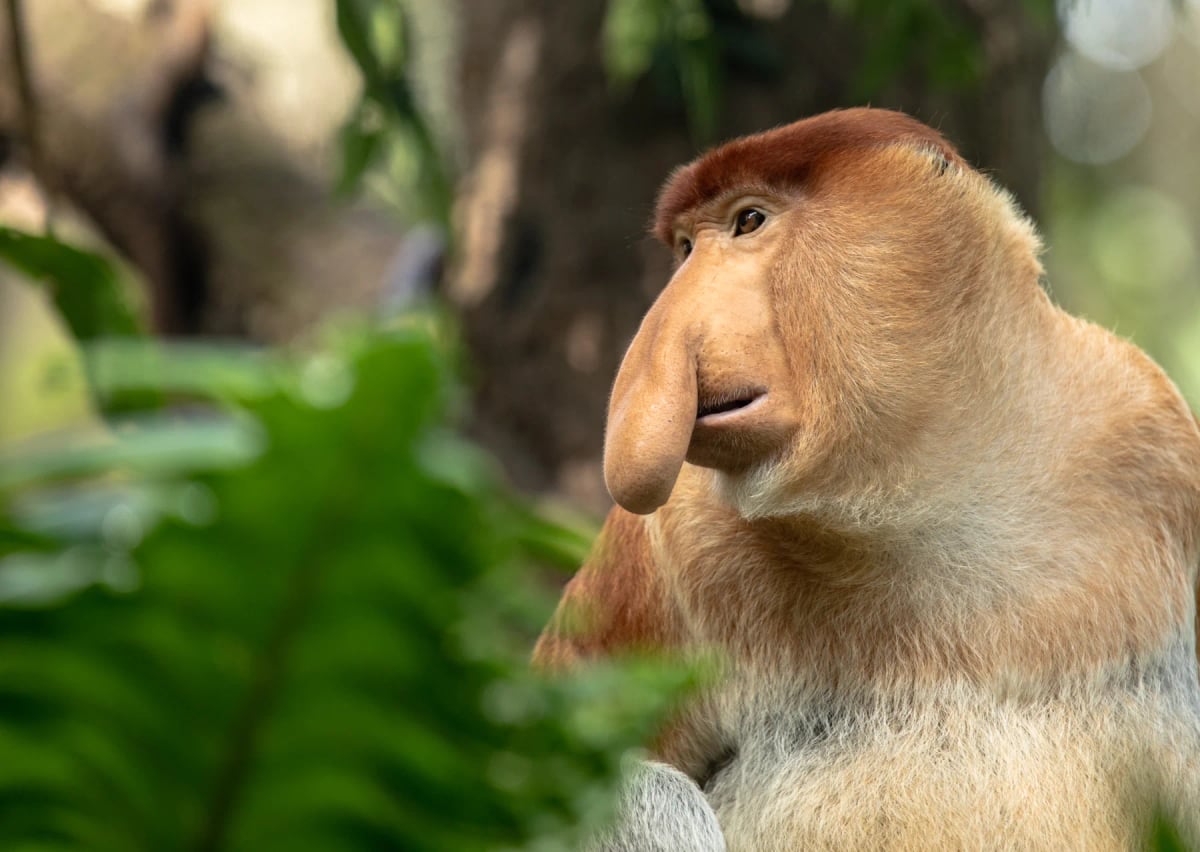
The proboscis monkey is a large primate found only on the island of Borneo, spread across the forests of Brunei, Malaysia and Indonesia. It favors coastal mangroves, riverbanks and swamp forests, rarely straying far from water. Males are instantly recognizable by their bulbous, drooping noses, which can exceed 10 cm in length, and by their rounded, prominent bellies. Both traits are linked to social signaling: the nose amplifies honking calls and appears to attract females, while the belly houses a complex, multi-chambered stomach that breaks down fibrous leaves and unripe fruits through fermentation. Proboscis monkeys are surprisingly strong swimmers and will leap from branches into rivers to escape predators such as crocodiles. They live in groups that typically gather in trees along riverbanks at dusk. Habitat loss driven by the clearing of mangroves and peat swamps has pushed the species to Endangered status.
Habitat and range
Borneo is the only place on Earth where proboscis monkeys exist, making the island their entire world. Within it, they stick closely to habitats near water: coastal mangroves, forests growing over peat swamps, and the wooded banks of rivers and streams. Their range covers the three countries that share the island, including Brunei, the Malaysian states of Sabah and Sarawak, and the Indonesian region of Kalimantan. They rarely venture into dry inland forests, since access to water is essential for both drinking and escape from predators. Groups tend to settle in trees along riverbanks as the sun goes down, roosting together overnight before spreading out again at dawn. Tidal mangroves are a particularly important habitat, offering food and shelter, yet these forests are among the most heavily cleared in the region.
Diet
Food for proboscis monkeys comes almost entirely from plants. Young leaves make up the bulk of their diet, supplemented by shoots, seeds and unripe fruits. Ripe, sugary fruits are largely avoided because sugars can ferment too quickly inside their specialized stomachs and cause dangerous bloating. That stomach is a remarkable organ: it has multiple chambers lined with bacteria that break down tough plant fibers through a process similar to what happens inside a cow. This allows the monkeys to extract nutrients from vegetation that most other primates cannot digest efficiently. They also consume certain flowers and small amounts of insects on occasion. Because their food is low in calories, proboscis monkeys spend a large portion of the day eating, resting to digest, and then eating again, following a calm and fairly predictable daily routine.
Distinctive features
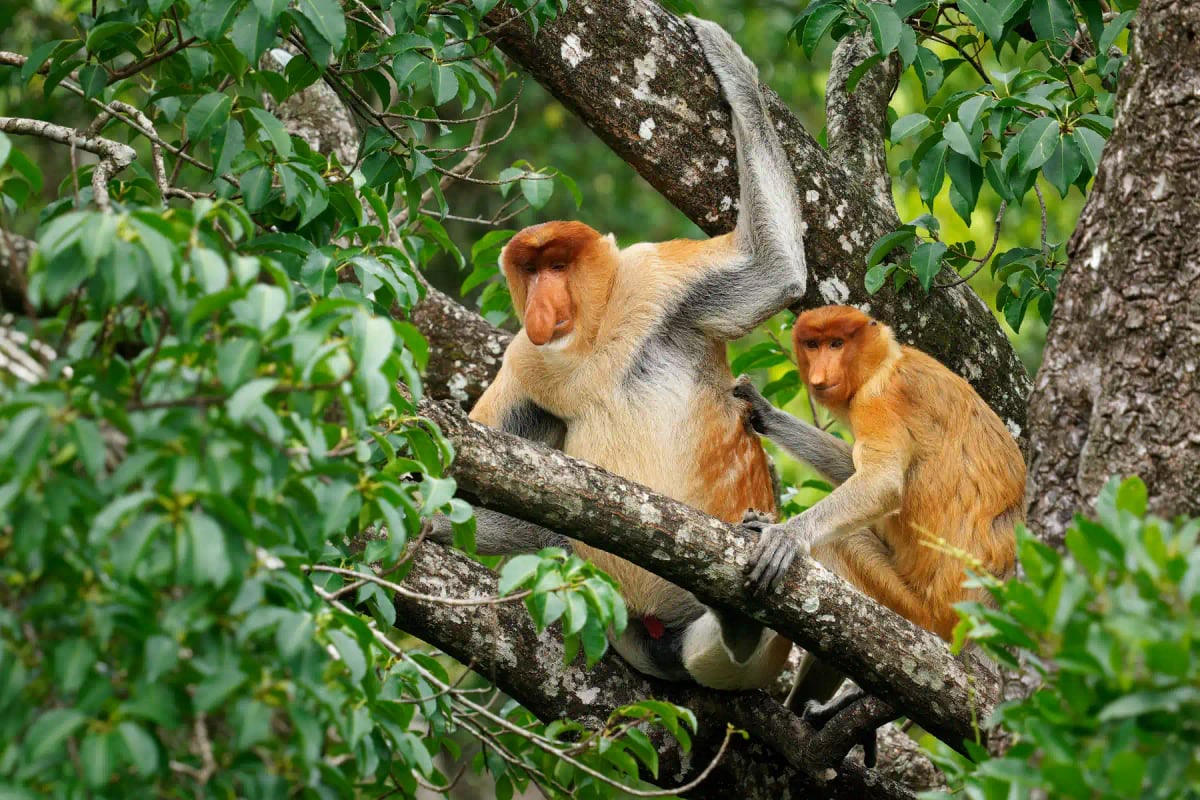
Few animals are as immediately recognizable as an adult male proboscis monkey. His nose, which can grow beyond 10 cm in length, droops well below the chin and wobbles noticeably when he calls out. Scientists believe it works like a resonating chamber, making his honking vocalizations louder and deeper, which both attracts females and warns rival males. Females and young have smaller, upturned noses by comparison. Males are also considerably larger than females, sometimes weighing twice as much. The rounded, prominent belly is another signature trait, reflecting the large stomach needed for fermentation. Their fur is reddish brown on the back and cream to pale gray on the limbs and underside. Newborns are born with strikingly blue faces, which gradually fade to the pinkish tone seen in adults over the first few months of life.
Behavior
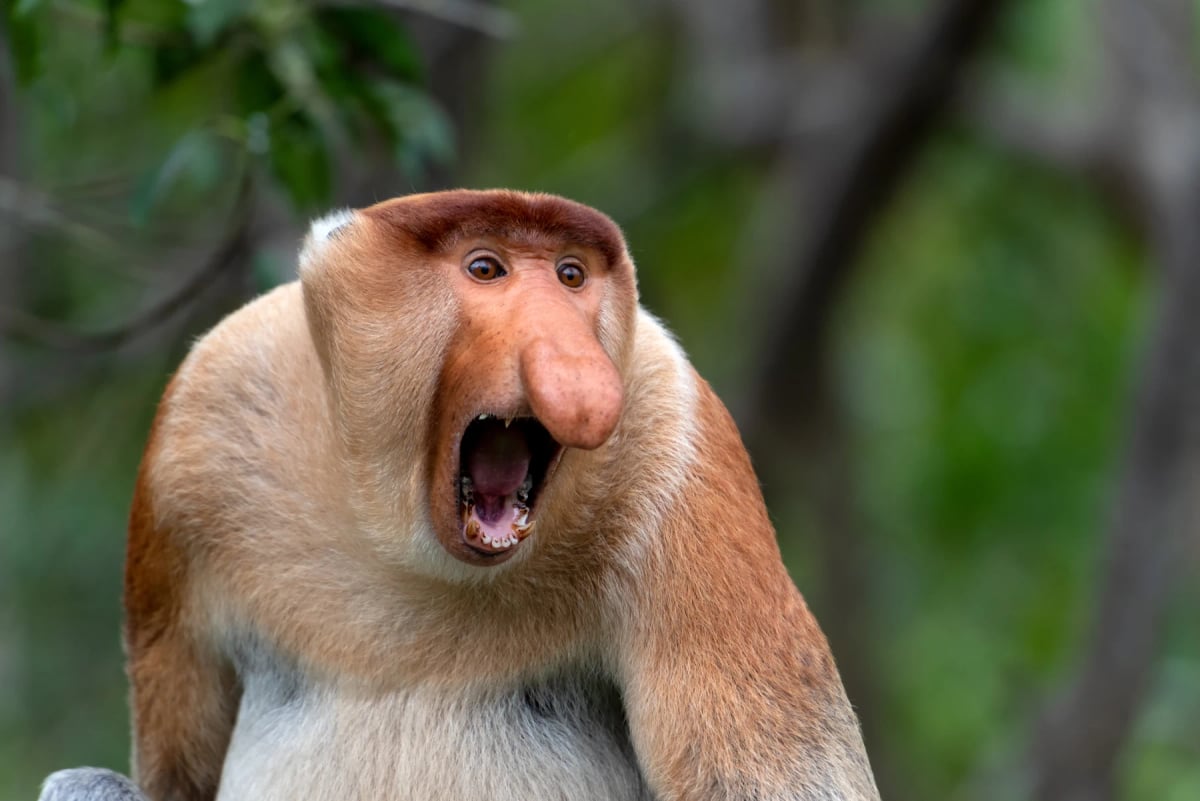
Social life for proboscis monkeys revolves around groups that typically consist of one adult male, several females and their young. Bachelor groups made up of males without a harem also form and are commonly observed. Individuals from different groups sometimes gather in large numbers along riverbanks at dusk, creating temporary congregations that can be quite noisy. One of their most striking abilities is swimming. Proboscis monkeys are among the most capable swimmers of any primate, crossing wide rivers with ease using a partly webbed hand and foot. They will plunge from a branch straight into the water when threatened by a predator such as a clouded leopard or a saltwater crocodile. Most of the day is spent moving through the forest canopy in search of food, alternating with long periods of rest while their multi-chambered stomachs get to work.
Conservation
The IUCN lists the proboscis monkey as Endangered, and its population has declined sharply over recent decades. The greatest threat is the loss of habitat. Mangrove forests have been cleared extensively for aquaculture, agriculture and coastal development, while peat swamp forests have been drained and burned to make way for palm oil plantations. Because proboscis monkeys depend so completely on forest near water, even partial clearing can fragment their habitat in ways that isolate groups and reduce genetic diversity. Hunting adds additional pressure in some parts of their range, and they are occasionally killed when they raid crops near forest edges. Conservation efforts include protected areas across Borneo, as well as research programs tracking population numbers. Restoring and connecting patches of riverside and mangrove forest remains one of the most important steps toward securing a future for this species.
Researched and written by Juan Pablo. Sources: IUCN Red List, scientific literature and regional field guides. Last updated: .
Technical factsheet



Frequently Asked Questions
What do proboscis monkeys eat?
Proboscis monkeys eat mostly young leaves, along with shoots, seeds and unripe fruits. They avoid ripe, sugary fruits because sugar ferments too fast in their stomachs and can cause dangerous bloating. Their multi-chambered stomach works similarly to a cow's, using bacteria to break down tough plant fibers. Because their food is low in calories, they spend much of the day eating and resting to digest.
Where do proboscis monkeys live?
Proboscis monkeys are found only on the island of Borneo, which is shared by Brunei, Malaysia and Indonesia. Within the island, they stick to habitats near water: mangrove forests along the coast, peat swamp forests and the wooded banks of rivers. They rarely move into dry inland forests because water is essential for drinking and for escaping predators. At night, groups roost together in trees close to riverbanks.
Why do proboscis monkeys have such big noses?
The large, drooping nose is found only on adult males and works as a kind of built-in amplifier. It makes their honking calls louder and deeper, which helps attract females and puts rival males on notice. Females tend to prefer males with bigger noses, so over generations the trait became more pronounced. Females and young have much smaller, upturned noses. Newborns are also born with striking blue faces that slowly fade to pink.
Can proboscis monkeys swim?
Yes, and they are remarkably good at it. Proboscis monkeys are among the most capable swimmers of any primate. They will jump straight from a branch into a river to escape predators such as crocodiles or clouded leopards, and can cross wide rivers with ease. Their hands and feet are partly webbed, which helps them move through the water efficiently. Swimming is a regular part of life for a species that depends so heavily on riverside forests.
Are proboscis monkeys endangered?
Yes. The IUCN classifies proboscis monkeys as Endangered, and their numbers have dropped significantly in recent decades. The main cause is habitat loss: mangrove forests have been cleared for fish farming and coastal development, while peat swamp forests have been drained for palm oil plantations. Hunting and crop raiding add further pressure. Because these monkeys rely so completely on forests near water, even partial clearing can isolate groups and reduce their chances of survival.
How do proboscis monkeys live in groups?
A typical proboscis monkey group consists of one adult male, several females and their young offspring. Separate groups made up only of males, often called bachelor groups, are also common. Different groups sometimes gather in large numbers along riverbanks at dusk, forming noisy temporary congregations. During the day, individuals spread out through the forest canopy to feed and rest, coming back together as evening approaches to roost safely overnight.
What are the main predators of the proboscis monkey?
The main threats from predators come from saltwater crocodiles and clouded leopards. When a predator approaches, proboscis monkeys will often leap from a tree branch directly into the river below and swim away, a behavior that makes their strong swimming ability so important for survival. They also rely on living in groups and roosting high in riverside trees at night to stay out of reach of animals that hunt on the ground.