Flamingo
Flamingos are among the most recognizable birds on the planet, known for their pink plumage, long necks, and legs built for wading through shallow water. There are six species in the family Phoenicopteridae: the greater and lesser flamingos of Africa, Europe, and Asia, the American flamingo of the Caribbean, and the Chilean, Andean, and James's flamingos of South America. They favor salt and soda lakes, coastal lagoons, and estuaries, harsh places where food is abundant and predators are few. Their bent bills, unique among birds, work upside down as filters, pumping out mud and water while trapping algae, brine shrimp, and other small animals. The pink, red, and orange tones in their feathers come entirely from carotenoid pigments in that food, and a flamingo fed without them fades to white. Flamingos are highly social and nest in colonies that can reach hundreds of thousands of birds, each pair raising a single chick on a mud mound. The greater and American flamingos are listed as Least Concern, the lesser, Chilean, and James's as Near Threatened, and the Andean flamingo as Vulnerable.
Types of flamingo: the six species
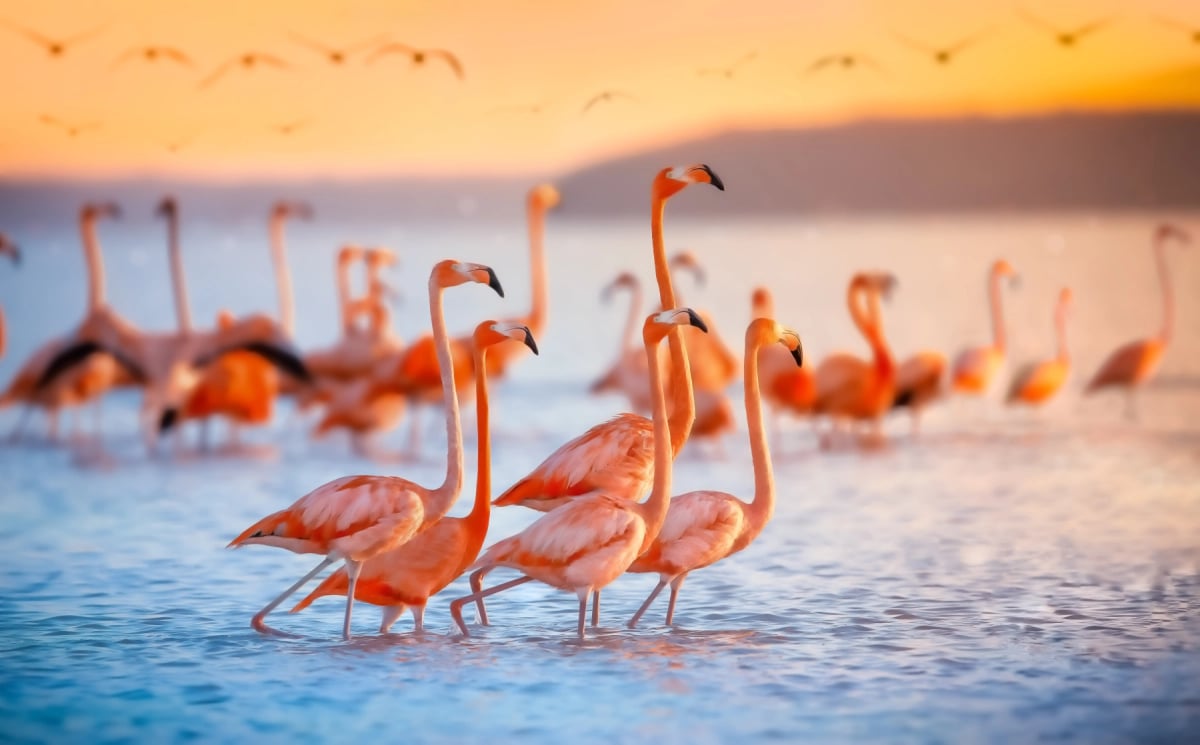
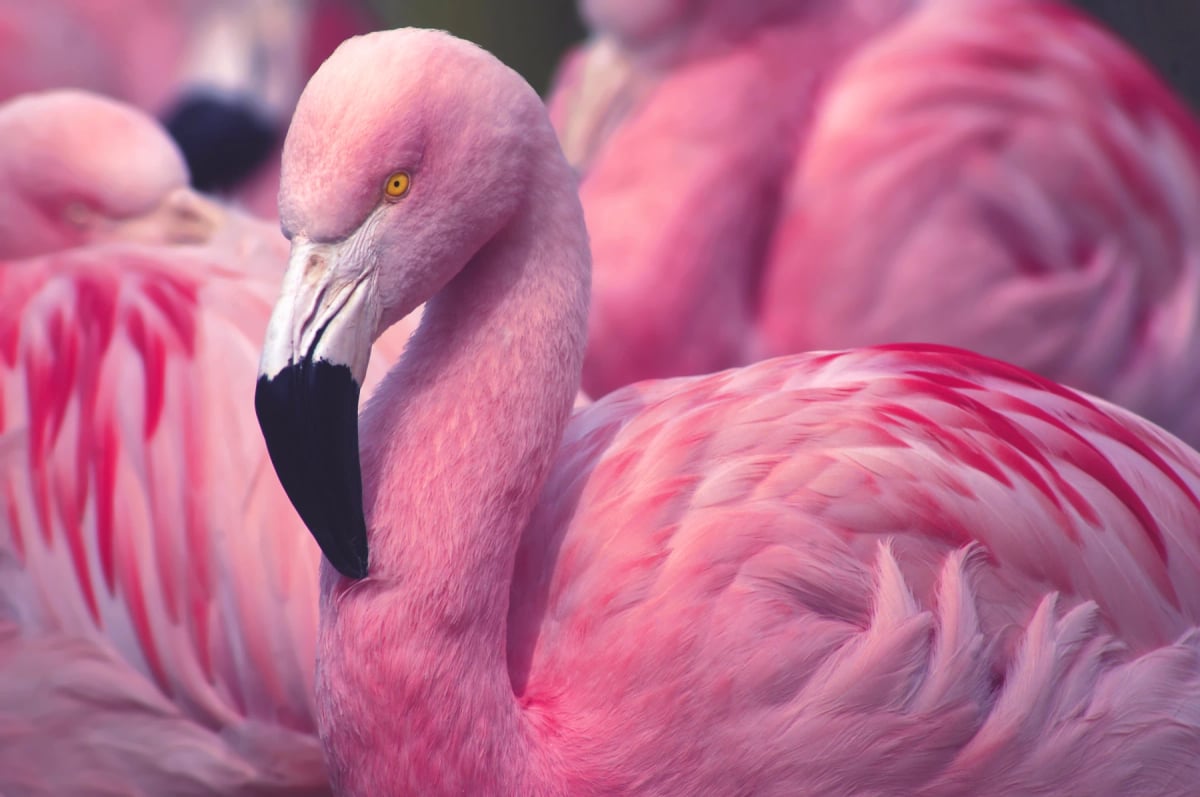
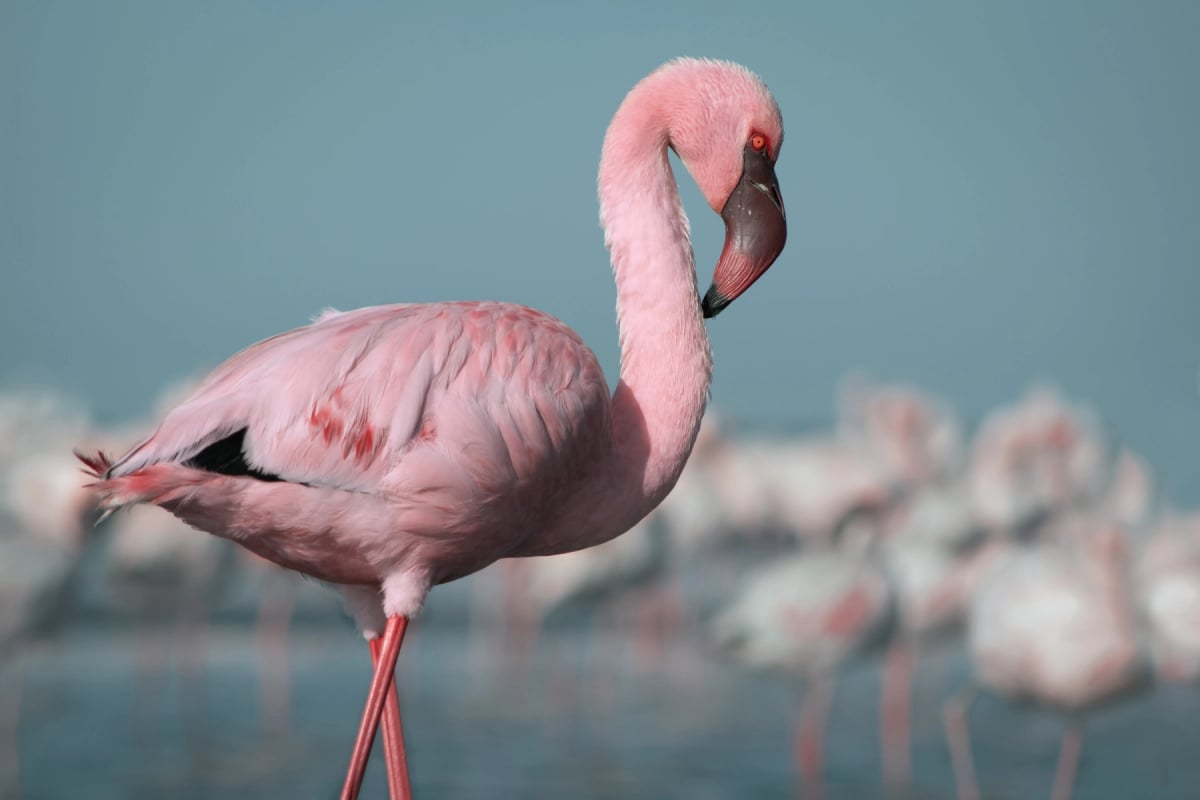
There are six species of flamingo, in three genera, and this page covers all of them. The greater flamingo is the tallest, up to about 1.5 meters, and the most widespread, found from southern Europe and Africa to the Middle East and India; it is pale pink with bright coral red wings and a pink bill with a black tip. The lesser flamingo of Africa and India is the smallest and by far the most numerous, with a population of a few million, and it has a dark red bill that looks almost black at a distance. The American or Caribbean flamingo is the most intensely colored, orange pink to red, and lives in the Caribbean, from the Bahamas and Cuba to Florida, Mexico, northern South America, and the Galápagos. The other three live in South America. The Chilean flamingo is pale pink with gray legs and pink knees and a bill more than half black. The Andean flamingo, the rarest of all six, has yellow legs and a black rear end when resting. The James's or puna flamingo, the smallest of the Andean species, has a bright yellow bill with a black tip. The greater and American flamingos are Least Concern, the lesser, Chilean, and James's are Near Threatened, and the Andean is Vulnerable. On this page, the main photo shows a lesser flamingo, the second a group of American flamingos, and the third a Chilean flamingo.
Where flamingos live
Flamingos live on every continent except Antarctica and Australia, making them among the most widespread large waterbirds on Earth. They seek out places most other birds avoid: shallow salt lakes, soda lakes rich in minerals, coastal lagoons, salt pans, and tidal estuaries. These harsh waters keep predators away and produce dense blooms of algae and brine shrimp. Each species has its own region. The greater flamingo ranges from the Mediterranean, where it breeds in the Camargue in France, in Spain, Italy, and Turkey, across Africa and the Middle East to Kazakhstan, India, and Sri Lanka. The lesser flamingo is an African specialist, with outposts in India and Pakistan, and gathers by the hundreds of thousands on the soda lakes of the Rift Valley in Kenya and Tanzania. The American flamingo lives around the Caribbean, from the Bahamas, Cuba, and the Yucatán to Florida, Venezuela, and the Galápagos. The Chilean, Andean, and James's flamingos share the high salt lakes of the Andes in Peru, Bolivia, Chile, and Argentina, some of them above 4,000 meters, and the Chilean flamingo also reaches lowland lagoons as far as Patagonia, Paraguay, Uruguay, and southern Brazil. Flamingos are not strict migrants, but they fly long distances, often at night, whenever water levels or food change.
Diet
Few birds feed quite like a flamingo. They wade into shallow water and plunge their bent bill in upside down, then use a muscular tongue to pump water in and out up to four times per second. Rows of tiny plates called lamellae line the bill and act as filters, trapping algae, diatoms, small crustaceans such as brine shrimp, and other invertebrates while pushing out mud and water. The carotenoid pigments found in these foods, particularly in algae and crustaceans, are what give flamingos their famous pink and orange tones. The more carotenoids a bird consumes, the deeper its color. A flamingo kept on a diet lacking these pigments will gradually fade to white. Diet varies somewhat by species, with smaller flamingos tending to eat more algae and larger ones taking more invertebrates.
Behavior
Sociability is central to flamingo life. Colonies can swell to hundreds of thousands of birds, and individuals within them are rarely idle. Groups perform elaborate courtship displays in which birds march in tight formations, stretch their necks, snap their heads from side to side, and call loudly in near perfect unison. Scientists believe these synchronized routines help stimulate breeding activity across the colony at the same time, which improves the chances of survival for chicks. Outside of breeding, flamingos spend most of their waking hours feeding or preening. They are also well known for standing on one leg, a posture thought to help them conserve body heat by tucking a limb close to their warm torso. Flamingos can swim when water is deep enough, and they take to the air readily, often traveling at night.
Reproduction
Breeding in flamingos is a colony effort from start to finish. Pairs form after group courtship displays and together build a raised mound of mud, stones, and vegetation that can reach about 30 centimeters in height. The elevated shape protects the single egg from flooding and helps keep it cool in the heat of sun baked lakeshores. Both parents take turns incubating the egg for around 27 to 31 days. Once the chick hatches, it is covered in grey down and has a straight, pink bill that will gradually curve as it matures. For the first week or two, adults feed their chick a protein and fat rich secretion called crop milk, produced in the digestive tract of both parents. Young flamingos gather in large nursery groups called crèches, supervised by a small number of adults, while the rest of the parents go out to feed.
Conservation
The global picture for flamingos is mixed. Two of the six species, the greater and the American flamingo, are listed as Least Concern and have even grown in some regions, helped by protection of wetlands such as the Camargue, Fuente de Piedra in Spain, and Inagua in the Bahamas. The other four are in trouble. The lesser flamingo is Near Threatened because it depends on a handful of breeding sites, above all Lake Natron in Tanzania, where most of the world's lesser flamingos hatch, and plans to extract soda ash or change the water supply there could hit the whole species at once. The Chilean and James's flamingos are Near Threatened, and the Andean flamingo is Vulnerable, with fewer than 40,000 birds left. The high Andean salt lakes where they breed are under pressure from lithium and other mining, which uses huge amounts of water, from egg collecting, and from droughts linked to climate change. Across all species, wetland drainage, pollution, and disturbance at colonies can make birds abandon an entire nesting season. Conservation work focuses on protecting key lakes, monitoring colonies, and coordinated censuses across countries, such as the counts organized for the three Andean species in Peru, Bolivia, Chile, and Argentina.
Where it is found
The Flamingo can be found in places such as:
Researched and written by Juan Pablo. Sources: IUCN Red List, scientific literature and regional field guides. Last updated: .
Technical factsheet

Frequently Asked Questions
What is a group of flamingos called?
A group of flamingos is often called a flamboyance, a name that fits their bright colors and showy displays. Other collective nouns include a stand, a colony, and a regiment. Flamingos are almost never alone: they feed, fly, and nest in groups, and some colonies of lesser flamingos in East Africa contain hundreds of thousands of birds. Living in crowds helps them spot predators and seems to be necessary for breeding, since flamingos rarely nest unless enough birds are present to perform their group courtship displays.
Can flamingos fly?
Yes, and very well. Flamingos are strong fliers that travel hundreds of kilometers between lakes, usually at night and often at high altitude, which is why their movements went unnoticed for a long time. To take off, they run across the water to gain speed. In flight they stretch out their long necks and legs, and the black flight feathers under their pink or red wings become visible. Flocks fly in lines or V shapes. Flamingos in zoos have their flight feathers clipped, which is why many people never see them fly.
How long do flamingos live?
Flamingos are long lived birds. In the wild, many live more than 30 years, and ringed greater flamingos in Europe have been recorded living well into their thirties and beyond. In captivity they can live even longer: a greater flamingo known as Greater, which lived at Adelaide Zoo in Australia, died in 2014 at an estimated age of about 83, making it one of the oldest birds ever recorded. Their long lives help make up for their slow breeding, since each pair raises only one chick a year, and not every year.
How tall is a flamingo?
It depends on the species. The greater flamingo is the tallest, standing up to about 1.5 meters and weighing up to 4 kilograms, with males larger than females. The lesser flamingo is the smallest, at about 80 to 90 centimeters and under 2 kilograms. The American, Chilean, Andean, and James's flamingos fall in between. Much of that height is legs and neck: a flamingo's body is not much bigger than a goose's, and its long legs let it wade into deeper water than most birds.
Are all flamingos pink?
No. Chicks hatch gray and white and take several years to turn fully pink, and adults range from the pale pink of the greater and Chilean flamingos to the deep orange red of the American flamingo, depending on species and diet. A flamingo that stops eating enough carotenoids fades toward white. Very rarely, a flamingo is born black because of a genetic excess of dark pigment: a black greater flamingo seen in Cyprus in 2015 became famous around the world, and one was also seen in Israel.
Why are flamingos pink?
Their color comes entirely from carotenoid pigments found in the algae, brine shrimp, and other invertebrates they eat. The more of these foods a flamingo consumes, the deeper its pink or orange tone. A bird that stops eating carotenoid rich food will gradually fade to white. Flamingos in zoos are given special dietary supplements to help them keep their color.
Why do flamingos stand on one leg?
Scientists believe this posture helps flamingos conserve body heat. By tucking one leg close to their warm torso, they reduce the amount of heat lost through their limbs, which is especially useful when standing in cold water for long periods. It appears to be an effortless position for them, since their legs lock into place without much muscle effort.
What do flamingos eat?
Flamingos feed mainly on algae, diatoms, brine shrimp, and small invertebrates found in shallow, salty water. They dip their bent bill upside down into the water and use their muscular tongue to pump water in and out rapidly. Tiny comb like plates inside the bill filter out food while pushing mud and water back out. Diet varies slightly depending on the species.
Where do flamingos live?
Flamingos are found on every continent except Antarctica and Australia. They favor salt lakes, soda lakes, coastal lagoons, and estuaries, places most other animals avoid. The greater flamingo lives from southern Europe and Africa to India, the lesser flamingo mainly in Africa, the American flamingo around the Caribbean, and the Chilean, Andean, and James's flamingos in South America, many of them on salt lakes high in the Andes. They will travel long distances if water levels or food supplies at a site drop.
Are flamingos endangered?
It depends on the species. The greater and American flamingos are listed as Least Concern by the IUCN, but the lesser, Chilean, and James's flamingos are Near Threatened, and the Andean flamingo is Vulnerable, with fewer than 40,000 birds left. The main threats are the loss and drying of wetlands, mining for lithium and other minerals around the high Andean salt lakes, pollution, and disturbance at breeding colonies, which can cause birds to abandon an entire nesting season.
How do flamingos raise their chicks?
Both parents share incubation duties for about 27 to 31 days. After hatching, the chick is covered in grey down and has a straight bill that curves as it grows. Parents feed it a nutritious secretion called crop milk for the first couple of weeks. Chicks then join large nursery groups called crèches, watched over by a few adults while the rest of the parents go off to feed.
How many species of flamingo are there?
There are six species of flamingo: the greater, lesser, American or Caribbean, Chilean, Andean, and James's or puna flamingo. They belong to one family, Phoenicopteridae, split into three genera. They vary in size, color intensity, and the food they prefer. The greater flamingo is the tallest and most widespread, the lesser flamingo is the smallest and most numerous, the American flamingo is the most brightly colored, and the Andean flamingo is the rarest, found only in the high salt lakes of South America.