Brown Bear

The brown bear (Ursus arctos) is one of the largest and most widespread land carnivores on Earth, ranging from the forests and mountains of Europe to the tundra and river valleys of Asia and North America. Despite its classification as a carnivore, it is highly omnivorous, building up fat reserves in autumn by eating berries, roots, grasses, insects, fish, and occasional mammals before entering a winter torpor that can last several months. Adult males are largely solitary and hold extensive home ranges, while females raise cubs for two to three years with exceptional protectiveness. Brown bears communicate through scent marking, vocalizations, and body posture. Their coat varies from pale blond to near black depending on the population. The global population stands at roughly 200,000 individuals, and the species is listed as Least Concern by the IUCN, though several regional populations in Europe remain small and fragile.
Appearance and size
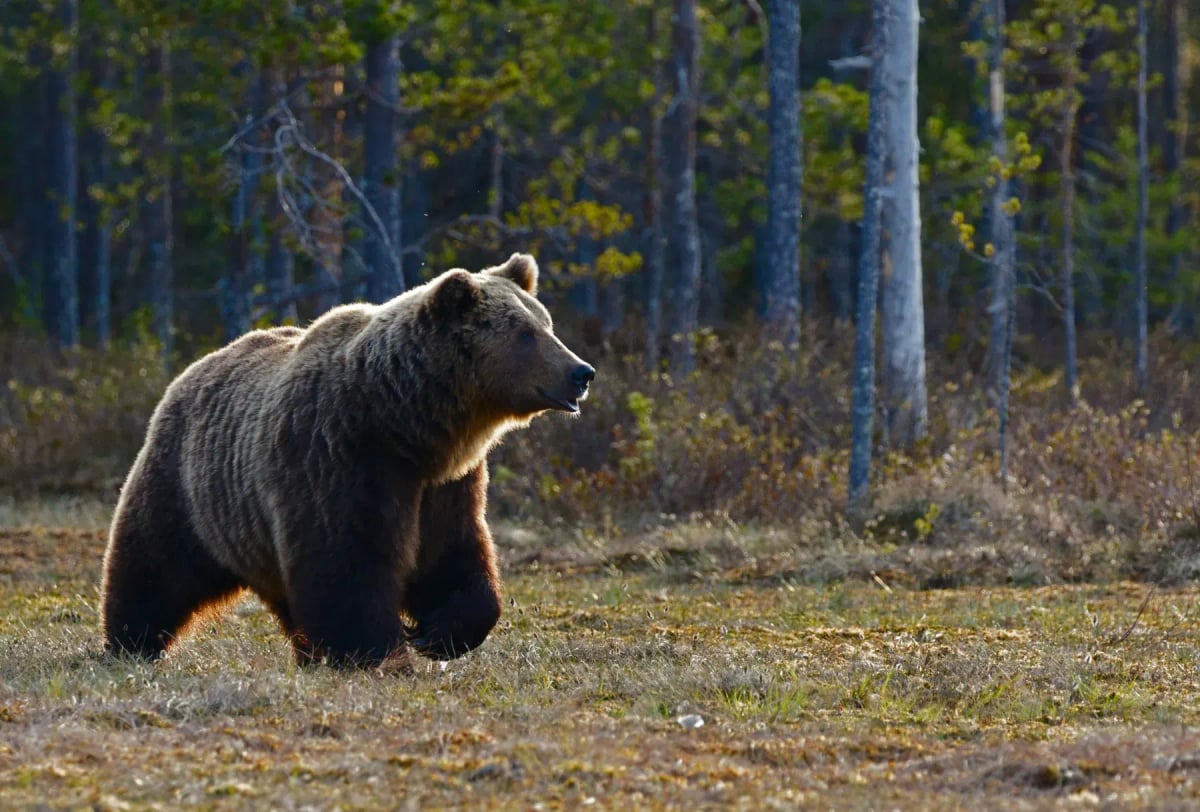
Few land mammals match the physical presence of a brown bear. Shoulder height typically ranges from 90 to 150 cm, and body weight spans roughly 100 to 350 kg, though some adult males in coastal Alaska and Kamchatka regularly exceed 500 kg after a summer of feeding on salmon. The signature muscular hump above the shoulders, formed almost entirely by muscle rather than fat, powers the digging that occupies much of a bear's foraging time. Coat color ranges from pale cream through cinnamon and chocolate to near black, varying by population and season. The head is broad and slightly dished in profile, and the claws on the front paws are long and only gently curved, making them well suited to excavating roots, rodents, and insect colonies rather than climbing trees.
Diet
Despite belonging to the order Carnivora, the brown bear obtains the majority of its calories from plant material. Grasses, sedges, roots, tubers, berries, and nuts form the backbone of the diet across most of the year, supplemented by insects, grubs, and the occasional small mammal. In river systems of Alaska, Kamchatka, and parts of Scandinavia, the arrival of spawning salmon transforms the diet dramatically: a single bear can consume dozens of fish in a day during peak runs. This period of intense eating, known as hyperphagia, extends through late summer and autumn and is critical for building the fat reserves needed to survive winter dormancy. Carrion is taken opportunistically, and larger prey such as elk or reindeer calves may be hunted when conditions favor it.
Relation to the grizzly bear
The grizzly bear is not a separate species but rather a subspecies of the brown bear, designated Ursus arctos horribilis, native to the interior of North America. The coastal brown bears of Alaska, sometimes called Kodiak bears when found on Kodiak Island, belong to a different subspecies and are considerably larger. Across the full range of Ursus arctos, taxonomists have proposed numerous subspecies, though genetic studies continue to refine those boundaries. European brown bears are most closely related to the bears that recolonized the continent after the last ice age. Interestingly, genetic research has shown that polar bears descended from a lineage of brown bears, and the two species can still interbreed where their ranges overlap in the Canadian Arctic, producing fertile offspring.

Behavior and hibernation
Adult male brown bears are largely solitary, patrolling home ranges that can cover hundreds of square kilometers. Females are similarly solitary outside of the mating season, though they maintain smaller territories centered on reliable food sources. Communication relies heavily on scent: bears rub against trees and scratch bark to deposit odor signals that convey identity, reproductive condition, and dominance. Hibernation in brown bears is more accurately described as winter torpor. Body temperature drops only modestly, and bears can rouse relatively quickly, yet metabolic rate falls sharply enough that they neither eat, drink, nor pass waste for months. Pregnant females give birth during this dormant period, typically to one to three cubs in January or February. Cubs remain with their mother for two to three years, during which she teaches them foraging routes and defends them with considerable ferocity.
Conservation
The IUCN lists the brown bear as Least Concern globally, reflecting a total population estimated at around 200,000 individuals, with the largest concentrations in Russia, Canada, and Alaska. In Europe, however, the picture is more fragmented. Several populations, including the Cantabrian bears in northern Spain, the bears of the Pyrenees, and the Apennine population in Italy, number in the dozens and face real risks of local extinction without active management. Habitat loss, illegal hunting, and conflict with livestock farmers remain the primary pressures. Conservation programs across Europe have worked to reduce such conflict through compensation schemes for livestock losses and efforts to restore connectivity between isolated populations. Legal protection under the EU Habitats Directive has been important for the survival of the species in Western and Central Europe over recent decades.
Where it is found
The Brown Bear can be found in places such as:
Researched and written by Juan Pablo. Sources: IUCN Red List, scientific literature and regional field guides. Last updated: .
Technical factsheet
Frequently Asked Questions
Where do brown bears live?
Brown bears occupy a vast range across the Northern Hemisphere, including the forests, mountains, and tundra of Russia, Scandinavia, parts of Europe, Alaska, Canada, and the western United States. In Europe, populations survive in countries such as Romania, Finland, Sweden, and the Balkans, though some western groups are very small. They adapt well to a variety of habitats as long as food is plentiful and human disturbance is limited.
Are brown bears dangerous to humans?
Brown bears generally avoid people, and unprovoked attacks are rare. Most encounters turn aggressive when a bear feels surprised at close range, when a mother is defending her cubs, or when a bear is protecting a food source. Making noise while hiking in bear country significantly reduces the chance of a surprise encounter. Fatal attacks do occur but are uncommon given how many people live and travel within brown bear range worldwide.
What do brown bears eat?
Brown bears are highly omnivorous. Berries, roots, grasses, insects, and grubs make up much of their diet throughout the year. In regions with salmon rivers, they gorge on fish during spawning season, which is critical for building fat before winter. They also eat carrion and will hunt young deer or elk calves when the opportunity arises. The exact makeup of the diet shifts with the seasons and differs considerably between populations.
How long do brown bears hibernate?
Brown bears typically spend between five and seven months in winter torpor, though the exact duration depends on the local climate and the individual bear. In milder regions, some bears barely hibernate at all. During this period, they do not eat, drink, or produce waste, surviving entirely on stored body fat. Pregnant females give birth during torpor, usually in January or February, and nurse their newborn cubs without ever fully waking.
How fast can a brown bear run?
Brown bears are capable of reaching speeds of around 48 to 56 km/h over short distances, which makes outrunning one essentially impossible for a person. Their build, which appears heavy and lumbering at a walk, disguises a body that is powerful and explosive in short bursts. They can also swim well and are surprisingly agile on steep terrain. Speed is rarely needed for foraging but proves useful when chasing prey or competing with other bears.
How many brown bears are left in the world?
The global population is estimated at roughly 200,000 individuals, making the brown bear one of the more numerous large carnivores on Earth. Russia holds the largest share, followed by significant populations in Canada and Alaska. In Europe, numbers are much lower, and some regional groups, such as the bears in the Cantabrian Mountains of Spain and those in the Pyrenees, consist of only a few dozen animals and remain at serious risk.
How long do brown bears live?
In the wild, brown bears typically live between 20 and 30 years, though reaching the upper end of that range is uncommon due to competition, hunting pressure, and the physical toll of life in challenging environments. Bears in captivity often live longer, sometimes exceeding 30 years, thanks to a reliable food supply and veterinary care. Females generally outlive males, partly because male bears take greater risks during the mating season and in territorial disputes.