Gila Monster
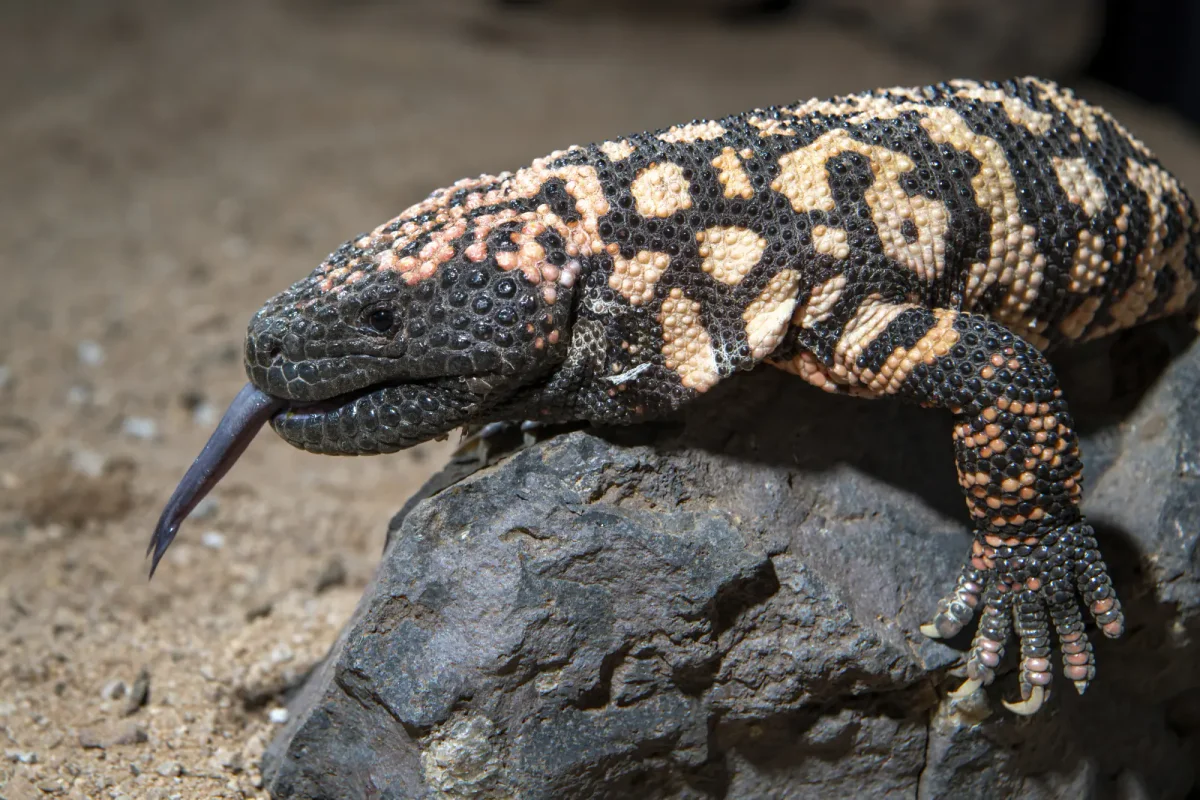
The Gila monster (Heloderma suspectum) is a heavy, slow lizard of the deserts of the southwestern United States and northwestern Mexico, and the largest lizard native to the United States. Adults usually measure 35 to 50 centimeters, with a thick tail that stores fat and skin covered in small bony beads in black, pink, orange and yellow. It lives in desert scrub, rocky foothills and canyons from southern Nevada and Utah through Arizona and New Mexico to Sonora and Sinaloa. It spends more than 90 percent of its life underground and comes out mainly in spring and during the summer rains to raid nests for eggs and young birds and mammals. It is one of the few venomous lizards in the world: its bite is very painful, but it rarely bites unless handled. A compound from its venom led to a diabetes drug. The IUCN lists it as Near Threatened, mostly because of habitat loss.
Name and Relatives
The Gila monster takes its name from the Gila River, which flows from New Mexico across Arizona through the heart of its range. Its scientific name, Heloderma suspectum, was given in 1869 by the paleontologist Edward Drinker Cope. Heloderma means studded skin, and suspectum reflects that Cope suspected it was venomous because of the grooves on its teeth, something later confirmed. It belongs to the family Helodermatidae, an ancient group whose relatives lived alongside the dinosaurs. Its only living relatives are the beaded lizards, which are larger and live farther south in Mexico and Guatemala. Two forms have long been described: the reticulated Gila monster of the south, with a broken, netlike pattern, and the banded Gila monster of the north, with clearer dark bands. Genetic studies have found little difference between them, so many scientists now treat the species as a single variable population.
Size and Appearance
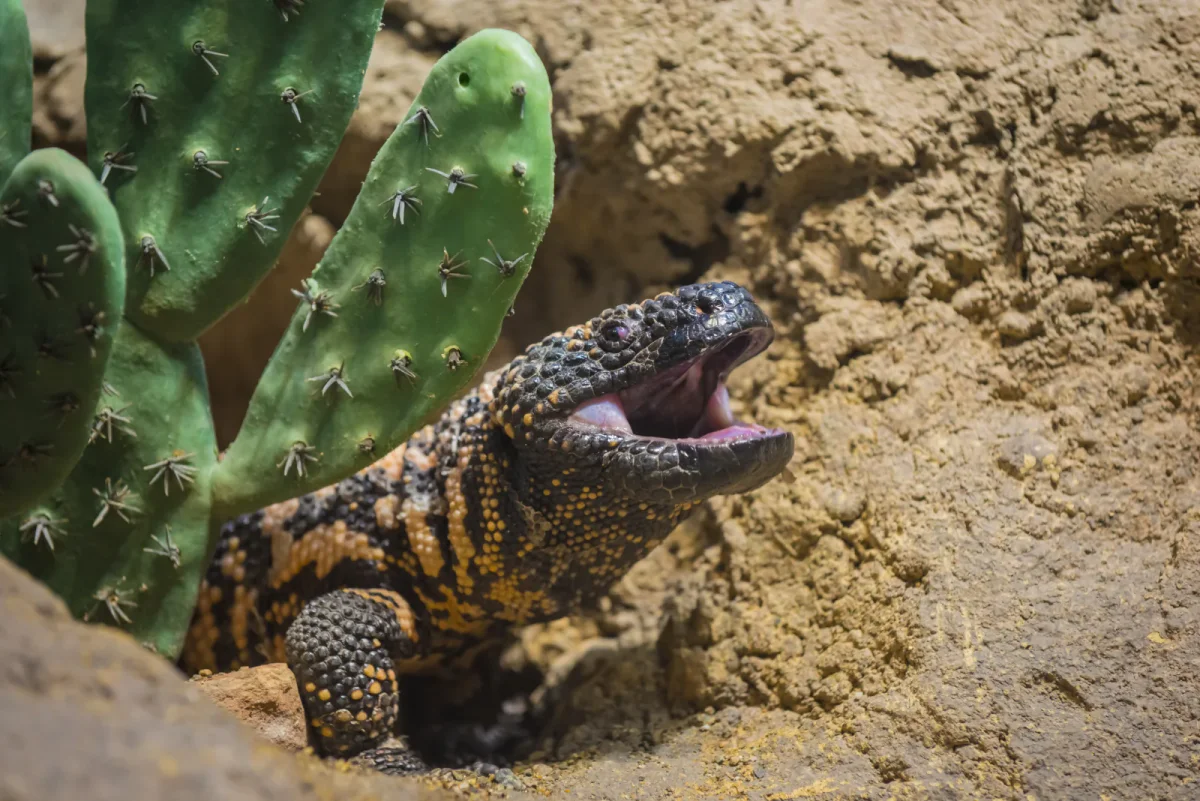
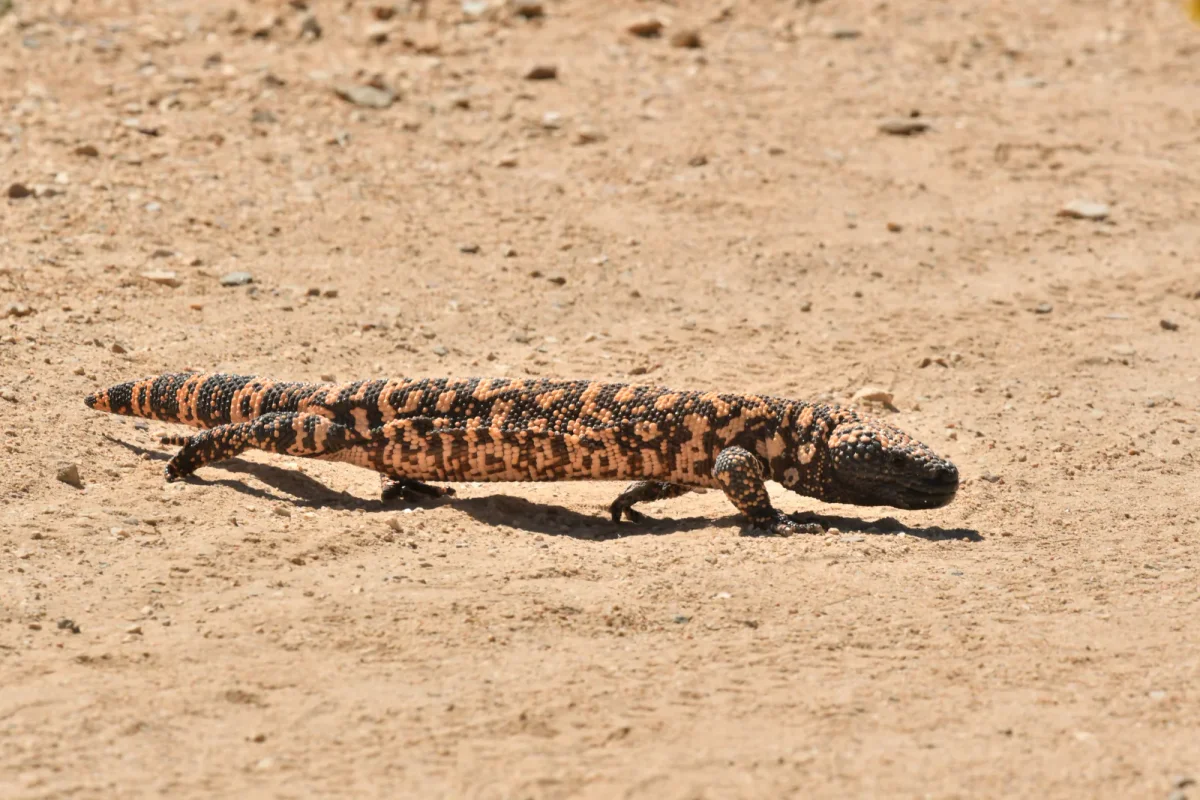
The Gila monster is the largest lizard native to the United States, although it is not long. Most adults measure 35 to 50 centimeters from snout to tail tip, and the largest reach about 56 centimeters. Healthy adults usually weigh between 350 and 800 grams. The body is stout and low, with short legs, strong claws for digging and a broad head. The thick tail works as a pantry: when food is plentiful it fills with fat, and a lean tail is a sign of a hungry animal. Its skin is covered with small rounded scales that look like beads. Inside many of them are tiny bones called osteoderms, which make the skin tough like armor. The colors are black mixed with pink, orange or yellow, in patterns that differ from one animal to another. These bright colors are a warning to predators that the lizard is dangerous, yet in the shade of rocks and shrubs they also break up its outline.
Habitat and Range
The Gila monster lives in the deserts of the American Southwest and northwestern Mexico. Its range runs from the far southwest of Utah and southern Nevada through western and southern Arizona and the southwest corner of New Mexico, and south through Sonora to northwestern Sinaloa. Most of it lies in the Sonoran Desert, with the northern edge in the Mojave. A few have been found in southeastern California, but only around 28 credible records exist there in more than 150 years. Within this range it prefers desert scrub with plenty of cover, rocky foothills, canyon bottoms and washes, and it also enters dry grassland, thornscrub and the lower edges of oak woodland. It avoids open, sandy flats with no shelter. What it needs most is a safe place underground: rock crevices, packrat nests or the burrows of other animals, which it reuses and enlarges with its claws.
Life Underground
Few animals spend as little time in the open as the Gila monster. Studies show it stays underground for more than 90 percent of its life, and some estimates put the figure close to 98 percent. Shelters protect it from the desert heat in summer and from the cold in winter, when it stays inactive for months. Its busiest season is spring, from about March to June, when it searches for food and mates, mostly in daylight. In the hottest months it moves at dusk or at night, and it becomes active again after the summer monsoon rains bring humidity. Being so slow, it relies on its stored fat instead of speed. Its body runs on very little energy, so it can go months without eating. Each animal keeps to a familiar home area and returns to the same shelters year after year, often for many years in a row. Adults live alone, although males sometimes meet and wrestle over females.
Diet
The Gila monster is a nest raider. Its favorite foods are eggs and very young animals that cannot run away: the eggs of quail, doves and other ground nesting birds, the eggs of tortoises, snakes and lizards, nestlings, and newborn rabbits and rodents in their burrows. It also eats some insects and dead animals. It finds food mainly by smell, flicking its forked tongue to pick up scents and following them to a hidden nest, which it digs out or climbs to with its claws. Because it eats so much at once, it needs very few meals. A large meal can be a big share of its own body weight, and three or four good meals in spring can be enough for a whole year, with the extra stored as fat in the tail. This way of feeding explains why the venom is not used much for hunting. Eggs and helpless young do not fight back, so the Gila monster simply swallows them.
Venom and Bites
The Gila monster is one of the few venomous lizards in the world, and it delivers venom in a very different way from a snake. It has no fangs. Instead, its venom glands sit in the lower jaw, and the venom flows along grooves in the lower teeth into the wound. To get enough venom in, it bites hard, holds on and chews, sometimes for minutes. The venom serves mainly for defense. A bite causes intense, burning pain that can last for hours, with swelling, nausea, vomiting, weakness, sweating and sometimes low blood pressure. There is no specific antivenom, and treatment focuses on the pain and the symptoms. Even so, bites are rare and almost always happen when people pick up or provoke the animal. In the wild a Gila monster usually hisses, opens its mouth and backs away. Deaths are extremely rare. In 2024 a man in Colorado died four days after being bitten by one of his pet Gila monsters, and the autopsy blamed complications of the venom, with heart and liver problems also playing a part.
From Venom to Medicine
The Gila monster has had an unexpected impact on medicine. It can go months without food while keeping its blood sugar stable, and that caught the attention of researchers. In the early 1990s, scientists working with its venom, among them the endocrinologist John Eng at a Veterans Affairs hospital in the Bronx, identified a molecule called exendin 4. It works much like GLP 1, a hormone that helps the body release insulin after a meal. The human hormone breaks down within minutes, but exendin 4 lasts for hours. A synthetic version of it, exenatide, was approved in the United States in 2005 as a treatment for type 2 diabetes. It was the first medicine of its kind. Its success helped open the way for the family of GLP 1 drugs that came later, including the ones now widely used for diabetes and weight loss, such as liraglutide and semaglutide.
Reproduction and Young
Gila monsters mate in late spring. Males find females by following their scent, and when two males meet they may wrestle, twisting their bodies around each other for hours until one gives up. In July or August the female digs a nest in moist soil and lays a clutch of usually about four to six eggs, sometimes more. She leaves soon after and gives no further care. The eggs hatch in autumn, but the young do something remarkable for a lizard: they stay underground in the nest through the whole winter. A study in Arizona published in 2018 showed that hatchlings remain there for seven to ten months and only come out the following late spring or summer. This timing seems to match their food. When they emerge, other lizards are laying eggs small enough for them to eat. The young look like small copies of the adults, with brighter colors, and grow slowly over several years before they can breed.
Threats and Conservation
The IUCN lists the Gila monster as Near Threatened, with a population that is decreasing. Nobody knows how many there are, because they are so hard to find. The main threat is the growth of cities and suburbs in some of the best parts of its range, around Phoenix, Tucson, Las Vegas and St. George, along with farms and new roads, where many are run over. Illegal collection for the pet trade, invasive plants that change the desert and fuel fires, and people who kill them out of fear also play a part. Studies in the Mojave suggest that a hotter, drier climate could shrink the areas where it can live. Protection began early: in 1952 Arizona made it the first venomous animal in North America to receive legal protection. Today it is protected in every state where it lives, is listed as threatened under Mexican law and appears in Appendix II of CITES, which controls its international trade.
Where to See Them
Seeing a Gila monster in the wild takes luck, since even park rangers who spend years in the desert may meet only a few. Saguaro National Park, on both sides of Tucson, is one of the best known places, and the park asks visitors to photograph any they find so researchers can identify each animal by its unique pattern. Tonto National Monument, east of Phoenix, runs a long study of its Gila monsters. In Utah, the Red Cliffs Desert Reserve and Snow Canyon State Park near St. George protect the northern edge of the range. In Mexico, the deserts and foothills of Sonora hold much of the population. The best time to look is on warm spring mornings from April to June, and again after the first summer monsoon storms in July and August, when the lizards come out to drink and feed. Anyone who finds one should enjoy it from a distance and never touch it.