African Penguin
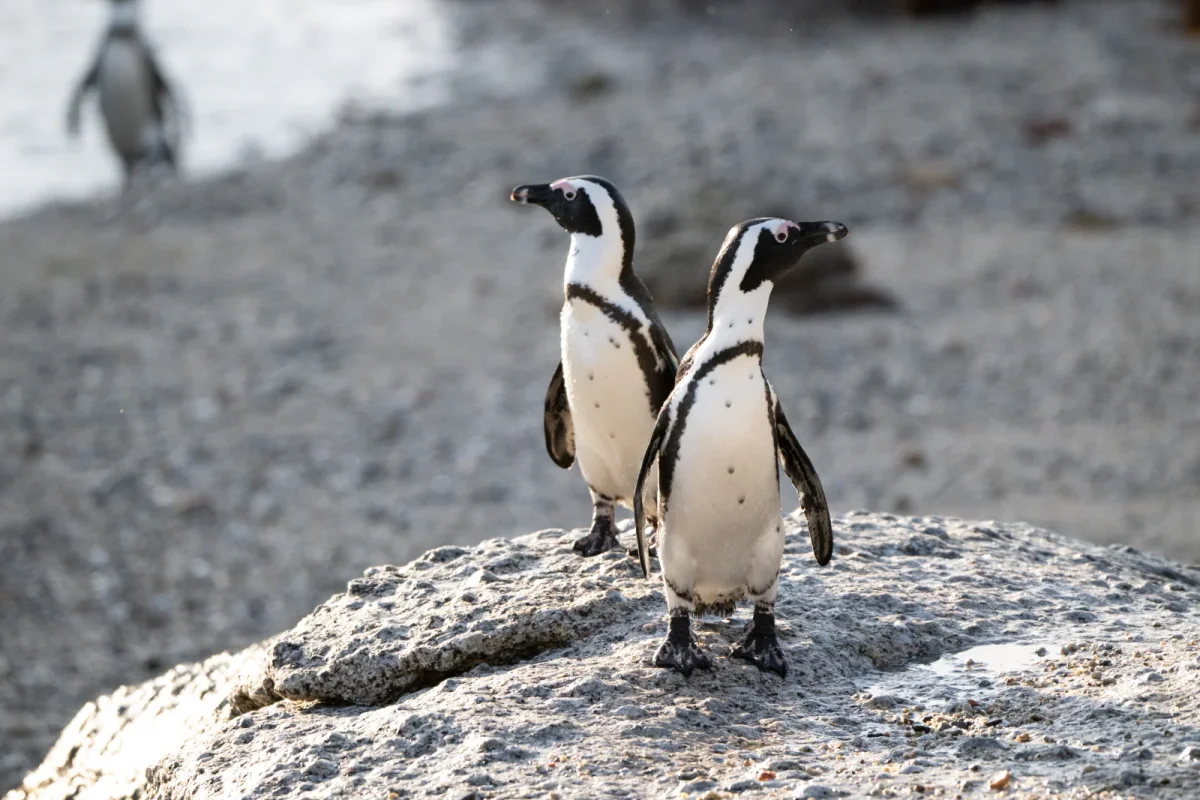
The African penguin (Spheniscus demersus), also called the jackass penguin or Cape penguin, is the only penguin that breeds in Africa. It lives along the coasts and islands of South Africa and Namibia, where the cold Benguela Current brings rich fishing waters close to a warm, dry land. It stands about 60 to 70 centimeters tall and weighs around 2 to 3.5 kilograms. Its back is black and its front is white, with a black band across the chest, a scattering of black spots that is unique to each bird and a patch of bare pink skin above each eye that helps it lose heat. It feeds at sea on small schooling fish such as sardines and anchovies and nests in colonies on rocky islands and a few mainland beaches. Its loud, braying call, much like a donkey, gave it the name jackass penguin. The species has declined dramatically over the past century, and the IUCN lists it as Critically Endangered.
Names and Relatives
The African penguin belongs to the genus Spheniscus, the banded penguins, a group of four closely related species that live in warmer waters than most people expect of penguins. Its relatives are the Humboldt penguin of Peru and Chile, the Magellanic penguin of Argentina, Chile and the Falkland Islands, and the small Galápagos penguin, the only penguin that lives at the equator. All four share the same black and white face pattern, black bands on the chest and bare skin around the eyes, and all nest in burrows or sheltered spots rather than on open ice. The African penguin is the only one that breeds in Africa. It has had several names. Sailors called it the jackass penguin because of its loud, donkey like call, and that name is still common. It has also been called the Cape penguin and the black footed penguin. Its species name, demersus, comes from a Latin word meaning plunged or sunk, a fitting name for a diving bird.
Size and Appearance
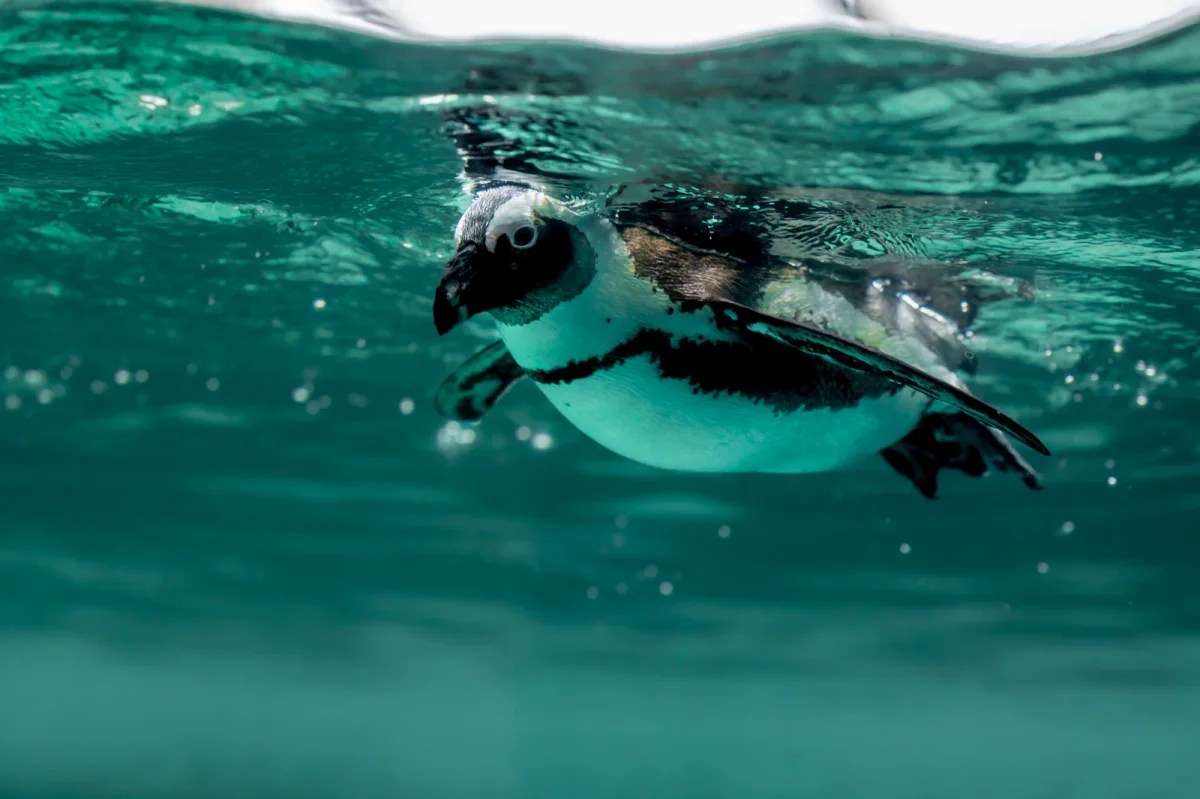
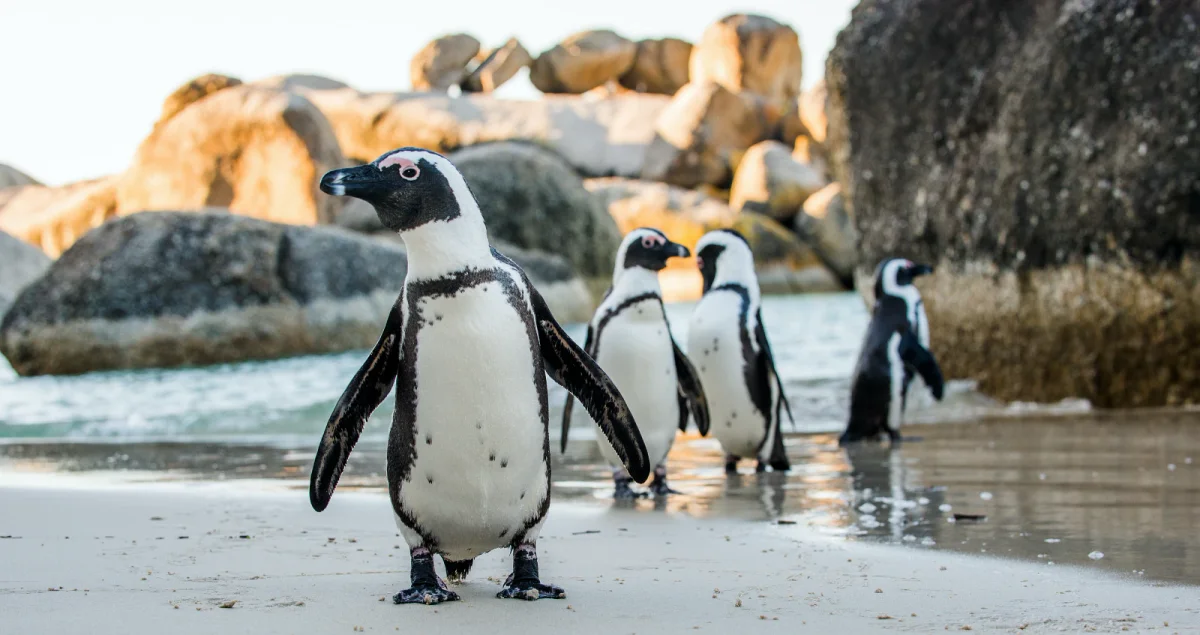
The African penguin is a medium sized penguin, standing about 60 to 70 centimeters tall. Adults usually weigh between 2 and 3.5 kilograms, and their weight changes a lot through the year, since they fatten up before molting and lose much of it while they fast. Males are slightly larger than females and have heavier, deeper bills. The back, head and flippers are black, and the front is white. A broad white stripe curves from above each eye down the side of the head to the throat, framing a black face, and a thin black band runs across the chest and down the flanks. The white belly is sprinkled with black spots, and the pattern is different on every bird, so researchers can recognize individuals by it. Above each eye is a patch of bare pink skin. When the penguin gets hot, more blood flows to this skin, which turns a deeper pink as it releases heat. Young birds look very different: they are grayish blue on the back and white below, with no bands, until they molt into adult plumage.
Habitat and Range
The African penguin lives only along the southwestern coast of Africa, from central Namibia to Algoa Bay in South Africa's Eastern Cape. Outside the breeding season birds move along the coast and may travel hundreds of kilometers, but they stay in coastal waters, usually within about 40 kilometers of shore. Their home is shaped by the Benguela Current, which carries cold, nutrient rich water north along the west coast and supports huge schools of sardines and anchovies. Penguins breed in about 30 colonies, most of them on small offshore islands, where they are safe from land predators. The best known island colonies include Dassen Island and Robben Island near Cape Town, Dyer Island near Gansbaai, St Croix and Bird islands in Algoa Bay, and Mercury, Ichaboe, Halifax and Possession islands off southern Namibia. Two colonies formed on the mainland in the 1980s, at Boulders Beach in Simon's Town and at Stony Point in Betty's Bay, and both are now protected for visitors.
Diet and Hunting
African penguins feed mainly on small fish that swim in large schools, especially sardines and anchovies, along with round herring, horse mackerel, squid and small crustaceans. An adult eats several hundred grams of food a day, and much more when it has chicks to feed. Penguins hunt by day, often in groups that work together to herd a school of fish into a tight ball near the surface before darting through it to catch them. They are fast, agile swimmers, using their stiff flippers like wings and steering with their feet and tail. Most dives are shallow, often less than 30 meters, but they can reach well over 100 meters. While raising chicks, parents must return to the colony every day or two, so they can only hunt within a limited distance of their nests, often 20 to 40 kilometers. This makes them very sensitive to where the fish are, and when sardines and anchovies are scarce near the colonies, breeding suffers.
Nests and Chicks
African penguins breed in colonies and usually return to the same colony, and often the same nest, every year. They can breed at almost any time of year, but in South Africa most eggs are laid between March and May, and in Namibia around November and December. Traditionally the penguins dug their nests into thick layers of guano, the hardened droppings of seabirds built up over centuries, which kept eggs and chicks cool and safe. Today they nest in burrows in sand, under bushes and rocks, or in artificial nest boxes. The female lays two eggs, and both parents take turns sitting on them for about 38 to 41 days. The chicks hatch covered in gray down and are guarded constantly for their first weeks while the parents take turns fishing. Later the chicks gather in groups while both parents hunt. They leave the colony for the sea when they are about two to four months old. Young penguins spend their first years at sea and usually start breeding at about four years old.
Life in the Colony
An African penguin colony is a noisy place. Birds call to their partners with loud, braying sounds, throwing their heads back and flapping their flippers, and they use other calls and displays to defend their nests and greet each other. Once a year each adult goes through a catastrophic molt, replacing all its feathers at once over about three weeks. Before it starts, the penguin feeds heavily at sea to build up fat. While it molts its feathers are not waterproof, so it cannot go to sea and must stand on land without eating, losing close to half its weight. Life on land is also a challenge because of the heat. Penguins pant, hold their flippers away from their bodies and seek shade, and on very hot days breeding birds may even abandon their nests. In the water, Cape fur seals and sharks hunt penguins. On land, kelp gulls take eggs and small chicks, and on the mainland mongooses, caracals and even leopards can raid colonies, which is why most colonies are on islands.
Where to See Them
Boulders Beach, in Simon's Town on the Cape Peninsula, is the most famous place to see African penguins and one of the most visited wildlife sites in South Africa. The colony began in the early 1980s, when a few pairs settled on the sheltered beaches between large granite boulders, and it is now part of Table Mountain National Park. Boardwalks at Foxy Beach let visitors watch penguins nesting, swimming and walking just a few meters away, and nearby Boulders Beach has a small area where people can share the sand with them. Stony Point, at Betty's Bay along the coast east of Cape Town, is a quieter mainland colony with its own boardwalk. Robben Island, best known as the prison where Nelson Mandela was held, also has a breeding colony, and boat trips from Gansbaai pass Dyer Island and its penguins. In Namibia, boat trips from Lüderitz visit Halifax Island, where penguins can be seen from the water. Visitors should keep their distance, never feed the birds and stay on the paths.
Population and Conservation
The IUCN lists the African penguin as Critically Endangered, with a decreasing population, in an assessment from 2024. It was the first penguin species to reach this category. A century ago there were more than a million breeding pairs. Today there are fewer than 10,000, and some scientists warn that the species could disappear from the wild by around 2035 if the decline continues. In the past, millions of eggs were collected for food and the guano where penguins nested was scraped away for fertilizer. Today the main problem is food. Sardine and anchovy stocks have shifted east and south, away from many colonies, while fishing boats compete for what remains. Oil spills, ship noise, disease and heat add to the pressure. Conservation groups such as SANCCOB now rescue and hand rear chicks, install artificial nests and push for protected fishing areas, and in 2025 a court order closed waters around six colonies to sardine and anchovy fishing for ten years.