Sea Turtle
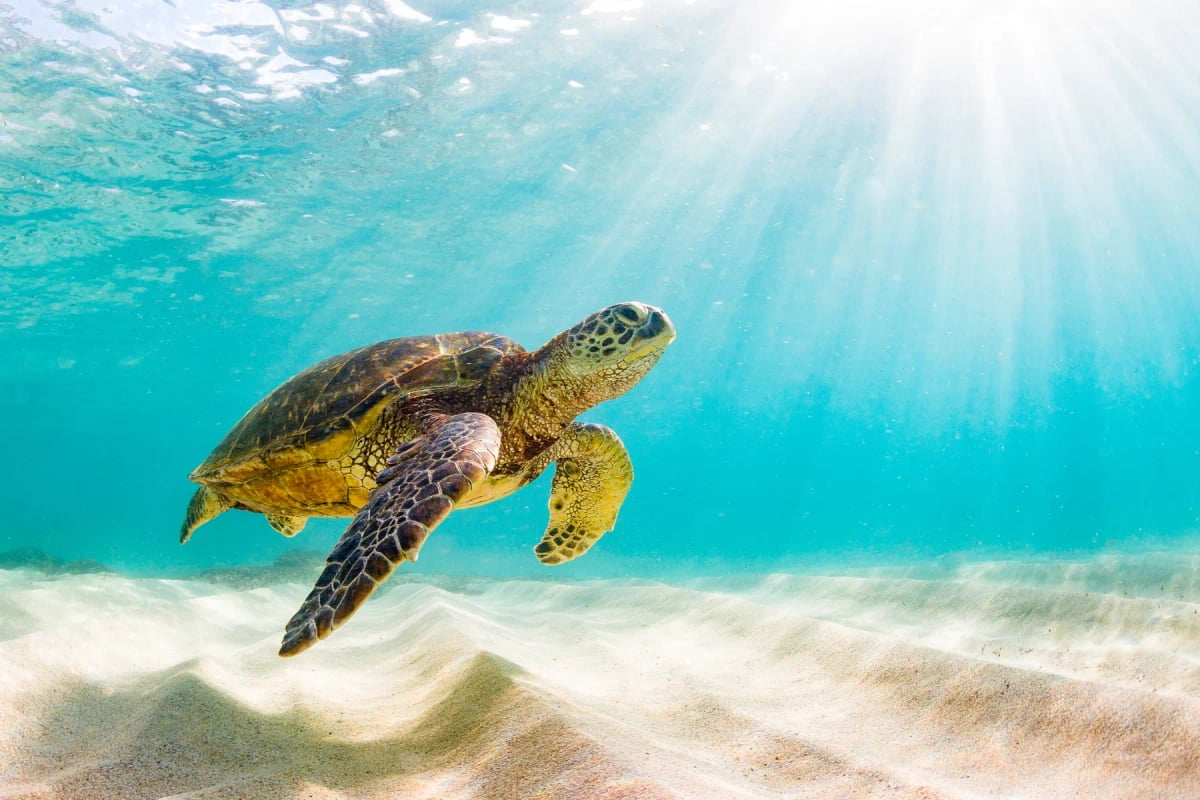
The green sea turtle (Chelonia mydas) is the most widespread of the large sea turtles, living in tropical and subtropical seas along the coasts of more than 140 countries. Its name comes not from its olive to brown shell but from its greenish fat, the result of a diet of seagrass and algae: adults are the only herbivorous sea turtles, and they keep seagrass meadows healthy as they graze. Adults usually weigh 68 to 190 kilograms. Females return every two to four years to nest on the beaches where they were born, laying 85 to 200 eggs several times a season, and the sand temperature decides whether hatchlings are male or female. Green turtles are also the only sea turtles that regularly bask on land, as in Hawaii. After decades of protection, the IUCN moved the species from Endangered to Least Concern in 2025, although several regional populations remain at risk.
What is a green sea turtle?
The green sea turtle (Chelonia mydas) is the most widespread of the large sea turtles and the species shown on this page. It was described by Carl Linnaeus in 1758 and is the only member of its genus, Chelonia. Despite its name, its shell is not green but olive, brown or almost black: the name comes from the greenish color of its fat, a result of its diet of seagrass and algae. Sea turtles are reptiles that descend from land ancestors and have lived in the oceans for more than 100 million years, since the age of the dinosaurs. Unlike land turtles, they cannot pull their head and flippers into the shell, and their front limbs have become long, powerful flippers for swimming. The green turtle lives in tropical and subtropical seas around the world, roughly between 30 degrees north and 30 degrees south, along the coasts of more than 140 countries, and nests on beaches in more than 80. The darker turtles of the eastern Pacific, once described as a separate species called the black sea turtle, are now considered part of the same species. Green turtles are the only sea turtles that are herbivores as adults, and the only ones that commonly come out of the water to bask on beaches.
How many sea turtle species are there?
There are seven living species of sea turtles, and the green turtle is one of them. The leatherback (Dermochelys coriacea) is the largest and the most different: it has no hard shell but a leathery back with long ridges, can reach about 2 meters and often weighs 250 to 700 kilograms, with a record male of 916 kilograms found in Wales in 1988; it dives deeper than 1,000 meters and feeds almost only on jellyfish. The loggerhead (Caretta caretta), named for its huge head and powerful jaws, crushes crabs and shellfish and is the main nesting turtle of Florida, Greece and Turkey. The hawksbill (Eretmochelys imbricata), with its narrow, bird-like beak and beautiful overlapping shell plates, lives on coral reefs and feeds on sponges; hunting for its "tortoiseshell" made it Critically Endangered. Kemp's ridley (Lepidochelys kempii), the smallest and rarest, nests mainly on one stretch of beach in Tamaulipas, Mexico, and the olive ridley (Lepidochelys olivacea) is famous for its mass nestings, or arribadas. The flatback (Natator depressus) nests only in Australia. On the IUCN Red List, the hawksbill and Kemp's ridley are Critically Endangered, the leatherback, loggerhead and olive ridley Vulnerable, the flatback Data Deficient and, since 2025, the green turtle Least Concern.
Size and appearance
The green turtle is one of the largest hard-shelled sea turtles. Adults usually have a shell 78 to 112 centimeters long and weigh 68 to 190 kilograms, and the largest on record weighed 395 kilograms, with a shell 153 centimeters long. The smooth, heart shaped upper shell, or carapace, is made of large plates that do not overlap, in shades of olive, brown, gray or almost black, often with radiating streaks or blotches, while the lower shell, or plastron, is pale yellow or white. Eastern Pacific green turtles are smaller and much darker, which is why they were once called black turtles. The head is small and rounded for the size of the body, with a short, blunt beak whose lower jaw is finely serrated to cut seagrass and algae, and a single pair of large scales in front of the eyes, a detail that helps tell it apart from the hawksbill, which has two pairs. Each flipper usually carries a single visible claw. Males and females look alike until maturity, when males develop a much longer tail that extends well beyond the shell, used in mating, along with longer, curved front claws for holding onto the female.

Where do green sea turtles live?
Green turtles live in warm seas around the world, and their life takes them through very different places. Hatchlings swim from the beach into the open ocean, where they drift for three to five years among floating seaweed and debris. Juveniles then settle in shallow coastal waters, the habitat where they spend most of their lives: seagrass meadows, algae covered reefs, lagoons, bays and estuaries. Adults travel between these feeding grounds and the beaches where they were born, sometimes more than 2,000 kilometers away. The largest nesting site in the world is Raine Island, on the northern Great Barrier Reef in Australia, and other major rookeries include Tortuguero in Costa Rica, Ascension Island in the middle of the Atlantic, Poilão in Guinea-Bissau, Ras al Jinz in Oman, the islands of Sabah and the Philippines, the Galápagos, the French Frigate Shoals in Hawaii and the east coast of Florida. In the Mediterranean, green turtles nest almost only in the far east, mainly in Turkey and Cyprus, with smaller numbers in Syria, Israel and Egypt. Some populations live unexpectedly far from the tropics, such as a resident group of 60 to 100 turtles in San Diego Bay, California, and young turtles that feed off northern Chile.
What do green sea turtles eat?
Green turtles change diet as they grow. Young turtles in the open ocean are omnivores, eating jellyfish, small crustaceans, fish eggs, sponges and other small animals along with floating algae. Once they move to coastal waters, they gradually become herbivores, and adult green turtles are the only sea turtles that live almost entirely on plants. They graze on seagrass and algae, cropping them with the finely serrated edge of the lower jaw. This plant diet is what turns their body fat green and gives the species its name. Green turtles are true gardeners of the sea. By regularly grazing the same patches of seagrass, they keep the blades short and young, which makes them more nutritious and easier to digest, and they help keep seagrass meadows healthy, productive and free of excess sediment. Where turtles have disappeared, some meadows grow tall, slow and prone to disease, while in places where turtle numbers have recovered quickly, such as parts of the Indian Ocean, scientists have seen the opposite problem, with meadows overgrazed. Because seagrass and algae are low in energy, green turtles grow slowly and take decades to reach adulthood.
When do sea turtles hatch? Nesting and hatching
Green turtles reach maturity late, at an estimated 20 to 50 years of age. Females return to nest on the same region of coast where they were born, usually every two to four years, guided by Earth's magnetic field. Mating takes place in the water off the nesting beach. At night, the female crawls up the beach above the high tide line, digs a body pit and then a deep egg chamber with her rear flippers, and lays a clutch of 85 to 200 eggs the size of ping pong balls, before covering them and returning to the sea. She nests three to five times in one season, about two weeks apart. The eggs incubate in the warm sand for about 50 to 70 days. The temperature of the sand decides the sex of the young: warmer nests produce females and cooler nests males. The hatchlings break out of their eggs together, dig upward for several days and usually emerge at night, when the sand is cooler, racing toward the brightest horizon, normally the sea. In Florida, where green turtle nesting has grown enormously, reaching more than 37,000 nests in 2015, green turtles nest from about June to September and hatchlings emerge from late summer into autumn. Only about one hatchling in a hundred survives to adulthood.
Behavior and migration
Green turtles are mostly active by day, when they graze in shallow water, and at night many rest on the bottom, wedged under ledges or among rocks. They breathe air, but they are superb divers: a routine dive lasts about four or five minutes, with breaths of just one to three seconds at the surface, and a resting turtle can stay underwater for several hours because its metabolism slows down. They are also great navigators. Adults migrate between feeding grounds and nesting beaches, some covering more than 2,000 kilometers, like the turtles that swim from the coast of Brazil to tiny Ascension Island in the middle of the Atlantic, and they find their way using Earth's magnetic field. Green turtles are the only sea turtles that regularly haul themselves out of the water to bask, something seen mainly in Hawaii, the Galápagos and a few other places, where turtles lie on beaches and rocks to warm up, rest and perhaps avoid sharks. In Hawaii, where they are called honu, basking turtles are a famous sight and are protected by law. Green turtles are generally solitary, though many may gather at rich feeding grounds or off nesting beaches. They can live 70 years or more.
How many sea turtles are left? Is the green turtle endangered?
The green turtle is one of the great conservation success stories. Listed as Endangered by the IUCN since 1982, it was moved to Least Concern in October 2025, after decades of protection helped the global population grow by roughly 28 percent since the 1970s. Nesting has soared in places like Florida, Hawaii, Tortuguero and Ascension Island, where beaches were protected and turtle hunting was stopped. The same assessment, however, evaluated 11 regional populations, and several remain small, fragmented or in decline, particularly in the central South Pacific and the northern Indian Ocean. Scientists warn that the species depends on continued protection, and that if conservation stopped, green turtles could quickly become endangered again. The main threats are the hunting of turtles for meat and the collection of their eggs, accidental capture in fishing nets and on hooks, the loss of nesting beaches to coastal development and artificial lights that disorient hatchlings, plastic pollution, boat strikes and the damage of seagrass meadows. A tumor disease called fibropapillomatosis affects many populations. Climate change is a growing threat: at Raine Island, research published in 2018 found that over 99 percent of young turtles from the northern Great Barrier Reef were female, because nesting beaches are getting warmer. The green turtle is listed on CITES Appendix I, which bans international trade.
Where it is found
The Sea Turtle can be found in places such as:
Researched and written by Juan Pablo. Sources: IUCN Red List, scientific literature and regional field guides. Last updated: .
Technical factsheet


Frequently Asked Questions
What is the turtle's name in Finding Nemo?
The laid-back sea turtle in Pixar's Finding Nemo (2003) is Crush, a 150 year old surfer turtle who rides the East Australian Current with his son Squirt and helps Marlin and Dory on their journey. Crush is voiced by Andrew Stanton, the film's director, and he returns in Finding Dory (2016). Judging by his shape and his home on the coast of Australia, Crush is a green sea turtle, the species shown on this page, although real green turtles are not known to live anywhere near 150 years.
Where can you see sea turtles?
Green turtles are among the easiest wild sea turtles to see. In Hawaii they graze along rocky shores and bask on beaches such as Laniakea on Oahu. Snorkelers meet them in the Galápagos, the Red Sea, the Maldives, Akumal in Mexico and around many Caribbean and Pacific islands, and they can be seen nesting at Tortuguero in Costa Rica, Ras al Jinz in Oman or on Florida's beaches on guided night walks. Always keep your distance, never touch or feed them, and use only red light near nesting beaches.
How long can a sea turtle hold its breath?
A green turtle on a routine dive while feeding usually stays down for about four or five minutes, then surfaces for breaths lasting just one to three seconds. When resting or sleeping on the bottom, however, its heart rate and metabolism slow down so much that it can stay underwater for several hours. Stress changes that: a turtle caught in a net uses up its oxygen quickly and can drown in a short time, which is why accidental capture in fishing gear is so deadly for sea turtles.
Why is it called a green sea turtle if its shell is brown?
The name has nothing to do with the shell, which is olive, brown, gray or almost black. It comes from the color of the turtle's body fat, which is greenish because adults eat mostly seagrass and algae. For centuries, that green fat was prized for turtle soup, and sailors and traders gave the species its name. Ironically, the demand for turtle soup and meat was one of the main reasons the species declined so much before it was protected.
Which is the biggest sea turtle?
The leatherback is by far the largest sea turtle and the largest living turtle of any kind. Adults are often about 2 meters long and weigh 250 to 700 kilograms, and the record, a male found on a beach in Wales in 1988, weighed 916 kilograms. Among hard-shelled sea turtles, the green turtle is one of the biggest, usually weighing 68 to 190 kilograms, with a record of 395 kilograms. The smallest sea turtles are the Kemp's ridley and the olive ridley.
How do sea turtles find their way back to the same beach?
Sea turtles navigate using Earth's magnetic field, which acts like an internal compass. Hatchlings imprint on the magnetic signature of their birth beach before swimming out to sea, and females use that same signature years later to return and nest in almost the exact spot where they hatched. Scientists believe turtles also rely on visual and chemical cues once they get close to shore.
How long do sea turtles live?
Green turtles are long lived but grow very slowly. They take an estimated 20 to 50 years to reach maturity, depending on the population and how much food is available, and can then breed for decades, living 70 years or more. Because so few hatchlings survive, only about one in a hundred, and because turtles mature so late, populations take a long time to recover from hunting or other losses, which is why decades of protection were needed before green turtle numbers began to rise.