Eastern Brown Snake
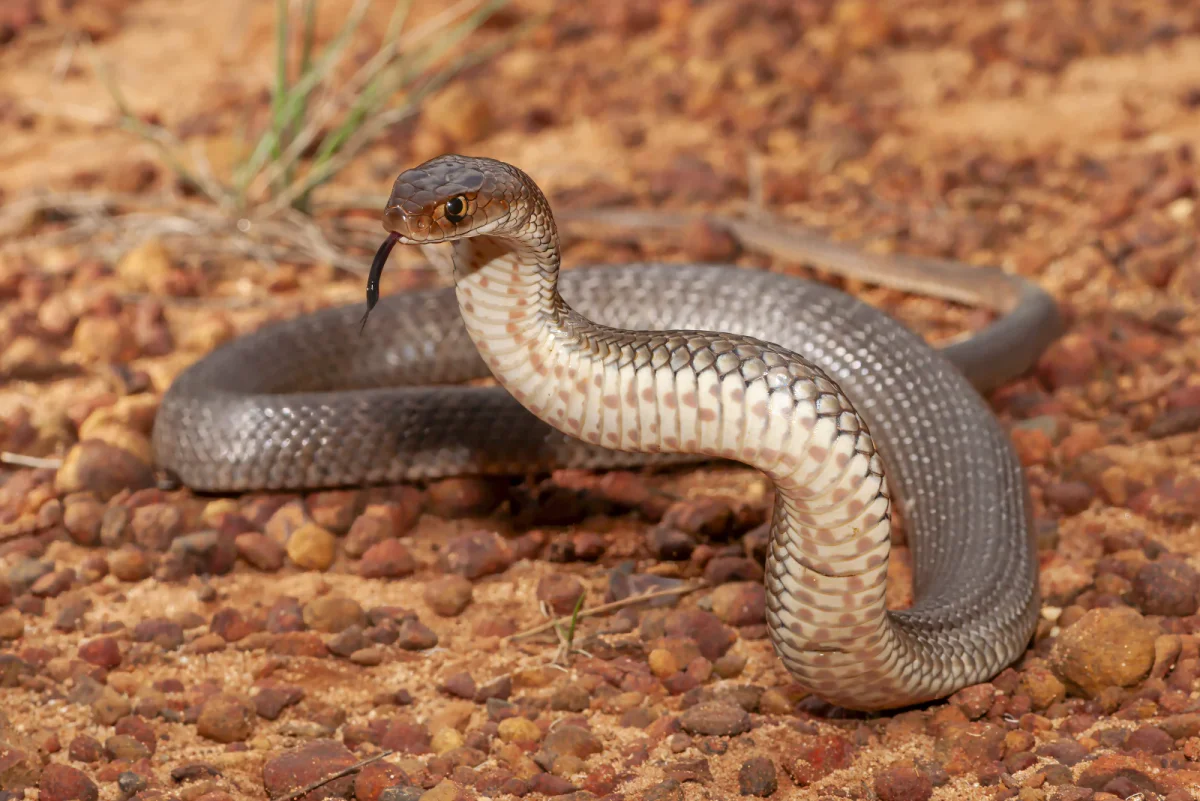
The eastern brown snake (Pseudonaja textilis), also called the common brown snake, is a fast, slender elapid of eastern and central Australia, with small populations in southern New Guinea. Adults usually measure up to 1.5 meters and are plain brown, from pale tan to almost black, with a cream or yellowish belly often marked with orange spots. It lives in open woodland, grassland, scrub and especially farmland and the edges of towns, where its favorite prey, the introduced house mouse, is abundant. It hunts by day, raising its head to look for prey, and lays clutches of 10 to 35 eggs. Its venom is the second most toxic of any land snake, after the inland taipan, and causes dangerous bleeding and sudden collapse. Brown snakes cause more snakebite deaths in Australia than any other group, although the eastern brown usually tries to escape or hide when it meets people. The IUCN lists it as Least Concern.
Name and Classification
The eastern brown snake belongs to the Elapidae, the family of cobras, mambas, taipans and most of Australia's venomous snakes. Within it, it is part of the genus Pseudonaja, the brown snakes, a group found only in Australia and New Guinea that also includes the western brown snake and the dugite. A snake matching its description was mentioned in 1790 by John White, surgeon of the First Fleet, but it was formally described in 1854 by the French zoologists André Duméril, Gabriel Bibron and Auguste Duméril. They named it textilis, meaning woven, because the fine net pattern of the young specimen they studied reminded them of knitted stockings. It is also called the common brown snake. Aboriginal peoples knew it long before: it was marragawan to the Eora and Darug of the Sydney area and goobalaang to the Dharawal of the Illawarra. It should not be confused with the king brown snake, or mulga snake, which belongs to a different genus.
Size and Appearance
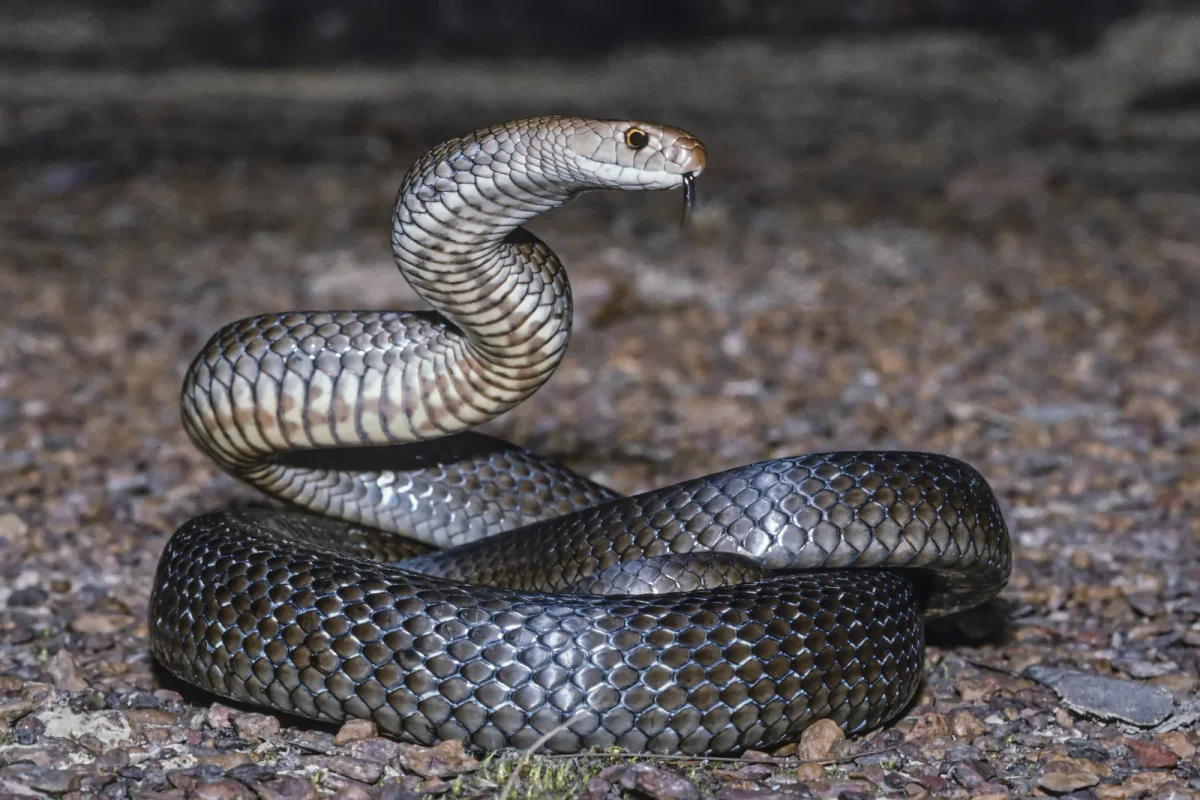
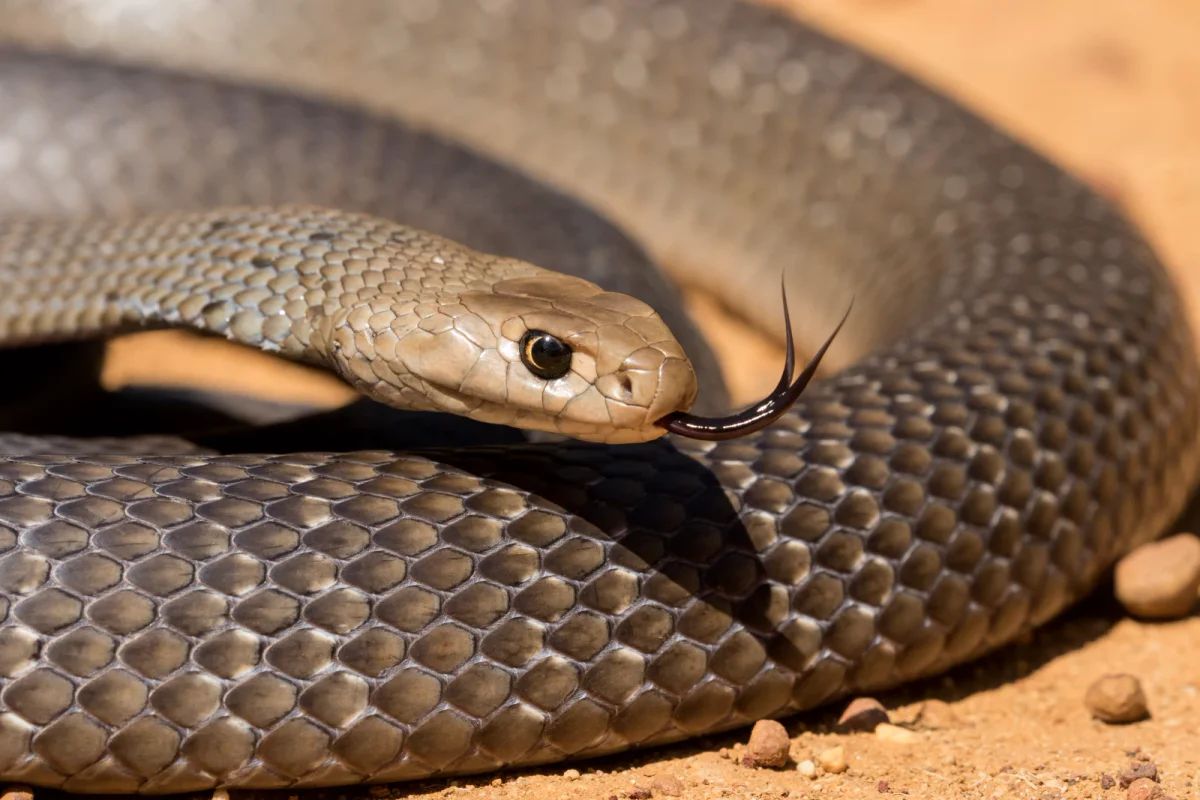
The eastern brown snake has a slender to medium build, a rounded snout and no clear neck, so the head flows straight into the body. Most adults measure up to 1.5 meters, some large ones reach 2 meters, and the longest on record measured about 2.4 meters. Snakes from the north of its range tend to be bigger than those from the south. Despite the name, its color varies a lot: the upper body can be pale tan, dark brown, orange, russet or almost black, usually without any pattern. The belly is cream or pale yellow, often with orange, brown or gray spots near the front, and the eyes are dark with an orange ring around the pupil. Its fangs are small for a dangerous Australian snake, about 3 millimeters long. Young eastern browns look very different from adults. They usually have a black head and a black band on the neck, and their bodies can be plain or crossed by many dark bands. These markings fade as they grow, which once led scientists to describe the young as separate species.
Habitat and Range
The eastern brown snake lives along the whole east of Australia, from Malanda in far north Queensland through the coasts and inland ranges of Queensland, New South Wales and Victoria to the Yorke Peninsula in South Australia. Isolated populations live on the Barkly Tableland and in the MacDonnell Ranges of the Northern Territory and in the far east of the Kimberley. Outside Australia it lives in a few parts of New Guinea: the Central, Oro and Milne Bay provinces of Papua New Guinea and the area around Merauke in the Indonesian province of South Papua. Genetic studies show these snakes crossed from Australia during the Ice Age, when land bridges joined the two islands. It uses habitats from dry eucalyptus forest and coastal heath to savanna woodland, grassland and dry scrub, but avoids dense forest and the alpine zone. It is most common in open country, farmland and on the edges of cities, where mice are plentiful and sheets of iron, rubbish piles and burrows give it places to hide.
Diet and Hunting
The eastern brown snake eats almost only vertebrates, and mammals make up most of its diet, especially the house mouse, which was brought to Australia by Europeans. Mice are so important to it that brown snakes living in crop fields eat more of them, while those in natural bushland and grazing land eat a higher share of lizards. It also takes rats, young rabbits, small birds, eggs, skinks, frogs and other snakes, including the common death adder and young carpet pythons. As it grows, it shifts from cold blooded prey such as lizards to warm blooded prey. Unlike many snakes, it seems to hunt mainly by sight. While searching, it raises its head every so often like a periscope to scan the ground around it. It usually finds prey hiding in burrows or cracks rather than chasing animals in the open. It has also been seen wrapping its body around prey while biting it, which may help its small fangs get through the tough scales of skinks. It rarely eats in winter.
Behavior and Defense
Eastern brown snakes are solitary and active by day. On very hot days they may hide at midday and come out again in the late afternoon, and at night they shelter in cracks in the soil or in burrows dug by mice, lizards or rabbits. They are most active in spring and spend the cold months in brumation, a winter rest. In the irrigated farmland of the Murrumbidgee in New South Wales, they spent an average of 140 days underground, with males going in by early May and coming out in early September, a few weeks before the females. On warm winter days they may come out to bask. They are among the fastest moving snakes in Australia. When cornered, an eastern brown snake rears up into one of two displays. In the partial display it lifts the front of its body just off the ground and flattens its neck. In the full display it rises high into an S shape with its mouth open, ready to strike. Because the snake stands so tall, bites from this position are often on the upper leg.
Venom
Measured by the dose that kills laboratory mice, the venom of the eastern brown snake is the second most toxic of any land snake in the world, after the inland taipan. A dose of about 3 milligrams is thought to be enough to kill an adult person. Its strongest effect is on the blood. The venom contains a complex called pseutarin C that sets off clotting all through the body. This uses up the clotting factors in the blood, so the victim then starts to bleed and cannot stop, a condition called venom induced consumption coagulopathy. About a third of serious cases develop dangerous complications such as very low blood pressure, collapse, kidney damage, bleeding in the brain or cardiac arrest. Symptoms can begin quickly, and collapse has been recorded as soon as two minutes after a bite. It also contains neurotoxins, but these rarely cause paralysis in people. The amount of venom it delivers is small, usually less than 5 milligrams, and the bite site often shows little pain or swelling.
Bites and Treatment
Brown snakes cause more snakebite deaths in Australia than any other snakes, and the eastern brown is the species most often involved. A study of coroners' records found that brown snakes were linked to 23 of the 35 snakebite deaths in Australia between 2000 and 2016, about two deaths a year from all snakes combined. The eastern brown is the dangerous snake people meet most often around Adelaide and also lives on the edges of Melbourne, Canberra, Sydney and Brisbane. Many bites happen when people try to kill or catch a snake, or step on one by accident. Because the bite often causes little pain or swelling, it may go unnoticed. Standard first aid in Australia is a pressure bandage wrapped firmly over the bite and along the whole limb, keeping the person as still as possible and calling an ambulance. In hospital, patients are watched for at least 24 hours and given antivenom if their blood tests show envenoming. A specific brown snake antivenom has existed since 1956.
Reproduction and Young
Eastern brown snakes mate in spring, usually from early October in the Southern Hemisphere. Rival males fight for females in ritual combat, twisting their bodies around each other so tightly that the pair has been compared to a braided rope, and the strongest male mates with the females in his area. Unlike many venomous Australian snakes, which give birth to live young, the eastern brown lays eggs. The female lays a clutch of 10 to 35 eggs, each weighing about 8 grams, in a sheltered spot such as a burrow, a hollow stump or a rotting log, and several females may use the same site, such as an old rabbit warren. The eggs are left alone, and the temperature decides how fast they develop: at 30 °C they hatch after about 36 days, but at 25 °C they take around 95 days. The young are independent from the start and carry the banded or black headed pattern of juveniles. Eastern brown snakes can reach maturity at about 31 months of age and have lived up to 15 years in captivity.
Predators and Conservation
The IUCN lists the eastern brown snake as Least Concern, with a stable population. It is common across most of its range and has done well from the spread of farming in Australia, because grain fields and farm buildings support huge numbers of introduced house mice, its main prey. Its enemies include birds of prey and larger snakes such as the mulga snake, and there is evidence that the eastern brown is resistant to the mulga snake's venom. Introduced foxes and feral cats also eat young snakes. People are a major threat. Many brown snakes are run over on roads or killed on purpose, even though, like all native snakes in Australia, they are protected by law. Leaving a snake alone is also the safest choice, since trying to kill one is a common way people get bitten. In cities, professional snake catchers remove and relocate many eastern browns every year from gardens, sheds and garages.
Where it is found
The Eastern Brown Snake can be found in places such as: