Verreaux's Sifaka
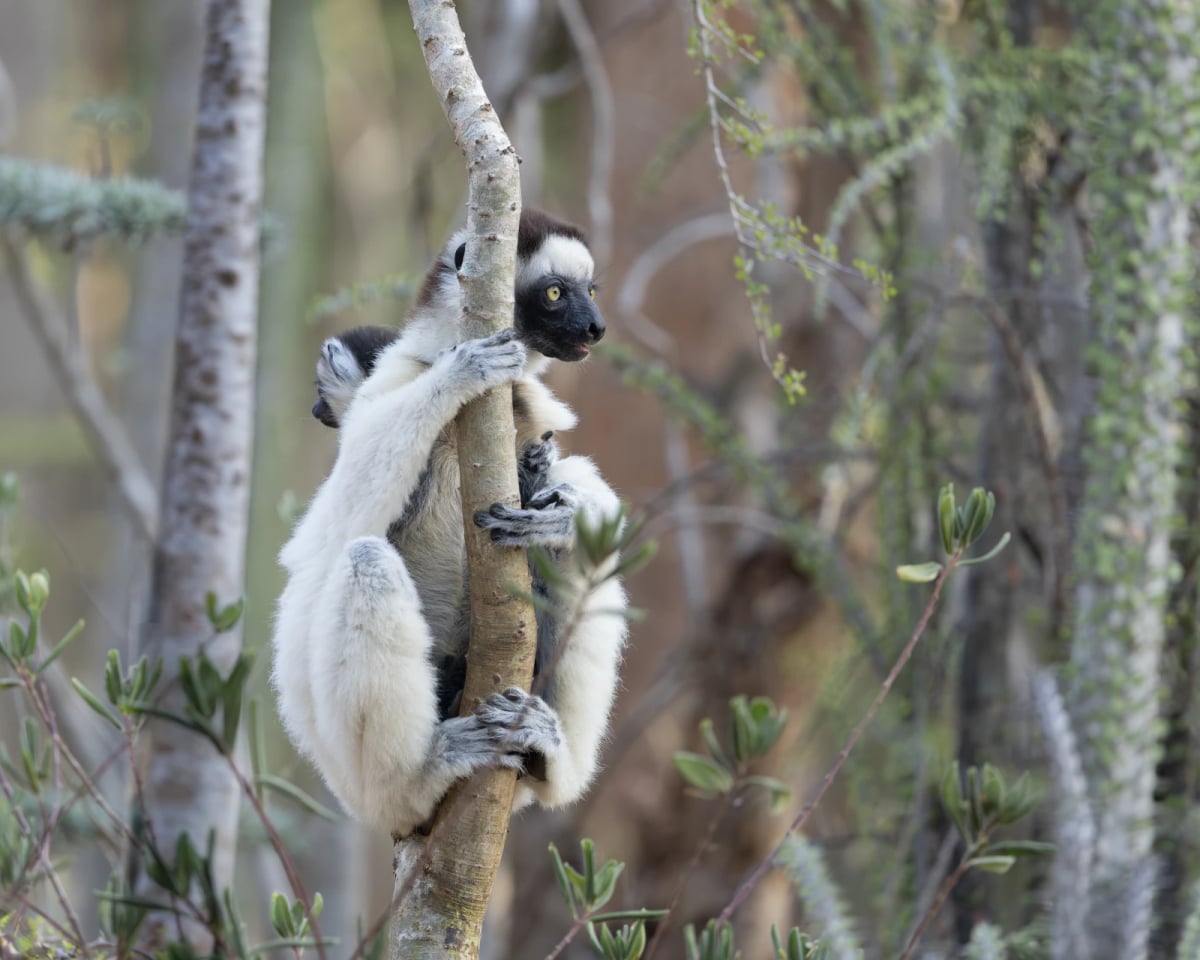
Verreaux's sifaka (Propithecus verreauxi) is a large lemur of the dry forests of western and southern Madagascar, famous for the way it crosses open ground: standing upright and bounding sideways on its hind legs, as if dancing. Adults have a body of about 45 centimeters, a tail even longer and a weight of around 3.5 kilograms. Their thick fur is white, with a dark brown cap, a black face and yellow eyes. In the trees they cling to trunks and leap from one to the next, covering up to about 10 meters in a single jump, even among the thorny trees of the spiny forest. They live in small groups led by females and feed on leaves, fruits, seeds and flowers. The name sifaka comes from their alarm call, which sounds like shi fak. Hunting, fires and the clearing of forests for farms and charcoal have made it Critically Endangered on the IUCN Red List.
Name and Relatives
The word sifaka is Malagasy and imitates the sound of the animal's alarm call, a sharp shi fak that it gives when it spots a predator on the ground. The second part of the name honors the Verreaux family of French naturalists, who collected and sold animal specimens in the 1800s. Its scientific name, Propithecus verreauxi, was given in 1867 by the French naturalist Alfred Grandidier, one of the first scientists to explore Madagascar in depth. Sifakas belong to the family Indriidae, together with the indri and the woolly lemurs, all of them leaf eaters that move by leaping between tree trunks. For many years Coquerel's sifaka, Decken's sifaka and the crowned sifaka of western Madagascar were treated as subspecies of Verreaux's sifaka, but genetic and body studies led scientists to recognize them as separate species. Today the genus Propithecus has nine species, all found only in Madagascar.
Size and Appearance
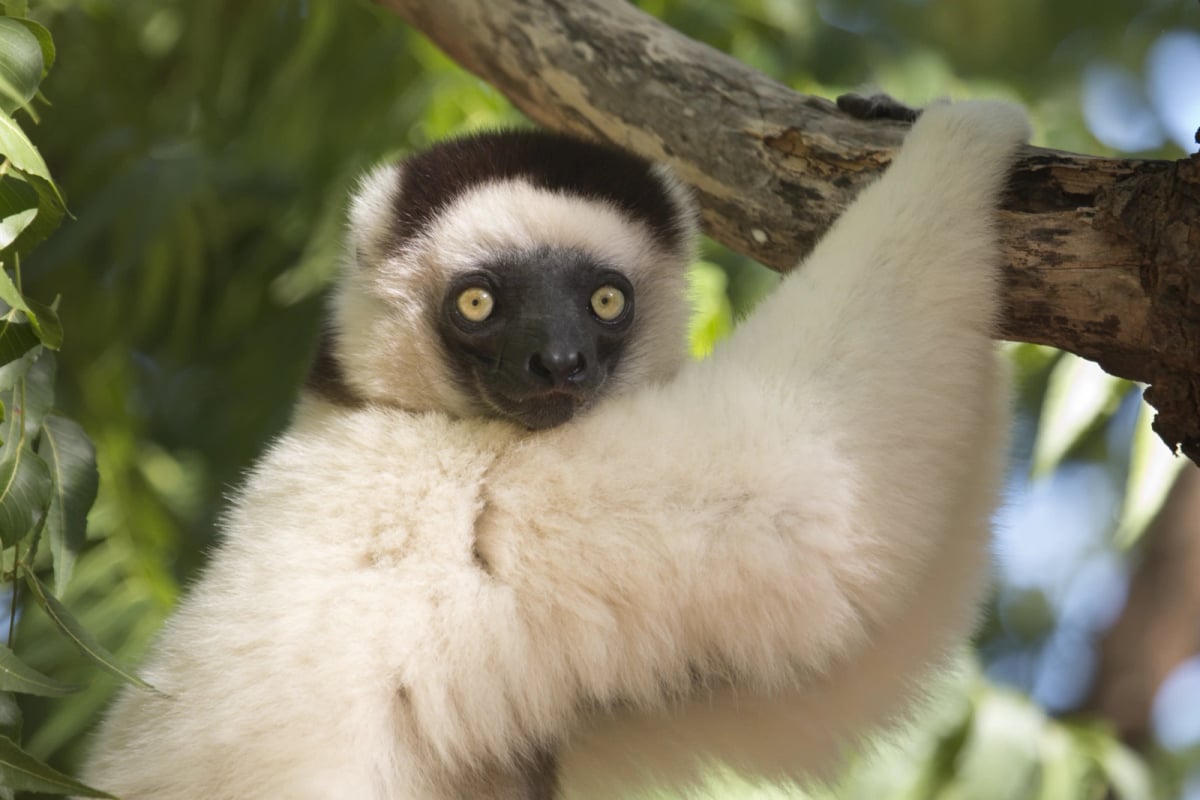
Verreaux's sifaka is a medium sized lemur with a slender body and very long legs. Adults measure about 42 to 45 centimeters from head to rump, and the tail adds another 56 to 60 centimeters, so it is longer than the rest of the animal. Females weigh about 3.4 kilograms on average and males about 3.6, so the two sexes look almost the same. The fur is long, thick and mostly white or creamy, with a dark brown or black cap on top of the head. The face is bare and black, and the large eyes are yellow or orange, which gives it an alert, almost surprised look. Some animals have brown patches on the arms, chest or back, and in parts of the southwest there are darker individuals. Males have a scent gland on the throat that they rub against tree trunks to mark their area, and it often leaves a brown stain on the fur. The long hind legs are built for jumping.
Habitat and Range
Verreaux's sifaka lives only in Madagascar, in the drier west and south of the island. Its range runs from around the Tsiribihina River in the west down through the southwest and across the far south toward the Andohahela area near Tolagnaro. It has the largest range of any sifaka, but within it the forests are broken into many separate patches. It lives in several kinds of forest: dry deciduous forest that loses its leaves in the dry season, the gallery forests of tamarind trees along rivers, and the spiny forest of the south, a strange landscape of tall, thorny plants found nowhere else on Earth. It is found from near the coast up into the hills of the interior. Groups use small home areas of only a few hectares and travel about a kilometer a day in the rainy season and less in the dry season, when food is scarce and the lemurs save energy by resting more.
Leaping and Dancing
Sifakas are vertical clingers and leapers. They hold on to tree trunks in an upright position and push off with their powerful hind legs, twisting in the air to land feet first on the next trunk. A single leap can cover about 10 meters, and they can travel quickly through the forest this way without ever touching the ground. In the spiny forest they jump between the trunks of thorny trees, landing among the spines without getting hurt. Their legs are so much longer than their arms that walking on all fours is awkward. So when they need to cross open ground, such as a clearing or a road, they stand up and bound sideways on their hind legs, with their arms raised for balance. This movement, which looks like a dance, has earned them the nickname dancing lemurs and has made them one of the most filmed animals in Madagascar. The famous scenes at Berenty show groups crossing paths in this way.
Diet
Verreaux's sifaka is a plant eater, and leaves make up the largest part of its diet. One study found that about half of what it eats is leaves and close to 40 percent is fruits and seeds, with flowers, buds and bark completing the menu. What it eats changes a lot with the seasons. In the rainy season, from about November to March, the forest is full of young leaves, fruits and flowers. In the long dry season many trees lose their leaves, and the sifakas have to get by on mature leaves, dry fruits and whatever buds they can find. To cope, they eat a wider range of plants, rest more and move less, saving energy until the rains return. Tamarind trees are especially important in the riverside forests of the south, where sifakas feed on their leaves and pods. Groups usually feed in the morning and late afternoon and rest during the hottest hours of the day, often in the shade of the canopy.
Family Life
Verreaux's sifakas live in stable groups of about 2 to 14 animals, with an average of around six in studies at Kirindy Forest. A group usually has several adult females, a few males and their young. As in most lemurs, females have the upper hand: they get first access to food and decide much of the group's daily life, and recent studies show that their control over mating gives them strong influence over males. Females usually stay in the group where they were born, while young males leave as they approach adulthood and try to join another group. Members groom each other with their lower front teeth, which form a comb, and huddle together to sleep. Groups defend their area by scent marking and by calls. They have different alarm calls for different dangers: the shi fak bark for predators on the ground, such as the fossa, and another call for birds of prey, so the group knows whether to climb higher or drop lower.
Reproduction and Young
Verreaux's sifakas have a short and strict breeding season. Females can only conceive for a few days a year, usually between late January and March, during the rainy season. Not every female breeds each year: in some long term studies fewer than half give birth in a given year. After a pregnancy of about 130 days, the female gives birth to a single baby, usually between June and August, in the middle of the dry season. The newborn clings to the fur on its mother's belly and goes everywhere with her, even during her long leaps between trees. As it grows, it moves to ride on her back, and it starts to try leaves and to make short jumps on its own. By the time the rains bring new leaves, the young are already eating much of their own food. Many babies die in their first year, from predators or hunger, which is one reason why populations recover slowly once they decline.
Threats and Conservation
In an assessment made in 2018 and published in 2020, the IUCN moved Verreaux's sifaka to Critically Endangered, along with seven other sifaka species. Its population is decreasing and severely fragmented. The dry forests of western and southern Madagascar are being cleared for slash and burn farming and cattle pasture, and cut for charcoal and firewood, the main fuels for cooking in the region. Fires that escape from fields burn even more forest. Hunting is another serious threat. Killing sifakas is illegal, and for the Antandroy and Mahafaly peoples of the south it is fady, a traditional taboo, which has protected many groups for generations. In other areas, however, sifakas are hunted for meat. Around Isalo the species is called sifaka bilany, the sifaka of the cooking pot, a name that may refer to it as food or to the sooty fur of the local animals. Protected areas, private reserves and community forest projects are now key to keeping the remaining populations connected.
Where to See Them
Verreaux's sifaka is one of the easiest lemurs to see in southern Madagascar. The best known place is the private Berenty Reserve, near Tolagnaro, where groups living in the tamarind forest along the Mandrare River are used to people, and visitors often watch them dance across the paths in the early morning. In the southwest, Isalo National Park, Zombitse Vohibasia National Park and Tsimanampetsotsa National Park all have populations, as does the Beza Mahafaly Special Reserve, where scientists have studied the same groups for decades. Andohahela National Park protects sifakas in its spiny forest section. Farther north, Kirindy Forest near Morondava, also famous for the fossa, is another good place to find them. The dry season, from about April to October, is the most comfortable time to visit. Sifakas are most active in the cooler hours of the morning and late afternoon.