Malayan Tapir
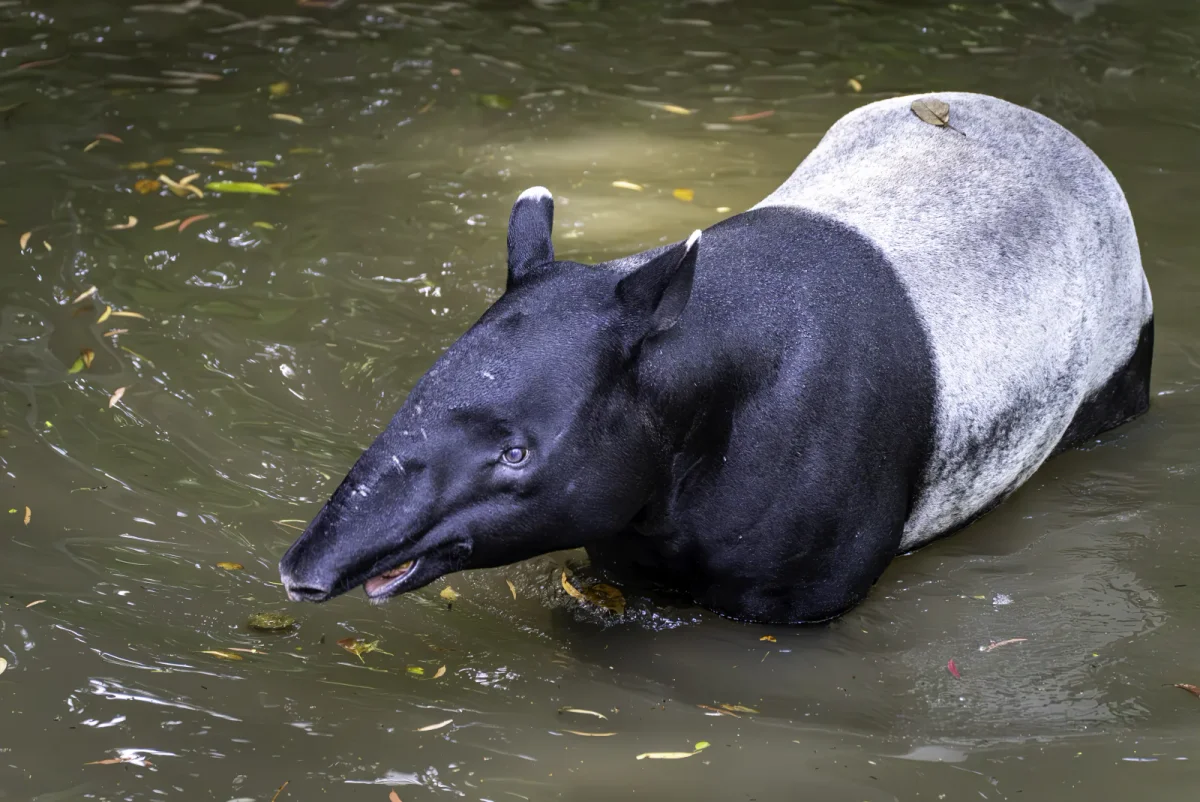
The Malayan tapir (Tapirus indicus), also called the Asian tapir, is the largest of the world's tapirs and the only one that lives in Asia. Adults measure 1.8 to 2.5 meters long and usually weigh 250 to 320 kilograms, with females larger than males. Its coat is unmistakable: black on the head, shoulders and legs, with a broad white or pale gray saddle around the middle. Like all tapirs it has a short, flexible snout that works like a small trunk, and its closest relatives are horses and rhinos. It lives in the rainforests of southern Myanmar, western and southern Thailand, Peninsular Malaysia and Sumatra, from the lowlands up into the mountains, always near water. It is solitary, active mostly at night and an excellent swimmer, and it feeds on leaves, shoots and fruit. Calves are born brown with white stripes and spots. Forest loss, roads and snares have made it Endangered on the IUCN Red List.
Name and Classification
The Malayan tapir is also known as the Asian tapir or Malay tapir, and it is the only living tapir outside the Americas. The French zoologist Anselme Gaëtan Desmarest gave it the scientific name Tapirus indicus in 1819, and the word tapir itself comes from Tupi, an Indigenous language of Brazil, where Europeans first met these animals. Tapirs belong to the odd toed hoofed mammals, the same group as horses and rhinoceroses, and despite a vague resemblance to pigs they are not related to them. The Malayan tapir is so different from its American cousins in size, color and skull shape that in 2011 the zoologists Colin Groves and Peter Grubb placed it in a genus of its own, Acrocodia, a name some references now use. Most sources still call it Tapirus indicus. Its American relatives, the lowland, Baird's and mountain tapirs, share its trunk like snout and its striped calves, and they are covered on the tapir page of this site.
Size and Appearance
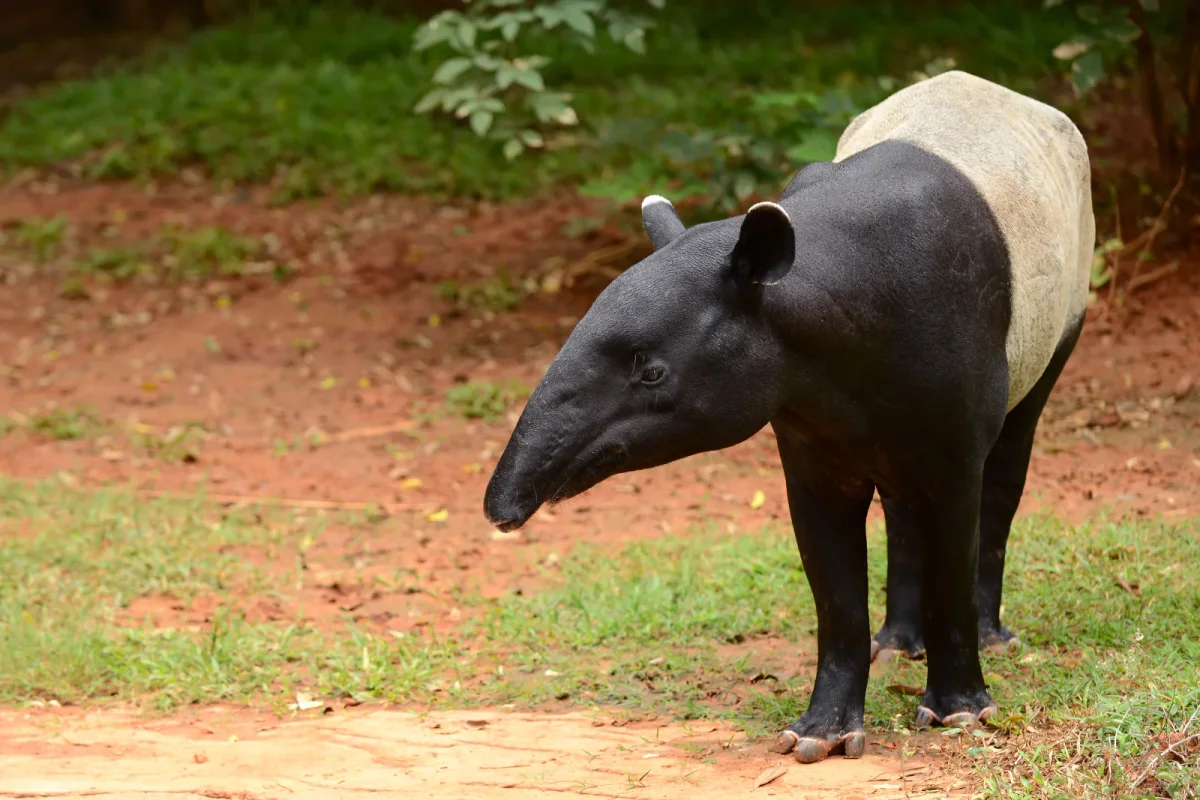
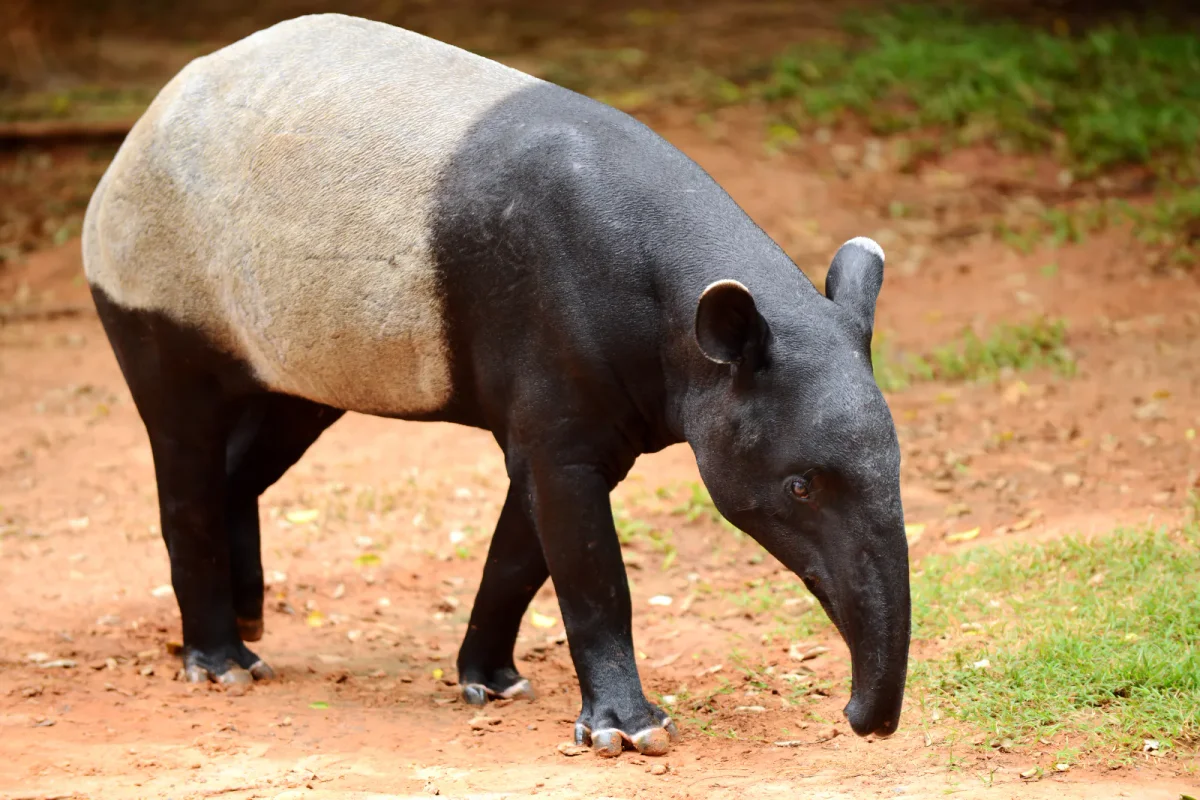
The Malayan tapir is the biggest of the four tapir species. Adults measure about 1.8 to 2.5 meters from snout to rump, plus a stubby tail of 5 to 10 centimeters, and stand 90 to 110 centimeters at the shoulder. Most weigh between 250 and 320 kilograms, and exceptionally large animals can be much heavier. Females are usually larger than males. The color pattern is what makes it famous. The head, shoulders, front legs and hind legs are black, while a broad band of white or pale gray wraps around the belly, back and rump like a saddle blanket. The edges of the ears are also white. The body is shaped like a wedge, narrow at the front and broad at the back, ideal for pushing through dense undergrowth, and the skin on the neck is thick. The snout is a short trunk formed by the nose and upper lip. The eyes are small, and the tapir relies on smell and hearing more than sight. A few all black tapirs have been recorded by camera traps in Malaysia.
Habitat and Range
The Malayan tapir lives in four countries of Southeast Asia: southern Myanmar, mainly in the Tanintharyi Region, western and southern Thailand, Peninsular Malaysia and the Indonesian island of Sumatra. It does not live on Borneo, although fossils show that tapirs once lived there, and its range was much wider in the past. It is a forest animal that uses lowland and hill rainforest, swamp forest and the edges of rivers, and it can also survive in selectively logged forest if enough cover remains. Water is essential: tapirs drink, bathe and cool off in rivers, streams and wallows almost every day, and they often cross rivers by swimming. Each animal follows a network of trails through its home area, linking resting places, feeding grounds, mineral licks and pools. In Peninsular Malaysia, camera traps in Pahang and Johor recorded more than 94,000 tapir images between 2009 and 2017, showing how widespread it still is there.
Diet
The Malayan tapir is a herbivore that browses on a wide range of plants. It eats leaves, young shoots, twigs and buds, along with wild fruit, grasses and water plants, which it reaches by wading or swimming. It is a selective feeder that moves slowly along its trails at night, taking a little from many different plants and choosing the most nutritious food available. The flexible snout does much of the work. It wraps around a branch to pull it closer, strips off the leaves and pushes them into the mouth, and it can also sweep fallen fruit from the ground. Tapirs regularly visit mineral licks, where they eat salty soil that adds minerals missing from their diet. Like the American tapirs, it swallows some fruits whole and walks long distances before leaving its dung, often in or near water, so it carries seeds far from the parent tree. This makes it a useful seed disperser in the forests of Southeast Asia, where other large plant eaters such as elephants and rhinos have become rare.
Behavior
Malayan tapirs live alone, except for mothers with their calves, and adults keep to home areas that can overlap with those of other tapirs. Camera trap studies show that they are strongly nocturnal: they spend the day resting in thick cover or lying in water and become active after dark, when they feed and travel along their trails. The black and white coat probably helps at night. In the dim light of the forest, the white saddle and the black front and back break up the outline of the body, so that a resting tapir looks less like a large animal and more like a pile of light and dark shapes. Tapirs are excellent swimmers and can stay underwater for a short time, using the snout like a snorkel, and they often escape danger by running into water. They communicate with high pitched whistles and clicks, especially between mother and calf, and mark their trails with urine and dung. Tigers may kill tapirs when they get the chance, but records of this are few.
Calves
A baby Malayan tapir looks completely different from its parents. It is born with a dark brown coat covered in white or cream stripes and spots, a pattern that works as camouflage on the forest floor, where it blends with patches of sunlight and shadow while the mother feeds nearby. The pregnancy is one of the longest of any land mammal, about 13 months, or roughly 390 to 410 days. The female almost always has a single calf, which can stand within a few hours but spends much of its first weeks hidden in dense vegetation. The stripes and spots start to fade after a few months and are usually gone by about six months of age, when the young tapir takes on the black and white adult pattern. Calves stay with their mothers for many months and learn the trails, feeding places and pools of their home area. Because a female usually has at most one calf every two years, the species cannot recover quickly from losses caused by hunting or road accidents.
Threats and Conservation
The IUCN lists the Malayan tapir as Endangered, with a decreasing population, in an assessment from 2014. The biggest threat is the loss and fragmentation of its forests, cleared for oil palm, rubber and other plantations, farms and towns, especially in the lowlands of Sumatra and Peninsular Malaysia. Roads that cut through forest are a growing problem, because tapirs follow fixed trails and are often killed by vehicles at night. Snares set for other animals also catch and injure them. Nobody knows exactly how many remain. In 2025 Malaysia's government gave a national estimate of 700 to 800 animals, down from an older official figure of 1,100 to 1,500, while some studies based on camera traps suggest there could be more, and experts agree that solid figures are still lacking. In Thailand, a 2026 study of camera trap photos from the Khlong Saeng and Khao Sok forests identified at least 43 individuals. The tapir is protected by law in all four countries.