Rhinoceros Hornbill
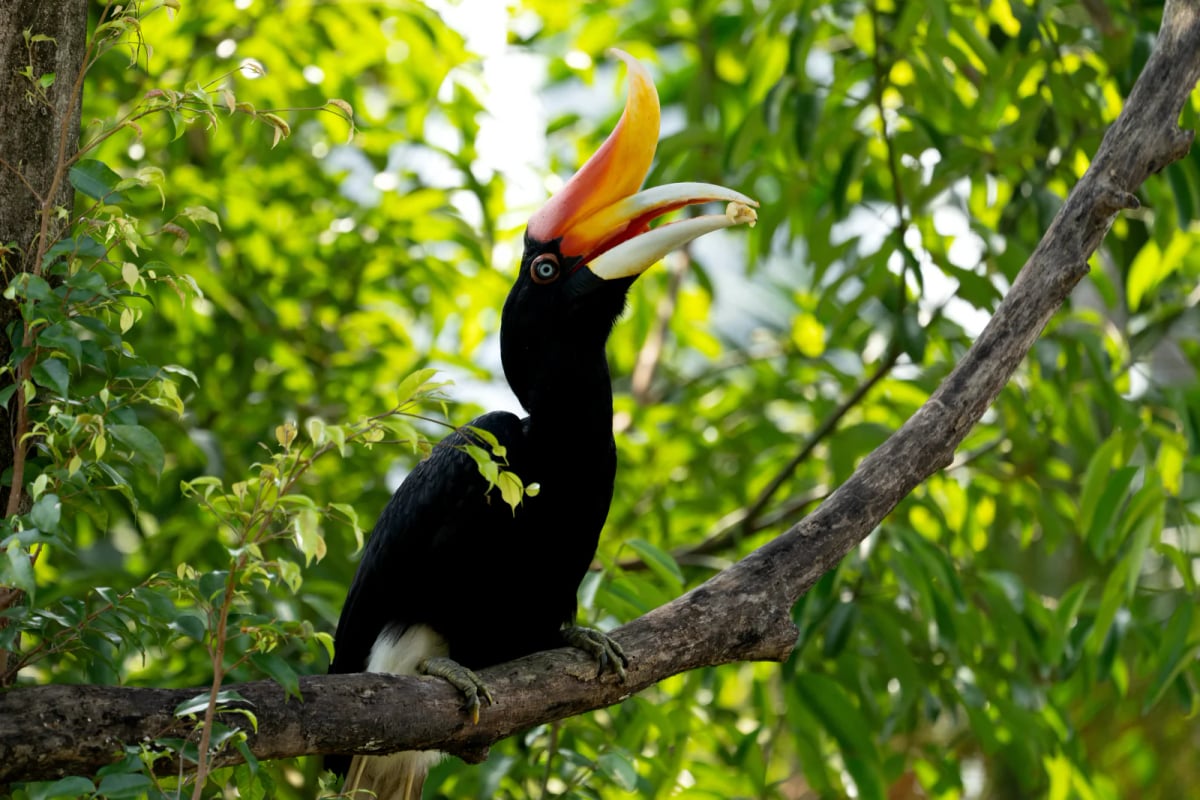
The rhinoceros hornbill (Buceros rhinoceros) is one of the largest hornbills in the world, a black and white bird of the rainforests of Southeast Asia with a huge yellow and orange bill topped by a red casque that curves upward like a horn. Adults measure about 80 to 90 centimeters and weigh 2 to 3.4 kilograms, males being larger. It lives in tall, old forest in southern Thailand, Peninsular Malaysia, Sumatra, Java and Borneo, including Brunei. It feeds mostly on fruit, especially figs, and spreads the seeds of many trees across the forest. Pairs nest in hollow trees, where the female seals herself inside with mud, droppings and fruit and depends on the male to feed her through a narrow slit. It is the state bird of Sarawak, in Malaysian Borneo, and a symbol of the Dayak peoples. Logging, forest clearing and hunting have made it Vulnerable on the IUCN Red List.
Name and Subspecies
The rhinoceros hornbill owes its name to the casque on top of its bill, which curves upward at the tip like the horn of a rhinoceros. The Swedish naturalist Carl Linnaeus gave it the scientific name Buceros rhinoceros in 1758. Buceros comes from Greek and means ox horn, a reference to the shape of the bill. It belongs to the hornbill family, a group of about 60 species found in the tropics of Africa and Asia, and within it to the genus Buceros, together with the great hornbill and the rufous hornbill. Three subspecies are recognized. The nominate form lives in southern Thailand, Peninsular Malaysia and Sumatra. The Bornean form is generally smaller, with a shorter casque that turns sharply up and curls at the tip. The Javan form has a straighter casque that points forward. In Sarawak the bird is known by its Iban name, kenyalang.
Size and Appearance
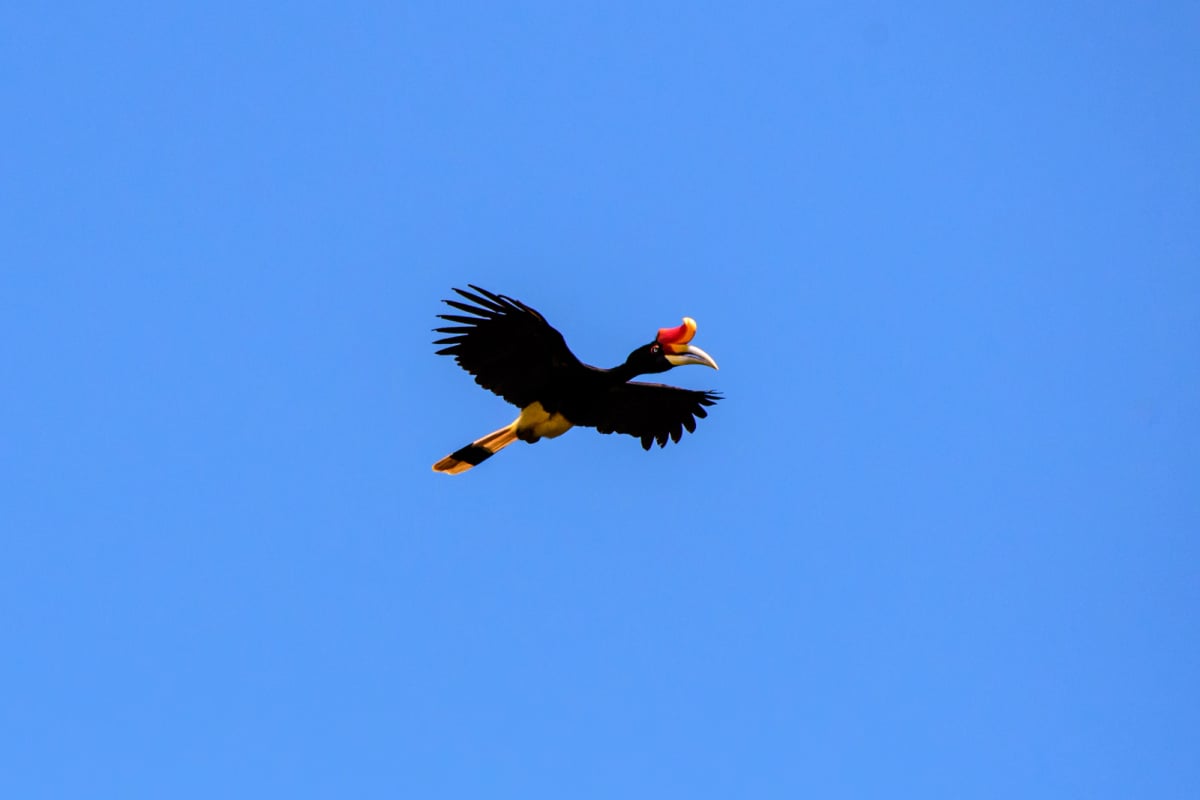
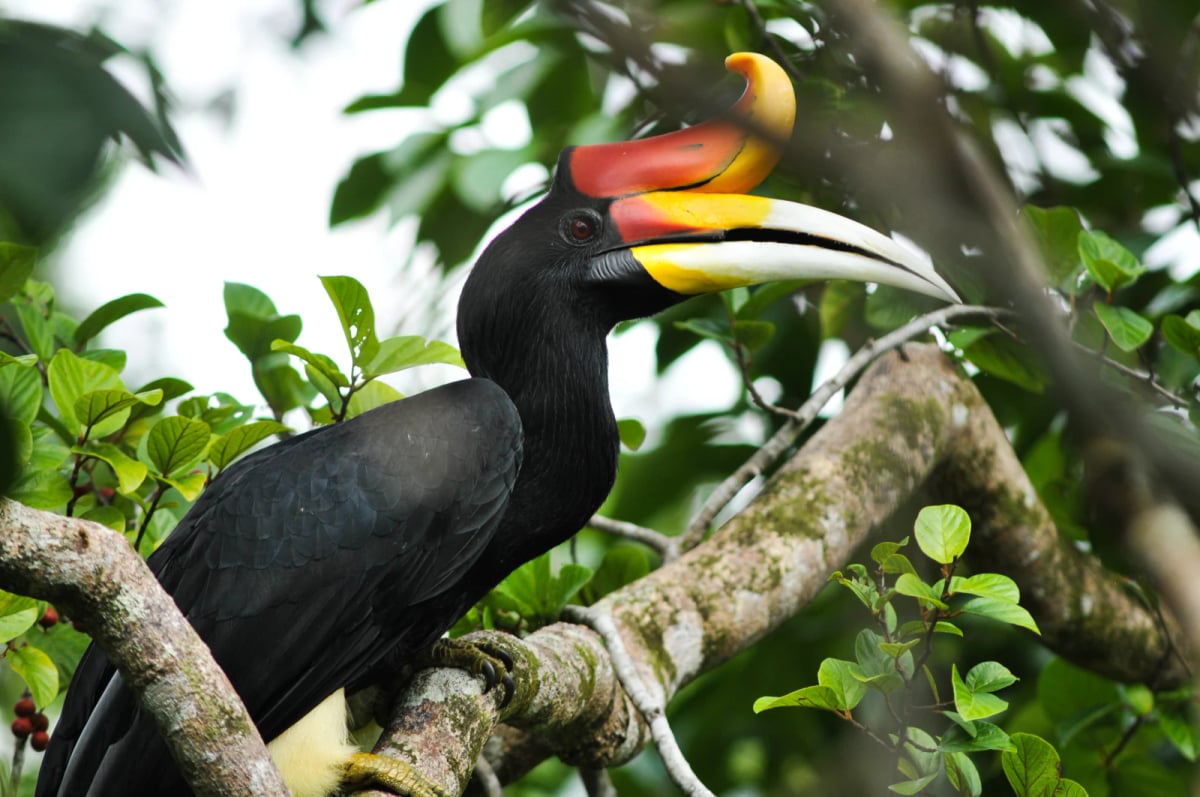
The rhinoceros hornbill is one of the largest hornbills in Asia. Adults measure about 80 to 90 centimeters from bill to tail, and much of that length is the enormous bill and the long tail. Males weigh about 2.6 to 3.4 kilograms and females about 2 to 2.3 kilograms. The plumage is mostly glossy black, with a white belly, white thighs and a white tail crossed by a broad black band. The bill is ivory at the tip and turns yellow and orange toward the base, and on top of it sits the red and orange casque. The sexes are easy to tell apart up close by the eyes: males have red eyes, while females have white or bluish eyes. Females are also smaller, with a smaller casque. Their legs are short and strong, suited to perching and hopping along branches rather than walking. In flight the broad wings and long tail give a striking silhouette, and the heavy wingbeats can be heard from a distance.
The Casque
The casque is the most striking feature of the rhinoceros hornbill. It is a structure that grows on top of the upper bill, made of a thin layer of keratin, the same material as our fingernails, over a light, spongy framework of bone. Although it looks heavy, it is mostly hollow inside, which keeps the weight of the head manageable. In this species it curves upward and backward at the front, giving the bird its rhinoceros look. Its exact purpose is still not fully understood. Scientists believe it works as a sound chamber that makes the deep calls of the pair louder in the dense forest, and it also helps birds recognize each other and judge the age, sex and condition of a possible mate. Young birds start with a small casque that grows and changes shape over several years. The rich red and orange colors are enhanced by an oil from a gland near the tail, which the bird spreads on its bill and casque.
Habitat and Range
The rhinoceros hornbill lives in the Sundaland region of Southeast Asia, the lands that sit on the shallow Sunda Shelf. Its range covers the far south of peninsular Thailand, Peninsular Malaysia, Sumatra, Java and the whole island of Borneo, which is shared by Malaysia, Brunei and Indonesia. It once lived in Singapore too, but it disappeared there as the forests were cleared. It is a bird of tall, mature evergreen rainforest, mostly in the lowlands and hills, though it also reaches lower mountain forest. It depends on big, old trees, which provide both the fruiting figs it eats and the large hollows it needs for nesting. For that reason it is most common in large, unbroken tracts of primary forest and becomes scarce where the forest has been heavily logged or cut into small patches. In southern Thailand it survives mainly in the extensive forests of the Hala Bala area, near the border with Malaysia.
Diet and Seed Dispersal
The rhinoceros hornbill feeds mostly on fruit, and figs make up a large part of its diet. Fig trees produce fruit at different times of the year, so they are a reliable food source in a forest where other fruits come and go. It also eats other soft fruits and adds animal food such as insects and other arthropods, lizards, tree frogs and the eggs of other birds, which are especially important when it is feeding its chicks. It picks food delicately with the tip of its huge bill, then tosses it back into the throat with a quick flick of the head, because its tongue is too short to help. Hornbills swallow many fruits whole and later bring up or pass the seeds, often far from the tree where they fed. This makes them important seed dispersers, sometimes called the farmers of the forest. Some large fruited rainforest trees depend on big birds like this one to carry their seeds away from the parent tree.
Nesting
Rhinoceros hornbills live in pairs and nest in natural hollows high in large trees. Once the pair has chosen a cavity, the female goes inside and walls up the entrance with a mix of mud, her own droppings and chewed fruit, some of it brought by the male. She leaves only a narrow vertical slit, just wide enough for the tip of the bill. Sealed in, she lays one or two eggs and incubates them for about 37 to 46 days. During all this time she depends completely on the male, who brings fruit and small animals and passes them to her through the slit, sometimes more than ten times a day. The sealed nest protects the eggs and chick from snakes, monkeys and other predators. After the chick has grown for some weeks, the female breaks out, and both parents seal the opening again and keep feeding the young bird until it leaves the nest at about 80 days old. Because they breed slowly, populations recover slowly too.
Symbol of Sarawak
Few birds carry as much cultural weight as the rhinoceros hornbill in Borneo. It is the state bird of Sarawak, the Malaysian state on the northwest of the island, which calls itself the Land of the Hornbills, or Bumi Kenyalang in Malay. The bird appears on the Sarawak coat of arms, with its wings spread and a shield bearing the state flag on its chest. For the Iban and other Dayak peoples of Borneo, the hornbill is a sacred bird linked to the spirit world and to the god of war. Iban communities have long carved and painted wooden hornbill figures, also called kenyalang, for important ceremonies. The casques and long tail feathers were traditionally worn in ceremonial dress, a practice that today has to compete with the protection of a bird that is becoming harder to find. In Sarawak the rhinoceros hornbill is a totally protected species under the Wild Life Protection Ordinance of 1998.
Threats and Conservation
The IUCN lists the rhinoceros hornbill as Vulnerable, with a population that is decreasing, mainly because of the loss of its forest. The lowland rainforests of Sundaland have been cleared faster than almost any other forest in the world, through commercial and illegal logging and conversion to oil palm, pulpwood and other plantations, and large fires have destroyed even more. Logging is especially harmful because it removes the giant old trees that hold nesting hollows and fruiting figs. Hunting adds to the pressure. The birds are shot for food, for the pet and bird trade, and for their casques and tail feathers, used in ceremonial dress, particularly in Borneo. Unlike the helmeted hornbill, whose solid casque is carved like ivory, the rhinoceros hornbill has a hollow casque that is not valued for carving. It occurs in many protected areas, and large forest reserves where hunting is controlled are its best hope.
Where to See Them
The rhinoceros hornbill is one of the great sights of a trip to the rainforests of Borneo, Sumatra and Peninsular Malaysia. In Sabah, boat trips along the lower Kinabatangan River often turn up several hornbill species in the riverside trees, and the old growth forest of the Danum Valley is another reliable place to hear and see them. In Peninsular Malaysia, Taman Negara National Park, one of the oldest rainforests on Earth, protects a healthy population. In Sumatra, the species lives in Gunung Leuser, Bukit Barisan Selatan and Way Kambas national parks, and in southern Thailand it can be found in the forests of Hala Bala. The best way to find one is to listen. Pairs give loud, deep honking calls that carry far through the forest, and the whoosh of their wings often announces them before they come into view. Fruiting fig trees are the best places to wait, since several hornbills may gather there to feed.