Copperhead
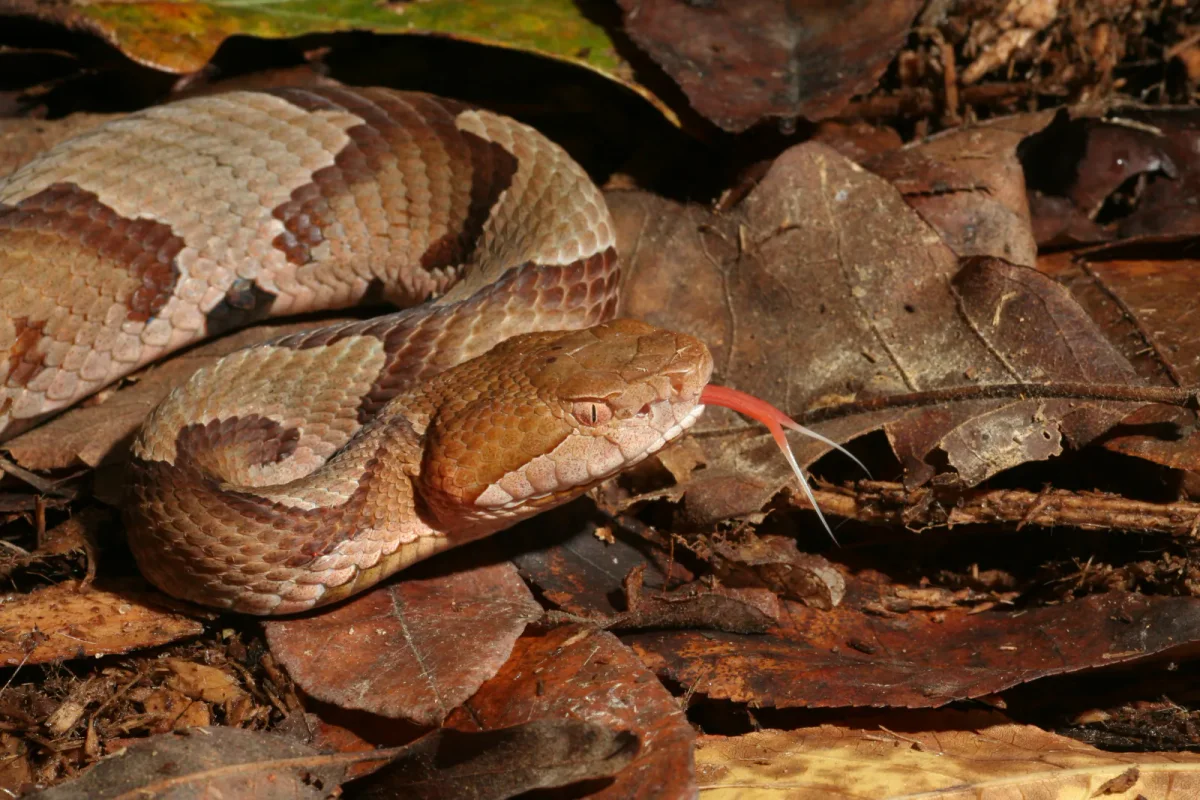
The copperhead (Agkistrodon contortrix) is a venomous pit viper of the eastern and central United States, with a small range in northeastern Mexico. It takes its name from its plain coppery or reddish brown head. The body is pale tan to pinkish brown, crossed by darker bands that are narrow along the spine and wide on the sides, a pattern often compared to an hourglass. Adults usually measure 50 to 90 centimeters. Like other pit vipers, it has a heat sensing pit on each side of the face and vertical pupils. It lives in leafy forests, rocky hillsides, stream edges and wooded neighborhoods, where its colors blend into dead leaves. The copperhead waits in ambush for mice, voles, frogs and insects, and the young wiggle the yellow tip of their tail as a lure. Females give birth to live young in late summer. It bites more people than any other snake in the United States, but its venom is mild and deaths are extremely rare. The IUCN lists it as Least Concern.
Name and Classification
The copperhead is a pit viper, part of the viper family Viperidae. Pit vipers are named for the heat sensing pit between each eye and nostril, which lets them detect warm blooded prey even in total darkness. The copperhead belongs to the genus Agkistrodon, which it shares with its closest relative, the cottonmouth or water moccasin, and with the cantils of Mexico and Central America. Its common name comes from the color of its head, which is usually a plain copper or reddish brown with no markings on top. For decades scientists divided the copperhead into five subspecies across its range. In 2015 a genetic study proposed splitting the western forms, from central Texas to Kansas and into Mexico, into a separate species, the broad banded copperhead (Agkistrodon laticinctus). Other researchers argue that the two groups still interbreed where they meet, so many references, including the IUCN, keep treating all copperheads as one species.
Size and Appearance
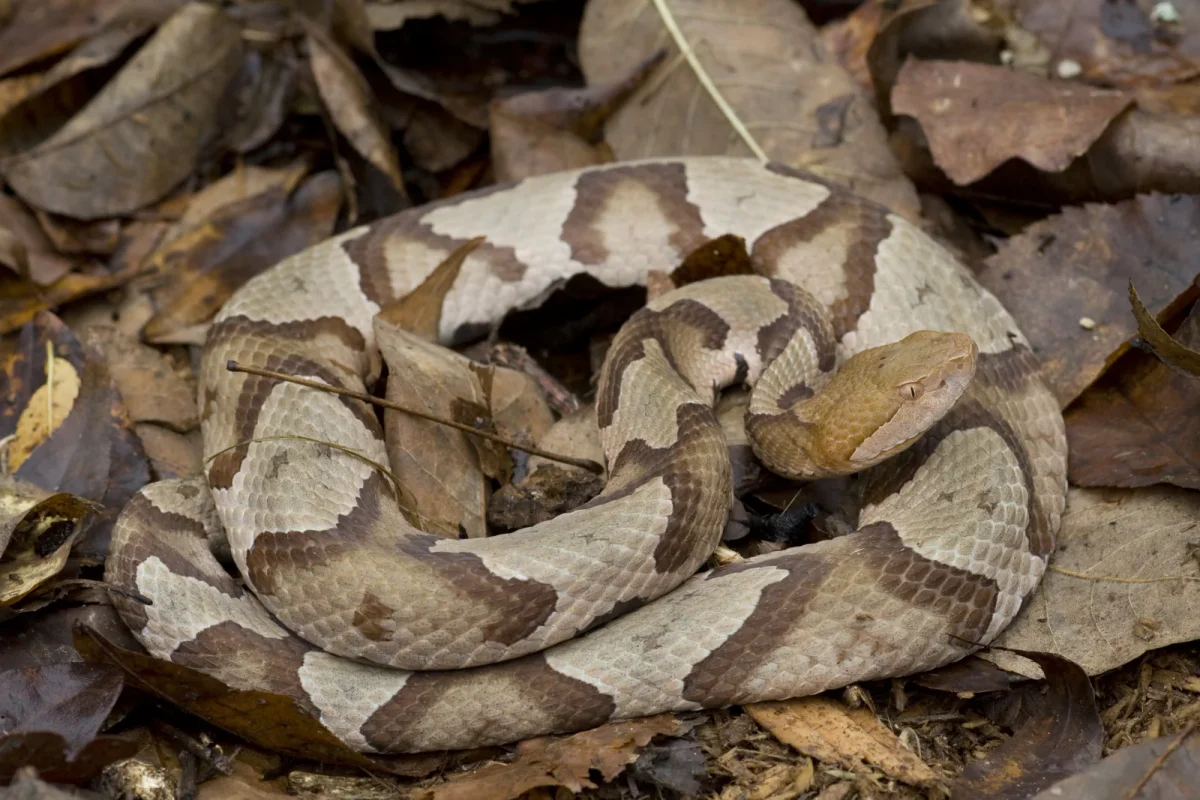
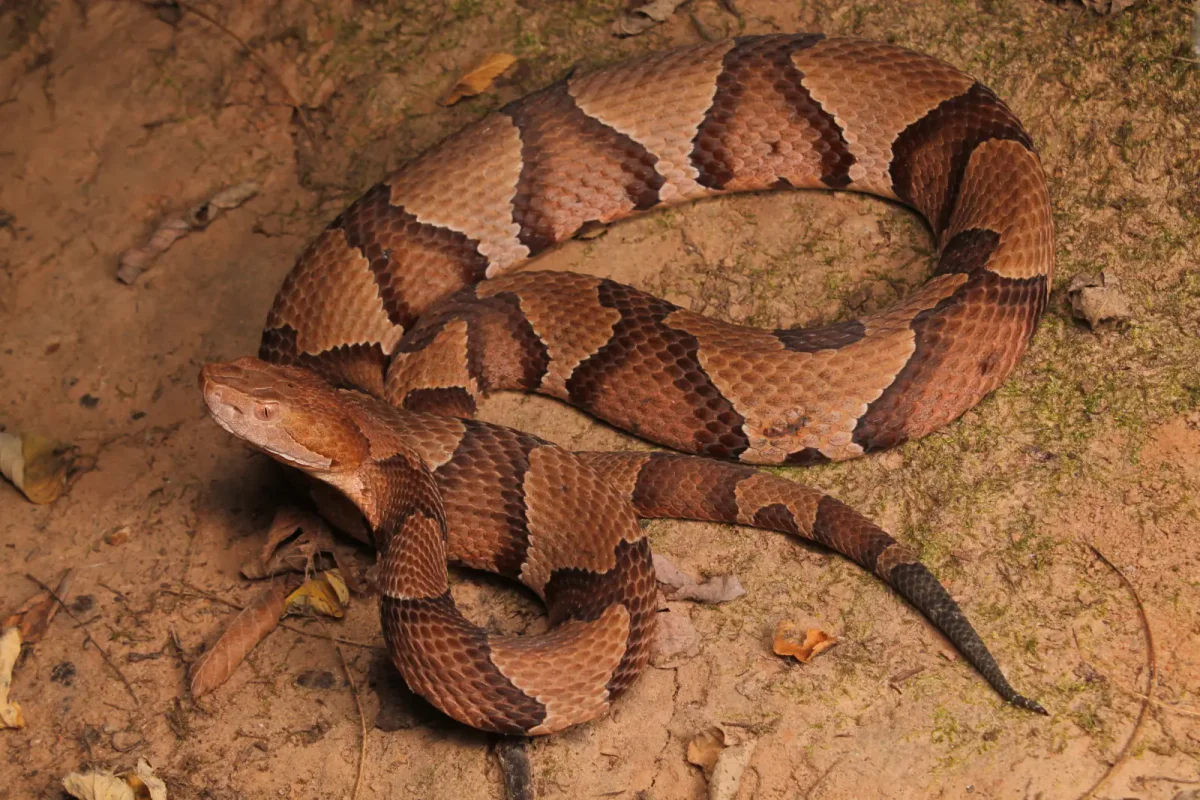
Adult copperheads usually measure 50 to 90 centimeters and weigh about 100 to 350 grams. The longest on record measured about 1.35 meters. They are stout snakes with a broad, triangular head that is clearly wider than the neck, keeled scales and vertical, catlike pupils. The base color ranges from pale tan and pinkish gray to light brown. Over it lie 10 to 18 darker crossbands that are narrow over the spine and wide on the sides, so from above they look like hourglasses or saddles. This pattern breaks up the outline of the body on a forest floor covered in fallen leaves, and a copperhead lying still is very hard to spot. Western copperheads tend to have broader, darker bands than eastern ones. Newborns look like small, grayer copies of the adults, with one key difference: the tip of the tail is bright yellow or greenish yellow. That color fades during the first year or two of life.
Habitat and Range
The copperhead lives across much of the eastern and central United States. Its range reaches north to Massachusetts, Connecticut and southern New York, south to northern Georgia, Alabama and the Florida panhandle, and west to eastern Nebraska, Kansas, Oklahoma and Texas. A small population lives across the Rio Grande in Coahuila and northeastern Chihuahua, Mexico. It is absent from peninsular Florida. In the east it favors deciduous and mixed forests, especially rocky, wooded hillsides with plenty of leaf litter, fallen logs and stone walls. It is also common along the edges of swamps and streams and in old fields next to woods. In the west it follows wooded river valleys and canyons with springs. Copperheads adapt well to people and often live in wooded suburbs, where they shelter under woodpiles, debris and garden mulch. This is one reason they come into contact with people more often than most venomous snakes in North America.
Diet and Hunting
Copperheads are carnivores with a broad diet. Adults eat mostly small mammals such as mice, voles, shrews and chipmunks, along with frogs, salamanders, lizards, small snakes and the occasional bird. Insects matter more than people expect: copperheads eat caterpillars, and they feast on cicadas, catching the insects as they crawl out of the ground and up nearby tree trunks and shrubs to molt. During large cicada emergences, several copperheads may gather under the same oak trees. Most of the time the copperhead is a sit and wait hunter. It lies coiled and motionless in the leaf litter beside a log or trail, using its eyes, its forked tongue and its heat sensing pits to track passing prey. It strikes fast, often lets a rodent go so it cannot bite back, and then follows its scent trail until the venom has worked. Frogs and other small prey are usually held in the mouth instead.
Behavior and Winter Dens
The copperhead relies on camouflage. When a person or predator comes near, its first reaction is usually to stay perfectly still, trusting its pattern to keep it hidden among the leaves. If disturbed further, it may vibrate the tip of its tail against dry leaves, release a strong smelling musk or try to slip away. It bites mainly when stepped on, touched or picked up. Copperheads change their daily schedule with the seasons. In spring and fall they are active by day and bask in the sun, while in the hot months of summer they become mostly nocturnal and hunt on warm evenings. Like many snakes in cold climates, copperheads in the north spend the winter in dens below the frost line, often in rock crevices on sunny, south facing slopes. They tend to return to the same den every year and may share it with timber rattlesnakes, rat snakes and other species, then scatter into the surrounding forest in spring.
Reproduction and Young
Copperheads mate in spring and again in late summer or fall. A female that mates in fall can store the sperm through the winter and fertilize her eggs the following spring. Like most vipers in North America, she does not lay eggs: the young develop inside her body and are born alive in late summer or early fall. A litter usually has 4 to 8 young, though it can range from 1 to about 20, and bigger, older females tend to have more. Females often breed only every other year, and a study in Illinois found that a severe drought stopped reproduction almost entirely. Newborns are about 18 to 25 centimeters long and are venomous from birth. They receive no care from the mother and soon leave on their own. Young copperheads wiggle their yellow tail tip to imitate a caterpillar or worm and draw frogs and lizards within striking range. Scientists have also confirmed that females can occasionally produce young without a male, both in captivity and in the wild.
Venom and Bites
Copperhead venom is hemotoxic: it attacks blood and tissue around the bite. It is the mildest venom of any pit viper in the United States, and adults inject relatively small amounts. Even so, copperheads bite more people than any other snake in the country, because they are common, live close to homes and freeze instead of fleeing, so people step on them or reach into leaves without seeing them. Many bites happen on the hands and feet during yard work or at night. A bite causes sharp pain and swelling that can spread up the limb, bruising and sometimes nausea, and recovery can take weeks. Some bites are dry, with little or no venom. Deaths are extremely rare. A study of United States poison center records from 2006 to 2020 counted about 56,000 pit viper bites and 32 deaths, 23 of them from rattlesnakes. Antivenom is available in American hospitals, and any copperhead bite is treated as a medical emergency.
Similar Snakes
Several harmless snakes are often mistaken for copperheads and killed for it. The eastern milksnake has red, brown or gray blotches with dark borders, but its blotches are rounded on the sides rather than wide at the base. The northern water snake has dark bands that are wide on the back and narrow on the sides, the opposite of a copperhead, and a less distinct head. Young rat snakes and corn snakes are blotched too, but their blotches are squarish saddles along the back. The most useful clue is the copperhead's pattern seen from the side: dark bands that are widest near the belly and pinch in over the spine. Copperheads also have a plain, unmarked head, a thick body and vertical pupils, although checking the eyes means getting too close. Young cottonmouths, the copperhead's closest relative, look very similar and also have yellow tail tips, but they live near water and their bands are darker. Giving any unknown snake space is the safest choice.
Population and Conservation
The IUCN lists the copperhead as Least Concern, with a stable population trend, in an assessment from 2007. It has a huge range, adapts well to farmland edges and suburbs, and remains common in much of the Southeast and the Ozarks. No total population estimate exists. The picture is different at the edges of its range. In Massachusetts, the northern limit of the species, copperheads survive only in a few rocky areas and are listed as endangered under state law. Across its range the main threats are the loss and splitting of forests by development, traffic on roads and people who kill snakes on sight, often mistaking harmless species for copperheads at the same time. Collection for the pet trade is a smaller problem. Copperheads play a useful role in their ecosystems, since they eat large numbers of mice and voles and are in turn eaten by hawks, owls, opossums and kingsnakes. Many live inside protected forests and state and national parks.
Where it is found
The Copperhead can be found in places such as: