Giant Manta Ray
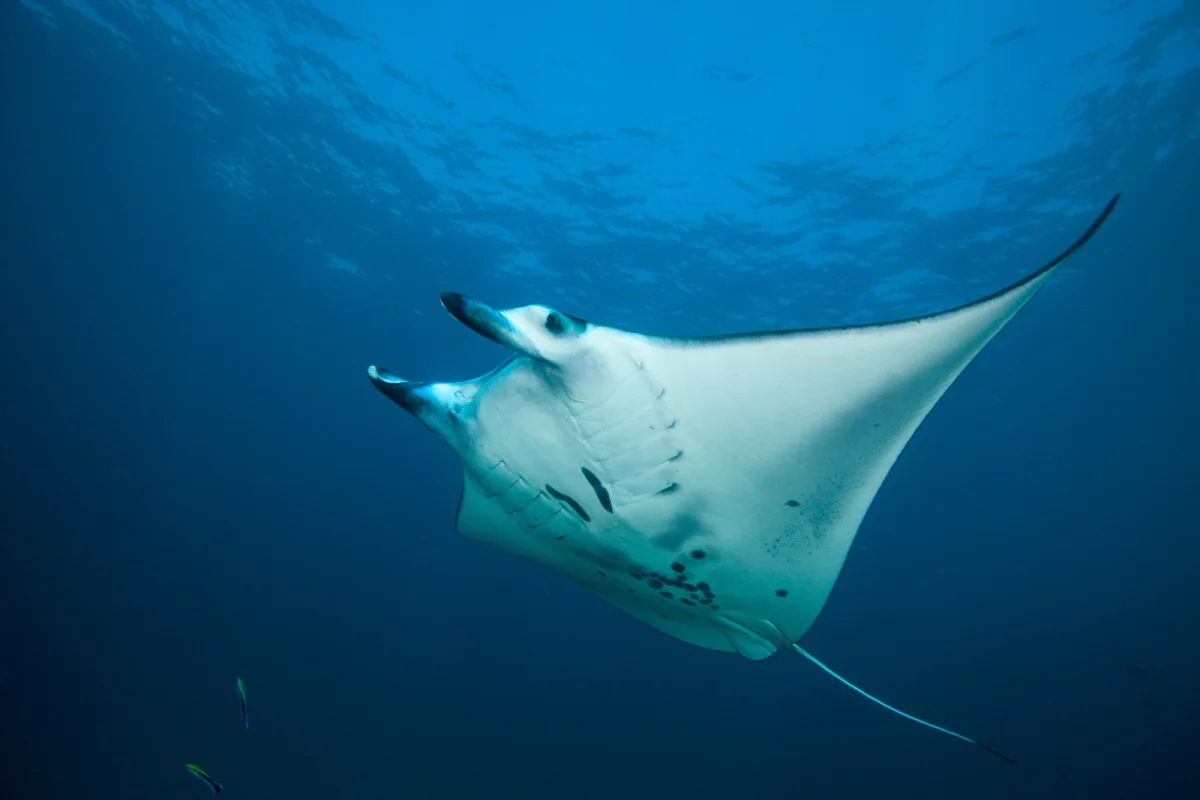
The giant manta ray (Mobula birostris), also called the oceanic manta ray, is the largest ray in the world, with fins that usually span 4 to 5 meters and can reach about 7 meters from tip to tip. It lives in tropical and warm temperate seas around the world, along coasts, around offshore islands and seamounts, and far out in the open ocean. Its back is black with two white patches on the shoulders, and its belly is white with dark spots that are unique to each animal. Despite its size it eats only tiny animals, mostly plankton, which it filters from the water with its wide mouth while two fleshy fins on its head guide the food inside. It has no stinging spine and is harmless to people. Mantas grow slowly and a female has a single pup every two to three years or longer, so their numbers recover very slowly. Fishing for their gill plates and accidental capture in nets have reduced many populations, and the IUCN lists the species as Endangered.
Manta Species
Manta rays belong to the same family as the smaller devil rays, and since 2018 scientists place all of them in the genus Mobula. Today three species of manta are recognized. The giant manta ray is the largest and travels the most, often crossing open ocean. The reef manta ray is smaller, stays closer to coasts and coral reefs, and is the manta most divers meet in places such as the Maldives, Hawaii and Bali. The third, the Atlantic manta ray (Mobula yarae), was formally described in 2025 from the western Atlantic, from the eastern United States and the Gulf of Mexico to the Caribbean and Brazil. Telling giant and reef mantas apart takes a careful look. The giant manta has sharp, T shaped white patches on its shoulders, a dark gray or black mouth, dark edges along the back of its fins underneath, and spots on its belly that sit below the gill slits rather than between them. The reef manta has softer, Y shaped shoulder patches and a white mouth.
Size and Appearance
The giant manta ray is the largest ray on Earth. Its body is a flat diamond with huge triangular pectoral fins that work like wings. Most adults measure 4 to 5 meters across, the biggest reliably measured animals reach about 7 meters, and there are reports of even larger ones. Females grow larger than males. A big manta can weigh up to about 2 tonnes. On each side of the head is a fleshy cephalic fin. When the manta swims, these fins are rolled up like horns, which gave mantas the old nickname devilfish, and when it feeds they unroll to guide water into the mouth. The mouth is wide and sits at the very front of the head. Behind the body trails a thin tail with a small fin at its base. Unlike stingrays, the giant manta has no working stinger. The back is black or very dark gray with two white patches on the shoulders, and the belly is mostly white. Some giant mantas are almost entirely black on both sides, a dark form well known at Mexico's Revillagigedo Islands.
Habitat and Range
The giant manta ray lives in tropical, subtropical and warm temperate waters of the Pacific, Indian and eastern Atlantic oceans. Individuals have been tracked moving more than 1,000 kilometers, and many spend long periods far from land. Even so, giant mantas return again and again to certain places where food is rich or where cleaner fish gather. These include offshore islands, seamounts, reefs on the edge of deep water and coasts where cold, nutrient rich water rises from the depths. The largest known population lives off mainland Ecuador, around Isla de la Plata, where researchers have identified thousands of individual mantas. Other important areas include Mexico's Pacific coast and the Revillagigedo Islands, northern Peru, the Andaman Sea off Thailand and Myanmar, eastern Indonesia, the coast of Mozambique and the northern waters of New Zealand. Giant mantas move with the seasons and with plankton, so in many places they are seen only during certain months of the year.
Diet and Feeding
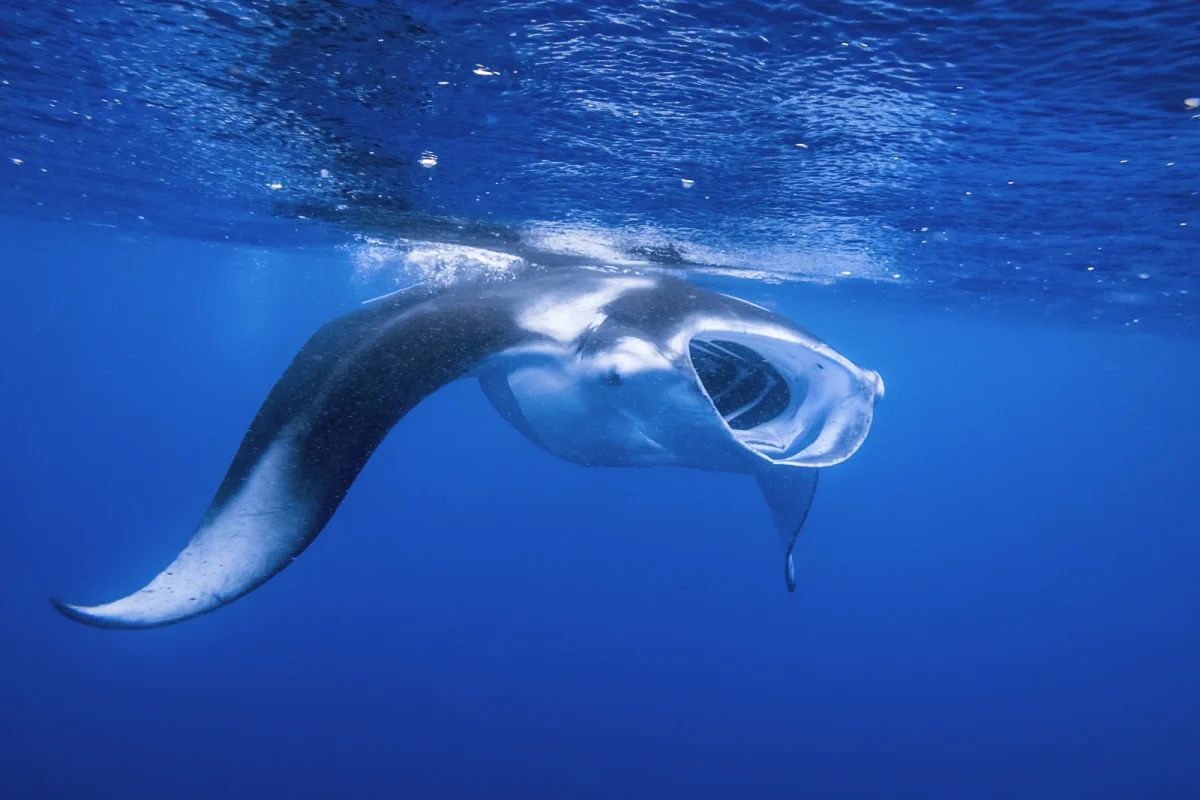
Although it is one of the largest fish in the sea, the giant manta ray feeds on some of the smallest animals. Its main food is zooplankton: tiny shrimp like crustaceans such as krill and copepods, along with fish eggs, larvae and small fish. To feed, the manta swims slowly with its mouth wide open and its cephalic fins unrolled, funneling water inside. The water passes over rows of spongy plates on the gills, called gill rakers, which trap the food before the water flows out through the gill slits. Mantas often feed near the surface, sometimes swimming in loops or turning backward somersaults to stay inside a dense patch of plankton. Studies of their chemistry show that much of their food also comes from deeper water, which they reach on dives that can go beyond 1,000 meters. A large manta needs to eat a lot of plankton every day, which is why it gathers where currents and upwelling bring food together, and why its movements follow the plankton blooms through the year.
Behavior and Intelligence
Giant mantas are usually seen alone or in small groups, but they gather in larger numbers where food is plentiful and at cleaning stations. These are spots on reefs and seamounts where small fish such as wrasses pick parasites and dead skin from larger animals. A manta will hover over a cleaning station for minutes at a time, and individuals come back to the same stations over many years. Like many sharks and rays, mantas must keep swimming so that water flows over their gills. They are graceful swimmers, and they sometimes leap completely out of the water and land with a loud slap, a behavior whose purpose is still not fully understood. Mantas have the largest brains of any fish. A 2016 study of two giant mantas in an aquarium reported behavior in front of a mirror that may suggest they recognize themselves, although scientists still debate what such tests show. Many giant mantas are also curious about divers and will approach them calmly.
Reproduction and Young
Giant manta rays reproduce very slowly, among the slowest of all sharks and rays. During courtship several males may follow a single female in a line, sometimes called a mating train, matching her turns as she swims. Mating takes place belly to belly, with the male holding the tip of one of the female's fins in his mouth. The eggs hatch inside the mother's body, and the embryo grows there for about a year, first living on yolk and later on a milky fluid made by the mother. She then gives birth to a single pup, or rarely two, that already measures more than a meter across and can swim and feed on its own from the start. Females usually rest for two to three years or longer between pregnancies, so over her whole life a female may have only a small number of young. Mantas also take many years to reach adulthood. Little is known about where giant mantas give birth or where the young spend their first years, since newborns are rarely seen in the wild.
Where to See Them
Seeing a giant manta ray usually means traveling to one of the few places where they gather each year. The best known is Isla de la Plata, in Ecuador's Machalilla National Park, where mantas arrive with the cool season, roughly from June to October. In Mexico, liveaboard dive boats visit the remote Revillagigedo Islands, where large mantas, including black ones, often swim close to divers at sites such as San Benedicto. In Thailand, the seamounts of Hin Daeng and Hin Muang and the Similan Islands are known for giant manta encounters, especially from February to April, and the same animals travel to Black Rock in Myanmar's Mergui Archipelago. In eastern Indonesia, Raja Ampat has cleaning stations visited by both giant and reef mantas. In New Zealand, giant mantas appear in the Hauraki Gulf and off Northland in summer. Good encounters follow simple rules: keep a few meters away, never touch or chase a manta, avoid flash photography and let the animal decide how close it wants to come.
Threats and Conservation
The IUCN lists the giant manta ray as Endangered, with a decreasing population, in an assessment from 2019 that moved it up from Vulnerable. Its biggest threat is fishing. In parts of Asia, Africa and Latin America mantas have been hunted for their gill rakers, which are dried and sold as gill plates in some Asian markets as a supposed health remedy, even though there is no evidence that they work. Many more mantas die as bycatch in gillnets, tuna purse seines and longlines. Because a female has so few young, even a small catch can make a local population shrink, and sightings have dropped sharply in places such as Mozambique. Since 2013 international trade in manta products has been controlled under CITES, and many countries, including Ecuador, Peru, Mexico, Indonesia and New Zealand, now protect mantas by law. Tourism also helps, because a living manta that divers come to see year after year is worth far more than one sold at a market.
Where it is found
The Giant Manta Ray can be found in places such as: