Groundhog
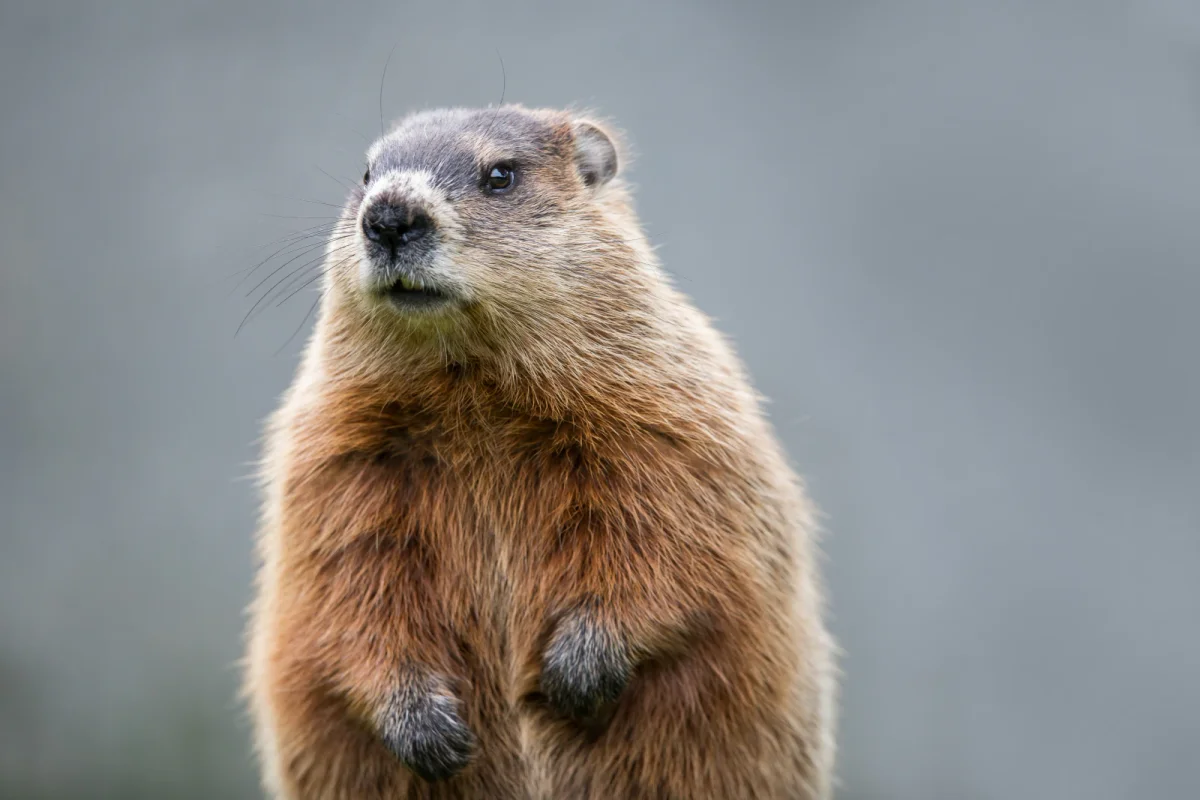
The groundhog (Marmota monax), also called the woodchuck or whistle pig, is a large ground squirrel of North America and one of about fifteen species of marmots. It lives from eastern Alaska and the Yukon across southern Canada to the Atlantic coast, and south through the eastern and central United States to Alabama and Georgia. It is a stocky rodent with short legs, strong digging claws, small ears and a short, bushy tail, and it usually weighs between 2 and 6 kilograms. Its fur is a grizzled brown, darker on the feet and paler around the nose. The groundhog favors open land next to woods, such as field edges, meadows, roadsides and suburban yards, where it digs large burrows. It feeds mostly on grasses, clover, dandelions and other green plants. It is one of the best known true hibernators, sleeping in its burrow from fall until early spring, and every February 2 Groundhog Day turns it into a weather forecaster for a day. The IUCN lists it as Least Concern.
Names and Relatives
The groundhog belongs to the squirrel family, and within it to the marmots, a group of large ground squirrels found across Europe, Asia and North America. It is the most widespread of the roughly fifteen marmot species and the one most tied to lowlands, living in fields and woodlands rather than in high mountains like the alpine marmot of Europe. Linnaeus described it in 1758, and today its scientific name is Marmota monax. It has several common names. Groundhog is the most used in the United States and Canada, while woodchuck is just as old and is preferred by many biologists. Despite how it sounds, woodchuck has nothing to do with wood: it is thought to come from an Algonquian word that English speakers reshaped into familiar English words. In Appalachia the animal is also called a whistle pig, because of the loud, high whistle it gives when it senses danger, just before it dives into its burrow.
Size and Appearance
The groundhog is the largest member of the squirrel family in most of its range. Adults usually measure 40 to 65 centimeters from nose to tail tip, and the flat, furry tail makes up roughly 10 to 25 centimeters of that. Most weigh between 2 and 6 kilograms, and males are usually a little larger than females. Weight changes a great deal through the year: a groundhog is lightest when it comes out of hibernation and heaviest in early fall, after months of eating to build up fat. The body is thick and rounded, set on short, powerful legs. The front feet have long, curved claws made for digging, and the large front teeth, like those of all rodents, grow throughout life and are worn down by gnawing. The coat has a dense gray underfur and long guard hairs with pale tips, which give it a grizzled, frosted look. Color ranges from yellowish brown to dark brown, with darker feet and a paler band around the nose. All black or all white animals appear now and then.
Habitat and Range
The groundhog has the largest range of any marmot. It lives from east central Alaska and the Yukon across the southern half of Canada to Labrador and the Atlantic provinces. In the United States it is found throughout the Northeast, the Midwest and the Appalachians, south to northern Alabama, Georgia and Mississippi and west to the eastern Great Plains, with a separate part of the range in northern Idaho and Washington. It is absent from most of the West and from Florida and Texas. Unlike its mountain relatives, the groundhog is an animal of lowlands and forest edges. It prefers open ground with good soil for digging next to woods or brush: pastures, hayfields, meadows, fence rows, stream banks, roadsides, railway embankments and the edges of farms. The clearing of the eastern forests for farming created exactly this kind of landscape, and the groundhog is probably more common today than before European settlement. It also lives in parks, cemeteries, golf courses and suburban yards.
Diet
The groundhog is mainly a herbivore. It eats a wide variety of green plants, especially grasses, clover, alfalfa, dandelions, plantain, chicory and other leafy plants, and in summer and fall it adds berries, apples and other fruit, along with the bark and buds of shrubs and young trees. Near people it eats crops and garden vegetables such as beans, peas, lettuce, carrots, squash and corn, which makes it unpopular with farmers and gardeners. It occasionally eats insects, snails and even bird eggs, but animal food is only a small part of its diet. A groundhog usually feeds close to its burrow, rarely going more than a few dozen meters from an entrance, and it often sits up on its hind legs to look around while it eats. It is active by day, with most of its feeding in the morning and late afternoon. Much of its water comes from juicy plants and morning dew. In late summer it eats heavily to store the fat that has to last it through the long winter in its burrow.
Burrows
Groundhogs are expert diggers and spend much of their lives underground. A typical burrow has a main entrance marked by a large mound of fresh soil, plus one or more hidden escape holes, often called plunge holes, that drop almost straight down. The tunnels usually run up to about 1.5 meters deep and often extend 8 meters or more, while systems used by several generations can reach 15 to 30 meters. Inside are separate chambers for sleeping, for raising young and for droppings, which the groundhog later buries. Many groundhogs use a summer burrow in open fields and a winter burrow in a wooded or brushy spot, dug below the frost line, for hibernation. When danger appears, a groundhog gives its sharp whistle and dashes for the nearest hole, though it can also swim and climb trees to escape. Its main predators are coyotes, foxes, bobcats, dogs, hawks and owls. Empty groundhog burrows shelter many other animals, including foxes, skunks, raccoons, opossums and rabbits.
Hibernation
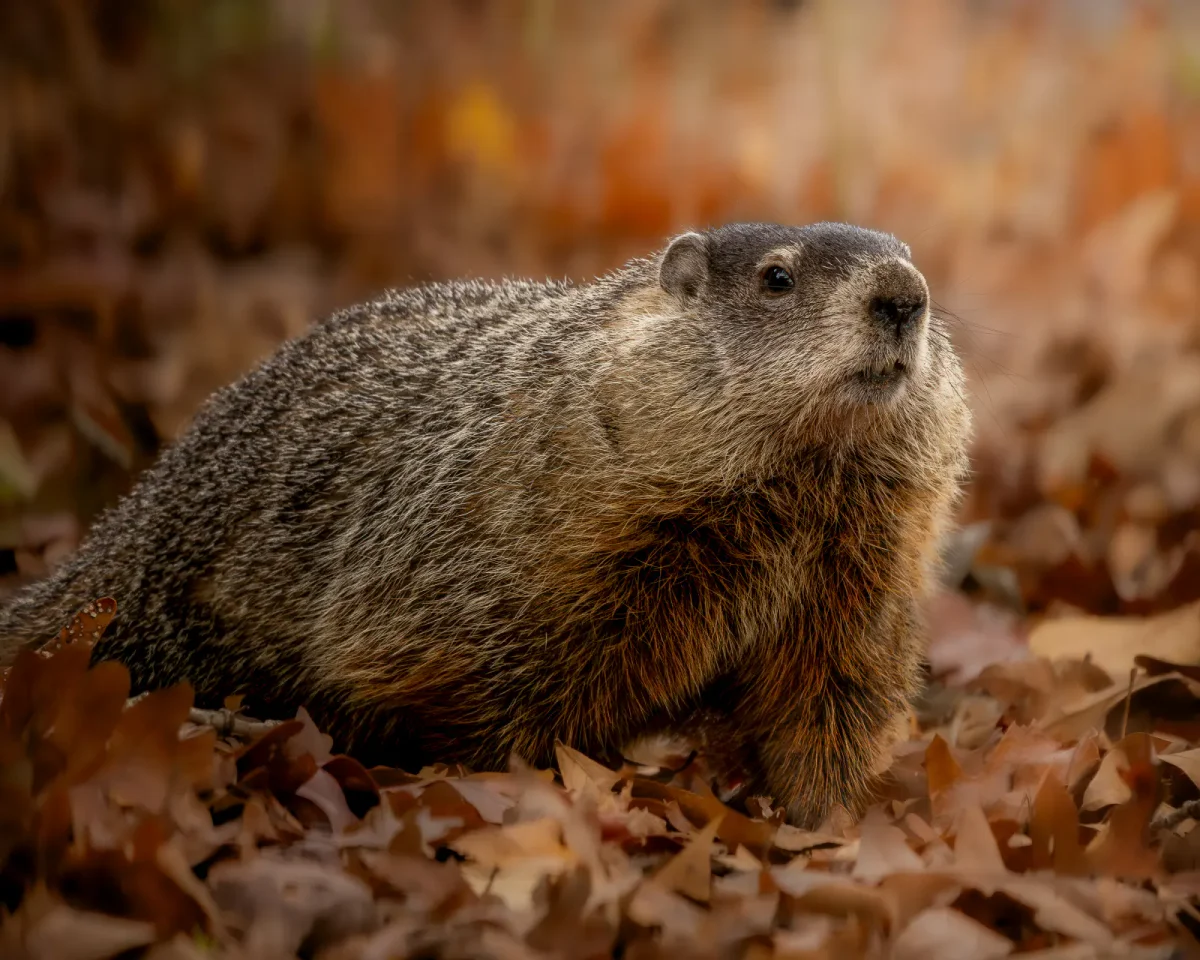
The groundhog is one of the best known true hibernators. In the fall it stops eating, enters its winter burrow and plugs the tunnel behind it with soil. In the northern part of its range it hibernates from about October to March, and in the south the season is shorter. During deep hibernation its body temperature falls from about 37 °C to only a few degrees above freezing, its heart slows from around 80 beats a minute to as few as 4 or 5, and it breathes only a couple of times a minute. Hibernation is not one continuous sleep, though. Every week or two the groundhog warms up for a short time before sinking back into torpor, and these arousals use much of its stored energy. By spring it has lost roughly a quarter to a third of its body weight. In late winter the males wake first and visit the burrows of nearby females, weeks before mating begins, and then go back to sleep. Most groundhogs come out for good in March and live on their fat until fresh plants start to grow.
Reproduction and Young
Groundhogs mate in early spring, soon after they come out of hibernation, usually in March or April, and they have one litter a year. After a pregnancy of about a month, usually 30 to 32 days, the female gives birth in a grass lined nest chamber deep in her burrow, in April or May. A litter typically has two to six young, most often four or five. The newborns, sometimes called kits or pups, are blind, hairless and helpless, and they weigh only about 25 to 30 grams. Their eyes open at around four weeks, and at about six weeks they start coming out of the burrow to eat plants near the entrance while their mother keeps watch. By midsummer the young leave to dig burrows of their own, often nearby, and many move into old burrows left by other groundhogs. Males play no part in raising them. In most of the range groundhogs do not breed until their second spring. In the wild they usually live two to three years and a few reach six, while groundhogs in zoos can live more than ten years.
Groundhog Day
Every February 2, crowds gather near Punxsutawney, Pennsylvania, to see whether a groundhog named Punxsutawney Phil sees his shadow. According to the tradition, if he does, there will be six more weeks of winter, and if he does not, spring will come early. The custom grew out of Candlemas, a Christian feast held on the same date, and old European beliefs that the weather on that day foretold the rest of winter. German immigrants in Pennsylvania brought the idea with them, and the badger of their homeland was replaced by the local groundhog. The first official celebration at Gobbler's Knob, near Punxsutawney, took place in 1887. Canada has its own forecasters, including Wiarton Willie in Ontario, Shubenacadie Sam in Nova Scotia and Fred la Marmotte in Quebec. As weather forecasters, groundhogs are not reliable: studies of Phil's record find him right about as often as a coin toss, or less. Biologically, though, early February is roughly when male groundhogs first stir from hibernation.
Population and Conservation
The IUCN lists the groundhog as Least Concern, with a stable population, in its most recent assessment from 2016. It has a huge range, adapts well to farmland and suburbs, and is common across most of eastern North America, although no one has estimated its total numbers. Groundhogs are hunted legally in many states and provinces, and many are killed by cars or removed because they damage crops, gardens and lawns, or because their burrows can weaken foundations and injure livestock or damage farm machinery. None of this threatens the species as a whole. Groundhogs can carry rabies, and in the eastern United States they are the wild rodents most often found with the disease, although cases are still rare and attacks on people are unusual. The groundhog is also important to medicine. It can be infected by a virus closely related to human hepatitis B, and for decades scientists have studied infected groundhogs to understand liver disease and to test new treatments.
Where it is found
The Groundhog can be found in places such as: