Striped Skunk
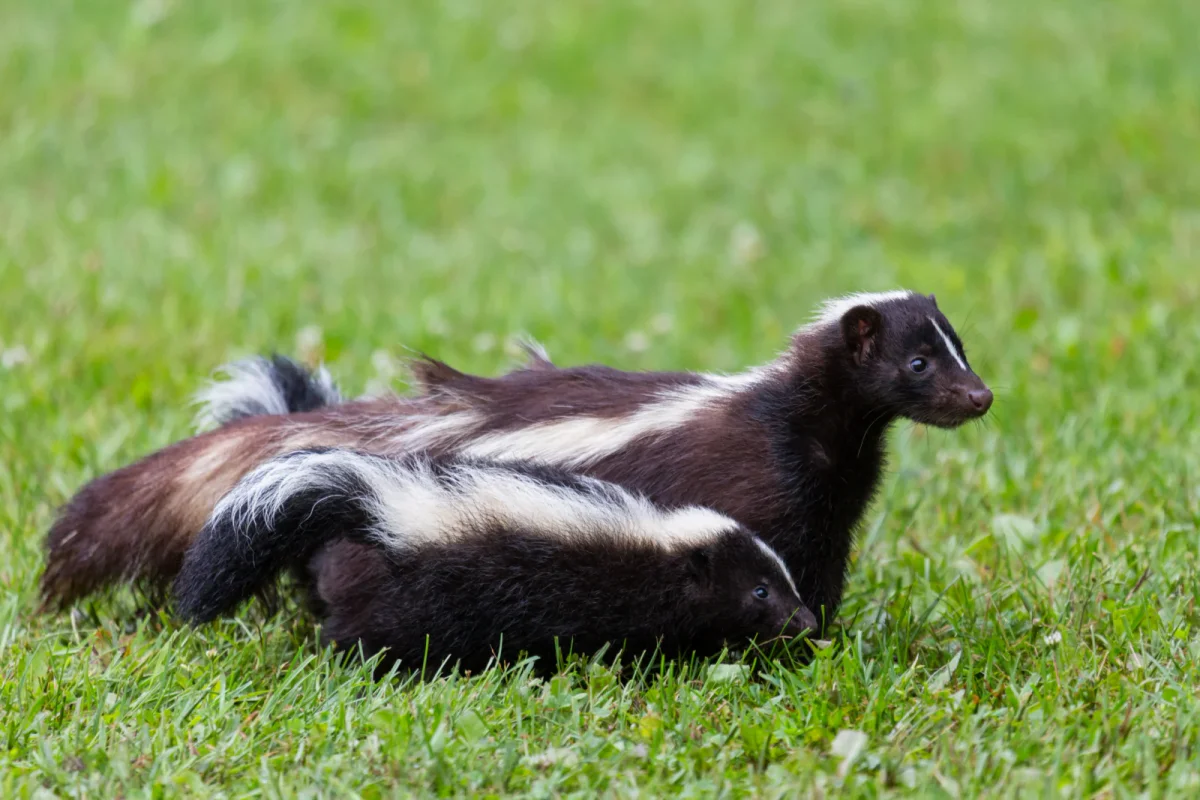
The striped skunk (Mephitis mephitis) is the most common and widespread skunk in North America, found from southern Canada across almost all of the United States to northern Mexico. It is about the size of a house cat, with a stocky body, short legs and a long, bushy tail. Its fur is black with a thin white stripe down the forehead and a broad white band on the neck that splits into two stripes along the back. These bold colors warn predators that the skunk can defend itself with a foul smelling spray, which it shoots from two glands under the tail. The striped skunk lives in woodland edges, grasslands, farmland and towns, often close to water. It is mostly active at night and eats insects, grubs, small rodents, eggs, fruit and almost anything else it can find. In winter it shelters in dens and sleeps through the coldest weather. It is also an important carrier of rabies. The IUCN lists the species as Least Concern.
Skunks and Their Relatives
Skunks were long classified as members of the weasel family, but genetic studies in the 1990s showed that they form a separate family, Mephitidae. The family takes its name from the Latin word mephitis, meaning a foul smell, and the striped skunk carries it twice in its scientific name. There are about a dozen species of skunks. Most live in the Americas: the striped and hooded skunks of North America, the small spotted skunks, famous for doing handstands before they spray, and the hog nosed skunks that range south to Argentina. The only skunks outside the Americas are the two stink badgers of Indonesia and the Philippines. The striped skunk is the largest and best known member of the family and the one most people picture when they hear the word skunk. The English name comes from an Algonquian word used by Indigenous peoples of the northeast. In Mexico skunks are called zorrillos, which means little foxes.
Size and Appearance
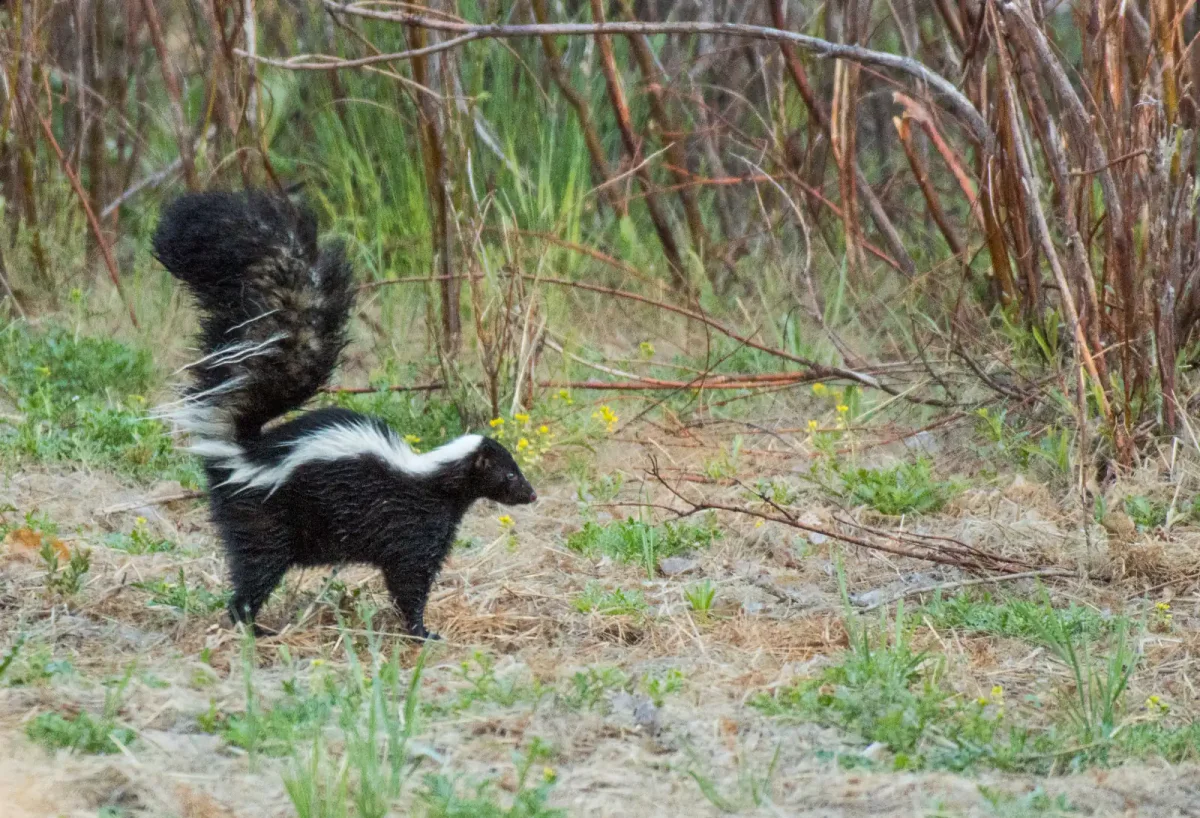
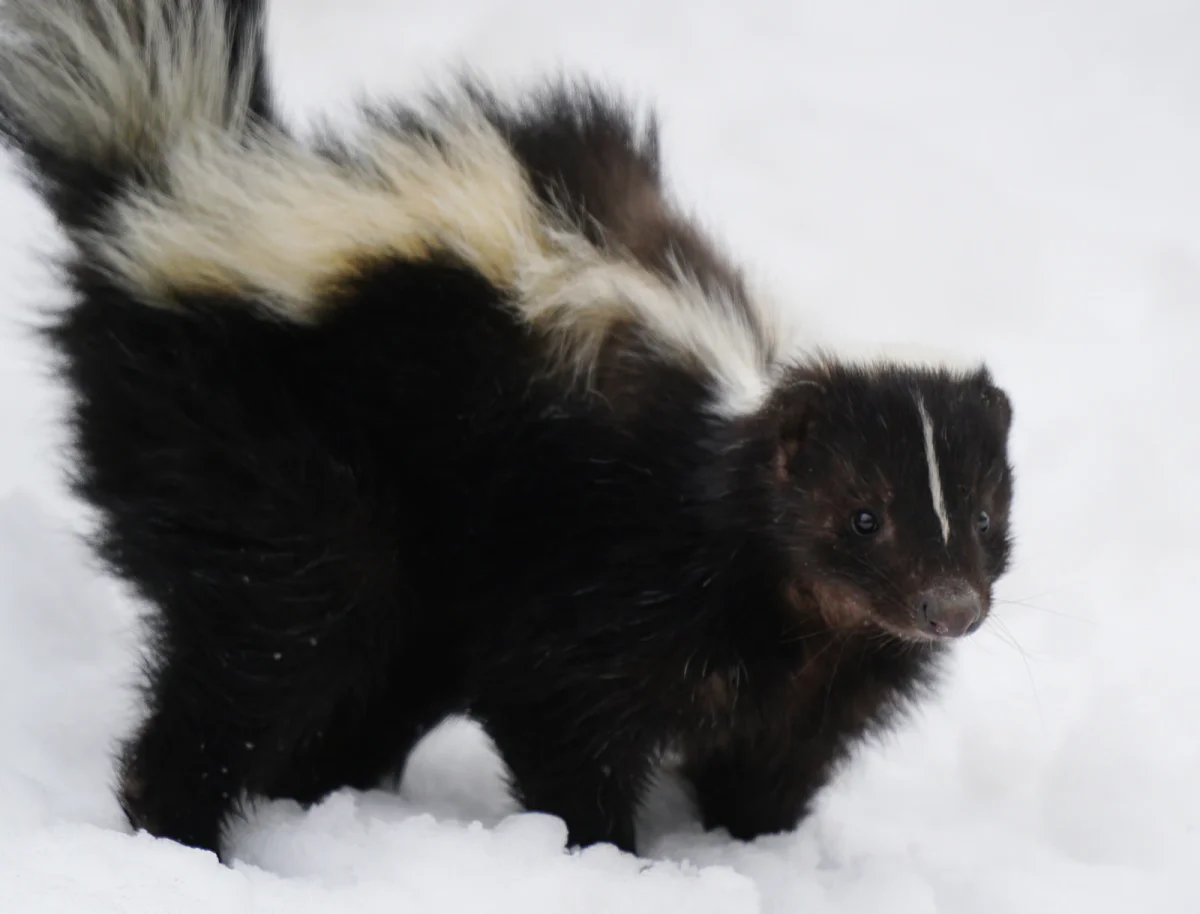
The striped skunk is about the size of a house cat. Including its tail, it usually measures 50 to 80 centimeters, and the tail alone makes up roughly a third of that length. Most adults weigh between 1.5 and 4.5 kilograms. Males are larger than females, and skunks are heaviest in the fall, when they have built up fat for the winter. The body is stocky, with a small, pointed head, small ears, short legs and long, strong front claws made for digging. The black and white pattern is the skunk's trademark. A thin white stripe runs from the nose up between the eyes, and a white patch on the back of the head splits into two broad stripes that run along the sides of the back and often join again near the tail. The amount of white varies a lot from one skunk to another. Some are almost all black, while others have so much white that the back looks white with black edges. These bold colors are a warning, not camouflage.
Habitat and Range
The striped skunk has one of the widest ranges of any North American mammal. It lives across southern Canada, from Nova Scotia to British Columbia and north into the forests of the prairie provinces, throughout almost all of the lower 48 United States, and south into northern Mexico. It is absent from Alaska, Hawaii and the driest parts of the southwestern deserts. It is found from sea level up to about 1,800 meters. The striped skunk prefers mixed landscapes rather than deep forest: woodland edges, brushy fields, grasslands, farmland, river valleys and the borders of marshes, usually within a few kilometers of water. It has adapted extremely well to people and is common in suburbs and even cities, where it finds food in lawns, gardens, pet bowls and garbage. For shelter it uses burrows dug by other animals, such as woodchucks and foxes, or digs its own, and it also moves into hollow logs, rock piles, woodpiles and the spaces under porches, decks and sheds.
Diet
The striped skunk is an omnivore with a very flexible diet that changes with the seasons. In spring and summer insects make up most of its food. It eats huge numbers of grasshoppers, crickets, beetles, bees and wasps, and it digs up beetle grubs and other larvae from the soil, leaving small cone shaped holes in lawns and fields. It also catches mice, voles, shrews, moles and young rabbits, along with frogs, lizards, snakes, earthworms and crayfish. Skunks are well known nest raiders and eat the eggs of ground nesting birds and turtles. In late summer and fall they add more plant food, such as berries, grapes, apples, corn and nuts, and they also feed on carrion. Near people they eat pet food, birdseed and garbage. A skunk forages slowly at night with its nose to the ground, using its sense of smell and hearing more than its eyesight, which is poor. By eating many insects and rodents, skunks help control crop pests, although their digging can damage lawns and golf courses.
The Famous Spray
A skunk's spray comes from two scent glands on either side of the anus, each with a small nozzle that the skunk can aim. The oily, yellowish liquid is made mostly of sulfur compounds called thiols, which humans can detect in tiny amounts. It also contains related compounds that smell less at first but slowly turn into thiols when they get wet, which is why the smell comes back when a sprayed dog gets a bath. A skunk can hit a target fairly accurately at about 3 meters, and the smell can carry much farther on the wind. Spraying is a last resort. The glands hold only enough for about five or six sprays, and refilling them can take a week or more, leaving the skunk defenseless in the meantime. So it gives plenty of warning first: it faces the threat, stamps its front feet, hisses, raises its tail and may make short false charges. Only if that fails does it twist its body into a U shape and spray. Most predators learn the lesson after a single encounter.
Behavior and Winter
Striped skunks are mostly solitary and nocturnal. They spend the day asleep in a den and come out around dusk to forage, often walking the same routes night after night. They are not fast runners and seldom climb, so instead of fleeing they rely on their warning colors and their spray. This works against most animals, from coyotes and foxes to bobcats and dogs. The great horned owl is the main exception: it hunts skunks often, perhaps because owls have a poor sense of smell, and it attacks from above without warning. Cars kill far more skunks than any predator. Skunks do not truly hibernate. In the northern part of their range they put on fat in the fall and spend the coldest weeks of winter in a den, sleeping for long periods and sometimes dropping their body temperature in a state called torpor. On mild nights they come out briefly to feed. Females often share winter dens, sometimes in groups of several animals, and huddle together to save energy, while males usually den alone.
Reproduction and Young
Striped skunks mate in late winter, usually from February to March, and males travel widely in search of females during this season. Pregnancy lasts about two months, between 59 and 77 days, because development may pause for a short time before the embryo attaches. The young, called kits, are born in May or early June in a den lined with leaves and grass. A litter usually has four to seven kits, though it can range from two to ten. At birth they weigh only about 30 grams and are blind and almost hairless, yet the black and white pattern is already visible on their skin. Their eyes open at about three weeks, and their scent glands start working soon after, although they cannot spray well until they are older. At around six or seven weeks the kits leave the den with their mother and follow her in a line on her nightly foraging trips. They become independent in late summer. Life is short for most skunks: many die in their first year, and few wild skunks live more than three years.
Skunks and People
Because they thrive in suburbs, striped skunks often live right next to people, and most encounters end with nothing worse than a strong smell. Dogs are sprayed far more often than humans. Tomato juice is a popular remedy, but it mostly masks the odor. A mixture of hydrogen peroxide, baking soda and a little dish soap works much better because it breaks down the thiols chemically, although it must be used right away and never stored in a closed container. The more serious concern is rabies. Skunks are one of the main wild carriers of the disease in North America, along with raccoons, foxes and bats, and they maintain their own strains of the virus across much of the Midwest, the Great Plains and California. A skunk that is active in daylight, acts confused or shows no fear can be a warning sign. Skunks are also sometimes kept as pets after their scent glands are removed, but this is illegal in many states and provinces, partly because of the rabies risk.
Population and Conservation
The IUCN lists the striped skunk as Least Concern, with a stable population, in an assessment from 2015. It has an enormous range and is common almost everywhere it lives. No one has estimated its total population, but in good habitat there can be several skunks per square kilometer. The species has actually benefited from the clearing of forests and the spread of farms and suburbs, which created the open, mixed landscapes it prefers. Its numbers can drop sharply in some areas during outbreaks of rabies or distemper, but they recover quickly thanks to large litters. The main causes of death linked to people are traffic, trapping and control in places where skunks damage property or raise rabies concerns. Skunks were once trapped in large numbers for their fur, which was often sold under the name Alaska sable, but the fur trade has declined greatly. Today striped skunks play a useful role by eating insects, rodents and carrion in both wild and urban areas.
Where it is found
The Striped Skunk can be found in places such as: