Andean Cock of the Rock
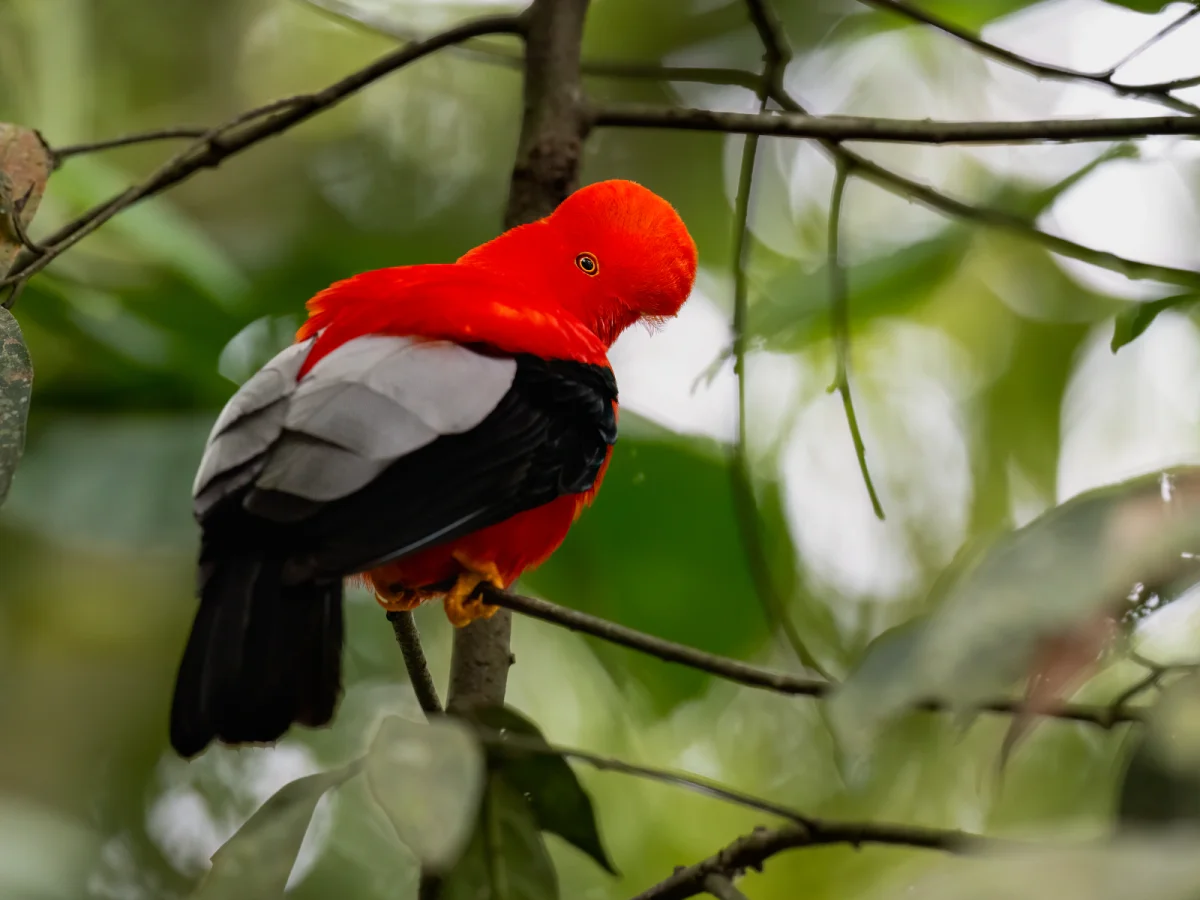
The Andean cock of the rock (Rupicola peruvianus) is a striking bird of the cloud forests of the Andes and the national bird of Peru, where it is also known by its Quechua name, tunki. The male is unmistakable: its head and body are brilliant orange or deep red, with a large rounded crest that hides its bill, and black wings and tail with a pale gray patch on the back. The female is a duller brownish orange with a much smaller crest. It is about 32 centimeters long and lives in humid forest ravines and along rushing mountain streams from western Venezuela through Colombia, Ecuador and Peru to Bolivia, mostly between 500 and 2,400 meters. It feeds mainly on fruit, with some insects, frogs and small lizards. Males gather at traditional display sites called leks, where they bow, jump and call loudly to attract females. The female builds a mud nest on a rock face and raises the chicks alone. The IUCN lists the species as Least Concern, although its numbers are slowly falling.
Names and Relatives
The name cock of the rock comes from the bird's crest, which recalls a rooster's comb, and from the female's habit of nesting on rock faces. Its scientific name, Rupicola, means rock dweller. In Peru it is called gallito de las rocas, or tunki in Quechua, and it was declared the country's national bird in 1941. In Ecuador it is known as gallo de la peña and in Colombia as gallito de roca. It belongs to the cotinga family, a group of tropical American birds that includes some of the most colorful and unusual species on the continent. Its closest relative is the Guianan cock of the rock, an orange bird of the forests of the Guiana Shield and the northern Amazon, which also displays at leks. Four subspecies of the Andean cock of the rock are recognized. They differ mostly in the color of the male, from bright orange on the eastern slopes of the Andes to a deep blood red in the western Andes of Colombia and Ecuador.
Size and Appearance
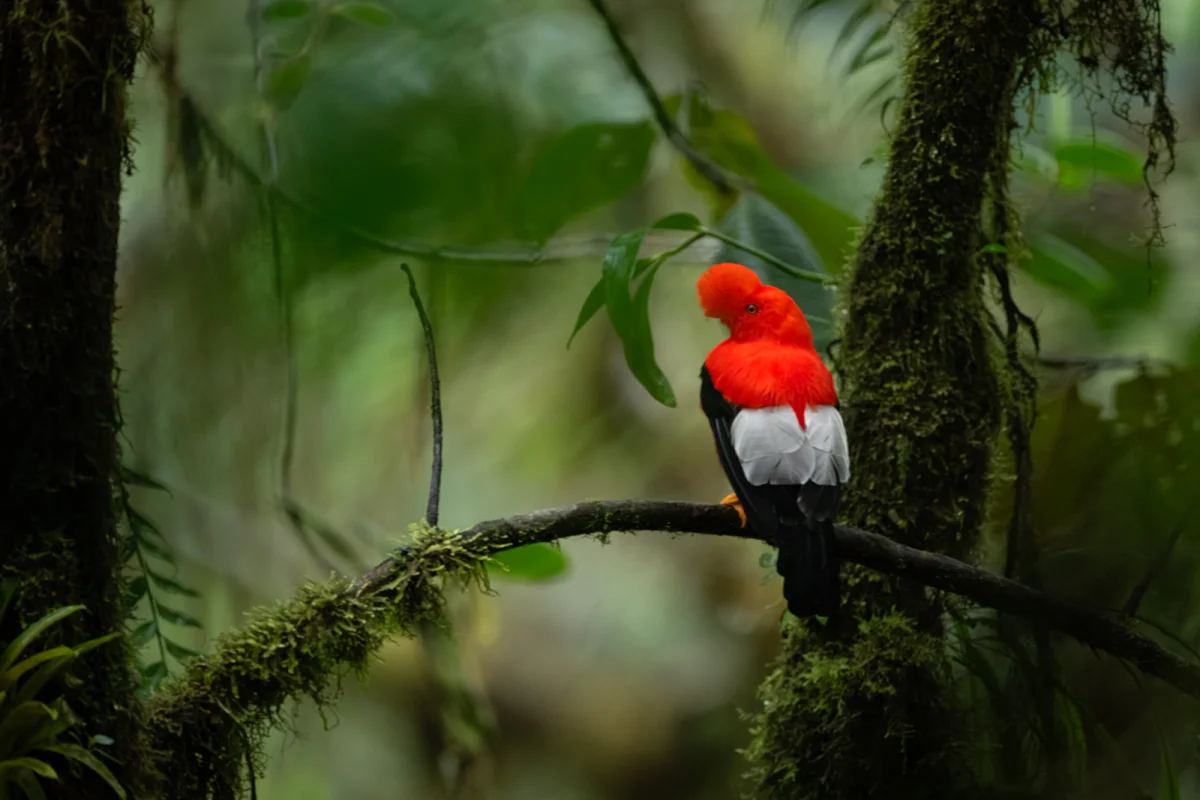
The Andean cock of the rock is a stocky bird about 30 to 33 centimeters long. Males are the heavier sex, at around 265 grams, while females weigh about 215 to 225 grams. The adult male is one of the most spectacular birds in South America. Its head, neck and body are covered in dense, brilliant orange or scarlet feathers, and a tall, flattened crest of the same color sits on top of the head and reaches forward over the bill, so that the bill is almost hidden. The wings and tail are black, and a broad patch of pale gray feathers covers the lower back, standing out sharply against the orange. The eyes are yellow to red, and the legs and feet are orange. Females look very different. They are dark brownish orange or maroon, with a much smaller crest and duller wings, colors that help them stay hidden while sitting on the nest. Young males start out looking like females and gain their bright plumage gradually as they mature.
Habitat and Range
The Andean cock of the rock lives only in the Andes of South America. Its range stretches from the mountains of western Venezuela through all three Andean ranges of Colombia, along both slopes of the Andes in Ecuador, and down the eastern slope of the Andes through Peru to central Bolivia. It is a bird of humid montane forest and cloud forest, usually between about 500 and 2,400 meters above sea level, where mist and rain keep the trees covered in moss, ferns and orchids. Within these forests it is closely tied to steep ravines and gorges with fast flowing streams and waterfalls, since the females need damp rock faces and cliffs to build their nests. Birds spend most of their time in the middle and lower levels of the forest and are often seen flying across rivers or perching on branches above the water. Because it depends on these narrow belts of mountain forest, the species is sensitive to forest clearing, which can isolate populations in separate valleys.
Diet
Fruit makes up most of the Andean cock of the rock's diet. It eats a wide variety of forest fruits, especially those of the laurel family, which includes wild relatives of the avocado, as well as fruits from the custard apple and coffee families and many others. It usually picks fruit while flying up to a branch or hovering briefly in front of it, then returns to a perch to swallow it. Fruits are swallowed whole, and the large seeds are later dropped or brought back up, often far from the parent tree. Besides fruit, it also takes insects and other small animals, and frogs and small lizards have been recorded in its diet. Animal food is thought to be especially important for growing chicks, which need extra protein. Cocks of the rock often feed alone or in small groups, and they sometimes join other fruit eating birds at trees that are full of ripe fruit. Because so many of their meals come from forest trees, they depend on large areas of healthy forest to find food all year.
Courtship Display
The Andean cock of the rock is famous for its courtship display. Males gather at traditional display sites called leks, usually in the forest near a ravine, where they may perform for years in the same place. A lek can hold up to around 15 males, each with its own display perch a few meters from its neighbors, and males often display in pairs facing a rival. Activity peaks in the early morning and again in the late afternoon. When a female arrives, the males burst into action: they bow deeply, hop from side to side, jump, flap their wings, snap their bills and fill the forest with loud squawks and grunts that can be heard from far away. The female watches from a nearby branch and chooses a mate, then leaves to nest on her own. The males take no part in building the nest or raising the young. As in other lek birds, a few males are thought to win most of the matings, while many others display for long periods with little success.
Nesting and Young
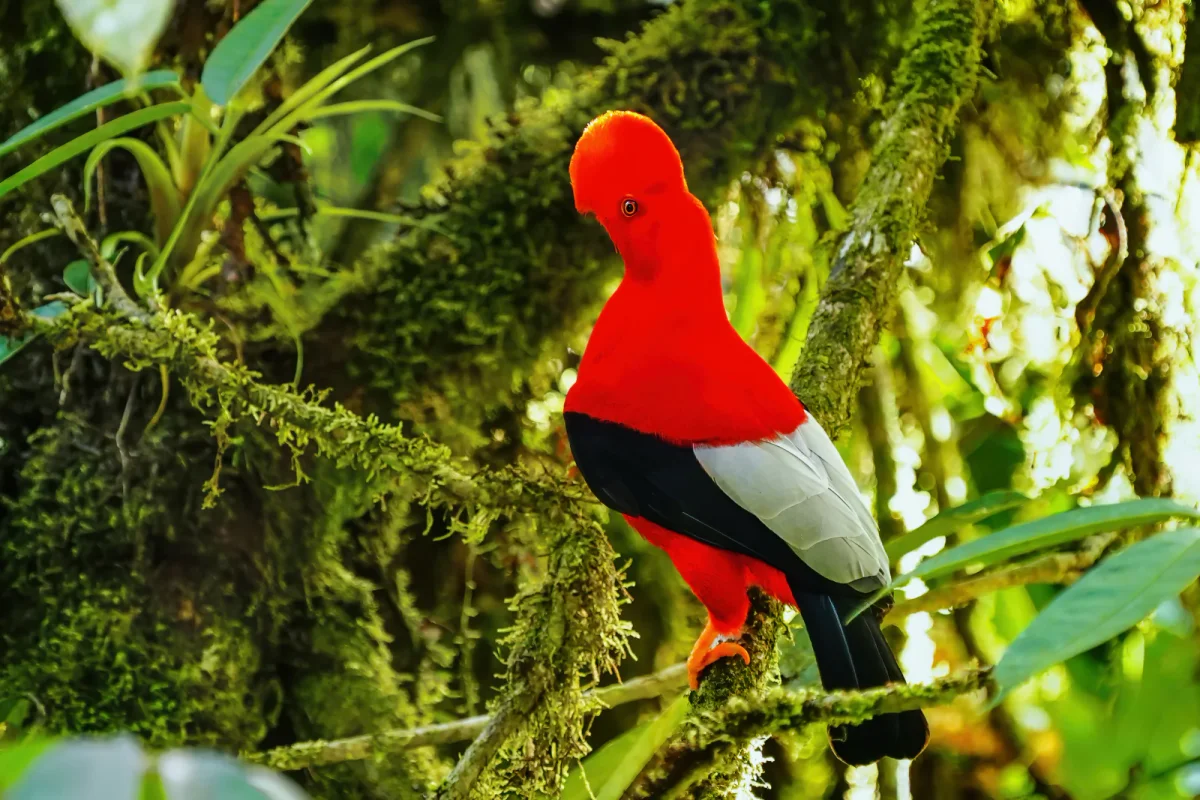
After mating, the female does all the work of raising a family. She chooses a sheltered spot on a damp rock face, the wall of a ravine, a ledge under an overhang or the entrance of a small cave, often near a stream or waterfall where the air stays moist. There she builds a cup shaped nest of mud mixed with plant material, plastered firmly onto the rock. Several females may nest on the same cliff, close to one another. The usual clutch is two eggs, which she incubates alone for about 28 days. The chicks hatch helpless and are fed by their mother with fruit and small animals until they are ready to leave the nest. Nesting on bare rock above water keeps the eggs and chicks out of reach of many predators, and the female's dark, dull colors help her stay hidden while she sits on the nest. Because each female raises only a small brood, and young males take time to gain their adult plumage, the population grows slowly.
Conservation and Where to See Them
The IUCN lists the Andean cock of the rock as Least Concern because it has a large range, but its population is thought to be slowly decreasing. The main threat is the loss of montane forest, cleared for farming, cattle, roads and mining along the slopes of the Andes. Birds are also sometimes captured illegally for the pet trade. At the same time, the species has become one of the stars of birdwatching tourism in the Andes, and protecting leks brings income to local communities. Some of the best known places to watch the display are the Paz de las Aves reserve near Mindo in Ecuador, where a local family began showing visitors a lek on their farm, the leks near the town of Jardín in Antioquia, Colombia, and the road down from the Andes into Manu National Park in Peru. In Peru the bird also appears near Machu Picchu. Visits are usually at dawn, when the males are most active, and quiet watching from a set distance keeps the birds from being disturbed.