Common Krait
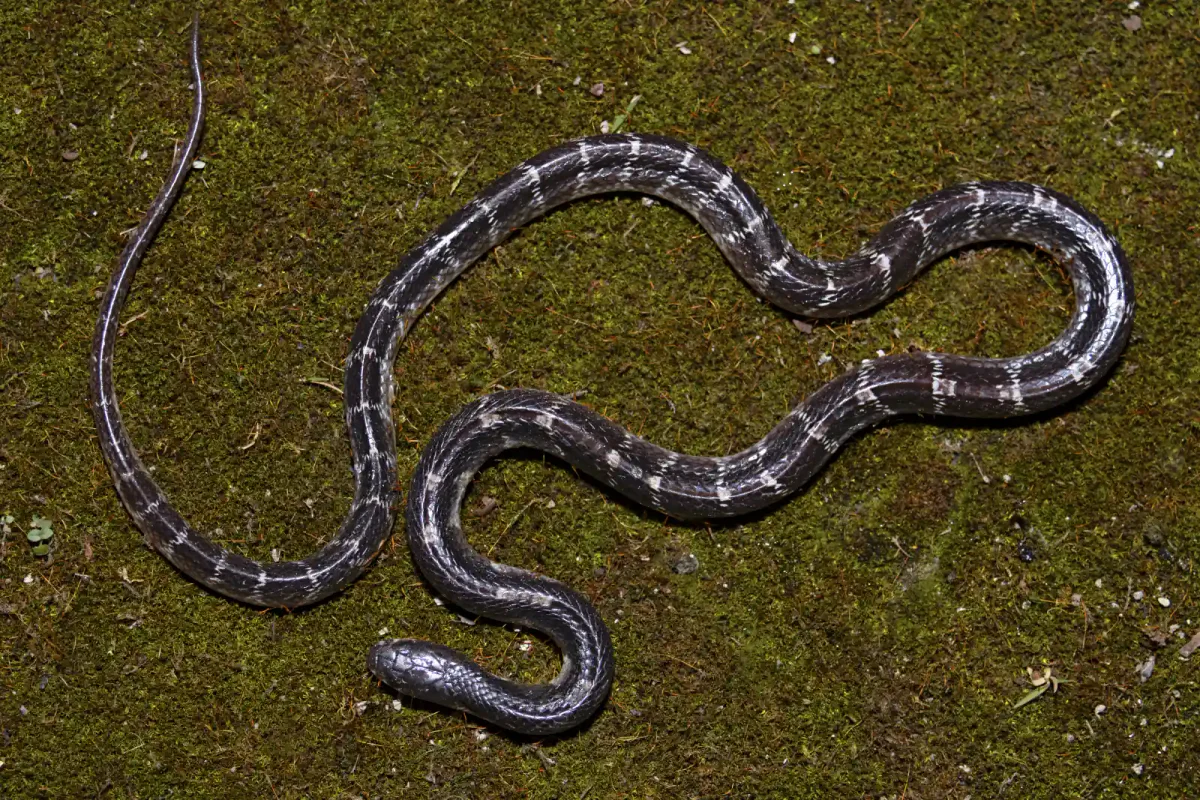
The common krait (Bungarus caeruleus), also called the Indian krait or blue krait, is a highly venomous elapid snake of South Asia, found across India, Sri Lanka, Pakistan, Nepal and Bangladesh. Adults usually measure about 90 centimeters and have glossy black or bluish black scales crossed by thin white bands, often in pairs. It lives in grassland, scrub, farmland and villages, often near water, and hides by day in rat burrows, termite mounds and piles of debris. At night it hunts other snakes, including other kraits, as well as rodents, lizards and frogs. The common krait is shy and rarely bites in daylight, but it often enters homes at night, especially in the rainy season, and bites people sleeping on the floor. Its neurotoxic venom is among the most potent of any snake in the region, and the bite is often painless, so victims may not notice it until paralysis begins. It is one of the Big Four snakes of India. The IUCN lists it as Least Concern.
Name and Classification
The common krait belongs to the Elapidae, the family of cobras, mambas, taipans and sea snakes. Within it, it is part of the genus Bungarus, the kraits, a group of about 15 species that live in South and Southeast Asia, including the banded krait and the greater black krait. The German naturalist Johann Gottlob Schneider described it in 1801. Its species name, caeruleus, is Latin for blue, a reference to the bluish shine of its glossy black scales, and it is also called the Indian krait or the blue krait. In India it is one of the Big Four, the four snakes responsible for most serious snakebites in the country, together with the spectacled cobra, Russell's viper and the saw scaled viper. The polyvalent antivenom made in India is produced against the venom of these four species. Several other kraits share parts of its range, such as the greater black krait and Wall's krait in Nepal, and they can be hard to tell apart, especially when they are young.
Size and Appearance
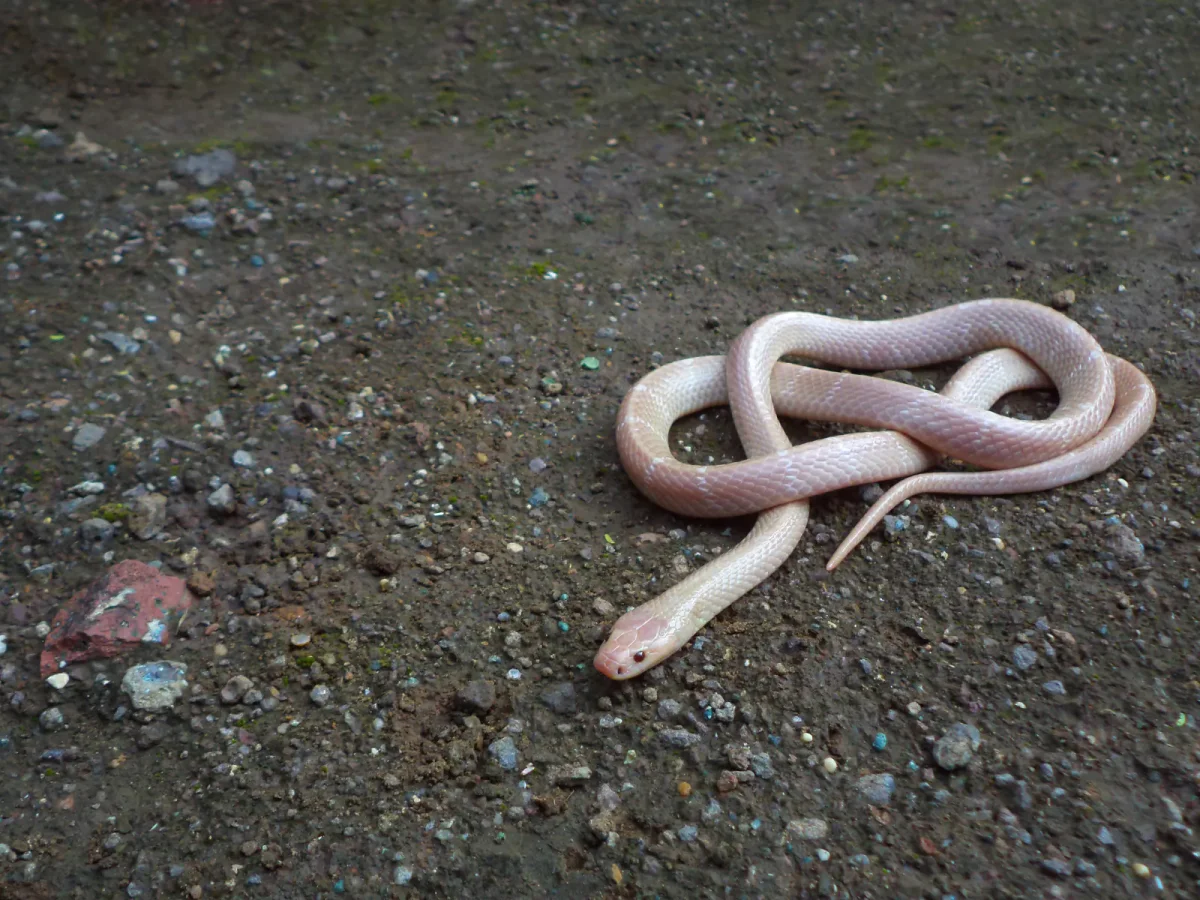
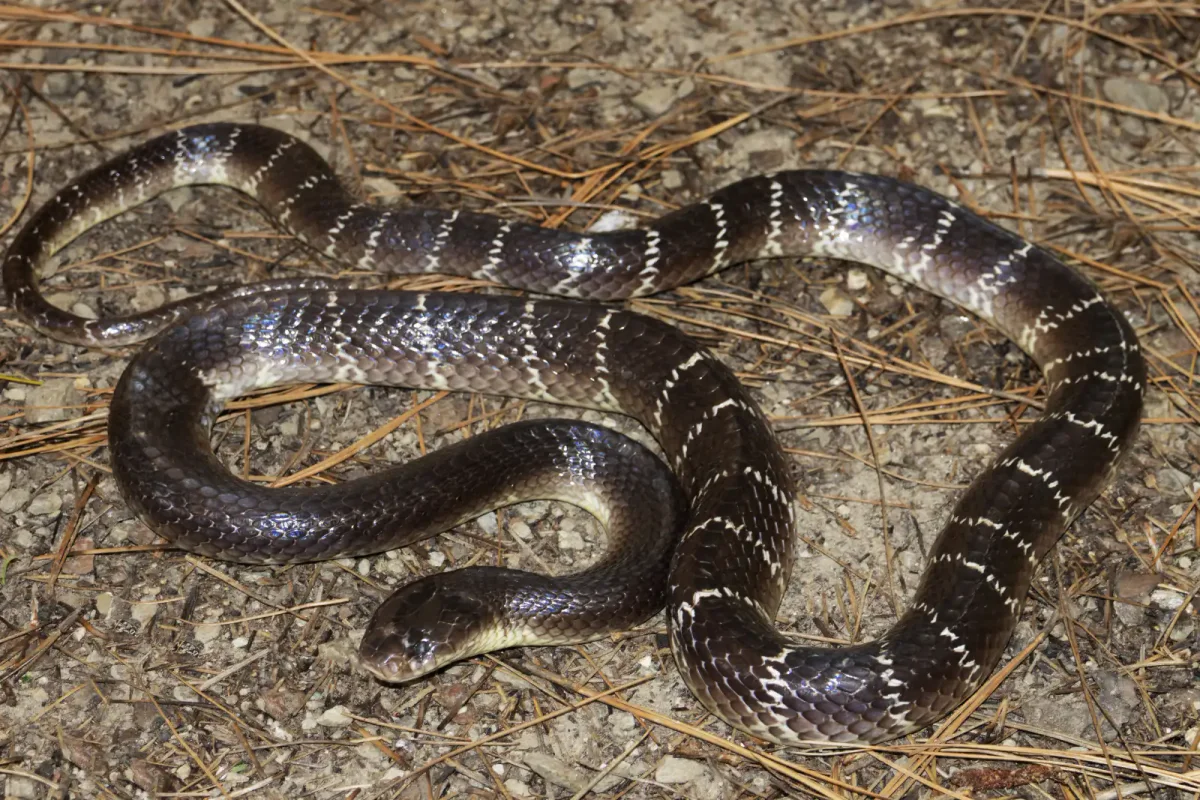
The common krait usually measures about 90 centimeters, and the largest reach about 1.75 meters. Males are longer than females, with proportionately longer tails. The body is slender and round in cross section, tapering to a short tail, and the flat head is barely wider than the neck. The eyes are small and black, so the round pupils are almost impossible to see in life. Its scales are smooth and highly polished, giving the snake a shiny, almost wet look, and the row of scales along the middle of the back is clearly enlarged and six sided. The color is black or bluish black, crossed by about 40 thin white bands that are often narrower toward the head and may fade or disappear there completely. In young kraits the bands are complete and sharp along the whole body, while in old adults they can break up into rows of small white spots. The belly and upper lips are white. Albino common kraits, pale pink or white with dark eyes, have been found but are extremely rare.
Habitat and Range
The common krait is widespread across the Indian subcontinent. It lives throughout India, including the Andaman Islands, and in Sri Lanka, Nepal, Bangladesh and Pakistan, where it reaches west into Sindh. It is a snake of the lowlands and low hills, found from sea level up to about 1,600 meters. Its habitats are varied: scrub jungle, grassland, dry open country, rocky areas, plantations, rice fields and other farmland, village outskirts and suburban gardens. It is often found close to water, such as streams, canals, ponds and the banks of irrigated fields. By day it shelters in rat holes, termite mounds, cracks in the ground, piles of bricks or firewood, and under leaf litter. The common krait adapts very well to land changed by people. Rural areas with crops and grain stores attract rats and the snakes that eat them, and in turn attract kraits. During the monsoon, when burrows flood and prey is active, common kraits often move into houses, sheds and huts looking for shelter or food.
Diet
The common krait is a snake that eats other snakes. Snakes make up the main part of its diet, and it takes many kinds, from tiny blind snakes that live underground to rat snakes and other larger species, including venomous ones such as vipers. It is also a cannibal and readily eats other kraits, including young ones of its own species. Besides snakes, it eats small mammals such as rats and mice, lizards including skinks and geckos, and frogs, and it has also been recorded taking small birds. The common krait hunts at night, moving slowly and steadily as it searches the ground, poking its head into burrows, holes and cracks where other animals hide. Once it bites, its neurotoxic venom quickly paralyzes the prey. This diet explains much of its behavior. The rat holes and termite mounds where kraits shelter are also where many of their prey animals live, and the rodents that gather around homes and grain stores attract both the krait and the snakes it eats.
Behavior
The common krait is strictly nocturnal. It spends the day hidden and inactive in a burrow, termite mound or pile of debris, and comes out after dark to hunt, so most people never see one even where kraits are common. It climbs and swims well. By day it is gentle. If it is uncovered or handled, it usually does not try to bite. Instead it coils loosely, hides its head under the coils of its body, flattens its body and may make sudden jerky movements. Many people in rural South Asia know the krait as a snake that seems almost harmless in daylight. At night it is a different animal: it is active, alert and much more likely to bite when touched or pinned. This is why most krait bites happen in the dark, often between late evening and early morning, and often to people who are asleep. A krait searching a house for prey may slip under a sleeping mat or blanket, and if the sleeper rolls over onto it, the snake bites in defense. Many bites in the region happen during the rainy months.
Venom
The common krait has one of the most potent venoms of any snake in South Asia. It is almost purely neurotoxic, meaning it attacks the nerves rather than the blood or tissue. Its main toxins, the beta bungarotoxins, damage the nerve endings that control the muscles and stop them from releasing the chemical signal that makes muscles contract. This damage cannot be reversed by antivenom once it has happened, and the body has to slowly repair the nerves. Other toxins block muscle receptors. An average bite delivers about 10 milligrams of dried venom, and only a few milligrams are thought to be enough to kill an adult. The fangs are small and the bite often causes little or no pain and almost no swelling, so it may leave no clear mark. Hours later, the victim may feel severe stomach pain, then the eyelids droop, swallowing and speaking get harder, and paralysis spreads until breathing stops. Paralysis can appear up to 12 hours after a bite that seemed harmless.
Bites and Prevention
India has more snakebite deaths than any other country: a national study published in 2020 estimated about 58,000 deaths a year between 2000 and 2019, around half of the world's total. Where the snake was identified, kraits were behind about 18 percent of cases, second only to Russell's viper. In Nepal, the common krait is reported to cause most snakebites in the Terai lowlands, mostly between June and November. Many krait victims are bitten while asleep on the floor of their homes. A study in North Bihar and southern Nepal found that sleeping on the floor made envenoming about six times more likely, while sleeping under a well tucked mosquito net lowered the risk. Raised beds, nets, a torch at night and homes free of rubbish and rats all help. Because the bite can be painless and the danger delayed, anyone who may have been bitten should go to a hospital and be watched for 24 hours. With antivenom and, if needed, a ventilator until the nerves recover, most patients survive.
Reproduction and Conservation
Common kraits lay eggs. Males fight for females in combat displays, twisting their bodies around each other. The female lays a clutch of about 5 to 15 eggs in a hidden spot such as a burrow, a termite mound or deep leaf litter, and has been reported to stay with the eggs until they hatch, which is unusual among snakes. The eggs hatch after about 60 days, and the young are fully independent and venomous from birth, with sharp white bands along the whole body. Young kraits have many enemies, including larger snakes, among them adult kraits and the king cobra, which feeds mostly on other snakes. The IUCN lists the common krait as Least Concern, with a stable population. It is widespread, common in farmland and villages, and adapts well to land changed by people. Its main threats are local: many kraits are killed on sight because they are feared, others die on roads at night, and habitat is broken up in some areas. Kraits also help control rats and other snakes around fields and homes.
Where it is found
The Common Krait can be found in places such as: