Indian Peafowl
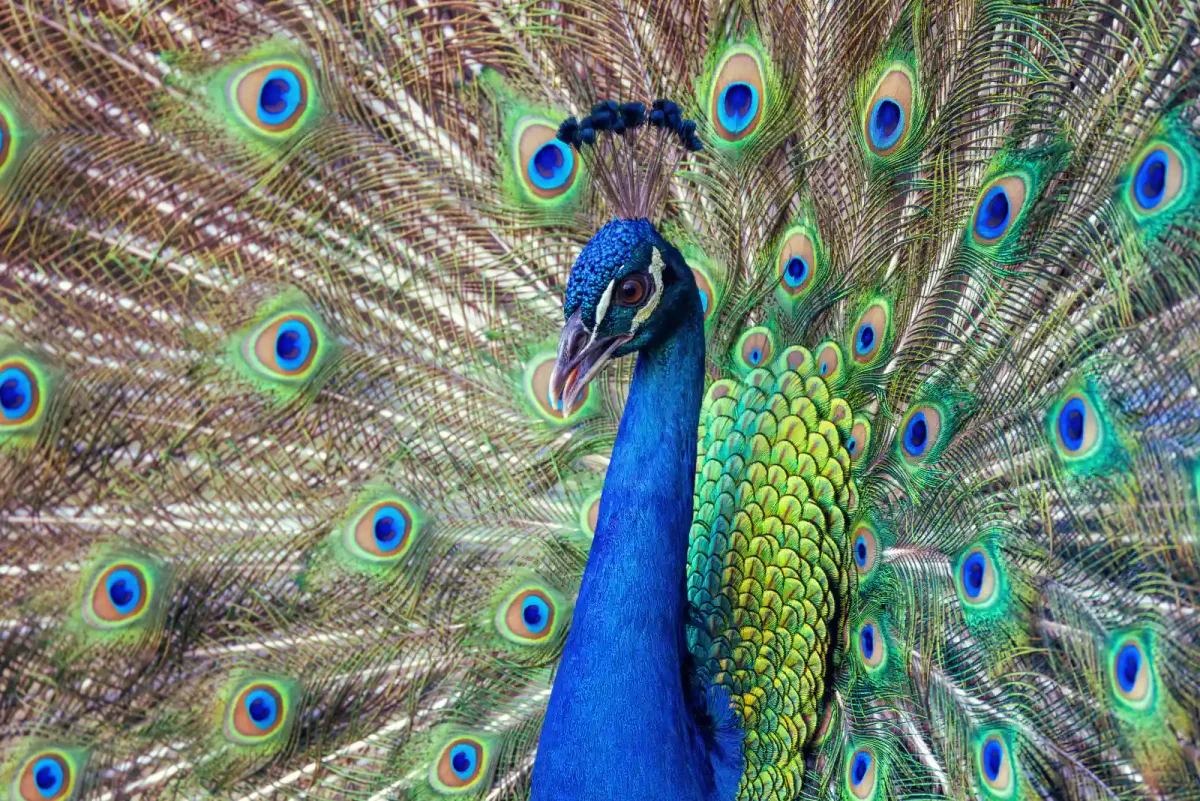
The Indian peafowl (Pavo cristatus) is a large bird of the pheasant family from South Asia, famous for the male's shimmering train. The male, called a peacock, has a bright blue neck and breast and a train of long, green feathers covered in eyespots that he raises into a fan during courtship. With the train, he can measure more than 2 meters from bill to tip. The female, or peahen, is smaller and brown, with a green lower neck and no train. Wild peafowl live in India, Pakistan, Nepal, Bhutan and Sri Lanka, in dry and moist forests, scrub, farmland and around villages, usually close to water. They feed on the ground on seeds, grain, insects, lizards and small snakes, and they fly up into tall trees to sleep at night. Their loud calls carry far and often warn of tigers and leopards. The Indian peafowl is the national bird of India. It has been taken to many other countries, and the IUCN lists it as Least Concern, with a growing population.
Peafowl, Peacocks and Peahens
Peafowl is the correct name for the species as a whole. The male is a peacock, the female is a peahen and the young are peachicks, although many people use peacock for any bird of the species. There are three kinds of peafowl in the world. The Indian peafowl, also called the blue peafowl, is the best known and lives in South Asia. The green peafowl lives in Southeast Asia and parts of China and is listed as Endangered, with a much smaller and shrinking population. The Congo peafowl, a little known and more modest bird, lives only in the rainforests of the Democratic Republic of the Congo. All three belong to the pheasant family, Phasianidae, together with junglefowl, pheasants and the Himalayan monal. The Indian peafowl has been kept by people for thousands of years and was carried to the Mediterranean in ancient times. Today it lives in parks, gardens and zoos on every inhabited continent.
Size and Appearance
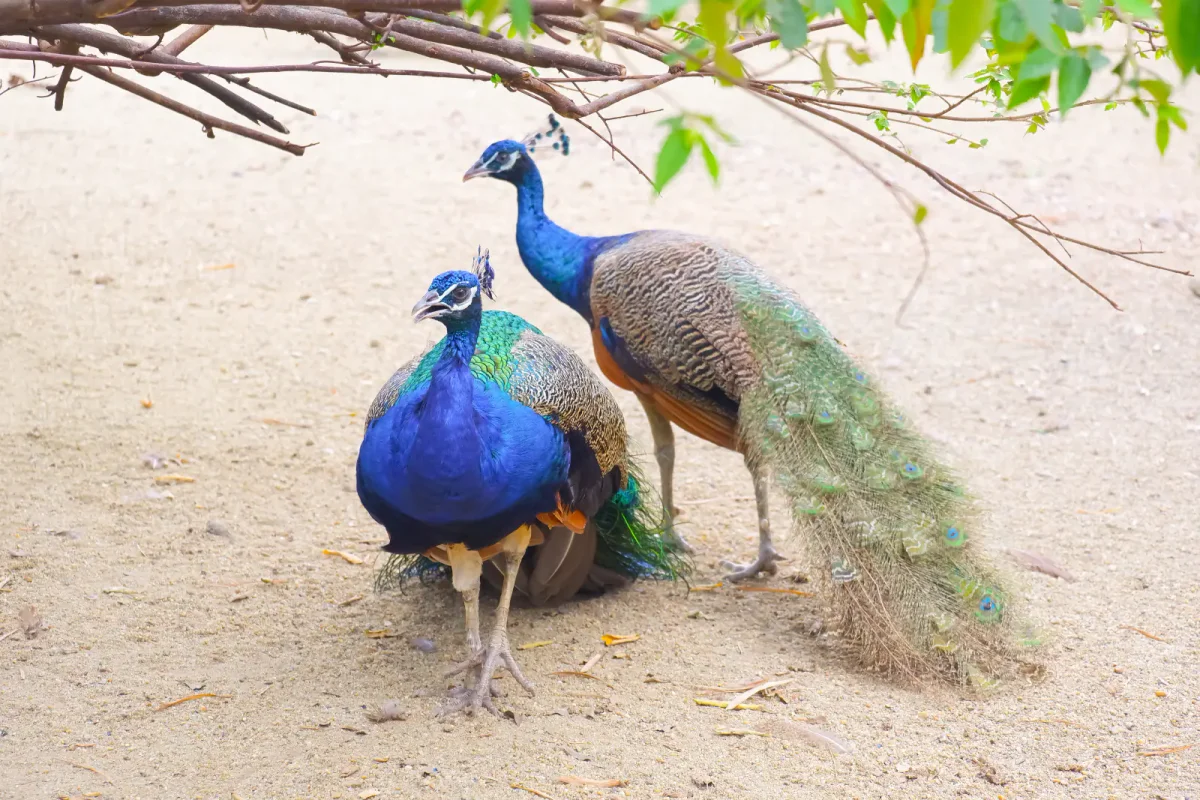
The peacock is one of the largest members of the pheasant family. From bill to tail it measures 100 to 115 centimeters, and a fully grown train can bring the total to about 2.25 meters. Males weigh 4 to 6 kilograms. The famous train is not the tail. It is made of very long upper tail coverts, the feathers that grow above the true tail, and most of them end in a shining eyespot. The short, stiff tail underneath helps hold the train up when the bird raises it. The male's head, neck and breast are deep blue, with a white patch above and below the eye and a fan shaped crest of bare shafts tipped with blue. These colors come mainly from tiny structures inside the feathers that bend light, not from pigment, which is why they shimmer and change with the angle. The peahen is about 95 centimeters long and weighs 2.75 to 4 kilograms. She is brown and gray with a metallic green lower neck and a white belly. Pure white peafowl are a color variety bred in captivity.
Habitat and Range
The Indian peafowl is native to South Asia. Wild birds live across most of India, in the lowlands of Nepal and southern Bhutan, in the Thar Desert and other areas of eastern Pakistan, and in the dry zone of Sri Lanka. In Bangladesh it has disappeared from the wild. It is found from sea level up to about 2,000 meters. Its natural home is dry and moist deciduous forest and scrub with open clearings, usually near rivers, streams or ponds, but it adapts very well to farmland. In much of India peafowl live around fields, orchards, temples and villages, where people often protect them, and they have even spread into towns and city parks. They need tall trees or other high perches for sleeping at night. Outside Asia, people have released peafowl in many places, and wild breeding flocks now live in Hawaii, the southern islands of Japan, parts of Australia including Kangaroo Island, and the North Island of New Zealand.
Diet
The Indian peafowl is an omnivore that eats almost anything it can find on the ground. Plant food makes up much of its diet: seeds, grain, grass shoots, flower buds, berries and fallen fruit. It also hunts a wide range of small animals, including termites, ants, beetles, grasshoppers and other insects, spiders, millipedes, frogs and lizards. It kills and eats small snakes, which is one reason people in parts of India welcome peafowl near their homes and fields. Peafowl usually feed in small groups early in the morning and late in the afternoon, walking slowly and pecking at the ground, and they rest in the shade during the hottest hours. They drink regularly and seldom live far from water. Their liking for grain and vegetables has a cost: as the population has grown in India, farmers in several states report more damage to grain and vegetable crops. On the islands where they were introduced, peafowl also eat native lizards and insects.
Courtship and the Train
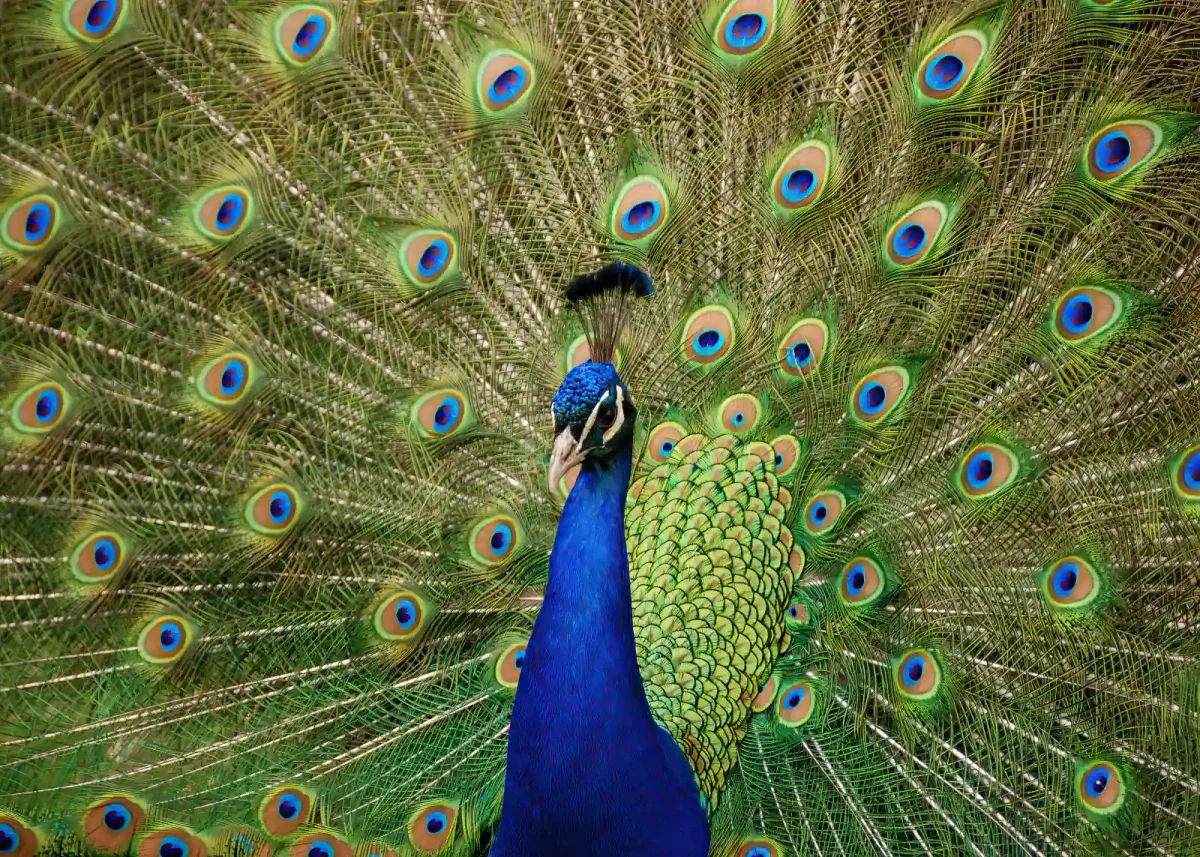
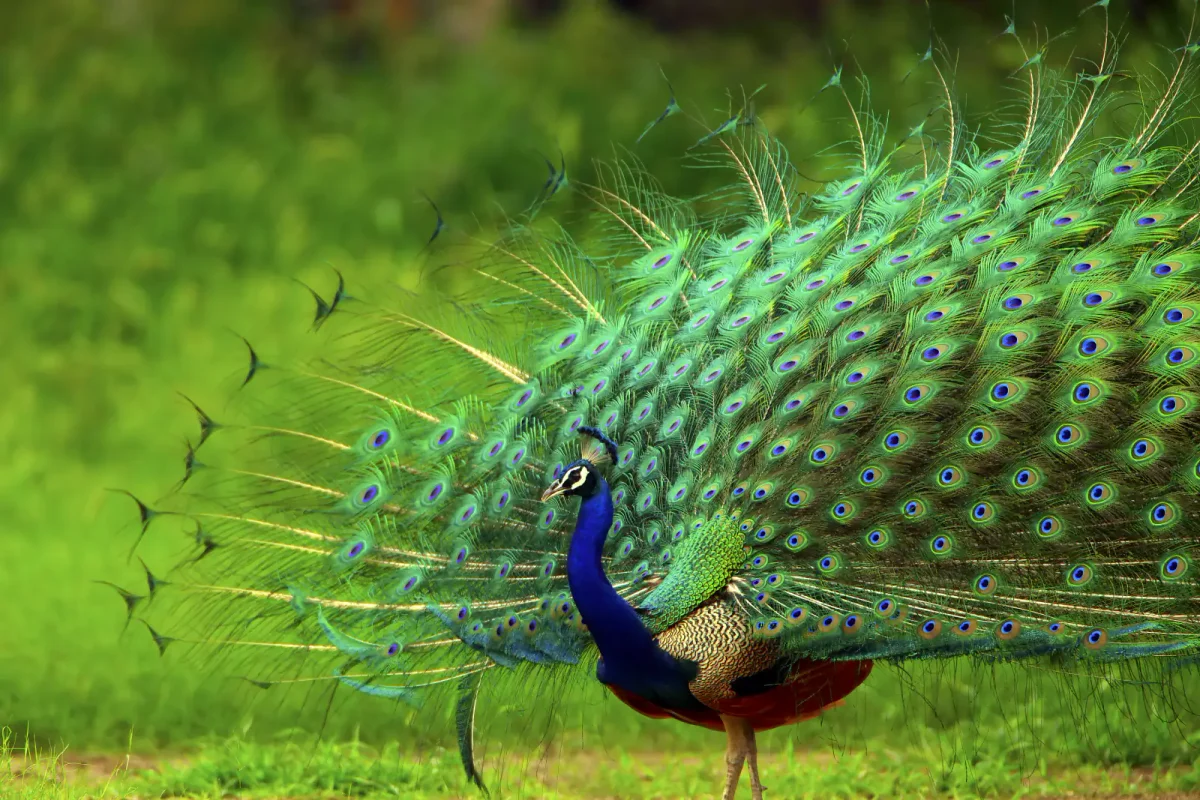
The peacock's train exists to impress females. It is a classic example of sexual selection, Darwin's idea for features that help animals win mates rather than survive. In the breeding season, which in much of India coincides with the monsoon, males claim display spots and wait for peahens. When a female comes close, the male raises his train into a huge fan, turns his back and then swings around to face her. He shakes the feathers about 25 times a second, a movement called train rattling that makes the eyespots shimmer and produces a rustling sound. Scientists have long tested what females look for. Studies of a free living flock at Whipsnade, in England, found that males with longer trains and more eyespots mated more often, while later studies found weaker or mixed effects, so the question is still debated. One male may mate with several females and plays no part in raising the young. After the breeding season, males shed their trains and grow new ones for the following year.
Nesting and Chicks
The peahen raises her young alone. She makes a simple nest in a shallow scrape on the ground, hidden in dense bushes, tall grass or under a hedge, and sometimes on a ledge or the roof of a building. She usually lays three to six pale, buff colored eggs and incubates them for about 28 days. If the clutch is lost, she may lay again. The chicks hatch covered in brown and yellow down and can walk and feed themselves within hours, following their mother as she shows them where to find insects and seeds. They grow flight feathers quickly and can soon flutter up to low branches, which protects them from predators at night. Young males look much like females at first. They begin to grow a train in their second year, and it reaches full length only when the bird is about four years old. Each year the train feathers are shed after the breeding season, usually around August or September in India, and grow back by February or March. Peafowl can live up to about 20 years.
Calls and Daily Life
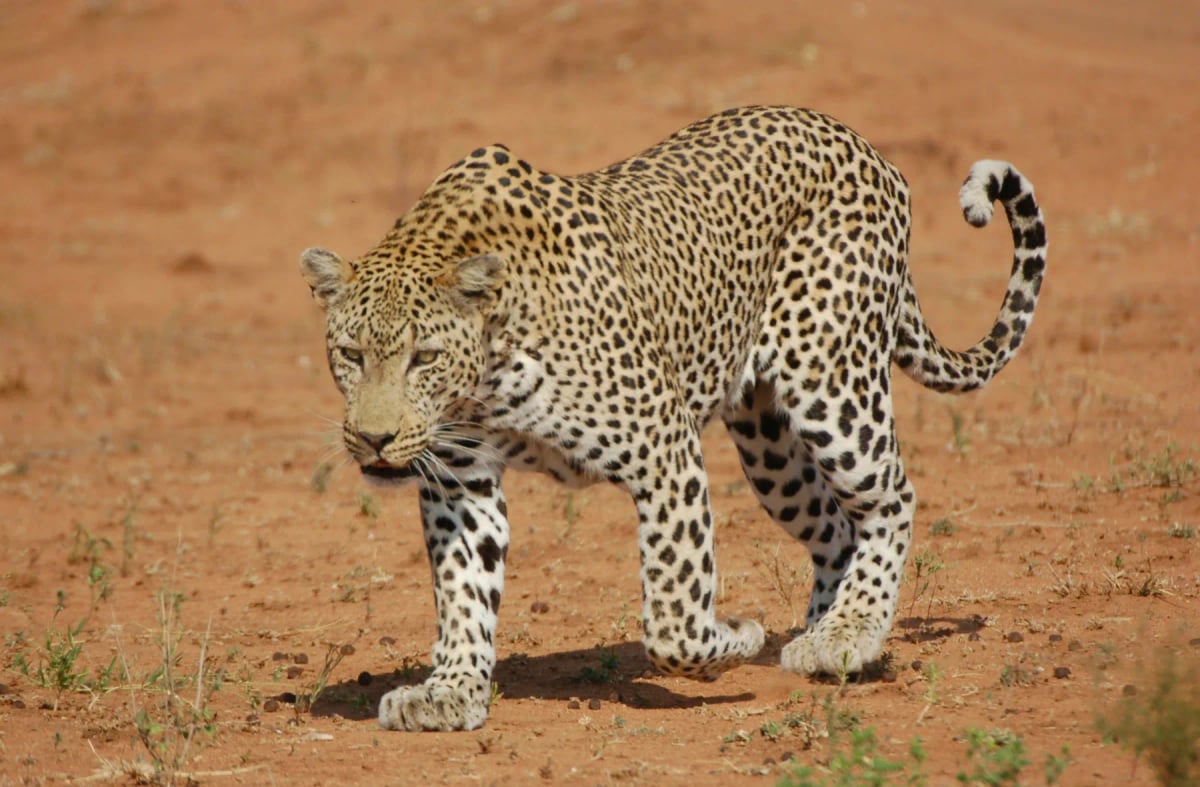
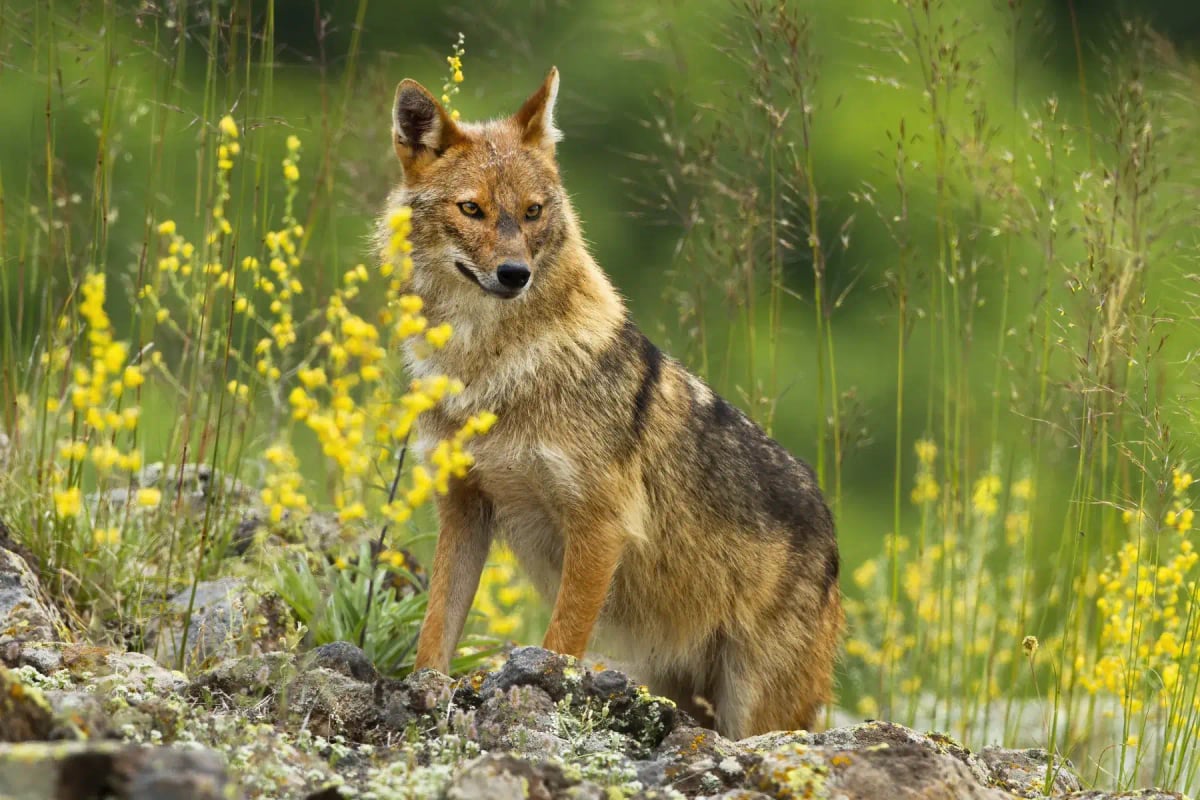
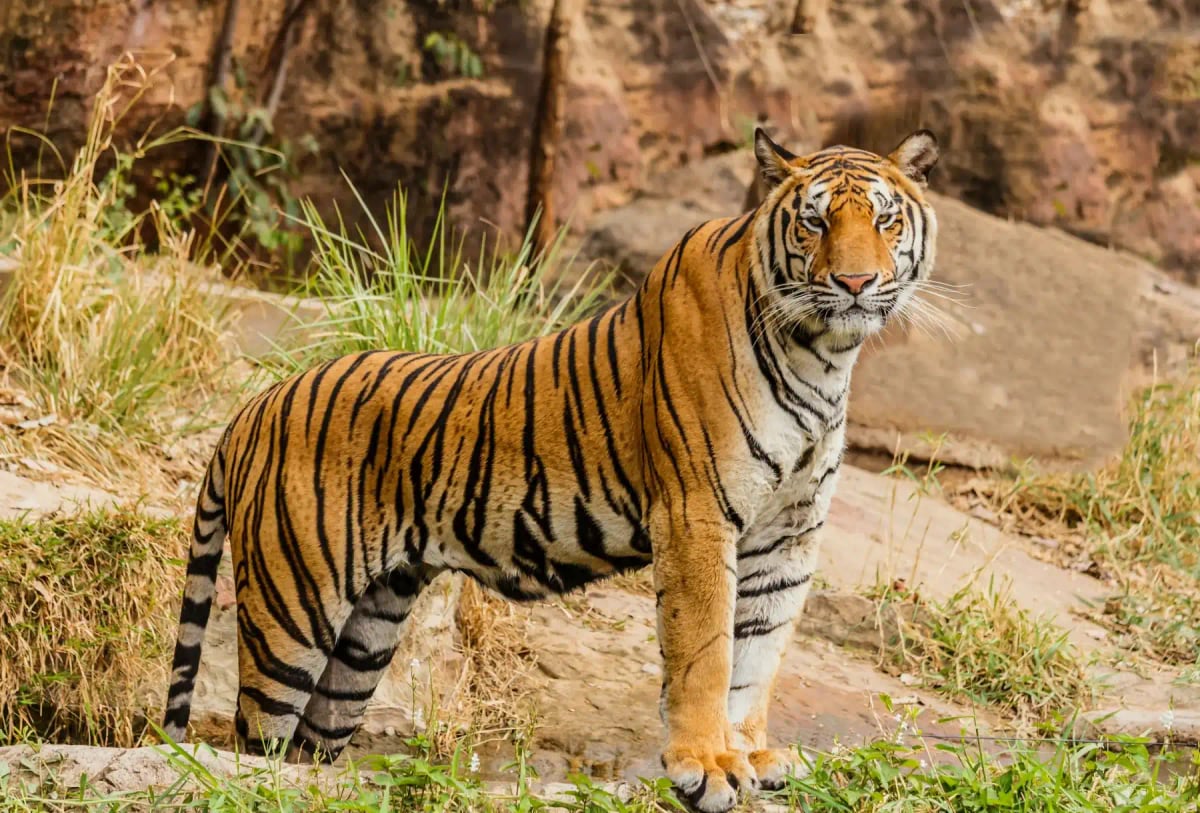
Peafowl are among the loudest birds in Asia. Their best known call is a far carrying scream, often written as may awe, that males repeat many times, especially in the breeding season and before rain. They also have several sharp alarm calls. When a peafowl spots a tiger or a leopard, it calls loudly from the ground or a tree, and deer, monkeys and safari guides alike pay attention, because the call can reveal where a big cat is moving. Wild peafowl are wary. They usually run into cover rather than fly, but they are strong fliers over short distances and can burst almost straight up into a tree. Outside the breeding season they live in small groups, often a few females with their young or several males together. Every evening they gather at traditional roosting trees and fly up to high branches, safe from predators on the ground such as leopards, jackals and dogs. They come down at dawn to drink and feed. Near villages and temples, where nobody harms them, they become tame.
Peafowl in Culture
Few birds have played as large a role in human culture as the Indian peafowl. India declared it the national bird in 1963, and it appears in art, dance, poetry and textiles across the country. In Hinduism it is the mount of Kartikeya, the god of war also known as Murugan, and the god Krishna is traditionally shown with a peacock feather in his crown. Because of these links, peafowl are considered sacred in many communities and are protected by villagers and temple keepers. The Mughal emperor Shah Jahan, who built the Taj Mahal, sat on the famous Peacock Throne, decorated with jeweled peacocks. Peafowl reached the ancient Mediterranean through trade, and in Greek mythology they were the sacred bird of the goddess Hera, who was said to have placed the eyes of the giant Argus on the peacock's tail. In medieval Europe roast peacock was served at royal feasts, and the bird has long been a symbol of pride and beauty.
Population and Conservation
The IUCN lists the Indian peafowl as Least Concern, with an increasing population, in an assessment from 2025. In India it is doing better than almost any other large bird: the State of India's Birds report of 2023 estimated that its abundance had grown by about 150 percent over the previous decades, and it has spread into areas where it was rare, such as every district of Kerala. India gives it the highest legal protection under the Wildlife Protection Act of 1972, so hunting it is a crime. Even so, peafowl face real threats. Many die after eating grain laced with pesticides, sometimes spread on purpose by farmers or poachers, and some are still killed for meat or feathers. In Pakistan's Thar Desert, outbreaks of Newcastle disease kill large numbers of birds. In Bangladesh the species is extinct in the wild, and in 2025 a first group of captive bred peafowl was released into an enclosure in Madhupur National Park as a test for its return.
Where it is found
The Indian Peafowl can be found in places such as: