Red bellied Piranha
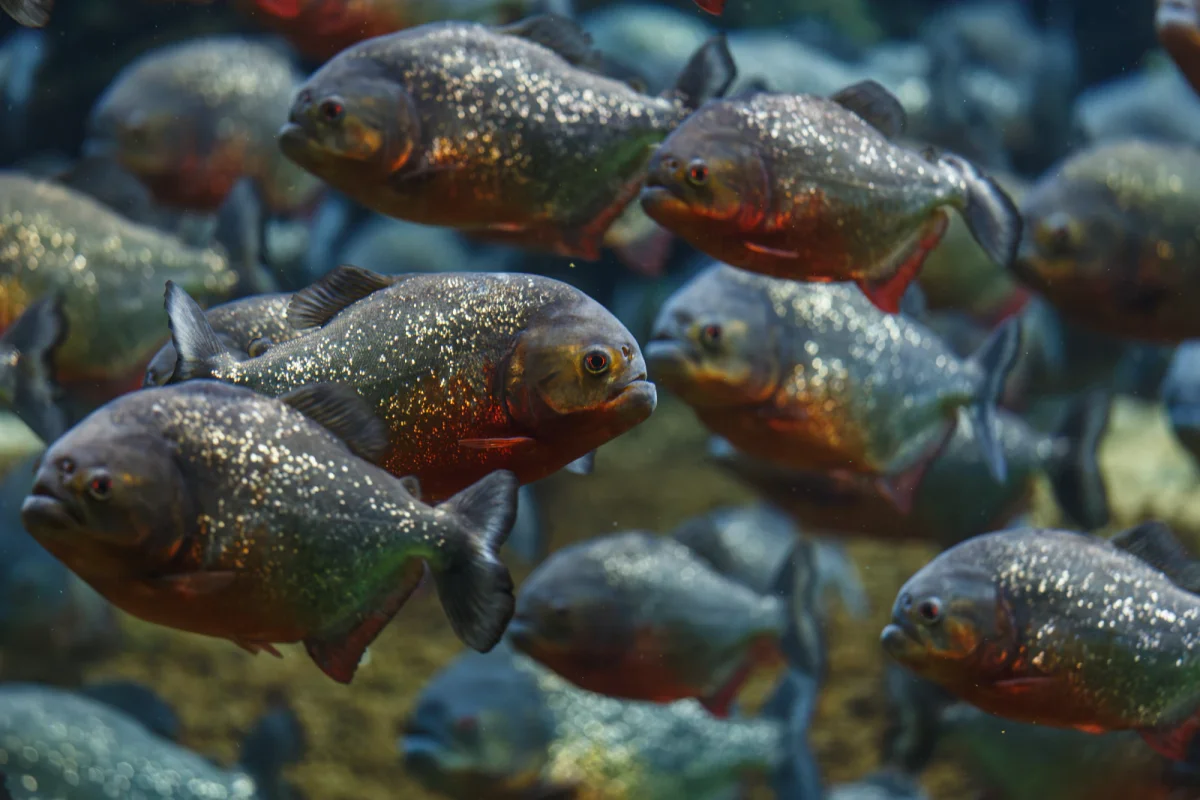
The red bellied piranha (Pygocentrus nattereri), also called the red piranha, is the best known piranha in the world. It is a deep bodied fish, silvery gray with glittering scales and a bright red or orange belly, that usually grows to 20 to 33 centimeters. It lives in the rivers, lakes and flooded forests of the Amazon and Paraná Paraguay basins, the Essequibo River and coastal rivers of northeastern Brazil. Its triangular teeth lock together into a single cutting blade, but it is more of an opportunist than a killer: it eats fish, pieces of fins and scales, insects, snails, carrion and even seeds. It travels in shoals mainly for safety, since caimans, otters, river dolphins and birds all hunt it. In the rainy season the male digs a nest among flooded plants and guards the eggs. Bites on people do happen, usually when water is low, but deaths are extremely rare. The IUCN lists the species as Least Concern.
Names and Relatives
The red bellied piranha is also known as the red piranha, and in Brazil it is called piranha vermelha. It belongs to the family Serrasalmidae, which also includes the pacus, close relatives with flat, crushing teeth that feed mostly on fruits and seeds. Within this family the red bellied piranha is one of three species in the genus Pygocentrus, the piranhas with the deepest bodies and strongest jaws. The other two have much smaller ranges: one lives only in the Orinoco basin of Venezuela and Colombia, and the other only in the São Francisco River of eastern Brazil. The red bellied piranha has by far the widest range of the three. Genetic studies have found at least five separate lineages across its range, and some researchers think it may one day be split into more than one species. It is also the piranha whose full genome was first read, which has helped scientists study how its teeth and feeding habits evolved.
Size and Appearance
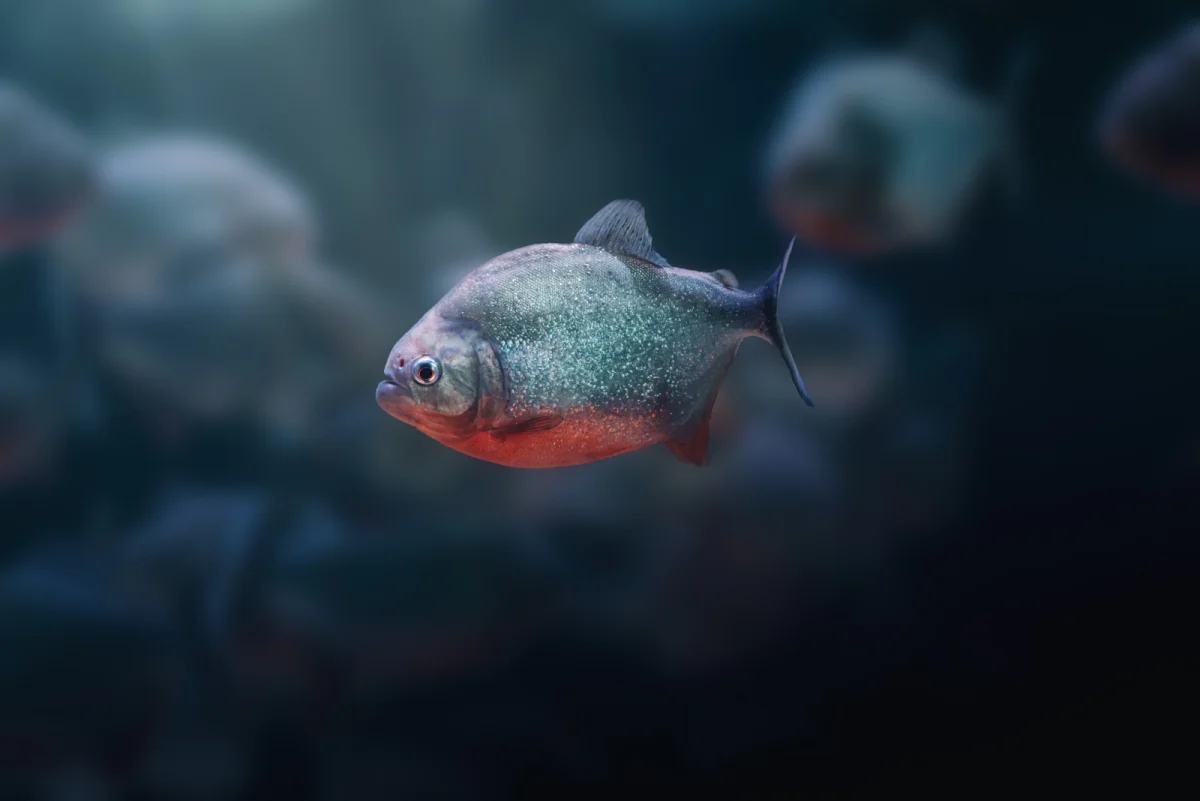
Most adult red bellied piranhas measure 20 to 33 centimeters, and the largest recorded reach about 50 centimeters and close to 4 kilograms. The body is tall, narrow and almost disc shaped when seen from the side, which lets the fish turn quickly in tight spaces among roots and plants. Adults are silvery gray to olive on the back and sides, covered in tiny scales that glitter like sequins in the light. The throat, belly and the fin under the belly are bright red or orange, the feature that gives the species its name, and the color is usually strongest in breeding adults. The eyes are often reddish too. Young piranhas look quite different: they are silvery and covered in small dark spots, which fade as they grow and the red underside appears. The head is blunt and the lower jaw sticks out slightly beyond the upper one, giving the fish its famous scowling face. Strong jaw muscles fill the sides of the head behind the mouth.
Teeth and Bite
A piranha's reputation rests on its teeth. Each jaw holds a single row of flat, triangular teeth with sharp points, and small side cusps on each tooth lock into the teeth next to it. Together they work as one saw edged blade rather than as separate teeth. When a piranha bites, the upper and lower blades meet like the edges of a pair of scissors, and a twist of the body tears away a clean, rounded piece of flesh, a fin or a group of scales. Because the teeth are joined, the force of each bite is spread across the whole row and single teeth rarely break off. Worn teeth are not replaced one at a time, as in most fish. A study of museum specimens published in 2019 showed that a full new row grows inside the jaw and replaces the old teeth on one side of the mouth together, then on the other, so the fish always has a working set. Pacus share this system, which suggests it came from a common ancestor and did not appear just for eating meat.
Habitat and Range
The red bellied piranha is found across much of tropical and subtropical South America. Its range covers the Amazon basin from the foothills of the Andes in Peru, Ecuador and Colombia to the mouth of the river in Brazil, the Paraná and Paraguay river systems south to Argentina and Uruguay, the Essequibo River in Guyana, and several coastal rivers of northeastern Brazil. It prefers slow or still water: river edges, oxbow lakes, floodplain lagoons, marshes and the flooded forests that form when the rivers rise. It is most common in nutrient rich white water rivers and much scarcer in the dark, acidic black water rivers. Life follows the seasons. During the high water months piranhas spread out into the flooded forest and grasslands, where food is plentiful. When the water drops, many become trapped in shrinking pools and lagoons, sometimes in huge numbers, and food becomes scarce. The Pantanal wetland is one of the places where the species is especially abundant.
Diet and Feeding
Despite its image as a pure meat eater, the red bellied piranha is an opportunist that eats almost anything it can find. Fish make up much of its diet, but it often takes only part of its victim, biting off pieces of fins, scales or flesh from larger fish that survive and swim away. It also eats insects, crustaceans, snails and worms, and studies of stomach contents regularly find seeds, fruit and other plant material. Young piranhas feed mostly on small crustaceans and insect larvae before moving on to fins and larger prey as they grow. Piranhas are also important scavengers that clean up dead fish and other animals that fall into the water, which helps keep rivers and lagoons healthy. The famous feeding frenzies are real but uncommon. They mostly happen when many hungry fish are packed together, as in drying pools at the end of the dry season, or when blood and fish waste attract them, such as where fishermen clean their catch.
Shoals and Sounds
Red bellied piranhas live in shoals that can include dozens of fish of similar size. For a long time people assumed these groups were hunting packs, but research shows that safety is the main reason they stay together. Piranhas are prey for many animals, including caimans, giant otters, Amazon river dolphins, large fish and birds such as cormorants and herons. In a 2005 study, wild caught piranhas breathed faster, a sign of stress, when kept in small groups, and calmed down more quickly after a model bird attack when they were in larger ones. Piranhas are also surprisingly noisy. A 2011 study recorded three distinct sounds: a dog like bark made with muscles attached to the swim bladder when two fish face off, a lower drumming sound when they circle or fight for food, and a short snapping sound made by the jaws when one bites at a rival.
Breeding and Young
Red bellied piranhas breed during the rainy season, when the rivers rise, the water warms and food becomes plentiful in the newly flooded areas. Breeding success changes from year to year depending on how high and how long the floods are. The male chooses a spot in shallow water, often among flooded grasses, plant roots or soft bottom debris, and clears a shallow nest by pushing material away with his body and mouth. The female lays her eggs in several batches, and they stick to the plants or the bottom while the male fertilizes them. A female can produce thousands of eggs in a season. The male stays to guard the nest against other fish, and sometimes the female helps. At warm water temperatures the eggs hatch in just a few days. The tiny young hide among floating plants and the flooded vegetation, where they feed on small crustaceans and insect larvae and grow quickly.
Piranhas and People
Much of the piranha's fearsome image comes from Theodore Roosevelt, who traveled through Brazil in 1913 and 1914 and described piranhas as the most ferocious fish in the world in his 1914 book Through the Brazilian Wilderness. Local guides are thought to have staged a show for him by releasing a cow into a stretch of river packed with starving fish. In reality, red bellied piranhas are usually wary of people. Bites do happen, mostly on the feet and hands of swimmers, and they are most common when water is low and warm, in still water near dams, or where fish waste is thrown in. Studies of human remains with piranha damage found that most of those people had already drowned or died of other causes. For people across its range the piranha is also food: it is caught with simple lines and eaten fried or in soup, and piranha fishing is a popular activity on river tours. The species is common and widespread, and the IUCN lists it as Least Concern with a stable population.