South American Coati
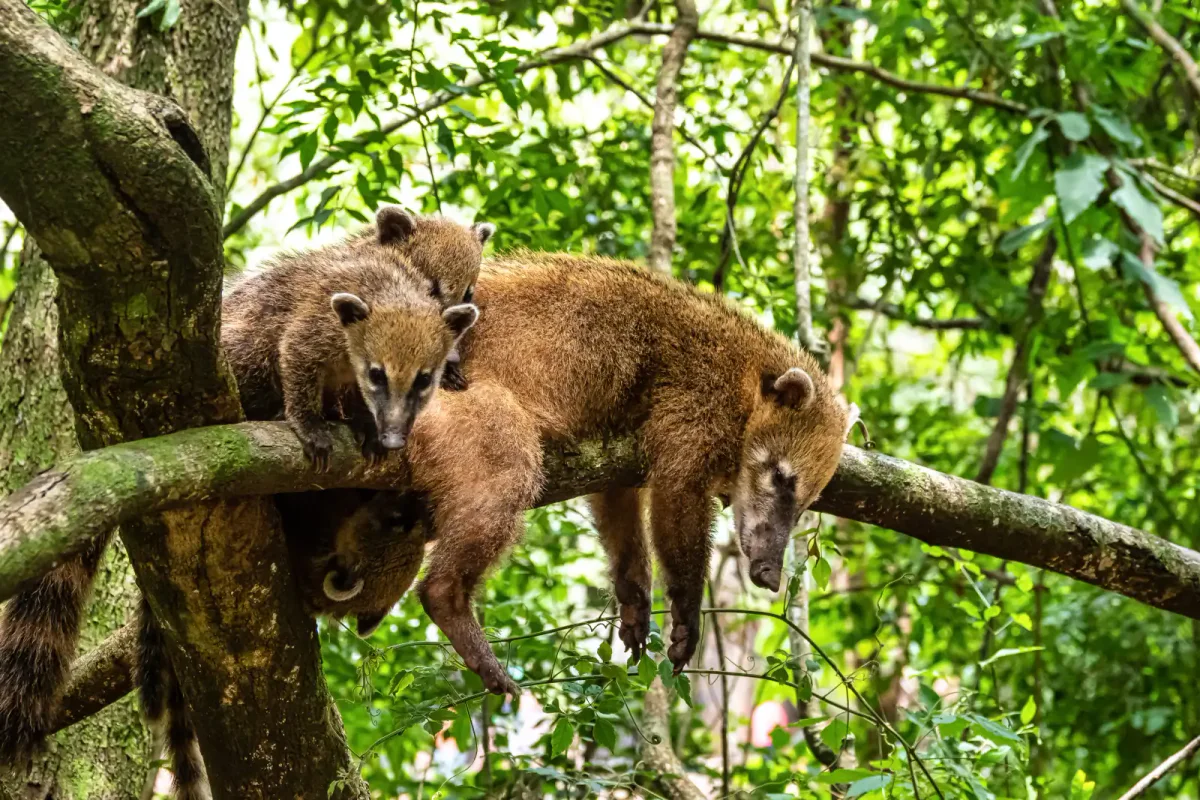
The South American coati (Nasua nasua), also called the ring tailed coati, is a member of the raccoon family that lives in the forests of tropical and subtropical South America, from Colombia and the Guianas south to Uruguay and northern Argentina. It has a long, flexible snout, a slim body and a long tail with dark rings that it often holds upright. Adults measure 85 to 113 centimeters including the tail, which is about half of that length, and weigh 2 to 7 kilograms. Coatis are active by day and move easily between the ground and the trees, where they sleep at night. They eat fruit, insects, spiders and other small animals, digging through leaf litter with their snouts and claws. Females and young live in noisy bands of 15 to 30 animals, while adult males usually live alone. Coatis are famous at Iguazú Falls, where bands walk among visitors. The IUCN lists the species as Least Concern, although its population is decreasing.
Name and Classification
The South American coati belongs to the Procyonidae, the raccoon family, which also includes the raccoon, the kinkajou, the ringtail and the olingos. Carl Linnaeus described it in 1766 under the name Viverra nasua, and it was later placed in the genus Nasua, which it shares with the white nosed coati of Central and North America. Its closest relatives in South America are the mountain coatis, smaller animals that live higher up in the Andes. In English it is also called the ring tailed coati or the brown nosed coati, a name that sets it apart from its white nosed northern cousin, while in Spanish speaking countries it is usually just called coatí. For a long time the solitary adult males were thought to be a different species from the animals living in groups, and they were given a name of their own, coatimundi. The word is still used today, often for any coati. As of 2005, scientists recognized 13 subspecies across its wide range, which differ in size and in the color of their fur.
Size and Appearance
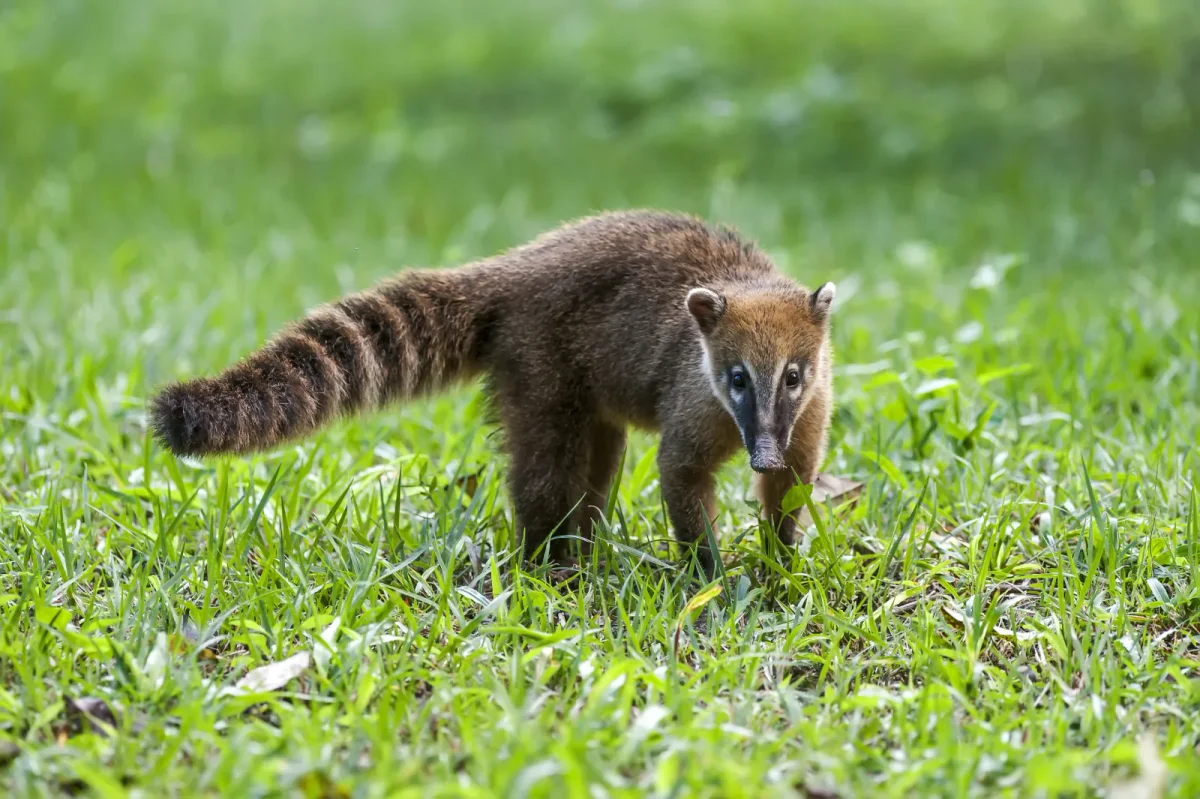
Adult South American coatis measure 85 to 113 centimeters from nose to tail tip, and about half of that is tail. They usually weigh between 2 and 7.2 kilograms, and males are larger than females, with bigger canine teeth. The most striking feature is the snout: long, narrow, dark and so flexible that it can bend and twist as the coati sniffs through leaves, soil and holes in logs. The fur is highly variable, from reddish orange and golden brown to dark brown or almost black, often with paler markings around the eyes and on the cheeks. The long tail has light and dark rings, which may be bold or barely visible, and coatis often carry it straight up as they walk. Unlike the white nosed coati, it lacks a largely white snout. Its feet are strong, with long, curved claws for digging and climbing. Like raccoons, coatis can turn their ankles around, which lets them climb down tree trunks head first instead of backing down.
Habitat and Range
The South American coati is widespread in tropical and subtropical South America. Its main range covers the lowland forests east of the Andes, from Colombia, Venezuela and the Guianas through the Amazon basin, Bolivia, Paraguay and Brazil to Uruguay and northern Argentina. It also reaches parts of western Ecuador and northern and western Colombia. It lives from sea level up to about 2,500 meters, and above that it is replaced by the smaller mountain coatis. It is above all a forest animal. Studies show that coatis are more likely to be found where there is more forest cover and less likely at higher elevations. It uses Amazon rainforest, the Atlantic Forest of Brazil, Paraguay and Argentina, the dry forests of the Chaco, the gallery forests along rivers in the Pantanal and the cerrado, and the edges of farms and towns. Outside its native range, people introduced it to Robinson Crusoe Island, off the coast of Chile, where it has become an invasive species.
Diet and Foraging
The South American coati is an omnivore that spends most of its waking hours looking for food. Its diet is built around fruit and small invertebrates such as beetles and their larvae, ants, termites, spiders, centipedes and snails. It also eats bird eggs, lizards, frogs, small rodents and other small animals when it finds them. On the ground, a coati pushes its long snout into crevices, leaf litter and loose soil, sniffing out prey, and uses its strong claws to turn over rocks and rip open rotting logs. In the trees, it climbs high into the canopy to reach ripe fruit. What it eats changes through the year. A long study of coati bands in Iguazú National Park, Argentina, found that when fruit was in season the animals spent about 44 percent of their fruit foraging time on the fruit of the pindo palm, and the timing of this harvest shaped where the groups moved. In the leaner months they relied more on invertebrates dug from the forest floor.
Bands and Social Life
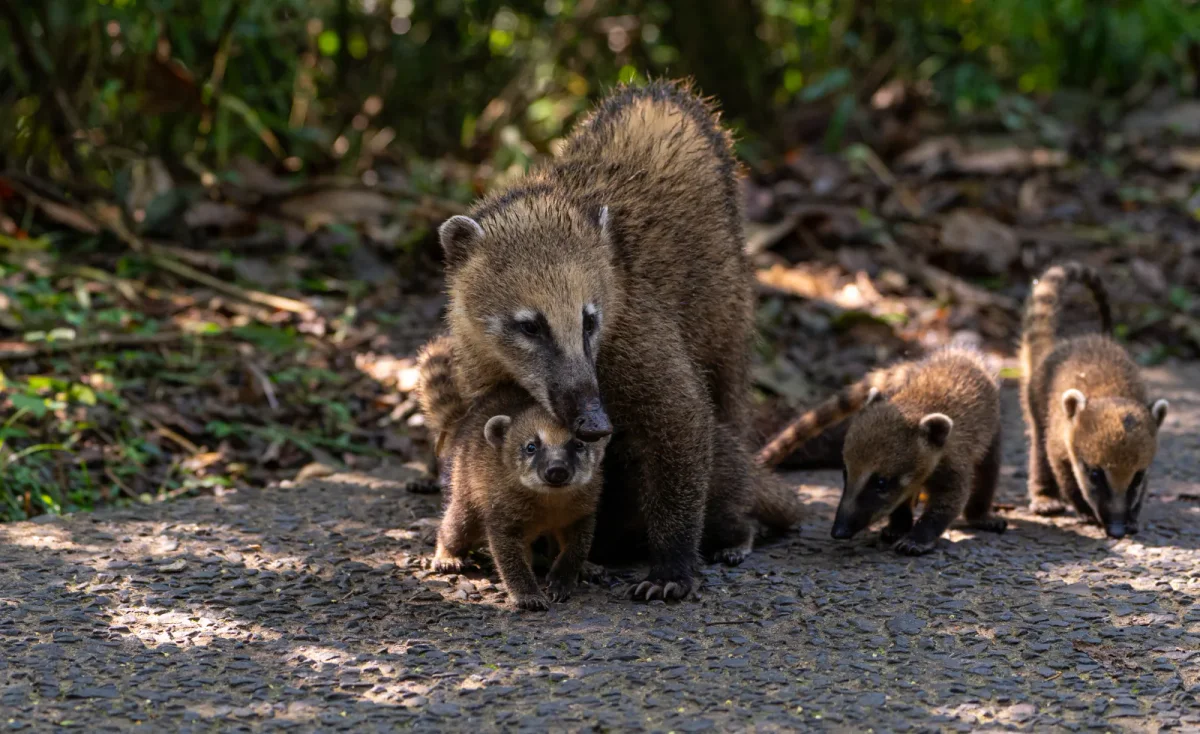
Coatis are among the most social members of the raccoon family. Adult females and their young live together in groups called bands, usually of 15 to 30 animals, which travel, forage and rest together. Adult males, by contrast, usually live alone and join the bands only in the mating season. The young males stay with their mothers until about three years of age and then leave. Neither the bands nor the solitary males defend an exclusive territory, so their home ranges overlap. Living in a group helps coatis spot danger. Studies of two bands at Iguazú found that the animals at the edges of the group watched for predators more than those in the middle, and that each coati spent less time on guard when the band was larger or when more neighbors were close by. Bands keep in touch with soft whining sounds. When a coati spots danger, it gives loud woofs and clicks, and the whole band climbs into the trees. Coatis are active by day and sleep at night high in the branches.
Reproduction and Young
Coati reproduction is closely tied to fruit. All the adult females in a band come into heat at about the same time, during the season when fruit is plentiful, and each one stays receptive for one to two weeks. During this time, adult males approach the band and the females mate with several of them. Pregnancy lasts 74 to 77 days. Shortly before giving birth, each female leaves the band and builds a nest of leaves and branches in a tree, where she gives birth alone. Litters usually have a few young, and captive females have had from one to seven at a time. The babies are born blind and helpless and spend their first weeks hidden in the nest. When the young are about five to six weeks old, the mother brings them down and returns with them to the band, so the group suddenly fills with small coatis at about the same time. This shared timing may help protect the young from predators. Daughters usually stay with the band in which they were born, while sons leave at about three years of age.
Where to See Them
The most famous place to see South American coatis is Iguazú Falls, on the border between Argentina and Brazil. In both Iguazú National Park in Argentina and Iguaçu National Park in Brazil, bands of coatis walk along the trails and walkways and gather around the restaurants and picnic areas, often just a few meters from visitors. Over the years many of them have learned to grab food from bags, tables and hands. Feeding them is forbidden in both parks, as human food is bad for their health and makes them bold and demanding. Coatis that expect food can scratch and bite, and the parks put up signs with photos of the wounds they can cause. They can also carry diseases such as rabies, so any bite should be checked by a doctor. Outside Iguazú, coatis are commonly seen in the Pantanal of Brazil and Bolivia, along rivers and forest edges, and in many Amazon reserves in Peru, Ecuador and Bolivia, where bands often cross trails during the day.
Predators and Conservation
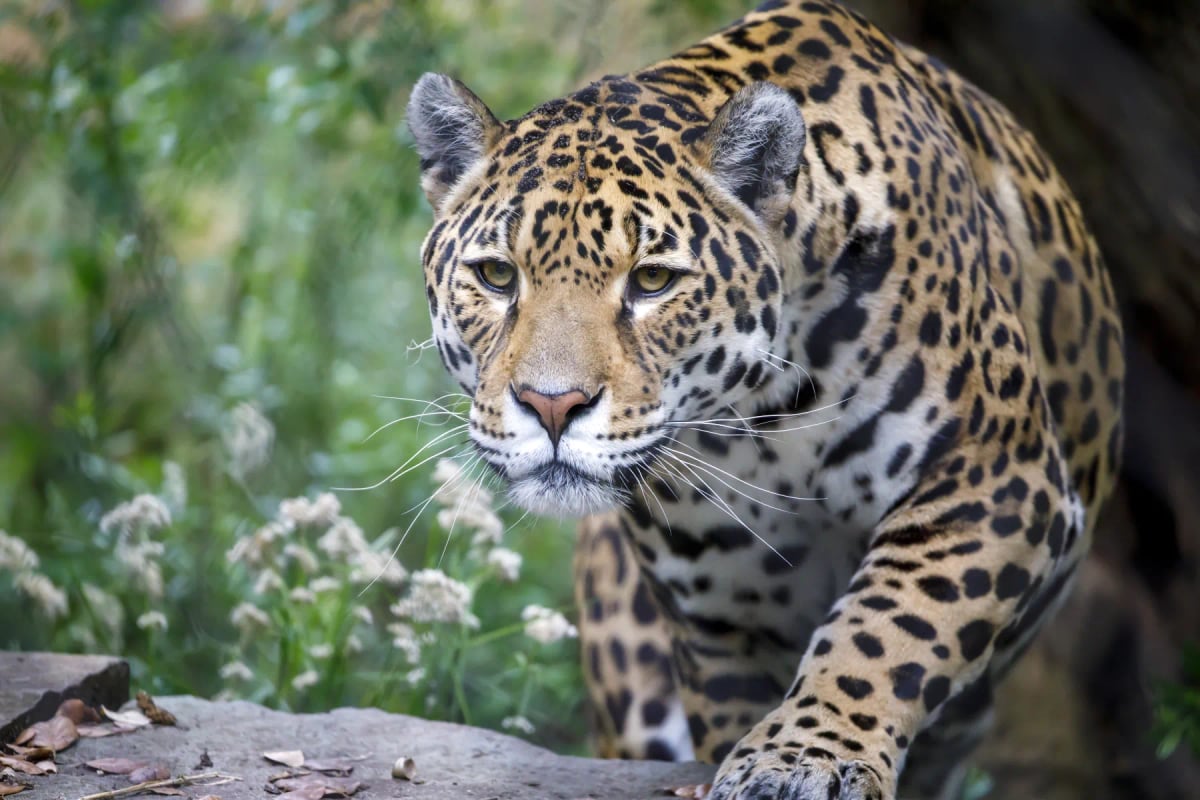
The IUCN lists the South American coati as Least Concern because it is still widespread and common where forest remains, but its population is decreasing. The main threat is the loss and breakup of forest for farming, ranching and roads, since coatis depend on forest cover. They are also hunted for meat in some areas, and many are killed by vehicles on roads that cut through their habitat. In regions such as the Atlantic Forest, where most of the original forest has been cleared, coatis survive mainly in parks and forest remnants. Natural predators include jaguars, foxes and jaguarundis, and the young are especially vulnerable when they first join the band. Coatis help the forest by spreading the seeds of the fruit they eat. Where people have moved them outside their range, they can become a problem. On Robinson Crusoe Island, in Chile's Juan Fernández Archipelago, introduced coatis prey on nesting seabirds, and the island has a program to remove them.