Common Vampire Bat
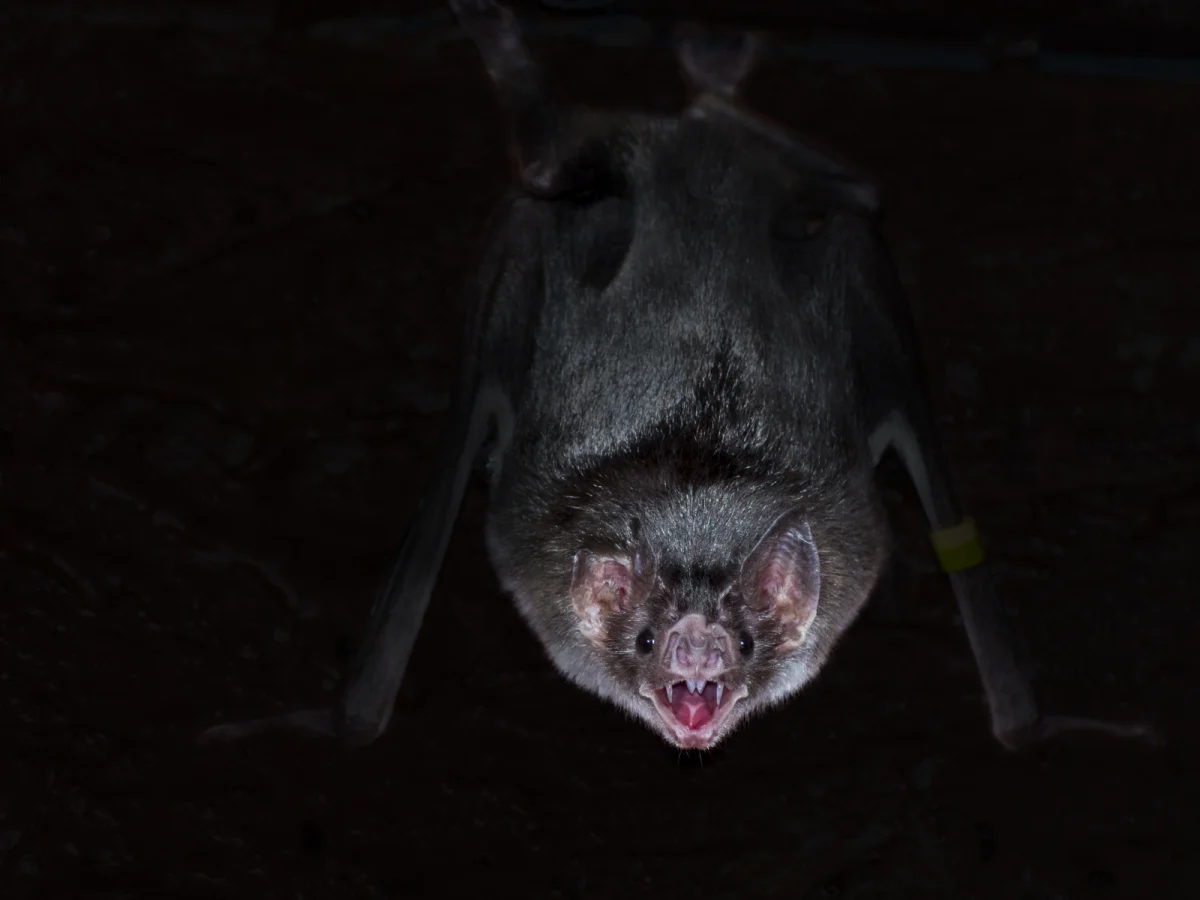
The common vampire bat (Desmodus rotundus) is a small bat of Latin America and one of only three mammals in the world that feed entirely on blood. It weighs about 25 to 40 grams and has short grayish brown fur, a flat, piglike nose and very sharp upper front teeth. It lives from northern Mexico to Uruguay, northern Argentina and northern Chile, in rainforests, dry forests, grasslands and deserts, from sea level up to about 2,400 meters. By day it roosts in caves, hollow trees, old mines and buildings, often in colonies of dozens to hundreds. At night it flies out to find a sleeping animal, today usually a cow, horse or pig, then lands nearby and walks or hops close. A heat sensing nose finds a spot where blood runs near the skin, the teeth make a small cut and the bat laps the flowing blood. Vampire bats share food with hungry roostmates. They also spread rabies to livestock. The IUCN lists the species as Least Concern.
Vampire Bats and Their Relatives
There are about 1,400 species of bats in the world, but only three feed on blood, and all of them live in Latin America. The common vampire bat is by far the most numerous and widespread. Its two relatives, the hairy legged vampire bat and the white winged vampire bat, are rarer and feed mostly on the blood of birds, while the common vampire bat prefers mammals. The three belong to the leaf nosed bat family, Phyllostomidae, a large group that also includes bats that eat fruit, nectar, insects and small animals. Feeding on blood evolved only once in this family, and the vampires share a long list of special features: razor sharp front teeth, a heat sensing nose, saliva that keeps blood from clotting and kidneys that can handle a liquid meal. When Europeans reached the Americas, they named these bats after the vampires of their own folklore. The real animals are small, shy and live in close family groups.
Size and Appearance
The common vampire bat is a small animal. Its body measures about 7 to 9 centimeters, about the size of an adult's thumb, and it usually weighs 25 to 40 grams, though it can weigh much more right after a meal. It has no tail. The fur is short and dense, dark grayish brown on the back and paler, often silvery gray, on the belly. Its face is easy to recognize: a flat, piglike nose with a small, horseshoe shaped fold of skin instead of the tall nose leaf of its relatives, pointed ears and large dark eyes. The upper front teeth and canines are large, curved and as sharp as blades, while the cheek teeth are tiny, because the bat never chews. Its thumbs are unusually long and strong, with thick pads, and its back legs are sturdy. These features let it move on the ground in a way few bats can, walking, hopping and even running on all fours with its wings folded.
Habitat and Range
The common vampire bat lives across most of Latin America. Its range begins in northern Mexico, in Sonora and Tamaulipas, and runs through all of Central America and South America to Uruguay, northern Argentina and northern Chile. It also lives on the island of Trinidad. It is found from sea level up to about 2,400 meters in the Andes. Few bats are as flexible about habitat. Common vampire bats live in tropical rainforests, dry forests, savannas, grasslands and even coastal deserts, as long as they have two things: a safe, dark place to roost and large animals to feed on. Natural roosts include caves, rock crevices and hollow trees. Old mines, wells, tunnels, abandoned houses and the undersides of bridges work just as well. The spread of cattle ranching across Latin America has given vampire bats a steady and easy food supply, and scientists believe their numbers have grown in many farming areas as a result.
Diet and Feeding
The common vampire bat feeds only on blood. Its natural prey were large wild mammals such as tapirs, deer and peccaries, and on rocky islands off the coast of Peru some colonies feed on sea lions. Today most of its meals come from cattle, horses, pigs and other livestock, and only rarely from people. The bat leaves its roost on dark nights, finds a sleeping animal and usually lands on the ground nearby, then walks or hops up to it. It often bites the feet, legs, neck or ears. Using its heat sensing nose, it picks a spot where blood flows close to the skin, trims away hair with its teeth and makes a small, shallow cut that the animal often does not feel. The bat does not suck. It laps the blood with its tongue while substances in its saliva keep the wound from clotting. A meal can take around half an hour and can reach about 40 percent of the bat's weight, so it starts to urinate while still feeding to shed water and stay light enough to fly.
Senses and Movement
Vampire bats have abilities that no other mammal combines. Around the nose they have three small pits packed with nerves that sense infrared radiation, the heat given off by a warm body. A study published in Nature in 2011 showed how this works: a heat sensor called TRPV1, which in other mammals reacts only to painful heat, is tuned in vampire bats to switch on at about 30 degrees Celsius. This lets the bat detect warm skin from roughly 20 centimeters away and find the best place to bite. Like other bats, vampires use echolocation to move in the dark, and they also have good eyesight and a keen sense of smell. On the ground they are remarkably agile. Using their long thumbs and strong hind legs, they can walk, sidestep, jump and gallop, and they launch into the air with a powerful push of the front limbs. This skill lets them approach a sleeping animal quietly on foot and leap away fast if it wakes up.
Food Sharing and Social Life
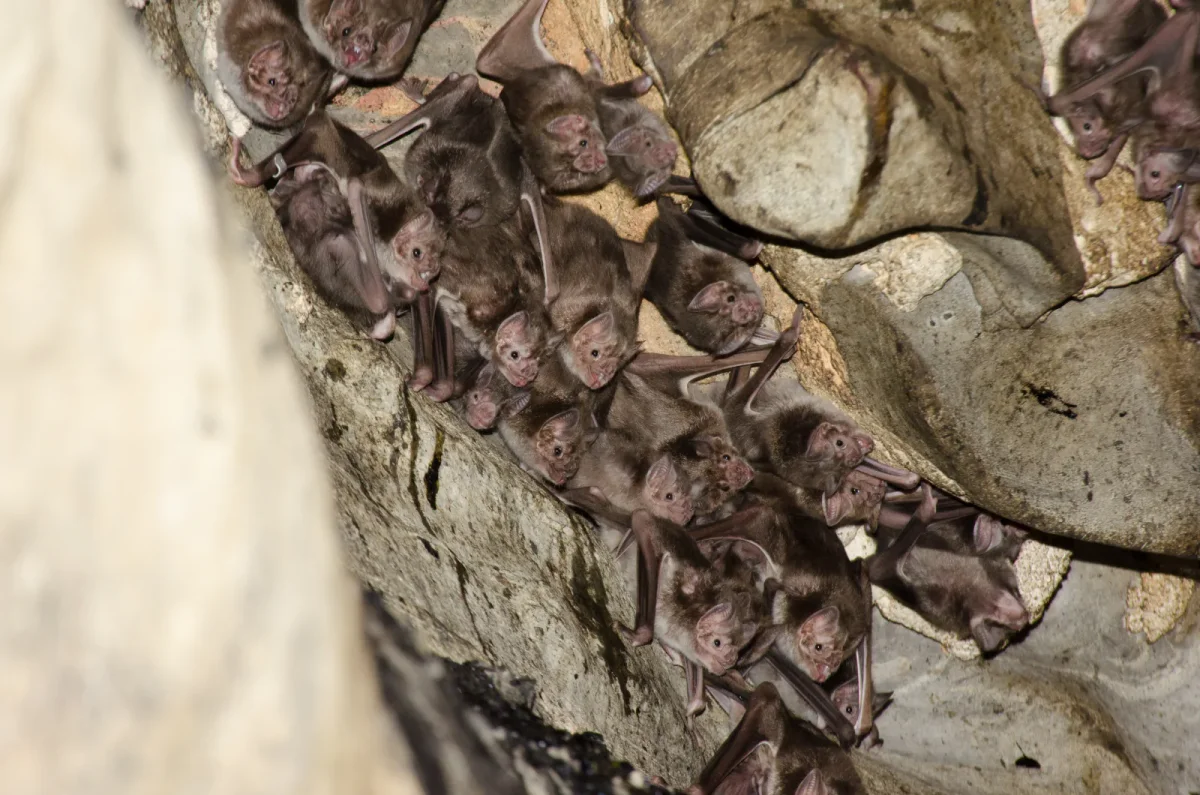
Common vampire bats live in colonies that range from a few dozen to hundreds of individuals, and sometimes more. The core of a colony is a group of adult females and their young, which can stay together for years. Living on blood is risky, because the bat stores little energy and can starve after about two nights without a meal, and on any given night some bats fail to feed. Their answer is sharing. A well fed bat regurgitates part of its meal for a hungry roostmate. In a classic study published in 1984, biologist Gerald Wilkinson showed in Costa Rica that this sharing depends both on family ties and on past help: bats feed relatives, but they also feed unrelated partners that have fed them before. Grooming is part of these bonds too, and later research found that bats build new partnerships slowly, starting with grooming before moving on to sharing food. Pairs that formed in captivity in Panama kept roosting and foraging together after release.
Reproduction and Young
In the tropics, common vampire bats can breed at any time of year, while at the southern edge of their range, as in Argentina, births follow a clearer season. Pregnancy is long for such a small mammal, about seven months, and the female almost always gives birth to a single pup, which weighs only about 5 to 7 grams. Twins are rare. For the first weeks the pup drinks only milk and clings to its mother, and she starts feeding it regurgitated blood as it grows. The young bat begins to follow its mother on foraging trips and learns to find prey, but it can keep receiving food from her for many months. Common vampire bats reach maturity at around nine months. Young females often stay in the colony where they were born, which helps explain the strong ties between females, while young males usually leave to find another group. In the wild, a common vampire bat can live about nine years, and in captivity some have lived around 20 years.
Rabies and People
The common vampire bat is the main carrier of rabies to livestock in Latin America. Infected bats pass the virus to cattle and horses through their bites, causing a paralytic form of the disease that kills thousands of animals each year, with losses estimated at about 30 million dollars annually. People are bitten far less often, but outbreaks happen in remote areas where people sleep without protection. The link was discovered in Trinidad, where bacteriologist Joseph Lennox Pawan found an infected vampire bat in 1932 during an outbreak that killed 89 people between 1929 and 1937. In 2004, 21 people died in two outbreaks in the Brazilian state of Pará. For decades, governments have tried to control the problem by killing vampire bats, but a study in Peru found that culling can backfire and spread the virus as bats move between colonies. Vaccinating livestock works better. Vampire bat saliva also inspired desmoteplase, a clot dissolving drug tested in people after strokes.
Population and Conservation
The IUCN lists the common vampire bat as Least Concern, with a stable population trend, in an assessment from 2015. It has an enormous range, lives in many kinds of habitat and benefits from the huge number of cattle, horses and pigs raised across Latin America. There is no estimate of its total population, but it is common in most farming regions. Unlike most bats, it is not a conservation worry. The real conservation problem comes from the way vampire bats are controlled. When people destroy roosts by burning, poisoning or blowing up caves, they often kill many other bat species that share those caves, including bats that pollinate plants, spread seeds and eat crop pests. Modern programs try to target only vampire bats, for example with a paste applied to captured bats that spreads to their roostmates through grooming. Scientists are also testing vaccines that bats could pass among themselves, an approach that could reduce rabies without killing large numbers of bats.