Olive Baboon
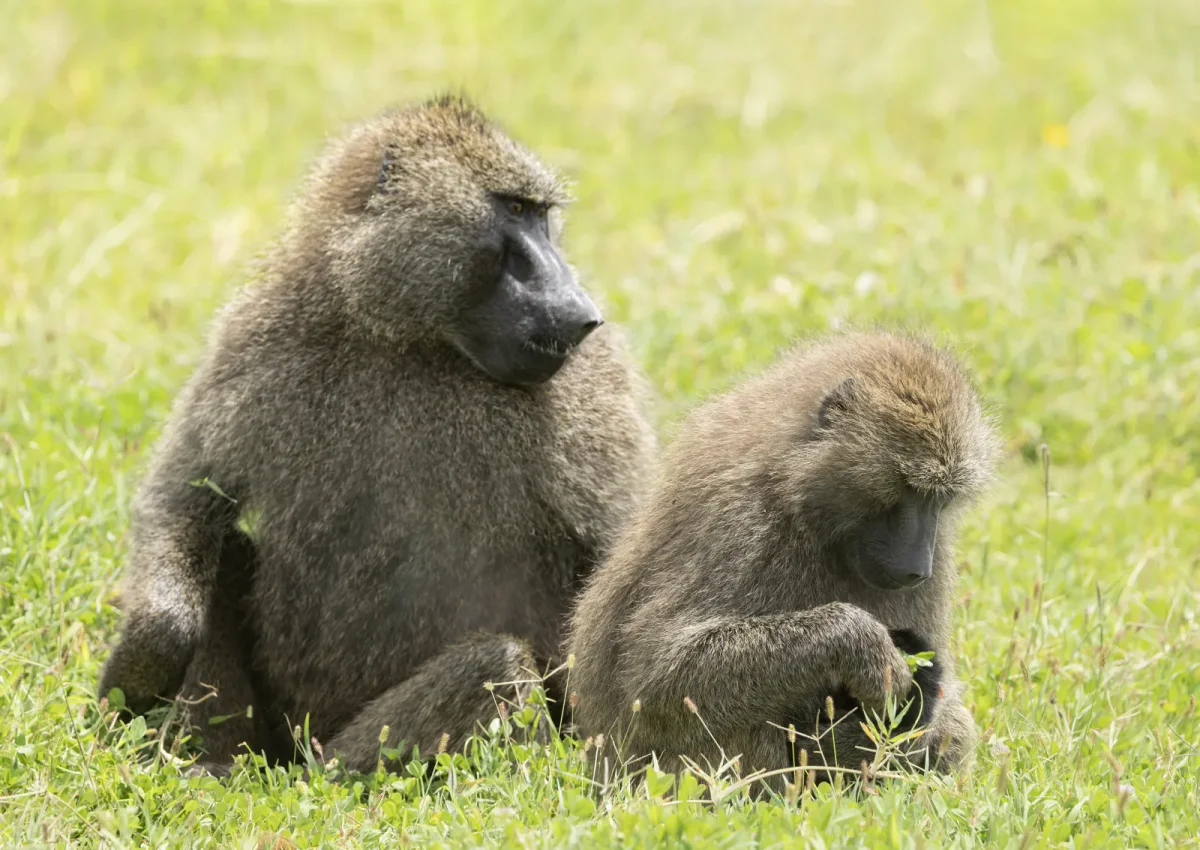
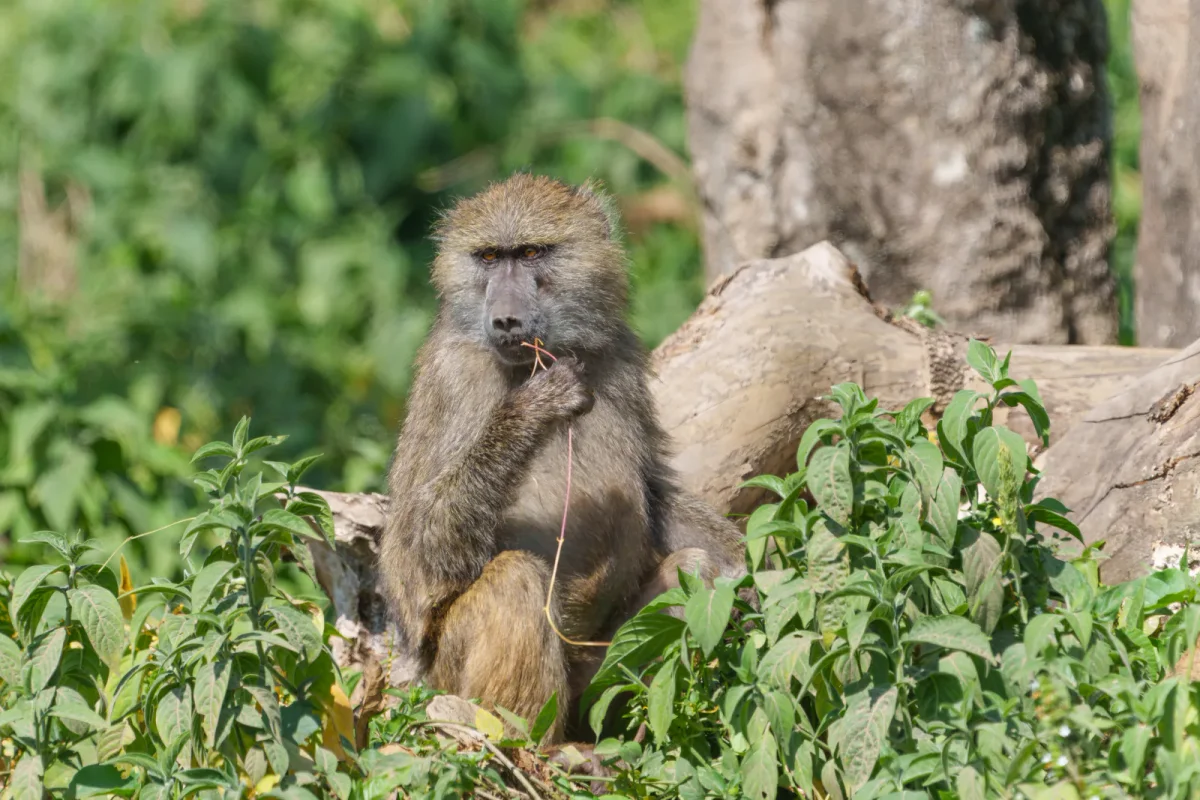
The olive baboon (Papio anubis), also called the Anubis baboon, is a large monkey of the African savanna and the most widespread of all baboons. Seen from a distance its coat looks greenish gray, the color that gives it its name. Males are about twice as heavy as females, weighing around 24 kilograms, and carry a thick mane and long canine teeth. It lives in a broad belt across Africa, from Mali and Guinea in the west through Nigeria, Chad and Sudan to Ethiopia, Kenya, Uganda and Tanzania in the east. Olive baboons live in troops of 15 to 150 animals, with females that stay in the troop where they were born and males that move to other troops as they grow up. They eat almost anything, from grass, seeds, roots and fruit to insects and the occasional young antelope, and sleep at night in tall trees or on cliffs. Adaptable and still common, the species is listed as Least Concern by the IUCN.
Names and Relatives
The olive baboon owes its common name to the color of its coat. Each hair is banded in yellow brown and black, and from a distance the mix looks like a greenish gray, the color of olives. Its scientific name, Papio anubis, and its other common name, Anubis baboon, come from the ancient Egyptian god Anubis, who was shown with the head of a dog, a reminder of the baboon's long, doglike muzzle. It is one of six baboon species, together with the yellow, chacma, Guinea, hamadryas and Kinda baboons. The olive baboon has the widest range of them all and meets several of its relatives at the edges. In the Awash valley of Ethiopia it mixes with the hamadryas baboon, and in southern Kenya and Tanzania with the yellow baboon, producing hybrids. The gelada of the Ethiopian highlands is sometimes called a baboon, but it belongs to a different genus.
Size and Appearance
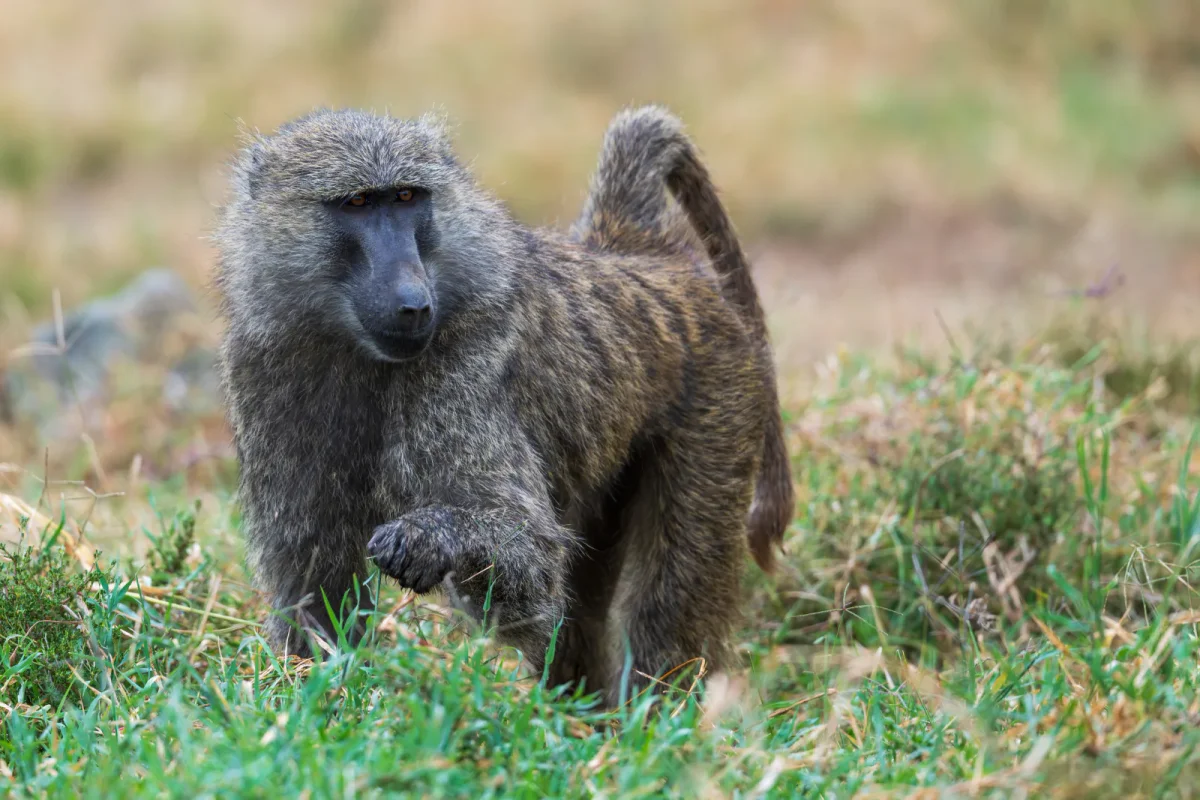
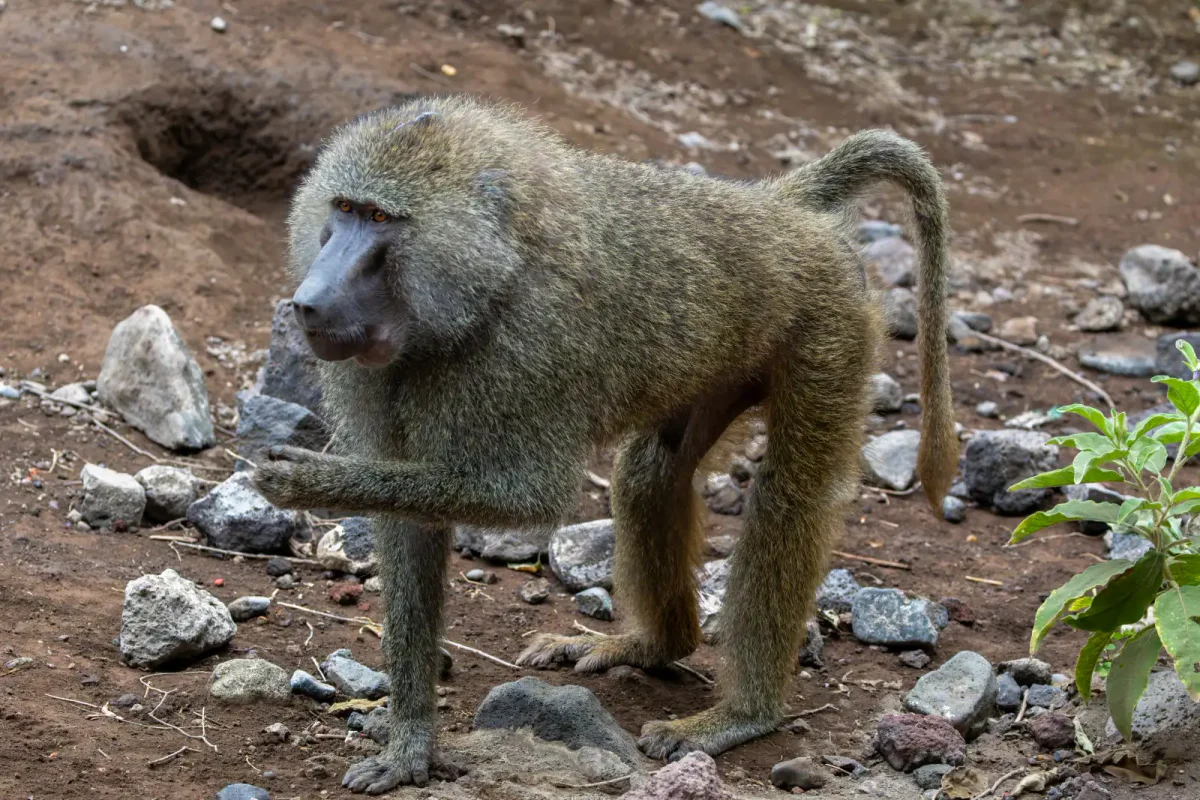
The olive baboon is one of the largest monkeys in the world. Males weigh around 24 kilograms on average and sometimes more than 35, while females average about 15 kilograms. The body measures up to about a meter from head to rump, and the tail adds another 38 to 58 centimeters. The tail has a curious shape: the first part rises from the body and then bends sharply downward, so it looks broken even though it is not. The face is dark gray and almost hairless, with close set eyes and a long muzzle that ends in a flat nose. Adult males are easy to recognize by the long, thick mane on the head, neck and shoulders and by their long, sharp canine teeth, which they show in threat displays by yawning widely. Both sexes have bare, tough pads on the rump that let them sit comfortably for hours, and females show a large pink swelling there when they are ready to mate.
Troop Life
Olive baboons live in troops of 15 to 150 animals, with several adult males, many more adult females and their young. The core of the troop is its females. They stay all their lives in the troop where they were born, and each family has a rank that daughters inherit from their mothers. Males leave home when they become adults and try to join another troop, where they compete for rank through threats and fights. Older males, past their prime, often team up to stand against stronger rivals. Many males also build close friendships with particular females, grooming them, staying near them and protecting their infants, and these friends are more likely to be chosen as mates. Grooming keeps the whole troop together and calms tensions. Each day the troop walks several kilometers to feed and drink, and at dusk it climbs into tall trees or onto cliffs to sleep, safe from leopards and lions.
Diet
Olive baboons are omnivores that eat almost anything they can find, which is a big reason for their success. Most of their food comes from plants: grasses and grass seeds, roots, bulbs and tubers dug from the ground with their strong hands, fruits, flowers, leaves, bark and the pods and gum of acacia trees. They also eat insects, spiders, scorpions and bird eggs. Now and then they hunt larger prey, such as hares, birds and the newborn young of gazelles and other antelopes. Studies in Kenya showed that some troops hunt often and that males usually do the hunting, sometimes sharing the meat. Baboons have cheek pouches where they can stuff food quickly and chew it later in a safer place. They need to drink water almost every day, so troops stay close to rivers, lakes or water holes. Near villages they also raid crops like maize, cassava and peanuts, which brings them into conflict with farmers.
Babies and Growing Up
Olive baboons can breed at any time of year. After a pregnancy of about six months, the female gives birth to a single baby, usually at night. Newborns have a black coat and a pink face, which makes them stand out in the troop, and they draw a lot of attention from other females, who try to touch and hold them. For the first weeks the infant clings to the fur of its mother's belly, and later it rides on her back like a jockey. The black coat slowly changes to the adult olive color during the first months of life. Infants nurse for about a year, and mothers usually give birth again every two years or so. Males that are friends of the mother often carry, protect and play with her infant. Young females stay close to their mothers and learn their place in the troop, while young males leave their birth troop when they are adults. In the wild, olive baboons can live 25 years or more.
Habitat and Where to See Them
The olive baboon lives in a wide belt across Africa, from Mali and Guinea in the west, through the savannas of Burkina Faso, Ghana, Nigeria, Cameroon, Chad and Sudan, to Ethiopia, Uganda, Kenya and Tanzania in the east. It is most at home in savannas, open woodlands and grasslands, but it also lives in rocky hills, along rivers lined with forest, at the edges of rainforest and in dry country, as long as there is water to drink and safe places to sleep. Because troops are active by day and often feed in the open, olive baboons are among the easiest African monkeys to watch. They are seen on almost every safari in the Masai Mara and around Lake Nakuru in Kenya, at Lake Manyara and Gombe in Tanzania, and in Murchison Falls and Queen Elizabeth National Parks in Uganda. In West Africa, troops are a common sight at Mole in Ghana, Yankari in Nigeria and Pendjari in Benin.
Baboons, People and Conservation
The olive baboon is listed as Least Concern by the IUCN, which considers its population stable. It is adaptable, eats almost anything and lives in many protected areas. That same flexibility often puts it in trouble with people. Baboons raid fields and gardens, and in some regions they are trapped, poisoned or shot as pests. In West and Central Africa they are also hunted for meat, and the spread of farms has cleared much of their habitat, so local numbers have fallen in some places. In parks and around lodges, troops that get used to people can become bold, steal food from tents and cars and sometimes threaten visitors, which is why feeding them is forbidden. The olive baboon is also one of the best studied primates on Earth. Long term research in Kenya and Tanzania has taught scientists much about friendship, stress, aging and family ties in animals living in complex societies.