Puff Adder
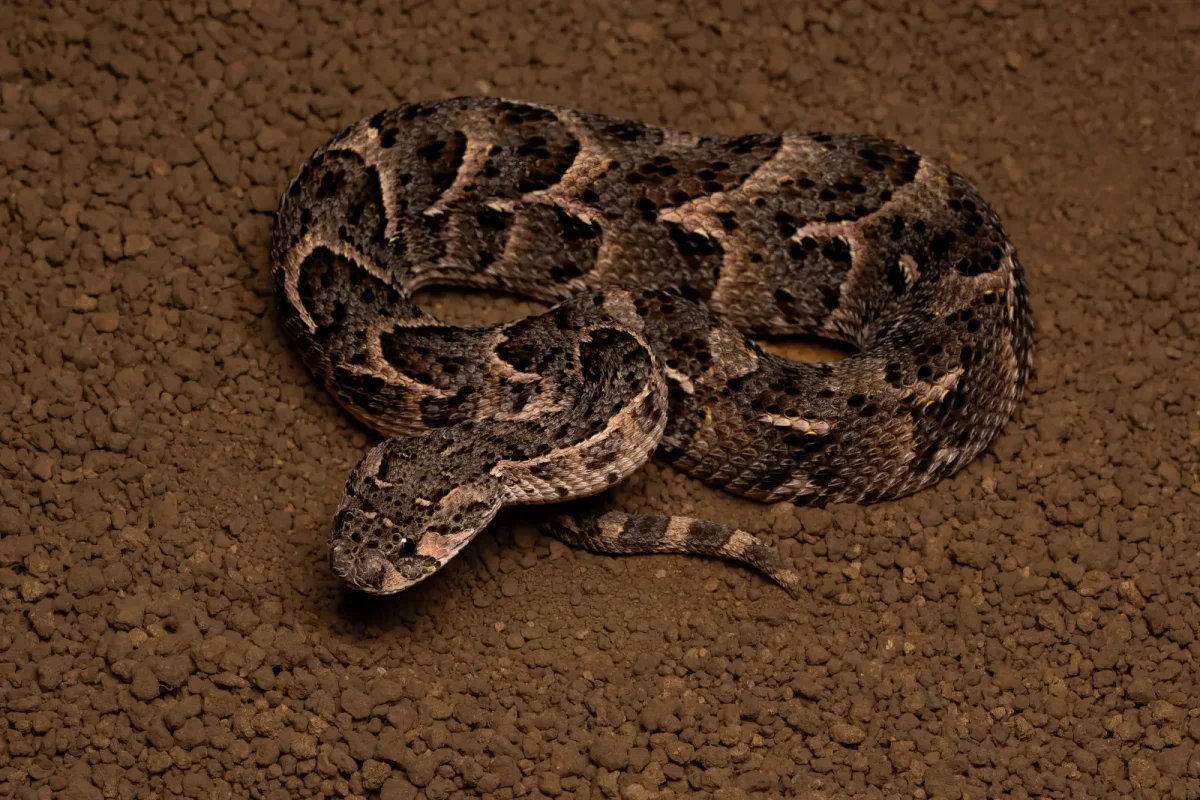
The puff adder (Bitis arietans) is a large, heavy bodied viper and one of the most widespread snakes in Africa. It lives almost everywhere south of the Sahara except in dense rainforest, with small populations in southwestern Morocco and the southwest of the Arabian Peninsula. Adults usually measure about 1 meter, with a broad, flat head and a pattern of dark chevrons on a yellowish, brown or gray body that blends perfectly into dry grass and sand. Its name comes from the loud, deep hiss it makes when it inflates its body to warn off a threat. The puff adder hunts by ambush, lying still for days beside a path or rodent trail and striking at mice, rats, birds and toads that come within reach. It gives birth to live young, often in litters of 20 to 50 or more. Its potent venom destroys tissue, and it causes more serious bites than any other snake across much of Africa. The IUCN lists it as Least Concern.
Name and Classification
The puff adder belongs to the viper family, Viperidae, and to the genus Bitis, a group of thick bodied African vipers that also includes the Gaboon viper, the rhinoceros viper and several small adders of southern Africa. The German naturalist Blasius Merrem described it in 1820 from a specimen collected at the Cape of Good Hope in South Africa. Its species name, arietans, comes from Latin and means striking violently, a fair description of its fast strike. The common name comes from its habit of puffing up its body and letting out a long, loud hiss when disturbed, and it is also called the African puff adder or common puff adder. Two subspecies are recognized: the widespread Bitis arietans arietans and the Somali puff adder, Bitis arietans somalica, of Somalia and northern Kenya, which has keeled scales under its tail. The name puff adder is also used in North America for harmless hognose snakes, which are not related to it.
Size and Appearance
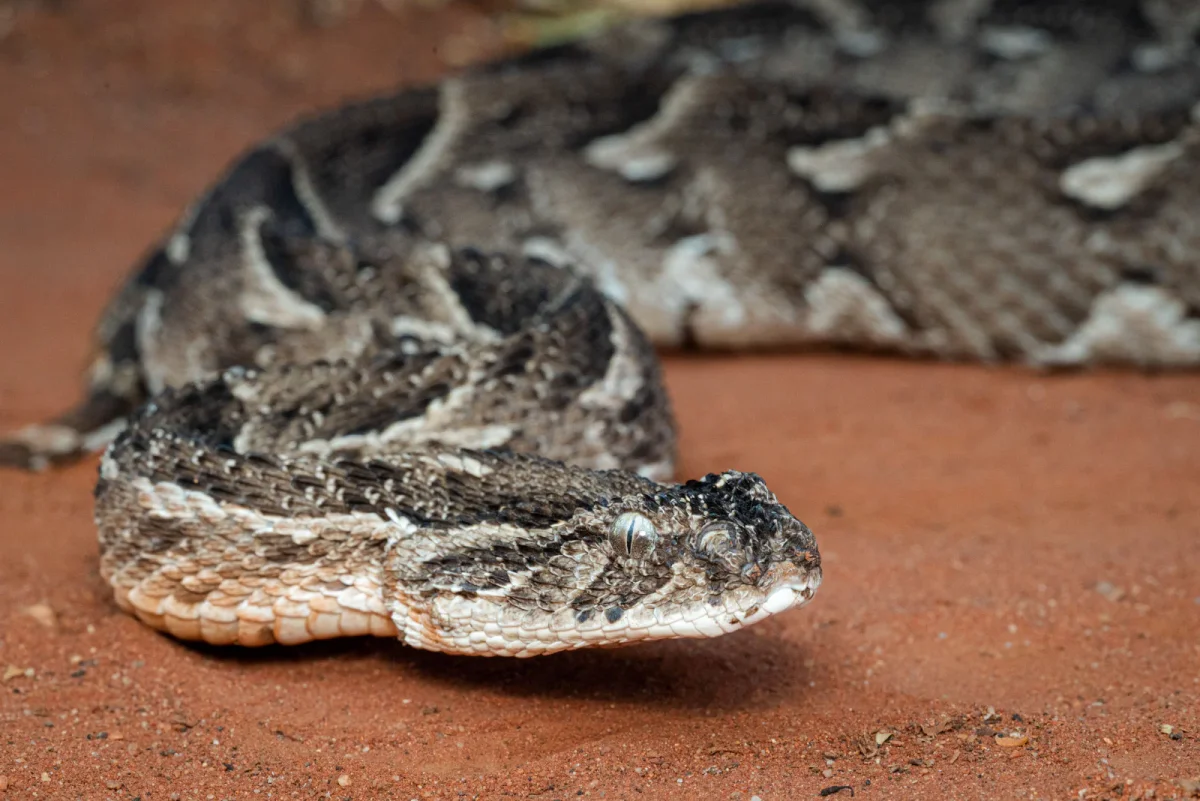
Puff adders usually measure about 1 meter long and are remarkably stout: large ones can measure about 40 centimeters around the middle of the body. In southern Africa most adults measure 0.9 to 1.2 meters, but in East Africa and Somalia much larger snakes have been reported, up to about 1.9 meters and more than 6 kilograms. Snakes from Saudi Arabia are smaller, usually no more than 80 centimeters. The head is broad, flat and much wider than the neck, with vertical pupils and gold to silver gray eyes, and two dark bands cross the top of it. The body is covered in rough, strongly keeled scales. The background color varies from straw yellow and light brown to orange, reddish brown or gray, crossed by about 18 to 22 dark chevrons that point toward the tail. This pattern breaks up the outline of the snake so well that it nearly disappears among leaves, grass and sand. Males from the highlands of East Africa and from South Africa's Western Cape often have a bold yellow and black pattern.
Habitat and Range
The puff adder may be the most common and widespread snake in Africa. It lives across nearly the whole continent south of the Sahara, from Senegal and Mauritania east to Eritrea and Somalia and south to the Cape of Good Hope. Beyond this main range, isolated populations survive in southwestern Morocco and Western Sahara, along the coast from the Souss Valley to Dakhla, and in the southwest of the Arabian Peninsula, from Yemen north to Ta'if in Saudi Arabia, with records in the Dhofar region of Oman. It is found in almost every kind of open country, including savanna, grassland, rocky hills, dry scrub, the Karoo and semidesert, from sea level into the mountains. It avoids true deserts, dense rainforest and high alpine zones, so it is missing from the forests of central Congo and much of the West African coast, as well as from the Mediterranean coast of North Africa. It also does well on farms, along roads and near villages, wherever rodents are common.
Diet and Hunting
The puff adder is an ambush hunter. Rather than searching for food, it coils beside a path, game trail or rodent run and waits, sometimes for days or weeks, until a meal walks past. Rodents are its main prey, including rats, mice and grass mice, but it also eats birds, frogs and toads, lizards, other snakes and the occasional small tortoise. Its strike is so powerful and its long fangs sink so deep that small prey are sometimes killed by the impact alone. It rarely holds on, letting go quickly and returning to its striking position. In 2016 researchers who followed 86 puff adders with radio transmitters and hidden cameras at Dinokeng Game Reserve, north of Pretoria, reported that the snakes flick their tongues slowly in front of frogs, which seem to mistake the moving tongue for an insect and come closer. The snakes used this trick only with frogs and toads, never with rodents, showing they can tell different prey apart. It was the first known case of tongue luring in a land snake.
Camouflage and Defense
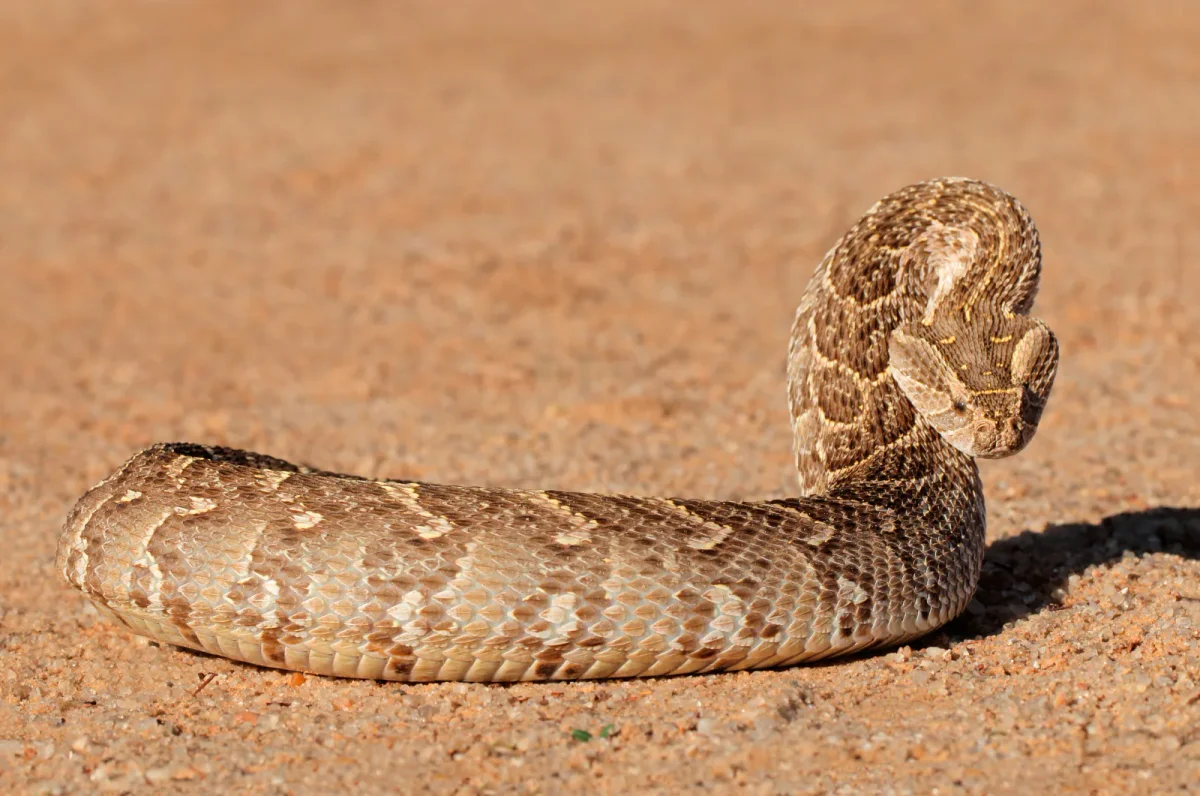
Puff adders spend most of their lives lying perfectly still and trusting their camouflage. They usually move slowly in a straight line, gripping the ground with their wide belly scales like a caterpillar, although they can move surprisingly fast when alarmed. Their disguise works on smell as well as sight. A 2015 study from the University of the Witwatersrand found that trained dogs and meerkats, which easily matched the scent of other snakes, could barely detect puff adders, making it the first land animal shown to use chemical camouflage. Researchers think this is linked to its slow metabolism. A hidden puff adder will not hiss or strike when approached, since that would give it away. If it is discovered and threatened, it inflates its body, hisses loudly and pulls its neck back into a tight S shape, ready to strike to the front or to the side. High speed video has shown that this heavy snake strikes at about 2.6 meters per second, as fast as or faster than much smaller snakes.
Venom and Bites
The puff adder is considered the snake responsible for the most snakebite deaths in Africa. This comes from a mix of factors: it is common over a huge area, it often lives near people, it has long hinged fangs and a large venom supply, and above all it lies still beside paths instead of moving away, so people step on it or near it. Its venom is cytotoxic, which means it attacks tissue and blood vessels. A bite causes intense pain, heavy swelling, blood blisters and bruising, and in serious cases the tissue around the bite dies, which can lead to the loss of fingers, toes or a limb. A large snake can deliver a lot of venom, and around 100 milligrams is thought to be enough to kill an adult. Death is not quick: it usually comes after several days, from shock, bleeding problems or infection. Most deaths are linked to late or poor treatment. A polyvalent antivenom made by South African Vaccine Producers covers puff adder bites and is effective, but supplies have been short in recent years.
Reproduction and Young
Puff adders give birth to live young instead of laying eggs. In the breeding season the female releases a scent that males follow, sometimes in groups: one female in Malindi, Kenya, was trailed by seven males. Rival males wrestle by twisting their necks around each other and trying to push the other down, without biting. After a pregnancy of several months, the female gives birth to a large litter. Litters of 20 to 50 are typical, 50 to 60 are not unusual and more than 80 have been recorded, with the biggest litters coming from the very large females of East Africa. A female from Kenya kept in a zoo in the Czech Republic gave birth to 156 young, the largest litter recorded for any snake. The newborns measure about 12 to 20 centimeters and are fully independent from birth, with working fangs and venom, so the mother gives them no care. In southern Africa, mating usually takes place in spring and early summer.
Predators and Conservation
The IUCN lists the puff adder as Least Concern, with a stable population. It is common across most of its range and adapts well to farmland and land near towns. Even so, it has many enemies. At least 42 predators are known, including mongooses, honey badgers, civets, secretary birds and snake eagles, and squirrels and birds often gather around a resting puff adder to mob it with alarm calls. People are its biggest threat. Puff adders are usually killed on sight because of their reputation, and their habit of lying on warm roads at night means many are run over. Burning of grassland and the spread of farms and towns also take away habitat in some areas. The small, isolated populations of southwestern Morocco are in a much weaker position, with snakes killed on roads and captured for snake charmers in places like Marrakesh. The puff adder plays a useful role, as it eats large numbers of rats and mice that damage crops and spread disease near homes.
Where it is found
The Puff Adder can be found in places such as: