Steppe Eagle
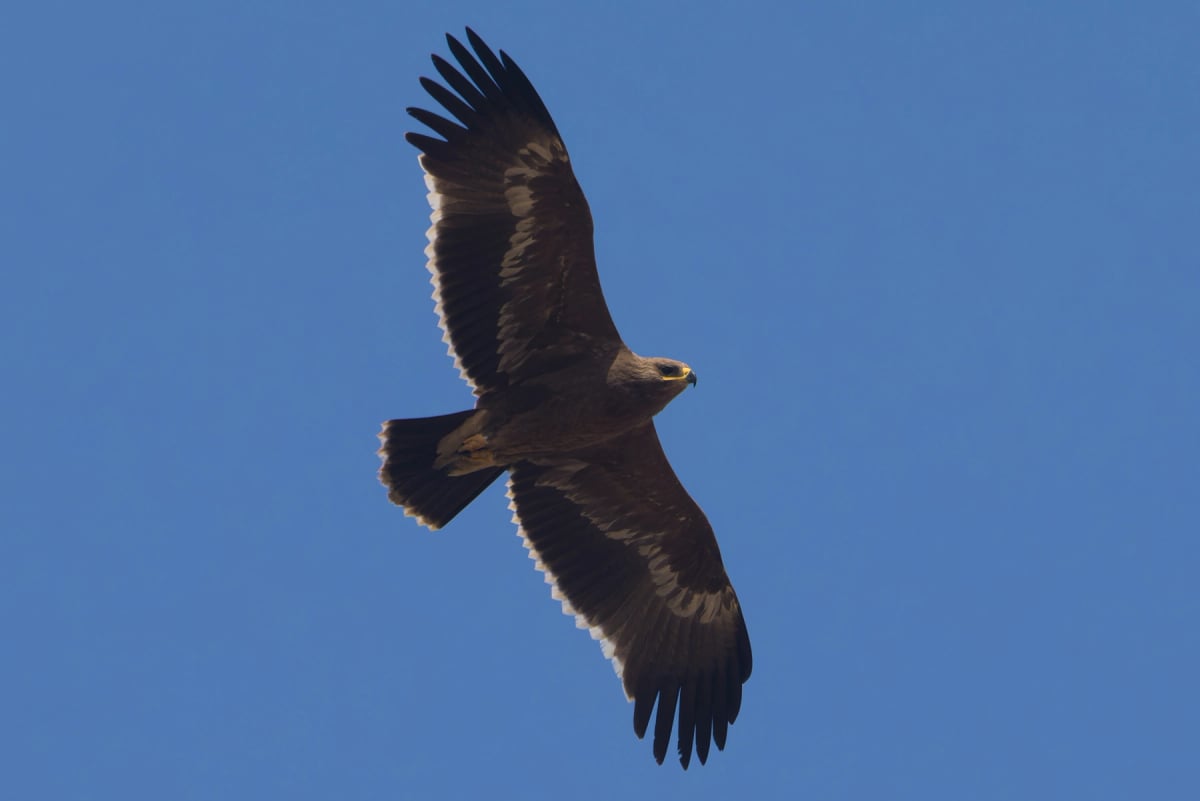
The steppe eagle (Aquila nipalensis) is a large, powerful raptor that breeds on the open steppes and semi deserts of Russia, Kazakhstan, Mongolia and China. Each autumn it makes one of the longest migrations of any eagle, traveling thousands of kilometers to spend the winter in Arabia, eastern and southern Africa and South Asia. Adults are mostly dark brown, with a huge gape, the corner of the mouth, that reaches back to the rear of the eye, longer than in any other eagle of its genus. Its wingspan reaches about 1.65 to 2.15 meters. On its breeding grounds it lives mainly on ground squirrels, and in winter it eats carrion, termites and almost anything easy to get, often in big groups. It is the national bird of Kazakhstan, where it flies on the national flag, and of Egypt. The IUCN has listed it as Endangered since 2015, after the population fell by more than half in 20 years, mainly because of electrocution on power lines, poisoning and the loss of steppe.
Size and appearance
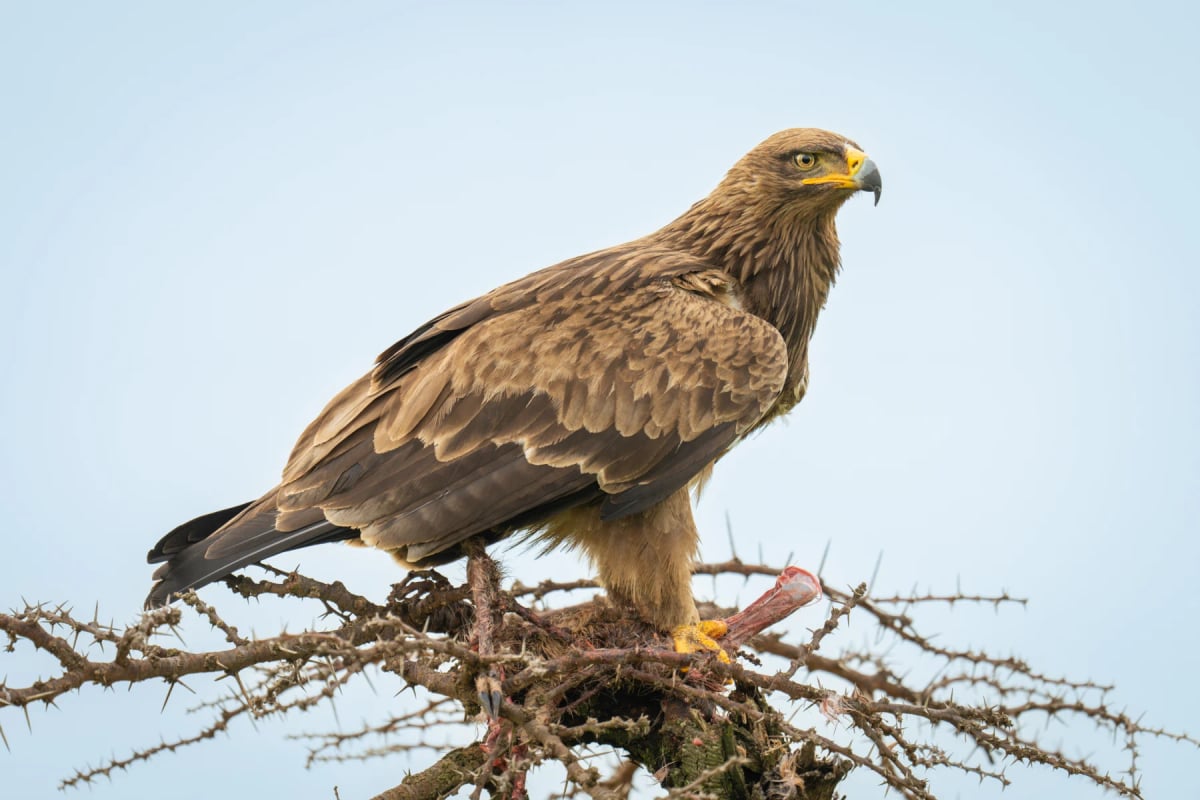
The steppe eagle is a big, heavy eagle with a thick neck, a fairly small head and a strong bill. Adults measure about 60 to 81 centimeters long, with a wingspan of roughly 1.65 to 2.15 meters, and females are larger than males. Most birds weigh between 2 and 4 kilograms, with males averaging about 2.5 kilograms and females about 3.5, and the heaviest females reach about 5 kilograms. Eagles from the eastern part of the range, in Mongolia and China, are around 20 percent heavier than those from the west. Adults are dark brown all over, often with a rusty patch on the back of the head. The best clue is the mouth: the yellow gape line runs back to level with the rear of the eye, longer than in any other Aquila eagle. Young birds are paler, from mid brown to sandy buff, and in flight they show a broad white band along the middle of the underwing, which makes them easy to identify. They take four to five years to reach adult plumage. In flight the wings are long and broad, and the eagle often looks heavy and flat, gliding with its wings slightly bowed.
Where does the steppe eagle live?
Steppe eagles breed almost entirely in four countries: Russia, Kazakhstan, Mongolia and China. The core of the range is the dry steppe of western Kazakhstan and the Kalmykia region of southern Russia, and it stretches east through the Altai, Tuva and Mongolia to Inner Mongolia, Xinjiang and northern Tibet. Kazakhstan alone holds most of the world's breeding pairs. They favour flat or rolling open grassland and semi desert with plenty of ground squirrels, and in the east they also nest on dry rocky hillsides. The species once bred in Ukraine, Moldova and Romania, but it has disappeared from Europe outside Russia. Once the breeding season ends, these eagles head south to spend the northern winter in very different places: the Arabian Peninsula, where some 7,200 birds were counted near Riyadh in Saudi Arabia, eastern and southern Africa from Ethiopia and Kenya down to Botswana and northern South Africa, and South Asia, from Pakistan and India to Nepal, Bangladesh and Myanmar. In winter they use savanna, farmland, rubbish dumps and almost any open country with easy food.
What does the steppe eagle eat?
On its breeding grounds the steppe eagle is a ground squirrel specialist. The little ground squirrel, or souslik, is the prey most linked to it, and in some areas it makes up almost the whole diet. Most prey weighs less than 250 grams: ground squirrels, hamsters, voles, pikas, young marmots and hares, plus some birds and reptiles. Nesting pairs are only common where small burrowing mammals are plentiful, so the decline of ground squirrels in places like Kalmykia has hit the eagles hard. It hunts by watching from the ground or a low perch, or by gliding low and dropping on prey, and in Kazakhstan and Mongolia it has been seen avoiding casting its shadow before it strikes. In winter its habits change completely. It becomes a lazy feeder that prefers food that takes little effort: carrion, slaughterhouse waste, rubbish dumps, swarms of termites and locusts, and flocks of small birds such as queleas. In Africa, dozens of eagles gather when winged termites emerge after the rains, catching them on the ground or in the air. This flexibility helps it survive its long annual journey.
Migration routes
Every autumn, steppe eagles leave their breeding grounds and travel thousands of kilometers south, soaring on warm rising air and gliding from one thermal to the next. They follow two main routes. Western birds cross the Middle East and Arabia, where many stay for the winter, while others go around the Red Sea to Africa. In the past the counts were enormous: about 76,000 steppe eagles crossed the Bab el Mandeb strait in Yemen in the autumn of 1987, up to 65,000 passed Suez in Egypt, and as many as 75,000 flew over Eilat in Israel in the spring of 1985. Today Eilat sees around 28,000 in an average spring, with the peak in early March. Eastern birds move through Central Asia and cross the Himalayas into South Asia, and Nepal is a key bottleneck: in one autumn count, steppe eagles made up more than 80 percent of the migrating raptors there. Satellite tags show that a young eagle's first autumn journey averages about 4,200 kilometers, and that young birds often change wintering areas from India to southern Africa from year to year.
Nesting and breeding
Unlike most large eagles, the steppe eagle usually nests on or near the ground, because its open steppe has few trees. Nests are piles of sticks, dry plants and even rubbish placed on the ground, on small mounds, cliffs and haystacks, in low bushes, or more and more often on power line poles, which is one of the reasons so many are electrocuted. Pairs return in spring and lay one to three eggs, usually two, and normally one or two chicks reach the point of flying. Because the nests are so exposed, chicks are at risk from foxes, dogs, wildfires and trampling by cattle. Breeding success depends heavily on the number of ground squirrels around the nest, and in poor years many pairs fail. Young eagles do not return to the place they hatched in their first summer; instead they wander widely across the northern steppes. They mature at four to five years old. More breeding by young birds that are not yet in full adult plumage has been seen in recent years, which scientists take as a sign of a population under stress.
Steppe eagle vs golden eagle and tawny eagle
The steppe eagle is easy to confuse with other big brown eagles. The golden eagle is a little larger and much more powerful, with bigger feet and talons, a longer tail, a smaller bill and a golden nape. It hunts larger prey such as hares and foxes and lives mostly in mountains and rugged country, while the steppe eagle prefers flat grassland and is far more social, often feeding in groups. Despite their looks, the two are not close relatives: genetic studies show the steppe eagle is nearer to the tawny eagle and the imperial eagles, and it has even paired with eastern imperial eagles in Kazakhstan and Turkey. The tawny eagle, a resident of Africa and South Asia, was treated as the same species until 1991. It is smaller and slimmer, with a shorter gape that stops below the middle of the eye, a longer tail and an upright posture, and its colour varies from pale buff to dark brown. Young steppe eagles have a white band under the wing that tawny eagles never show. In Africa and India, where both species meet in winter, telling them apart is a classic birdwatching challenge.
Threats
The steppe eagle faces serious pressures across much of its range, and the global population has fallen sharply: by at least 58.6 percent in the 20 years before 2015. Electrocution on poorly designed power lines is one of the leading causes of death. In Kazakhstan, studies estimated an average of 13 dead steppe eagles for every 10 kilometers of dangerous line, and in some stretches steppe eagles made up nearly half of all electrocuted raptors. Because they like to perch and even nest on poles in treeless country, they are especially exposed. Poisoning is another major concern: eagles die after eating carcasses laced with toxins, set to kill wolves and other predators, or rodents killed with poison. The loss of steppe to farming, overgrazing, wildfires and the collapse of ground squirrel colonies reduces food on the breeding grounds, and cattle and dogs destroy ground nests. Collisions with wind turbines and vehicles add further pressure. Because steppe eagles gather in large numbers at dumps, carcasses and migration bottlenecks, a single poisoned bait or bad stretch of line can kill many birds at once.
Conservation
The steppe eagle was uplisted from Least Concern to Endangered on the IUCN Red List in 2015, one of the fastest declines of any eagle. The IUCN estimates the world population at roughly 50,000 to 75,000 mature birds, and another recent study put it at 53,000 to 86,000 breeding pairs, most of them in Kazakhstan. Retrofitting dangerous power lines with insulated cables and safer pole designs has proven effective at reducing electrocutions, and more countries are starting to require bird safe designs. Conservation groups work with local communities in Kazakhstan, Russia and Mongolia to protect key nesting areas, guard nests and monitor breeding success. Satellite tagging programs follow individual eagles throughout their annual journey, revealing which stopover and wintering sites matter most. Campaigns in Africa, Arabia and South Asia aim to reduce poisoning. International cooperation is essential, since no single country can protect a species that depends on dozens of nations on three continents every year.
Where it is found
The Steppe Eagle can be found in places such as:
Researched and written by Juan Pablo. Sources: IUCN Red List, scientific literature and regional field guides. Last updated: .
Technical factsheet








Frequently Asked Questions
Which country has the steppe eagle as its national bird?
The steppe eagle is the national bird of Kazakhstan, the country that holds most of its breeding pairs, and a golden steppe eagle flies under the sun on the Kazakh flag. It is also listed as the national bird of Egypt, where large numbers once passed through Suez and Sinai on migration, and an eagle appears on the Egyptian flag and coat of arms. In Kazakhstan the bird is a symbol of freedom and of the open steppe, and eagles have a long history in Kazakh culture.
How can you tell a steppe eagle from a golden eagle?
Look at the head and the shape. The golden eagle has a golden nape, a smaller bill, a longer tail and bigger feet, and it looks more elegant in flight. The steppe eagle is bulkier, with a heavier bill and a very long yellow gape that reaches the back of the eye. Young steppe eagles show a broad white band under the wings, while young golden eagles have white patches at the base of the flight feathers and a white tail with a dark tip. Habitat helps too: golden eagles prefer mountains, steppe eagles flat open country.
Where can you see steppe eagles on migration?
The best places are the big raptor bottlenecks. In spring, Eilat in southern Israel sees tens of thousands, with the peak in early March. In autumn, the Himalayan foothills of Nepal are excellent, as steppe eagles stream west along the ridges in late October and early November. Batumi in Georgia, the Bab el Mandeb strait in Yemen and Djibouti, and the Suez area in Egypt are other key spots. In winter, they can be seen at rubbish dumps and open country in Saudi Arabia, India, Ethiopia and Kenya.
Why is the steppe eagle called Aquila nipalensis?
Aquila is Latin for eagle, and nipalensis means from Nepal. The species was described from a specimen collected in Nepal, which was most likely a bird on migration rather than a local breeder, since steppe eagles only pass through Nepal or spend the winter there. The name stuck even though the bird's real home is the steppe of Kazakhstan, Russia, Mongolia and China, thousands of kilometers to the north.
Do steppe eagles really eat termites?
Yes, and in large numbers. In Africa and India, steppe eagles gather when swarms of winged termites leave their mounds after the rains, walking on the ground or snatching them in the air, sometimes dozens of eagles together. It seems strange for such a large raptor, but termites are easy, rich food. Locusts, queleas and other small prey that come in huge numbers are taken the same way. It shows how differently the steppe eagle lives in winter compared with its breeding season, when it hunts ground squirrels.
How far does the steppe eagle migrate?
Steppe eagles are among the great travelers of the eagle world. Each year they fly from their breeding grounds in Russia, Kazakhstan, Mongolia and China to Arabia, eastern and southern Africa or South Asia, and then back again. Birds that winter in southern Africa cover well over 10,000 kilometers each way. Tracking of young eagles showed a first autumn journey averaging about 4,200 kilometers, and adult birds tracked from Kazakhstan took around 40 days to fly home in spring, covering more than 350 kilometers a day.
Is the steppe eagle endangered?
Yes. The steppe eagle has been listed as Endangered on the IUCN Red List since 2015, when it was moved up from Least Concern after the population fell by more than half in about 20 years. The IUCN puts the world population at roughly 50,000 to 75,000 mature birds, and it is still declining. The main threats are electrocution on power lines, poisoned baits and carcasses, the loss of open steppe and the collapse of the ground squirrels it feeds on. Because these eagles gather in groups, a single harmful event can kill many at once.
Why do steppe eagles gather in such large flocks?
Steppe eagles are far more social than most eagles, especially outside the breeding season. They come together in large numbers wherever food is plentiful and easy, such as rubbish dumps, slaughterhouses, animal carcasses and termite emergences after rain in Africa. Near Riyadh in Saudi Arabia, around 7,200 were once counted in a single wintering area. They also travel in loose groups along migration routes, using the same thermals, and hundreds can pass a bottleneck in a single day.