Common Kingfisher
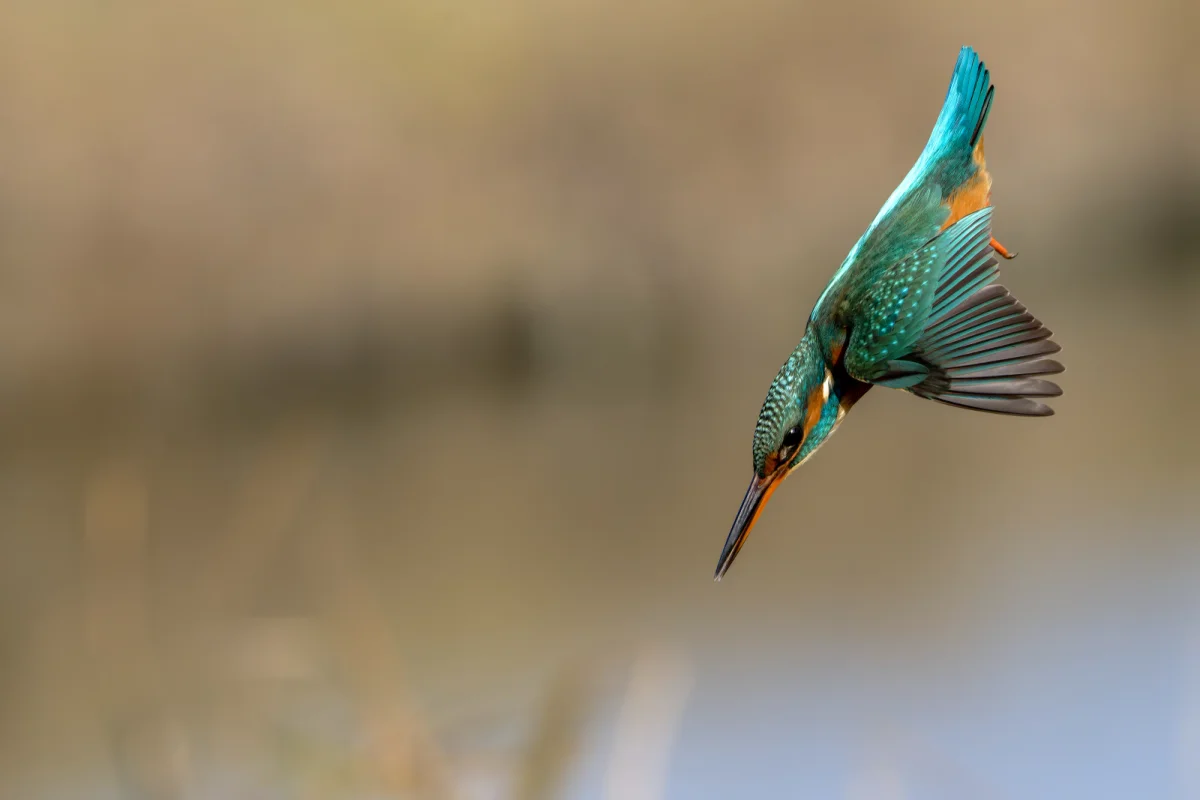
The common kingfisher (Alcedo atthis), also known as the European kingfisher or river kingfisher, is a small, brilliantly colored bird about 16 centimeters long. Its back and head shine electric blue and green, its underparts are bright orange and it has a long, dagger shaped black bill. It lives along clear, slow rivers, streams, lakes and ponds across Europe, North Africa and Asia, east to Japan, and south through Southeast Asia to New Guinea and the Solomon Islands. It feeds mainly on small fish, which it catches by diving headfirst into the water from a perch or after hovering in the air. Pairs dig a nesting tunnel up to about a meter long into a sandy riverbank and can raise two or three broods in a summer. Birds in the far north migrate south for the winter, when frozen water would leave them without food. Severe winters and polluted or straightened rivers can cause sharp local declines, but the IUCN lists the species as Least Concern.
Names and Relatives
The common kingfisher is also called the European kingfisher or river kingfisher, and in Britain and Ireland it is simply known as the kingfisher, since it is the only member of its family found there. It belongs to the kingfisher family, Alcedinidae, a group of more than 100 species spread across the world. The family includes small, fish eating river birds like this one, as well as large forest dwellers such as the kookaburras of Australia, which rarely fish at all. Scientists recognize seven subspecies of the common kingfisher. They differ slightly in size and in the shade of blue and orange, from the birds of western Europe to the larger, brighter races of East Asia, Sri Lanka, Indonesia, New Guinea and the Solomon Islands. The bird has a long place in European culture. In Greek mythology it was linked to the halcyon, a bird said to calm the sea while it nested in winter, which is the origin of the English expression halcyon days for a peaceful time.
Size and Appearance
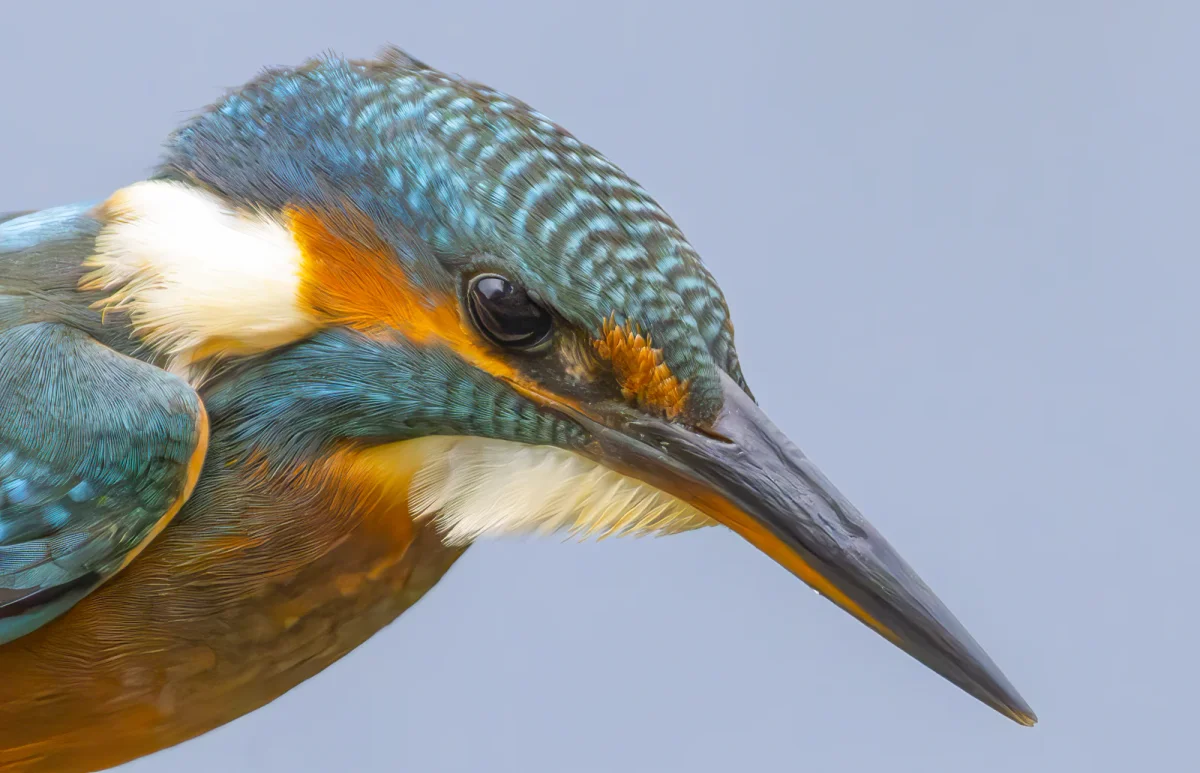
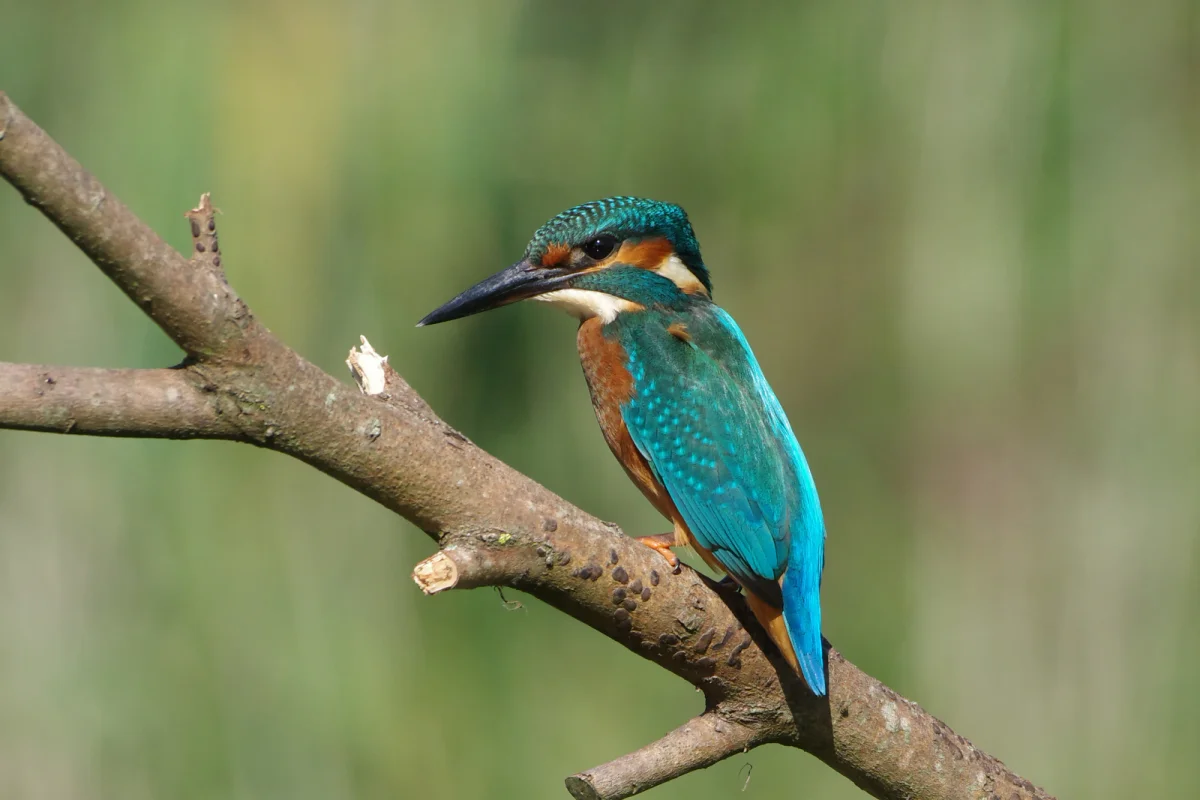
The common kingfisher is a small bird, about 16 to 17 centimeters long, with a wingspan of around 25 centimeters and a weight of only 34 to 46 grams. It has a large head, a short tail, tiny red feet and a long, straight, pointed bill that makes up a big part of its length. The crown and wings are blue green with pale blue spots, and a stripe of shining cobalt blue runs down the middle of the back to the tail. The cheeks and underparts are rich orange, and there is a white patch on the throat and on each side of the neck. Males and females look almost identical, but they can be told apart by the bill: the male's is all black, while the female has an orange or reddish lower half, as if she were wearing lipstick. Young birds are duller and greener. The famous blue is not made by pigment. It comes from the tiny spongy structure inside the feathers, which reflects blue light and makes the color change from blue to green as the bird moves.
Hunting and Diet
Small fish make up most of the common kingfisher's diet, usually between 3 and 8 centimeters long, such as minnows, sticklebacks, small roach and young trout. It also takes aquatic insects, freshwater shrimp, small crayfish and tadpoles, especially in winter, when fish are harder to catch. It hunts mostly from a perch one or two meters above the water, such as a branch, a reed or a post, sitting still and watching. When it spots prey it drops headfirst into the water at a steep angle with its wings folded back, grabs the fish in its bill and flies back up within a second or two. Where there are no perches it can hover over the water before diving. Back on the branch, it beats larger fish against the wood to stun them and then swallows them headfirst, so the fins and scales lie flat. Bones and scales are later coughed up as small pellets. Because it hunts by sight, the kingfisher needs clear water, and muddy or polluted rivers make fishing much harder.
Habitat and Range
The common kingfisher has one of the largest ranges of any kingfisher. It lives across almost all of Europe except the far north, in North Africa, and through the Middle East and much of Asia, from Central Asia and Siberia to China, Korea and Japan, and south through India, Sri Lanka and Southeast Asia to Indonesia, New Guinea and the Solomon Islands. It needs calm, clear fresh water with plenty of small fish and nearby perches: slow rivers and streams, canals, lakes, ponds, marshes and flooded gravel pits, often close to towns. For nesting it also needs a steep bank of sand or soft earth. In winter many move to estuaries, coastal lagoons, harbors and rocky shores, where the water does not freeze. Birds in western and southern Europe usually stay all year, though the young move away to find their own territories. Those breeding in Scandinavia, Russia, Central Asia and northern China migrate south in autumn, wintering around the Mediterranean, in the Middle East and in southern Asia.
Nesting and Young
Kingfishers spend most of the year alone, each defending its own stretch of river, and pairs usually form anew each spring. In spring the male courts the female by offering her fish. The pair then dig their nest together, a straight tunnel usually 60 to 90 centimeters long in a vertical bank of sand or soft earth, often over the water, ending in a rounded chamber. They dig by flying at the bank to break the surface and then loosen the soil with their bills, pushing it out with their feet. There is no nesting material, and the chamber soon fills with fish bones and droppings. The female lays usually five to seven round, glossy white eggs, and both parents take turns incubating them for 19 to 21 days. The chicks are fed in rotation, each receiving many fish a day, and they leave the nest after about 25 days. The parents often start a second brood right away, and some pairs raise three in a season. Most kingfishers live only about two years, and many young die in their first winter.
Kingfishers and People
With its bright colors and its habit of living close to towns, the common kingfisher is one of the most loved and most photographed birds in Europe and Asia. Photographers wait for hours beside rivers and ponds to catch the split second of a dive. Its fishing skill also inspired one of the best known examples of engineering copied from nature. In Japan in the 1990s, the first high speed Shinkansen trains made a loud boom when they shot out of tunnels, because they pushed a wall of air in front of them. Eiji Nakatsu, an engineer at the railway company JR West and a keen birdwatcher, noticed that the kingfisher moves from air into water, which is much denser, with barely a splash. His team tested nose shapes in models and computer simulations, and the best design closely resembled the kingfisher's long, pointed bill. The 500 series train, which entered service in 1997, was quieter in tunnels and used less energy than the trains before it.
Threats and Conservation
The common kingfisher is widespread and common in much of its range, and the IUCN lists it as Least Concern, although its population is thought to be slowly decreasing. Cold weather is its most dramatic natural danger. When rivers and lakes freeze for long periods the birds cannot reach fish and many starve. In Britain the severe winter of 1962 to 1963 is thought to have killed up to 90 percent of kingfishers, and a long frost in 2009 was reported to have killed about half of those in the Netherlands. Thanks to large clutches and several broods a year, numbers usually recover within a few seasons. The longer term threats come from people: water pollution that kills fish and clouds rivers, the straightening of rivers and the covering of banks with concrete or stone, which removes nesting sites, and disturbance along popular waterways. Cleaner rivers have helped kingfishers return to many cities, and conservation groups build artificial nesting banks where natural ones have been lost.
Where it is found
The Common Kingfisher can be found in places such as: