Akhal Teke Horse
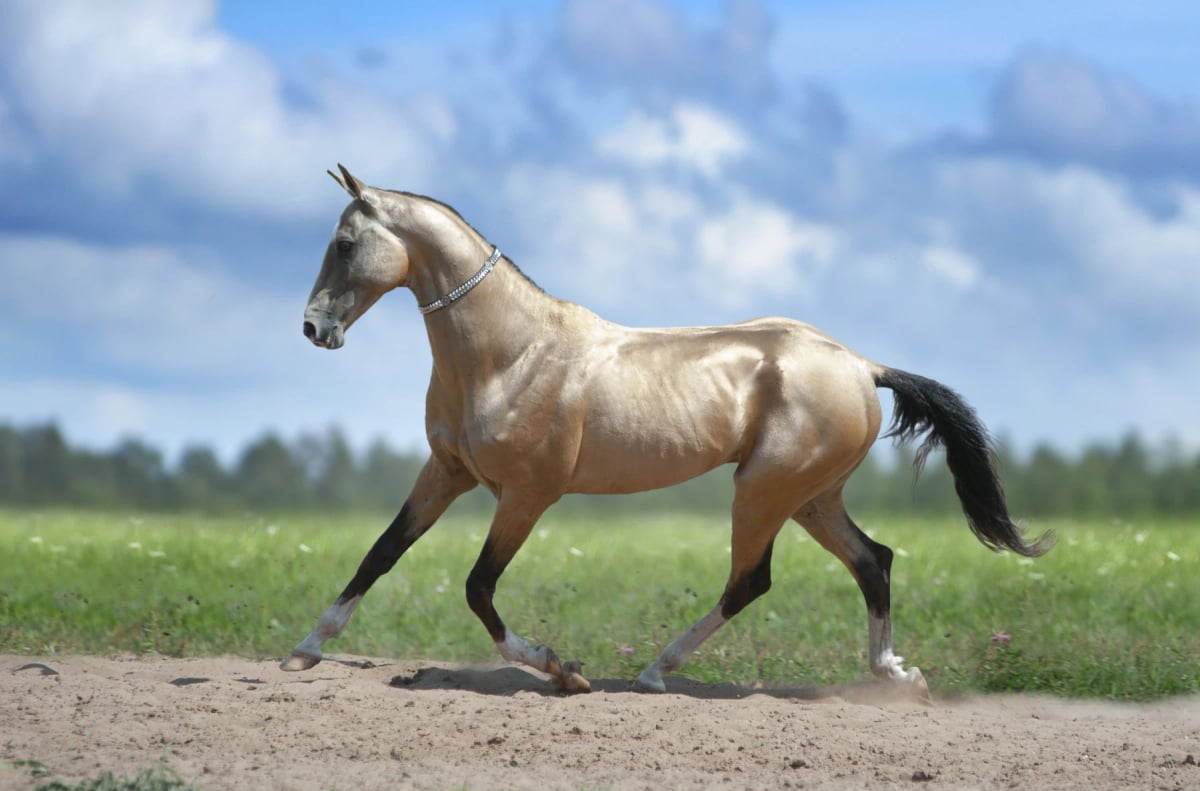
The Akhal Teke is a horse breed from Turkmenistan, famous for its metallic coat and its endurance. It was bred by the Teke tribe in the oases at the edge of the Karakum Desert, where horses had to cover long distances in great heat with little water, and it descends from the ancient Turkoman horse of Central Asia. The body is long, lean and narrow, with a long upright neck, a fine head and thin skin, and adults stand about 147 to 163 centimeters at the shoulder. Its hair has a special structure that bends light, so the coat shines like polished metal, most strikingly in the golden buckskins and palominos the breed is known for. Akhal Tekes are sensitive and quick, often bond closely with one rider and today compete in endurance riding, dressage and show jumping. The breed is the national animal of Turkmenistan and appears on its coat of arms. With only a few thousand purebreds worldwide and a closed stud book, careful breeding is needed to keep it healthy.
Origin
The Akhal Teke comes from Turkmenistan, and its name joins a place and a people: the Akhal oasis, a string of settlements at the foot of the Kopet Dag mountains on the edge of the Karakum Desert, and the Teke, the Turkmen tribe that bred these horses there. The Karakum is one of the hottest and driest deserts in the world, and the Teke raised their horses for speed and endurance on long raids across it, feeding them barley, mutton fat and dried alfalfa and keeping them close to their tents. The breed is descended from the ancient Turkoman horse of Central Asia and is often counted among the oldest horse breeds still in existence. Its lean body with little fat, thin skin and short, fine coat suit the desert heat. Today most Akhal Tekes live in Turkmenistan and Russia, with smaller breeding programs in Europe and the United States.
The Metallic Coat and Other Features
The most celebrated trait of the Akhal Teke is its coat, which shines with a metallic gleam, as if the horse were polished gold or bronze. The effect comes from the structure of the hair. In most horses each hair has a thick opaque core; in the Akhal Teke that core is small or missing in places, and the transparent part of the hair lets light in and bends it out again, a little like an optical fiber. Studies have also found that their hairs are finer than those of Arabians and Thoroughbreds. The sheen appears in every color, but it is most striking in the golden buckskins and palominos the breed is famous for; Akhal Tekes can also be bay, black, chestnut, gray and pale cream. The body is long, narrow and athletic, with a long, upright neck, a fine head, almond shaped eyes, long ears and a thin mane and tail. The skin is so thin that veins often show beneath it. Adults usually stand about 147 to 163 centimeters at the withers.
Endurance, Temperament and Famous Horses
Akhal Tekes are bred for endurance, and their best known feat proves it. In 1935 a group of Turkmen riders on Akhal Teke and Yomud horses rode from Ashgabat to Moscow, more than 4,000 kilometers in 84 days, including a crossing of the Karakum Desert with almost no water. The breed has also shone in sport. Absent, a black Akhal Teke stallion ridden by Sergei Filatov, won the individual dressage gold medal at the 1960 Olympic Games in Rome, still one of the most famous dressage horses in history. Akhal Tekes have a reputation for bonding strongly with one person, and many owners describe them as sensitive, intelligent and quick to react. They can be challenging for inexperienced riders, but with a calm, consistent handler they are willing and responsive. Today they compete in endurance riding, dressage, show jumping and racing.
National Symbol of Turkmenistan
No other country is as closely tied to a horse breed as Turkmenistan is to the Akhal Teke. The horse is the national animal, and since 2003 the center of the national coat of arms has shown Yanardag, a real Akhal Teke stallion foaled in 1991 that belonged to the country's first president. The breed also appears on banknotes and stamps. Since 1992 Turkmenistan has celebrated Turkmen Horse Day every year on the last Sunday of April, with races, parades and beauty contests for horses, and a decree in 2011 made those beauty contests an annual national event. Monuments to Akhal Tekes stand in Ashgabat, including one to Yanardag unveiled in 2014, and the state controls the export of the breed. Akhal Tekes have also been used as diplomatic gifts: in 1956 the Soviet leaders Nikita Khrushchev and Nikolai Bulganin presented Queen Elizabeth II with a golden stallion named Melekush. For Turkmen families, the horse remains a sign of pride, wealth and good fortune.
Population and Breeding
With roughly 6,000 to 7,000 purebred horses worldwide, the Akhal Teke is one of the rarest horse breeds. Its stud book has been closed since 1932, so only horses descended from registered Akhal Teke parents can be recorded as purebred, and the first official volume was published in 1941. Most of the breeding still happens in Turkmenistan and Russia, with smaller programs in countries such as Germany, the Czech Republic, Estonia, Italy and the United States. A closed stud book protects the breed's character, but it also means that many horses are closely related. Genetic studies have found different levels of diversity from one country to another, with some European herds well managed and others more inbred. One known problem is naked foal syndrome, an inherited disease in which foals are born almost without hair and usually die within weeks or a few years. In 2017 scientists found the gene behind it, and breeders can now test their horses to avoid mating two carriers.