Manatee
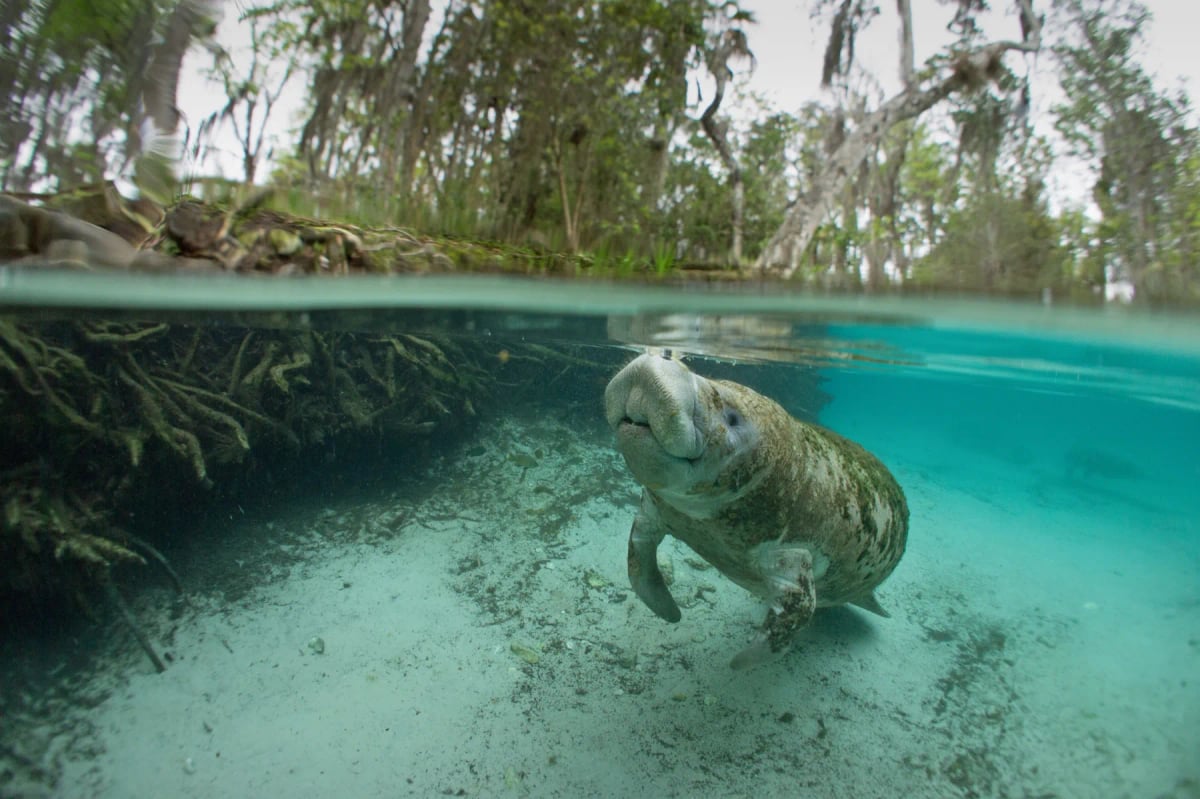
The West Indian manatee is one of the largest aquatic mammals in the Americas, stretching up to 4 meters in length and weighing as much as 600 kg. It lives in warm, shallow waters from Florida and the Caribbean down to northern South America, moving between rivers, estuaries, mangroves, and coastal lagoons depending on the season. This slow, barrel-shaped herbivore grazes on seagrass and aquatic plants for up to eight hours a day, consuming roughly 10 percent of its body weight in vegetation. Often called a sea cow, it surfaces every few minutes to breathe and can rest submerged for up to 20 minutes. Manatees are generally solitary but gather at warm water springs during cooler months. Despite legal protection across its range, the species remains Vulnerable, with boat collisions, habitat loss, and entanglement in fishing gear posing ongoing threats to its survival.
Habitat and distribution
The West Indian manatee ranges across a broad stretch of the western Atlantic, from the shallow coastal waters of Florida and the Gulf of Mexico through the Caribbean islands and Central America, all the way to northern Brazil. It favors warm, sheltered environments such as rivers, estuaries, mangrove channels, and coastal lagoons, rarely venturing into water colder than 20 degrees Celsius. During winter months in Florida, large numbers gather near natural warm water springs and the outflows of power plants to escape the cold. In tropical regions, manatees move more freely year round between freshwater and saltwater habitats, following the availability of aquatic vegetation. They are capable swimmers over short distances and have been recorded crossing open stretches of ocean between islands.
Appearance
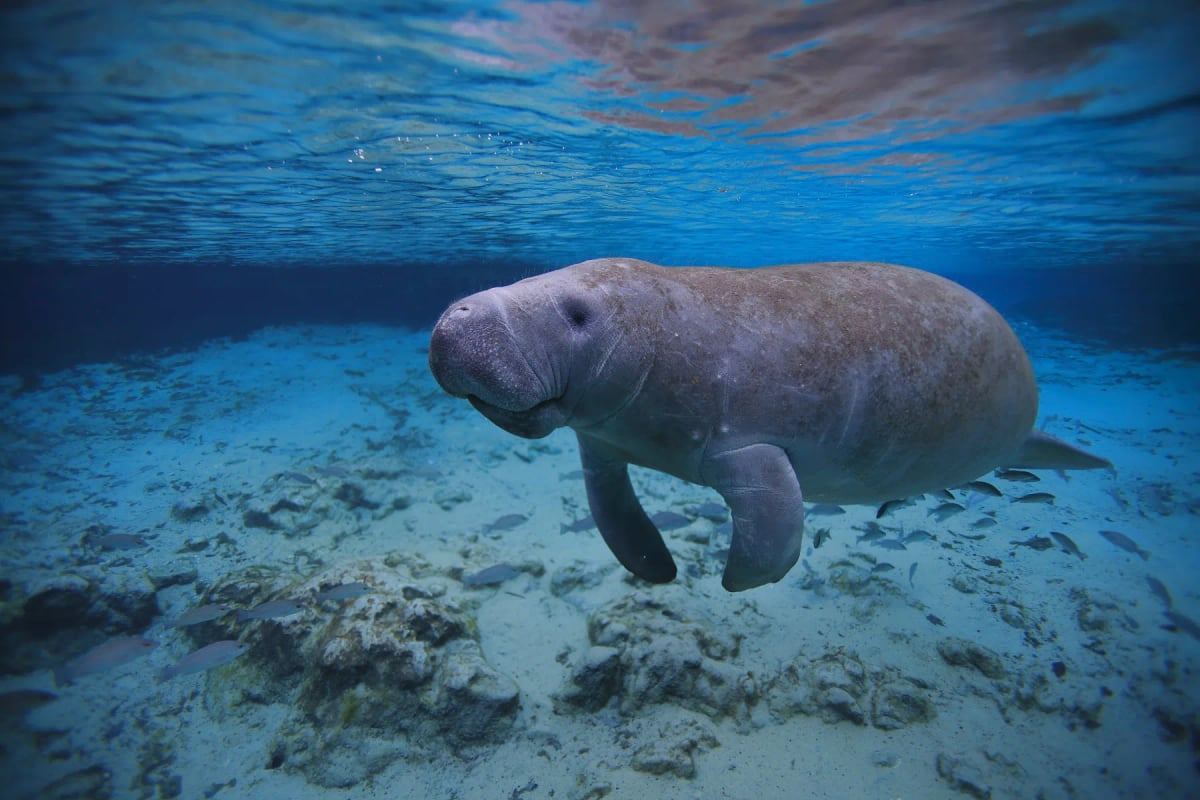
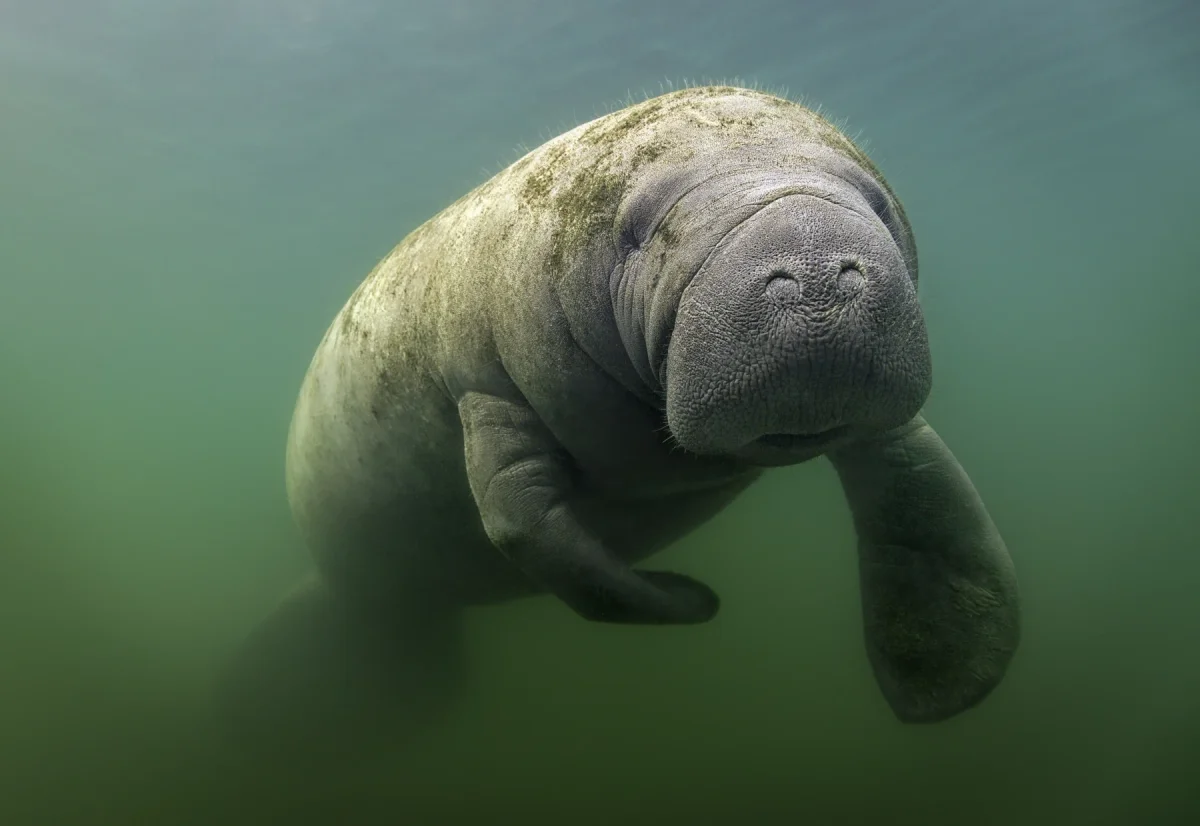
Few aquatic mammals look quite like a manatee. The body is large and barrel shaped, tapering toward a broad, paddle like tail that propels the animal through the water with slow, sweeping strokes. The skin is thick and wrinkled, ranging from gray to brownish gray, and is often covered in patches of algae. Two small, rounded flippers sit near the front of the body and are used for steering, grasping vegetation, and even pushing food toward the mouth. The face is surprisingly expressive, with a large, flexible upper lip split in two, which the animal uses to grip and pull plants. Adults typically reach between 2.5 and 4 meters in length and can weigh anywhere from 200 to 600 kilograms. There is no dorsal fin.
Diet
Grazing takes up a large part of a manatee's day. These animals are strict herbivores and feed on more than 60 species of aquatic plants, with seagrasses making up the bulk of their diet in coastal areas. In rivers and estuaries, they also consume freshwater vegetation, overhanging leaves, and algae. An adult manatee can eat up to 10 percent of its body weight in plant matter each day, which means up to 50 kilograms of vegetation for a large individual. Feeding sessions can last as long as eight hours. By cropping seagrass beds regularly, manatees encourage new growth and help maintain the health of these important ecosystems. Their teeth are unusual among mammals: worn molars are continuously replaced by new ones moving forward from the back of the jaw throughout their lives.
Behavior
For most of the year, manatees lead quiet, solitary lives. They spend their time alternating between feeding, resting on the seabed, and surfacing to breathe, typically every three to five minutes, though they can remain submerged for up to 20 minutes when resting. Communication between individuals involves squeaks, chirps, and whistles, which are particularly important between mothers and their calves. Manatees are not territorial and show no aggression toward one another. During cooler months, they gather in large aggregations at warm water refuges, sometimes numbering in the hundreds at a single spring. Mating groups, known as mating herds, form when a single female in estrus attracts multiple males over a period of weeks. Outside of these gatherings, social bonds are generally loose, with the strongest tie being the relationship between a mother and her calf.
Threats
Collisions with motorboats are the single biggest cause of manatee deaths in the United States, and most adult manatees in Florida carry propeller scars on their bodies. Beyond boat strikes, entanglement in crab trap lines and fishing nets causes injuries and drowning. Habitat degradation is another serious concern: the loss of seagrass beds due to water pollution and coastal development leaves manatees without adequate food sources. An unprecedented die off in Florida in 2021, in which over 1,000 animals perished, was directly linked to the collapse of seagrass in the Indian River Lagoon caused by algal blooms from nutrient pollution. Red tide events, triggered by naturally occurring but increasingly frequent harmful algal blooms, can also be lethal. In parts of Central America and the Caribbean, illegal hunting remains an ongoing pressure.
Conservation
Across its range, the West Indian manatee benefits from a range of legal protections. In the United States, it is covered by the Marine Mammal Protection Act and was listed under the Endangered Species Act since 1973, though its status was downlisted to Threatened in 2017 following population increases in Florida. Speed restriction zones in key waterways have reduced, though not eliminated, boat strike mortality. Rescue and rehabilitation programs operated by organizations such as SeaWorld and the Florida Fish and Wildlife Conservation Commission have returned hundreds of injured manatees to the wild. Internationally, the species is listed on Appendix I and II of CITES, restricting trade. Ongoing efforts focus on restoring seagrass beds, reducing water pollution, and strengthening protections across Central America and the Caribbean, where enforcement is often limited.
Where it is found
The Manatee can be found in places such as:
Researched and written by Juan Pablo. Sources: IUCN Red List, scientific literature and regional field guides. Last updated: .
Technical factsheet

Frequently Asked Questions
What do manatees eat?
Manatees are herbivores and feed almost entirely on aquatic plants. Seagrasses make up the bulk of their diet in coastal waters, but they also eat freshwater vegetation, algae, and even overhanging leaves in rivers. An adult can consume up to 50 kilograms of plant matter in a single day, spending as many as eight hours grazing. This constant feeding helps keep seagrass beds healthy by encouraging new growth.
How long can a manatee hold its breath?
Manatees surface to breathe every three to five minutes during normal activity. When resting on the bottom, however, they can stay submerged for up to 20 minutes without coming up for air. They are mammals, so they rely entirely on breathing air at the surface. Calves need to breathe more frequently than adults and gradually build up their capacity to stay underwater as they grow.
Where do manatees live?
West Indian manatees live in warm, shallow waters along the western Atlantic coast, from Florida and the Gulf of Mexico through the Caribbean and Central America down to northern Brazil. They move between rivers, estuaries, mangroves, and coastal lagoons depending on the season. They avoid water colder than 20 degrees Celsius and gather near warm water springs in Florida during winter to stay warm.
Are manatees endangered?
The West Indian manatee is currently classified as Vulnerable on the IUCN Red List. In the United States, its federal status was downlisted from Endangered to Threatened in 2017 after Florida populations showed signs of recovery. Even so, the species still faces serious threats, including boat collisions, habitat loss, and the collapse of seagrass beds. A mass die off in Florida in 2021 killed over 1,000 manatees, highlighting how fragile the population remains.
Why are manatees called sea cows?
Manatees earned the nickname sea cow because of their grazing habits and slow, gentle nature. Just like cattle on land, they spend most of their time eating large amounts of vegetation and moving at a relaxed pace. Their large, rounded bodies add to the comparison. Some researchers also believe that manatees, along with their relatives the dugongs, may have inspired ancient sailor legends about mermaids due to their unusual shape when seen from a distance.
How big do manatees get?
West Indian manatees are among the largest aquatic mammals in the Americas. Adults typically measure between 2.5 and 4 meters in length and weigh between 200 and 600 kilograms. Females tend to be slightly larger than males. Their size, combined with their slow movements and need for warm water, makes them particularly vulnerable to boat traffic in busy coastal areas.
Do manatees live alone or in groups?
Manatees are mostly solitary animals. They spend the majority of the year on their own, feeding and resting without forming permanent groups. The strongest social bond is between a mother and her calf, which stays with her for up to two years. During cooler months, manatees gather in large numbers at warm water refuges, and females in estrus attract groups of males. Outside of these occasions, they are content on their own.