Scarlet Macaw
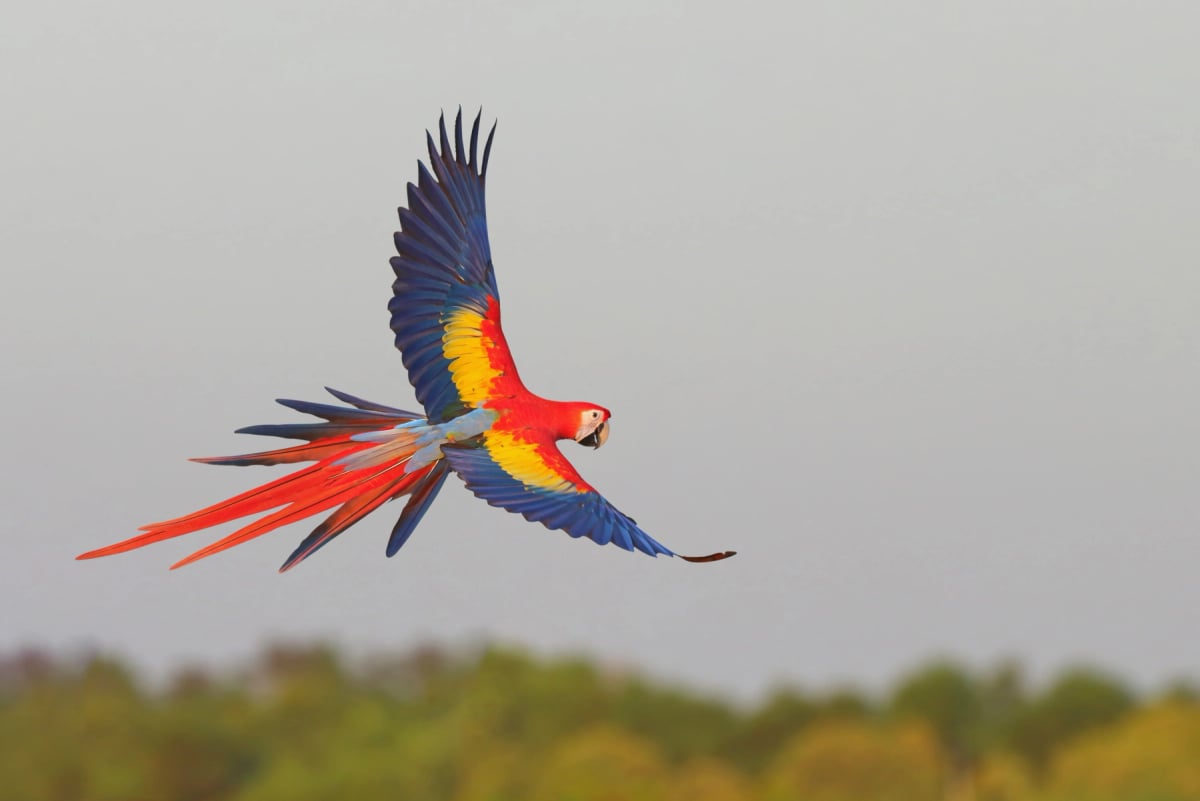
The scarlet macaw is one of the largest and most brilliantly colored parrots in the world. Its plumage is almost entirely scarlet red, with broad yellow bands across the wings and vivid blue flight feathers. Found from southern Mexico through much of Central America and down into the Amazon Basin, it favors lowland tropical forests and riverine woodlands. It mates for life and pairs stay close year round, flying together with loud, raucous calls that carry far through the forest canopy. Nesting takes place in natural cavities high in large trees. The species feeds on fruits, seeds, nuts and occasionally flowers, and is well known for visiting riverbank clay licks to ingest minerals that help neutralize toxins in some of its food. Populations have declined in parts of its range due to habitat loss and the illegal pet trade, though the species as a whole remains listed as Least Concern by the IUCN.
Scarlet macaw, red macaw or Ara macao?
Scarlet macaw is the standard English name, but many people simply call it the red macaw, and its scientific name is Ara macao. The name red macaw is loose, though: it is also used for the green-winged macaw, a close relative that is just as red, so the scientific name is the safest way to know which bird is meant. In Spanish the bird has a different name almost in every country. It is guacamaya roja in Mexico, Colombia and Venezuela, lapa roja in Costa Rica, guara roja in Honduras and guacamayo rojo in parts of Peru and Bolivia. Scientists recognize two subspecies. Ara macao cyanopterus lives from southern Mexico to Nicaragua, is slightly larger and has more blue in the wing, while Ara macao macao ranges from southern Central America into South America and shows a band of green between the yellow and blue of the wing. The northern subspecies is in far worse shape, reduced to a few scattered strongholds, and in 2019 the United States listed it as endangered under the Endangered Species Act.
Scarlet macaw or green-winged macaw?
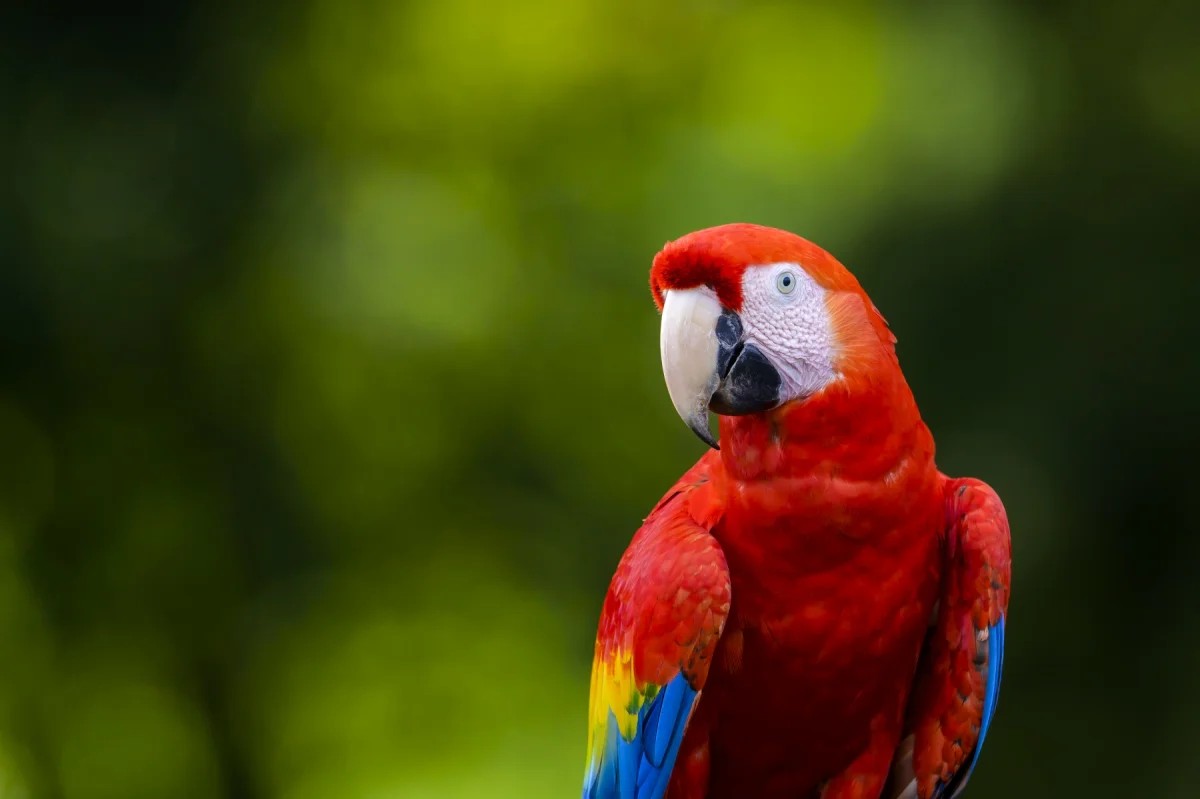
The bird most often confused with the scarlet macaw is the green-winged macaw, Ara chloropterus, also known as the red and green macaw. Both are large, long tailed and mostly red, and in South America they share forests and even the same clay licks, so they are often seen side by side. The easiest clue is the wing. The scarlet macaw has a broad yellow band across the upper wing, above the blue flight feathers, while the green-winged macaw has a green band in the same place and no yellow at all. The face helps too: the bare white skin around the eye of the scarlet macaw is almost plain, while the green-winged macaw has neat lines of tiny red feathers across its white face. The green-winged macaw is also the heavier bird, with a darker, deeper red body. The green-winged macaw lives only in South America and eastern Panama, so any red macaw seen in the wild in Mexico or most of Central America is a scarlet macaw.
Habitat and distribution
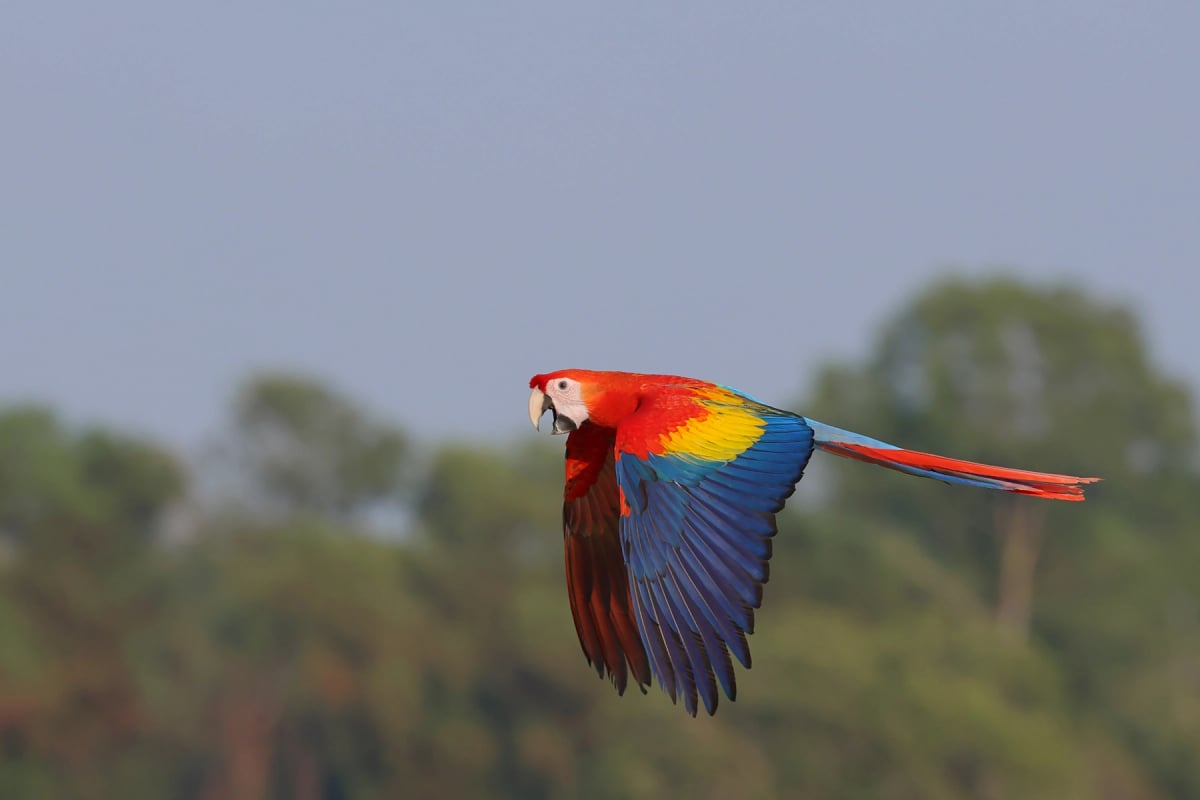
Scarlet macaws range across one of the widest distributions of any parrot in the Americas. Their territory stretches from the Pacific and Atlantic lowlands of southern Mexico through much of Central America, continuing south through Colombia, Venezuela, the Guianas, and deep into the Amazon Basin of Brazil, Peru, and Bolivia. They favor lowland tropical forests below 1,000 meters, especially areas close to rivers where large fruiting trees are plentiful. Forest edges and riverine woodlands also suit them well, and they are often spotted flying over open ground between patches of forest. Their presence in a landscape is usually announced long before they come into view, as their calls travel far above the canopy.
Diet
Fruits, seeds, and nuts make up the bulk of what a scarlet macaw eats each day, though flowers and the occasional leaf round out the menu. Their bill is extraordinarily powerful, capable of cracking open seeds and nuts with shells too hard for most other animals to breach. This gives them access to food sources that are largely out of reach for other species. One of the more striking habits linked to their diet is the regular visits these birds make to clay deposits along riverbanks. By swallowing small amounts of clay, they appear to neutralize naturally occurring toxins found in some of the unripe fruits and seeds they consume, allowing them to safely eat foods that would otherwise be harmful.
Behavior
Few birds are as loyal to a partner as the scarlet macaw. Pairs bond for life, spending almost every moment of the year together. They roost together, forage together, and fly side by side, often calling back and forth in a series of loud, raspy vocalizations that echo through the forest. Outside of mated pairs, scarlet macaws gather in flocks, sometimes numbering in the dozens at communal roosting sites or clay licks. Nesting happens in natural cavities found high in large, mature trees, and both parents take part in raising their chicks. Young birds remain dependent on their parents for several months after leaving the nest, gradually learning which foods to eat and how to navigate their forest home.
Ecological role
Tropical forests depend on a network of animals to move seeds from one place to another, and the scarlet macaw plays a genuine part in that process. As these birds travel across large areas of forest each day in search of food, seeds that pass through their digestive system or fall from their bill are deposited far from the parent tree. This kind of dispersal helps forests recover in areas where vegetation has been cleared or disturbed. Beyond seed dispersal, the nest cavities that scarlet macaws carve out or occupy in large trees are later used by a variety of other species, from smaller parrots to bats and insects. Their role in the forest is therefore broader than it might first appear.
National bird of Honduras and a Maya symbol
The scarlet macaw is the national bird of Honduras, and its bond with the region goes back well over a thousand years. At the Maya city of Copán, in western Honduras, the ball court is lined with carved stone macaw heads, and the founder of the city's ruling dynasty was called K'inich Yax K'uk' Mo', a name that includes both the quetzal and the macaw. The valley around the ruins is still known as the valley of the macaws. Farther north, in the 11th century and later, people at Paquimé in northern Mexico kept and bred scarlet macaws in adobe pens, trading their feathers across a wide region. Today Copán is also a conservation story. Wild macaws had nearly vanished from the valley when a bird park and rescue center called Macaw Mountain began releasing rehabilitated birds in 2010. More than 75 macaws now fly free around the ruins and they are breeding again, a sight that has become part of the visit to Copán.
Conservation
The IUCN currently lists the scarlet macaw as Least Concern, which reflects the overall size of the global population rather than the situation in every part of its range. Estimates put the wild population somewhere between 50,000 and 500,000 birds, most of them in the Amazon, and the trend is downward. In Mexico, Central America and parts of South America, populations have been lost entirely from areas where they were once common: in Mexico wild birds survive mainly in the Selva Lacandona of Chiapas and the Chimalapas forest of Oaxaca, and in El Salvador the species may already be gone. The two main drivers of this decline are the destruction of old growth forest, which removes the large trees these birds need for nesting, and the illegal capture of chicks for the pet trade. The scarlet macaw is listed in Appendix I of CITES, which bans international commercial trade in wild birds. Conservation responses have included habitat protection within national parks and reserves, community monitoring programs, and ecotourism initiatives that give local people a direct economic reason to protect nesting sites. Reintroduction programs have also brought macaws back to places they had lost, such as Palenque in Mexico, the Copán valley in Honduras and several sites along the Pacific coast of Costa Rica.
Where it is found
The Scarlet Macaw can be found in places such as:
Researched and written by Juan Pablo. Sources: IUCN Red List, scientific literature and regional field guides. Last updated: .
Technical factsheet







Frequently Asked Questions
Is a red macaw the same as a scarlet macaw?
Usually, but not always. Red macaw is an informal name that most people use for the scarlet macaw, Ara macao, the red, yellow and blue parrot of Central and South America. The same name is also used for the green-winged macaw, which is just as red but has green instead of yellow on the wing. In Spanish the scarlet macaw is often called guacamaya roja, which literally means red macaw. When it matters which bird is meant, the scientific name clears it up.
How many eggs does a scarlet macaw lay?
A scarlet macaw usually lays two or three white eggs, sometimes up to four, inside a cavity high in a large tree. The female incubates them while the male brings her food, and the chicks hatch naked and helpless a few days apart. They stay in the nest for about three months before they fly, and even then they depend on their parents for several more months. Often only one or two chicks survive, and pairs generally breed once every year or two, which is why these birds recover slowly when adults or chicks are taken.
What animals hunt scarlet macaws?
Adult scarlet macaws have few natural enemies thanks to their size and powerful bill. The main threat in the air comes from large forest raptors such as the harpy eagle and hawk-eagles, which can snatch a macaw from the canopy. Eggs and chicks are far more vulnerable: snakes, monkeys, other birds and small climbing mammals raid nest cavities when the parents are away. By far the biggest danger, though, comes from people, who cut the old trees macaws nest in and take chicks from the nest for the illegal pet trade.
Where can you see scarlet macaws in the wild?
Some of the best places are the clay licks of Tambopata and Manu in southeastern Peru, where dozens of macaws gather on the riverbank in the early morning. In Costa Rica, Carara National Park and the Osa Peninsula are famous for macaws flying overhead at dusk. In Honduras they fly free around the Maya ruins of Copán, and in Belize they gather near the village of Red Bank when certain trees are fruiting. Coiba Island in Panama, the Maya Biosphere Reserve in Guatemala and the Selva Lacandona in Mexico also hold wild birds.
Why is it illegal to take scarlet macaws from the wild?
The scarlet macaw is listed in Appendix I of CITES, the treaty that controls the international wildlife trade, which bans commercial trade in wild caught birds. Most countries in its range also protect it by law. The reason is that trapping emptied large parts of its range: poachers climb or cut nest trees to take chicks, and because pairs raise so few young, every chick removed is hard to replace. Many birds also die during capture and transport. Protecting nests from poachers is one of the main goals of conservation projects from Mexico to Peru.
What do scarlet macaws eat?
Scarlet macaws eat mostly fruits, seeds, and nuts. Their bill is strong enough to crack open shells that most animals cannot touch. They also visit clay deposits along riverbanks, swallowing small amounts of clay to neutralize toxins found in some of the unripe fruits and seeds they eat. This lets them safely consume foods that would otherwise make them sick.
Where do scarlet macaws live?
Scarlet macaws live across a huge stretch of the Americas, from southern Mexico through much of Central America and down into South America, including the Amazon Basin. They prefer lowland tropical forests below 1,000 meters, especially near rivers where large fruit trees grow. They also do well along forest edges and in riverine woodlands, and are often spotted flying over open areas between forests.
Do scarlet macaws mate for life?
Yes, scarlet macaws form bonds that last a lifetime. A mated pair stays together year round, foraging, roosting, and flying side by side. They also call back and forth constantly, which helps them stay in contact through dense forest. Both parents share the work of raising their chicks, and young birds stay close to their parents for several months after leaving the nest.
Are scarlet macaws endangered?
The scarlet macaw is listed as Least Concern by the IUCN, meaning the species as a whole is not at risk of extinction. However, populations in Mexico, Central America, and parts of South America have disappeared from many areas where they were once common. The main threats are the loss of old growth forest and the illegal capture of chicks for the pet trade.
How big is a scarlet macaw?
The scarlet macaw is one of the largest parrots in the world. Adults typically measure around 81 to 96 centimeters from the tip of the bill to the end of the tail, with much of that length coming from their long tail feathers. They weigh roughly 900 to 1,100 grams. Birds of the northern subspecies, from Mexico to Nicaragua, tend to be the largest. Males and females look alike, so the sexes are hard to tell apart in the field.
Why do scarlet macaws visit clay licks?
Scarlet macaws visit riverbank clay deposits to eat small amounts of clay or soil. Scientists believe this helps them counteract the natural toxins present in some of the unripe fruits and seeds that form part of their diet. By doing this, they can safely eat a wider range of foods. These clay lick gatherings can involve dozens of birds at once and are one of the most spectacular wildlife sights in Amazonia.
How long do scarlet macaws live?
Scarlet macaws are often said to live around 40 to 50 years, which is exceptionally long for a bird, although lifespan in the wild is hard to measure and few wild birds have been followed for that long. In captivity, some individuals have lived for more than 60 years. This long lifespan means that pairs spend decades together and invest a great deal of time in raising each clutch of chicks. It also means that losing adult birds to trapping or habitat loss has a serious impact on local populations.