Tree Kangaroo
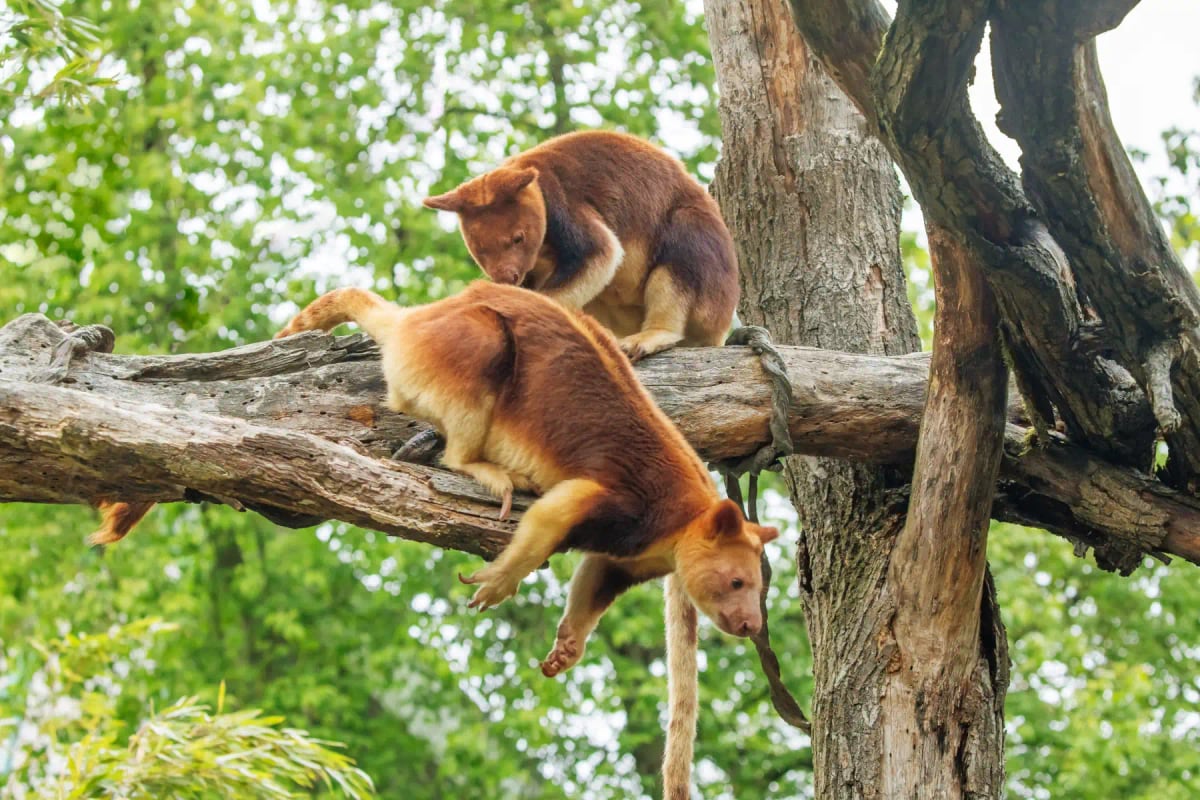
Tree kangaroos are marsupials of the genus Dendrolagus that live in the rainforests of Papua New Guinea, Indonesia and northeastern Australia. They are distant cousins of ground-dwelling kangaroos, but evolution has shaped them for a life in the trees. Their forelimbs are much stronger than those of their terrestrial relatives, their hind feet are broad and grippy, and their long tails help them keep balance on branches. They feed mainly on leaves and fruit, moving through the canopy at a relaxed pace. Most species rest during the day and become more active at night. A single joey is born at a very early stage of development and spends months growing inside the mother's pouch. Several species face serious pressure from hunting and the loss of forest habitat, and a number are listed as Endangered or Critically Endangered on the IUCN Red List.
Habitat and distribution
Tree kangaroos are found across a relatively narrow stretch of the world. Most species live in the rainforests of Papua New Guinea and the Indonesian provinces of Papua and West Papua, where dense forest covers steep mountain slopes and lowland valleys alike. One species, the Lumholtz's tree kangaroo, is native to the wet tropical forests of northeastern Queensland, Australia, particularly around the Atherton Tablelands. These animals depend heavily on continuous forest cover. They are most commonly found at elevations between 1,000 and 3,000 metres in montane cloud forest, though some species also occupy lowland and foothill forests. Fragmented or degraded forest is poorly suited to their needs, as they rely on large trees with a connected canopy to move, feed and shelter safely.
Diet
Leaves make up the core of a tree kangaroo's diet, particularly young, soft leaves that are easier to digest. They also eat fruit, flowers, moss, ferns, bark and occasionally bird eggs when the opportunity arises. Because leaves are low in energy, these animals tend to spend long hours resting to conserve what they take in. Their digestive system is well suited to breaking down tough plant material, with a long, complex gut that allows them to extract as much nutrition as possible. Foraging happens mostly in the canopy, where they move slowly from branch to branch, pulling food toward them with their strong forelimbs. Some species have been observed descending to the ground to drink or to pick up fallen fruit.
Behavior
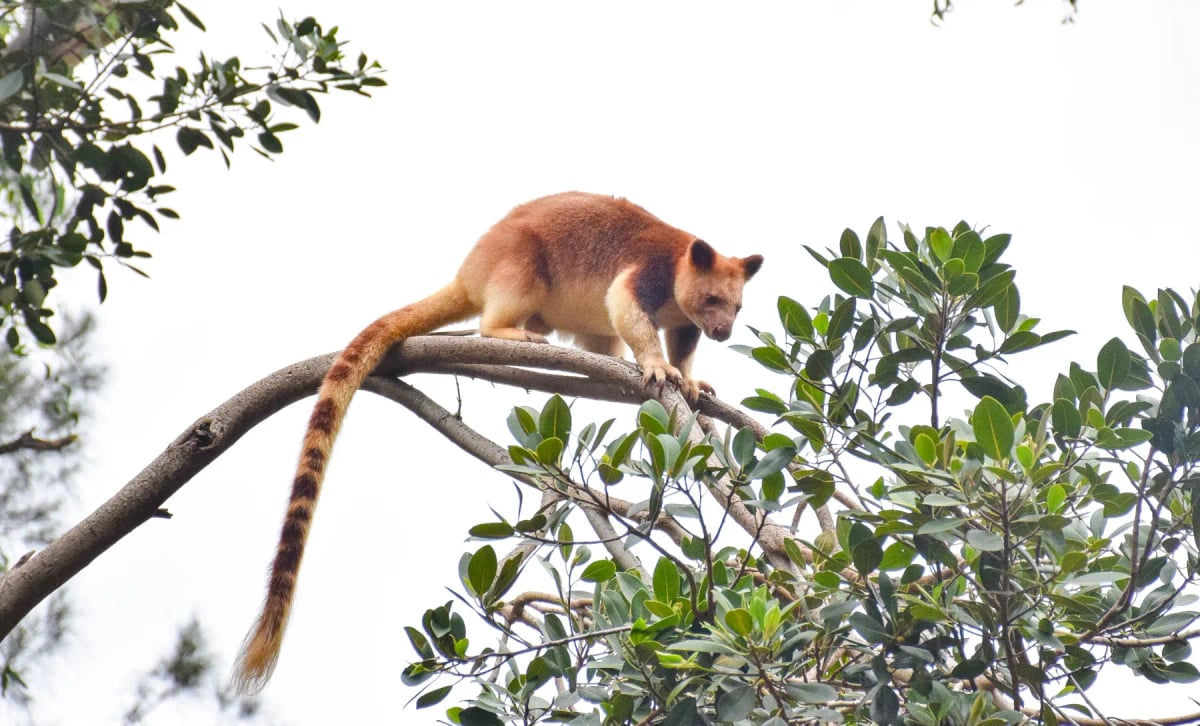
For the most part, tree kangaroos lead quiet, solitary lives. Adults tend to avoid one another outside of the breeding season, each occupying a home range that may overlap loosely with those of neighbors. During the day they rest in the forks of large trees or stretched out along thick branches. Activity picks up after dark, when they move through the canopy in search of food. Despite their calm, unhurried style of movement, they are capable jumpers. When threatened, they can leap from considerable heights onto lower branches or even to the ground, landing without apparent injury. Their long tail does not grip like a monkey's, but it acts as a counterbalance that helps them stay steady while climbing and navigating narrow branches.
Threats
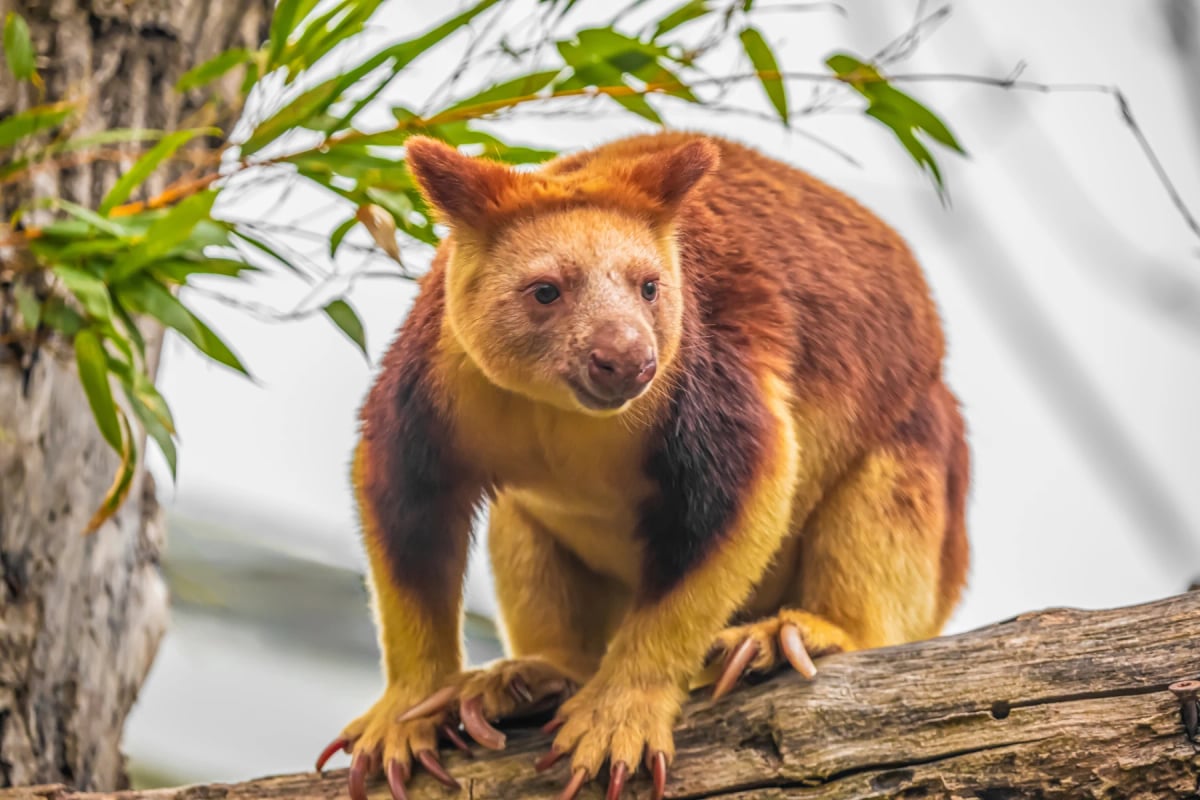
Pressure on tree kangaroo populations comes from several directions at once. Hunting is a significant concern across New Guinea, where they are pursued for food and, in some areas, as part of traditional practices. Because they tend to freeze when startled rather than flee immediately, they are relatively easy to locate and catch. At the same time, large areas of their forest habitat have been cleared or degraded by logging, agricultural expansion and the development of roads. These activities break up the forest into isolated patches, leaving small groups of animals cut off from others of their kind. Such isolated populations are especially fragile because a single disease outbreak or a run of poor breeding seasons can be enough to wipe them out entirely.
Conservation
Protecting tree kangaroos requires a mix of approaches, and efforts are under way on several fronts. Organizations such as the Tree Kangaroo Conservation Program work directly with local communities in Papua New Guinea to establish wildlife management areas where hunting is regulated and forests are protected. These community-led initiatives have shown real promise, with some populations showing signs of recovery in areas where local people take an active role in stewardship. Protected areas and national parks in both Papua New Guinea and Australia provide additional refuge. Zoos around the world participate in coordinated breeding programs that help maintain genetic diversity for the most threatened species. Research into population size, movement and health continues to guide decisions about where protection efforts are most urgently needed.
Where it is found
The Tree Kangaroo can be found in places such as:
Researched and written by Juan Pablo. Sources: IUCN Red List, scientific literature and regional field guides. Last updated: .
Technical factsheet

Frequently Asked Questions
Are tree kangaroos good climbers?
Yes, they are remarkably capable in the trees. Their forelimbs are much stronger than those of ground kangaroos, and their hind feet are wide and padded for gripping bark. They can move independently with each front limb, which most kangaroos cannot do. Their long tail helps them stay balanced on branches. They spend most of their lives in the canopy and rarely need to come down to the ground.
Can tree kangaroos jump from trees without getting hurt?
They can, and it is one of the most surprising things about them. When threatened, tree kangaroos can leap from heights of nine metres or more and land safely on the ground. Their muscular legs and sturdy build absorb the impact well. This ability to drop quickly from the canopy is one of their main ways of escaping predators, and they have been observed doing it repeatedly without any sign of injury.
What do tree kangaroos eat?
Leaves are the foundation of their diet, especially young, tender ones that are easier to digest. They also eat fruit, flowers, bark, moss and ferns. Because leaves provide little energy, tree kangaroos spend a lot of time resting between meals. They do most of their foraging up in the canopy, pulling branches toward them with their strong arms. Occasionally, they come down to the ground to pick up fallen fruit or to drink.
Where in the world do tree kangaroos live?
Tree kangaroos are found in the rainforests of Papua New Guinea, the Indonesian region of New Guinea and northeastern Australia. Most species prefer mountain forests at elevations between 1,000 and 3,000 metres, though some also live in lowland areas. The only species native to Australia is the Lumholtz's tree kangaroo, which lives in the wet tropical forests of Queensland. All of them depend on large, connected stretches of forest to survive.
Are tree kangaroos endangered?
Many species are, yes. Several are listed as Endangered or Critically Endangered on the IUCN Red List. The main threats are hunting and the loss of forest habitat due to logging, farming and road building. Because these animals live in specific types of forest and reproduce slowly, their populations can struggle to recover once they decline. Conservation efforts in Papua New Guinea and Australia are helping, but many species remain at serious risk.
How do tree kangaroos raise their young?
Like all marsupials, tree kangaroos give birth to a tiny, undeveloped joey that crawls into the mother's pouch right after birth. It stays there for many months, growing and feeding on milk. Even after leaving the pouch, the young kangaroo stays close to its mother for a while longer. Females usually raise only one joey at a time, which means the population grows slowly and takes time to recover from losses.
Are tree kangaroos related to regular kangaroos?
Yes, they belong to the same family and are genuine relatives, but they split from a common ancestor a very long time ago. Ground kangaroos evolved for speed on open land, while tree kangaroos took a different path and adapted to life in the forest canopy. The differences in their bodies reflect that split clearly. Tree kangaroos have stronger arms, shorter and broader feet, and a much more flexible spine than their ground-dwelling cousins.