Crane
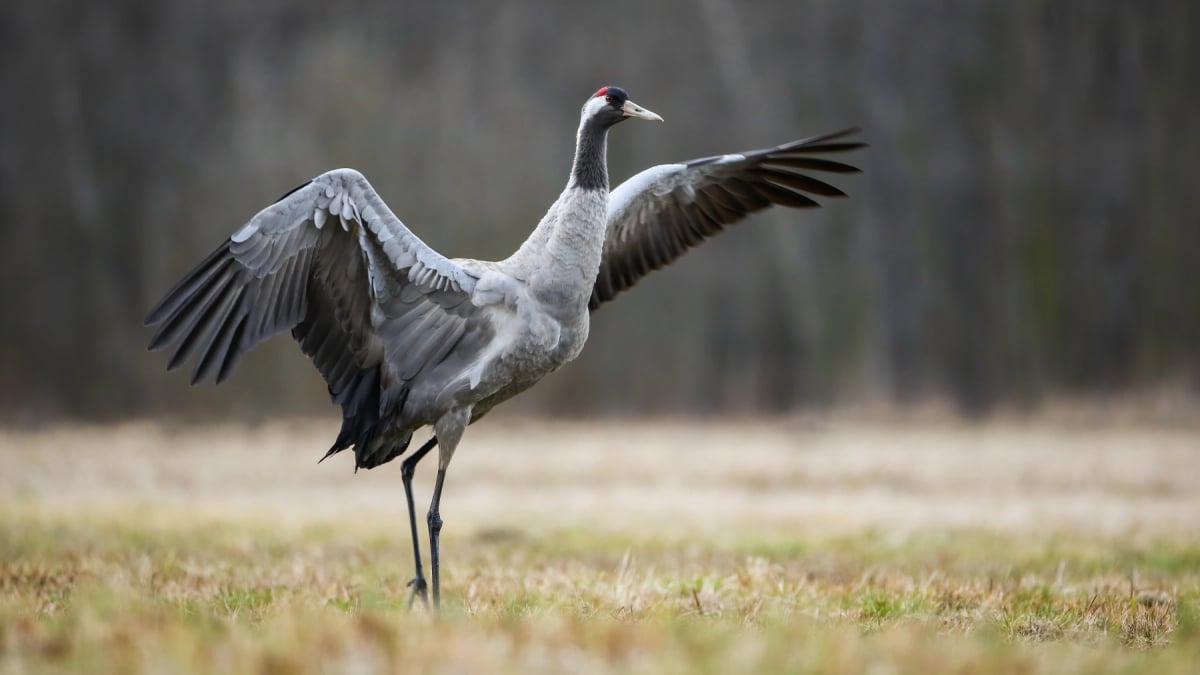
The common crane, also called the Eurasian crane, stands up to 120 centimeters tall and is one of the best known migratory birds in the world. Its body is mostly grey, with a bold black and white head and neck and a small patch of bare red skin on the crown, and the long, drooping inner wing feathers form a bushy 'bustle' over the tail. It breeds in bogs, marshes and forest wetlands from Norway and the United Kingdom east across Russia to northern China and Mongolia, laying its eggs on a mound of vegetation surrounded by water. Every autumn hundreds of thousands of cranes follow ancient flyways south to winter in Spain, France, North Africa, the Middle East, Ethiopia, India and China, stopping at famous gathering sites along the way. Pairs usually stay together for life and dance to strengthen their bond. The species is omnivorous, eating roots, seeds, grain, acorns, insects and small vertebrates depending on the season.
Habitat and distribution
The common crane has one of the widest ranges of any crane. It breeds across a vast belt of northern Eurasia, from Norway, Sweden and the United Kingdom through Germany, Poland, the Baltic states, Belarus and Finland, and on across Russia and Kazakhstan to Mongolia and northern China. Smaller breeding populations live in Turkey, the Caucasus and parts of Central Asia, and the species has recently returned to countries such as Denmark, the Netherlands, Czechia and France after long absences. For nesting it needs quiet wetlands: raised bogs, fens, reed marshes, flooded forest clearings and the shores of shallow lakes, where the nest can sit surrounded by water that keeps foxes and wild boar away. After breeding, cranes switch to open landscapes. In winter they feed on farmland, rice paddies, steppe and, in Spain and Portugal, the dehesa, the open oak woodland where acorns are a key food. Spain hosts the largest wintering population in Europe, roughly 200,000 to 300,000 birds in recent winters, with Extremadura the main area. Other important wintering regions include France, North Africa, Israel's Hula Valley, Turkey, Iran, Iraq, Ethiopia, Sudan, northwestern India and the Yellow River basin in China.
Size and appearance
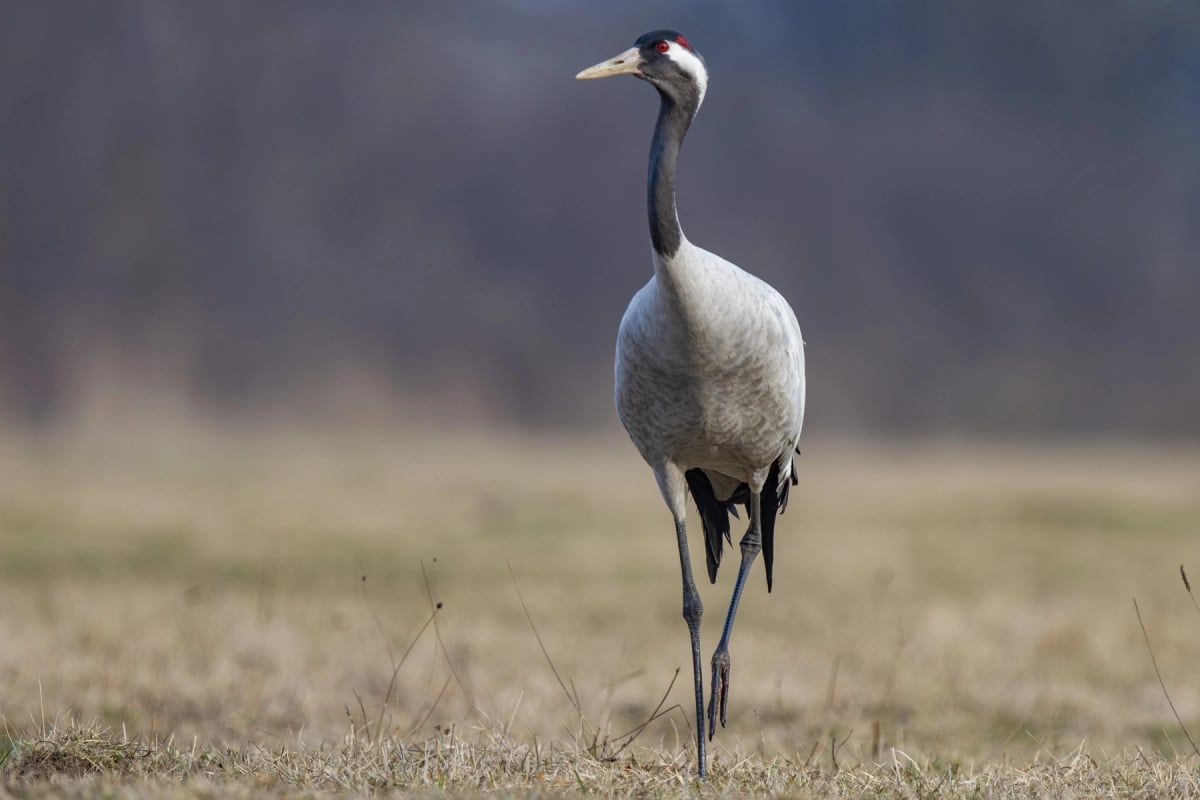
The common crane stands 100 to 120 centimeters tall, weighs about 3 to 6 kilograms and has a wingspan of roughly 180 to 240 centimeters, making it one of the largest birds in Europe. Males are slightly bigger than females, but the two look alike. The body is slate grey, often stained brownish in summer, when cranes rub mud and rotting plant matter into their feathers, probably as camouflage while nesting. The head and neck are the easiest way to recognize it: black with a broad white stripe running from behind the eye down the side of the neck, and a small patch of bare red skin on the crown. This red cap can swell and show more brightly when the bird is excited or displaying. What looks like a bushy tail is actually a bustle of long, curved inner wing feathers that droop over the short tail. Young birds are browner, with a plain tawny head, and gain the adult pattern during their second year. In flight, cranes stretch their necks straight forward and trail their legs behind, unlike herons, which fold their necks. Their loud, trumpeting calls, amplified by a long windpipe coiled inside the breastbone, can be heard several kilometers away.
Diet
Few birds are as adaptable in their eating habits as the common crane. Across the year its diet shifts considerably depending on what is available. During the breeding season in northern wetlands, cranes take insects, worms, amphibians, small rodents and the occasional lizard or frog. Plant material is just as important: roots, tubers, berries and the seeds of grasses and sedges all feature regularly. On migration and during winter, the birds move onto farmland and feed heavily on leftover grain in harvested fields, particularly maize and wheat, as well as acorns in the oak woodlands of Spain and Portugal. This ability to switch between animal and plant foods means cranes can maintain their energy reserves through long journeys and harsh winters without relying on any single food source.
Dance and social life
Outside the breeding season, common cranes are among the most sociable of all large birds. Tens of thousands gather at traditional staging and roosting sites, flying in at dusk to spend the night standing in shallow water, where predators cannot approach without splashing. The noise of their bugling calls carries over great distances. Pairs usually stay together for life and reinforce their bond each spring with the famous crane dance: the two birds face each other, bow, leap into the air with wings half open, toss sticks or grass and call loudly. Mates also perform unison calls, a duet in which the male and female call together with their heads thrown back. Dancing is not limited to couples, and young unpaired birds dance too, practicing the moves and looking for a partner. Breeding starts in April or May in the north. The pair builds a mound of reeds and grass in shallow water and usually lays two eggs, which both parents incubate for about a month. The chicks leave the nest within a day and can fly after about ten weeks. Families stay together through the first autumn migration and the winter, and within flocks the experienced adults often lead the way.
Migration
Every autumn common cranes leave their breeding grounds on journeys that can cover several thousand kilometers. In Europe, the western flyway carries birds from Scandinavia, Germany and Poland across France to Spain, Portugal and Morocco, with huge stopovers at the Rügen-Bock region on Germany's Baltic coast, Lac du Der in France and the Gallocanta lagoon in Spain. The Baltic and Hungarian flyway sends birds from Finland, the Baltic states and western Russia through the Hortobágy in Hungary, where more than 150,000 cranes can gather in October, on to Italy, Tunisia and Algeria. Farther east, cranes from Russia and Belarus cross the Black Sea region and Turkey to winter in Israel, the Middle East, Sudan and Ethiopia, while Asian populations fly to Iran, India and China, some crossing the Himalayas. Cranes migrate by day in noisy V shaped lines or loose flocks, riding thermals over land to save energy and often traveling several hundred kilometers in a day. Young birds learn the route from their parents. In spring the journey reverses, and at Lake Hornborga in Sweden up to 30,000 cranes stop in late March and April to feed and dance before the last stretch north.
Where to see common cranes
Few wildlife spectacles in Europe match a crane gathering, and several places have built festivals and viewing sites around them. In spring, Lake Hornborga in western Sweden draws up to 30,000 cranes in late March and early April, and visitors come to watch the dancing from the shore. In autumn, the Rügen-Bock region on Germany's Baltic coast hosts some 50,000 to 60,000 cranes at a time in October, and the Linum area near Berlin is another classic site. Farther south, the Hortobágy National Park in Hungary sees more than 150,000 cranes at its autumn peak, and Lac du Der in Champagne is France's great crane lake from October to March. In Spain, the Gallocanta lagoon in Aragon is the best known migration stop, and Extremadura's dehesas hold the bulk of the winter population from November to February. In the Middle East, the Hula Valley in northern Israel hosts some 35,000 to 50,000 cranes each winter, where supplementary feeding keeps them off farmers' crops and draws visitors to the Agamon Hula park. In the United Kingdom, where cranes returned to the Norfolk Broads in 1979, a few dozen pairs now breed in eastern England and Somerset. The best times to watch are dawn and dusk, when flocks fly between roosts and fields.
Conservation
The common crane is listed as Least Concern on the IUCN Red List, with an estimated 490,000 to 505,000 birds and an increasing trend, making it by far the most numerous crane in Europe and Asia. Europe alone holds about 113,000 to 185,000 breeding pairs. It was not always so: during the nineteenth and twentieth centuries hunting and the drainage of wetlands wiped the crane out as a breeding bird in much of western Europe, including the United Kingdom, Denmark, the Netherlands and France. Legal protection, the end of most hunting in Europe, the restoration of wetlands and a switch to feeding on waste grain in farmland have allowed a strong recovery. Numbers counted along the western European flyway have multiplied since the 1980s, and cranes have recolonized several countries on their own, while the Great Crane Project reintroduced birds to Somerset in England. Threats remain. Wetland drainage and peat extraction still destroy nesting sites in parts of Eastern Europe and Asia, collisions with power lines kill many birds on migration, and disturbance at roosts can force cranes to burn precious energy. Hunting and poisoning are still problems along parts of the eastern flyway, and crop damage creates conflicts with farmers, which projects such as the feeding stations in Israel's Hula Valley try to solve.
Where it is found
The Crane can be found in places such as:
Researched and written by Juan Pablo. Sources: IUCN Red List, scientific literature and regional field guides. Last updated: .
Technical factsheet



















Frequently Asked Questions
Is the common crane the same as the Eurasian crane?
Yes. Common crane and Eurasian crane are two English names for the same species, Grus grus. Common crane is the usual name in Britain and Europe, while Eurasian crane is more common in North American field guides and highlights its huge range across Europe and Asia. It is also sometimes called the grey crane. In Spanish it is known as grulla común, grulla euroasiática or grulla cenicienta.
What is the difference between a crane and a heron?
Cranes and herons look alike but are not closely related. The easiest clue is in flight: cranes fly with the neck stretched straight out, while herons pull the neck back into an S shape. Cranes feed mostly by walking on dry ground or farmland and eat many plants and seeds, while herons stand still in water and spear fish with a sharp bill. Cranes also nest on the ground, while most herons nest in trees in colonies.
Why do cranes have a red patch on their head?
The red patch on a common crane's crown is not made of feathers but of bare skin with many small blood vessels. Cranes can make it swell and look brighter when they are excited, alarmed or displaying to a mate or a rival, so it works as a signal. Both males and females have it. Young cranes lack the red patch and have a plain brownish head until they gain adult colors in their second year.
How many common cranes are there in the world?
The IUCN estimates the world population at about 490,000 to 505,000 common cranes, and the trend is increasing. Europe holds around 113,000 to 185,000 breeding pairs, with the largest numbers in Russia, Scandinavia, Finland, Germany, Poland and the Baltic states. Numbers have grown strongly since the 1980s thanks to protection and wetland restoration, and the species has returned to breed in countries such as the United Kingdom, Denmark and the Netherlands.
What does the crane symbolize?
Across Europe and Asia the crane has long stood for vigilance, loyalty and the changing seasons. Ancient writers told of cranes on night watch holding a stone in one raised foot, so that if they dozed off the falling stone would wake them, an image later used in heraldry. Because pairs stay together for years, cranes also became symbols of faithful love. In Sweden and Finland, the return of the cranes each spring is celebrated as a sign that winter is over.
What do common cranes eat?
Common cranes eat a wide range of foods depending on the season. In summer they hunt insects, worms, frogs and small rodents, while also feeding on roots, berries and seeds. During winter on farmland they rely heavily on leftover grain, especially maize and wheat. This flexibility means they can fuel themselves through long migrations and cold winters without depending on any single food source.
How long do common cranes live?
Common cranes are long lived birds. The oldest known wild crane, ringed as a chick in Sweden in 1989, was still alive at 27 years old, and many wild cranes live into their late teens or twenties. In captivity they have lived beyond 40 years. Their long lives go hand in hand with slow breeding: pairs usually raise only one or two chicks a year and often fail, so adult survival is key to the population.
Why do cranes dance?
The dancing of common cranes is one of nature's most memorable sights. Pairs bow, leap and spread their wings to strengthen the bond between them, repeating this display each breeding season. Younger birds that have not yet found a mate also dance as a way to practice and show off their fitness to potential partners. It is a behaviour rooted in communication rather than simple excitement.
Where do common cranes spend the winter?
European common cranes mainly winter in Spain, Portugal, France and North Africa. Spain holds the largest numbers, roughly 200,000 to 300,000 birds in recent winters, most of them in the oak dehesas of Extremadura. Cranes from eastern Europe and western Russia winter in Israel, Turkey, the Middle East, Sudan and Ethiopia, while Asian populations winter in Iran, northwestern India and the Yellow River basin in China. Milder winters now let more cranes stay farther north, in France and Germany.
Are common cranes endangered?
No. The common crane is listed as Least Concern by the IUCN, with about 490,000 to 505,000 birds and a rising trend. Populations recovered strongly after steep declines in the nineteenth and twentieth centuries, when hunting and the draining of wetlands wiped them out in much of western Europe. Legal protection and wetland restoration made a real difference. Wetland loss, power line collisions and disturbance at key stopover sites remain concerns worth watching.
How far do common cranes migrate?
Common cranes are impressive travelers. Birds breeding in Scandinavia or northern Russia can cover several thousand kilometers on their way to wintering grounds in Spain, East Africa or the Middle East. They fly in large flocks, often forming a V shape that lets each bird benefit from the air currents created by the one ahead. Key stopover sites along the route give them a chance to rest and feed before continuing.
Do common cranes mate for life?
Yes, common cranes form pairs that typically last for their entire lives. Once a bond is established, the two birds return to breed together each year and reinforce their relationship through elaborate dancing displays. If one partner dies, the surviving bird will usually seek a new mate, but established pairs show a strong attachment to each other that biologists consider one of the most stable bonds found among birds.