Brown Hyena
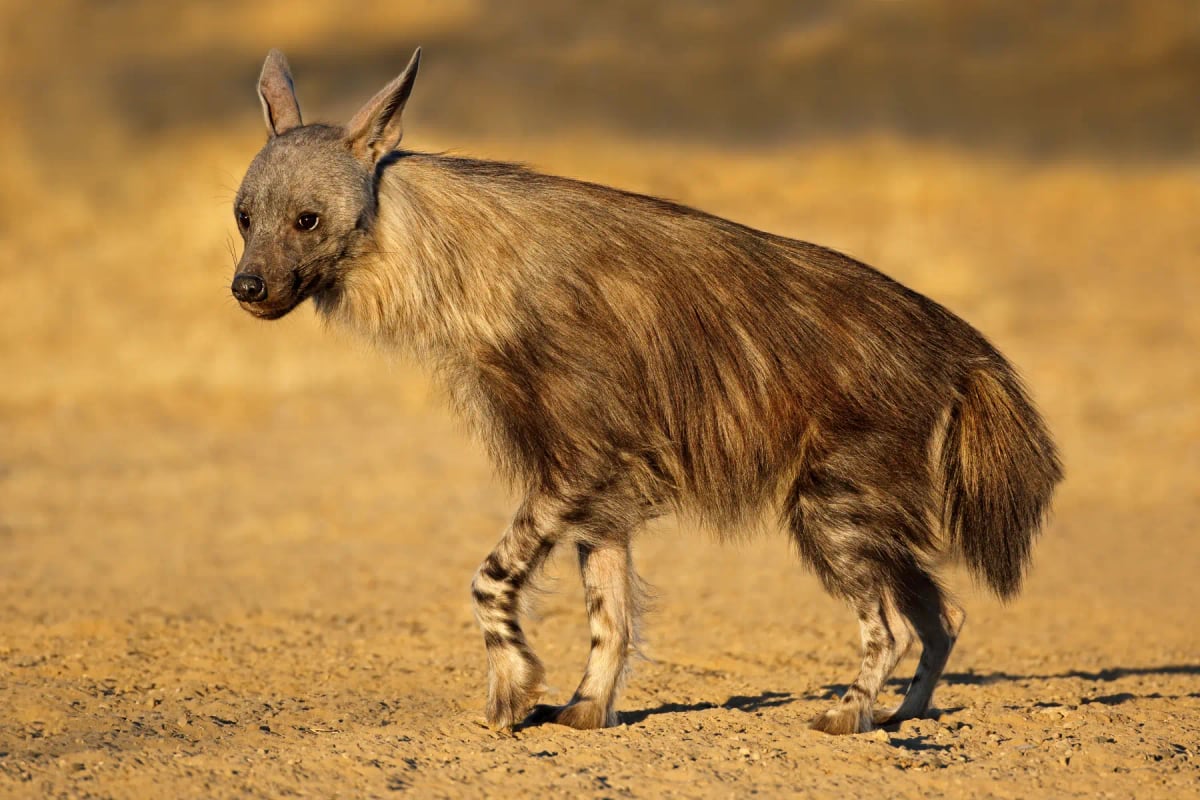
The brown hyena (Parahyaena brunnea) is the rarest of Africa's four hyena species and the one most strictly tied to southern Africa's arid landscapes. Its shaggy dark brown coat, cream-colored mane, and pale striped legs give it an unmistakable silhouette. Primarily a scavenger, it covers territories that can exceed 300 square kilometers in a single night, locating carcasses left by lions, leopards, and cheetahs. It rounds out its diet with wild fruits such as tsamma melons, insects, and the occasional small vertebrate. Brown hyenas live in clans of up to ten individuals that share a communal den and cooperate in raising cubs, yet each adult forages on its own. Scent marking with a paste secreted from anal glands is central to communication within the clan. The IUCN lists the species as Near Threatened, with fewer than 10,000 mature individuals remaining, pressured by deliberate poisoning and conflict with livestock farmers.
Habitat and distribution
Restricted entirely to southern Africa, the brown hyena occupies some of the continent's driest environments. Its stronghold lies across the Kalahari Desert, which spans Botswana, Namibia, and South Africa, but the species also roams the gravel plains and fog-shrouded coastal dunes of the Namib. Smaller populations persist in Zimbabwe and Angola. It consistently favors open, arid, and semi-arid landscapes, including scrublands, dry riverbeds, and rocky outcrops, and tends to avoid the moist savannas where spotted hyenas dominate. Home ranges are extraordinarily large, often exceeding 200 to 300 square kilometers per individual, a reflection of how thinly food resources are spread across desert terrain. The Kgalagadi Transfrontier Park, straddling Botswana and South Africa, supports one of the most studied and densest populations of the species.
Diet
Carrion forms the foundation of the brown hyena's diet, and its powerful jaws and robust teeth allow it to crush bones that most other scavengers cannot process. It typically arrives at carcasses after large predators such as lions, leopards, and cheetahs have finished feeding, making the most of what remains. Rather than competing directly with those predators, it relies on its exceptional sense of smell to locate leftovers across vast distances. The diet also includes wild fruits, particularly tsamma melons, which provide critical moisture during dry seasons. Insects, eggs, and small vertebrates round out its nutritional intake. When food is scarce, brown hyenas have been recorded carrying portions of carcasses back to the den to share with cubs, a behavior that underscores both their broad dietary flexibility and their investment in raising young.
Behavior
Social life in the brown hyena revolves around the clan, a group of typically four to six related adults and their offspring that share a communal den. Despite this group structure, each adult sets out alone after dark to forage, covering enormous distances through the night. Scent marking plays a central role in communication: individuals deposit a paste produced by anal glands onto grass stalks, leaving information for other clan members about their movements and identity. Adult males, which are often not resident in the clan, contribute to pup rearing by bringing food back to the den, a cooperative behavior that is notable among carnivores. Cubs from previous litters also help care for younger siblings. Interactions between clan members at the den tend to be tolerant and affiliative, contrasting sharply with the competitive dynamics seen in spotted hyena societies.
Comparison with other hyenas
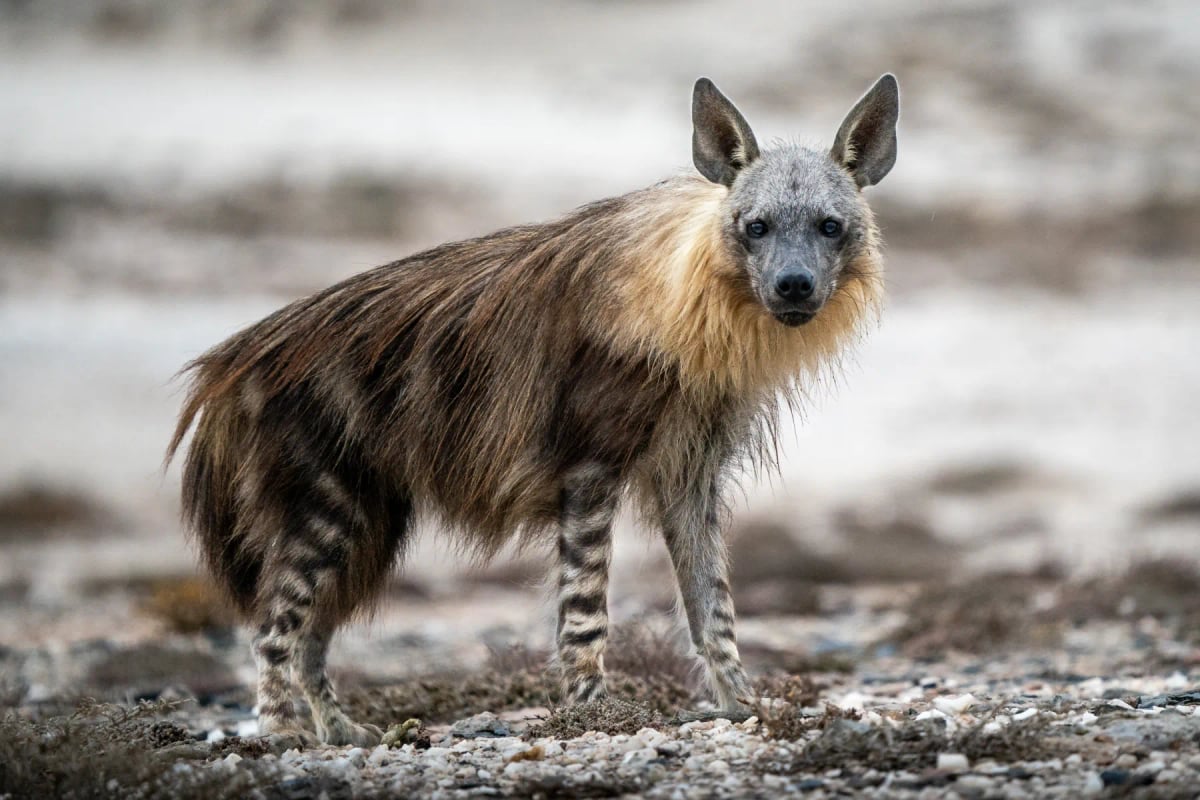
Africa's four hyena species differ considerably in size, diet, and social organization. The spotted hyena is the largest and most social, hunting in coordinated groups and maintaining strict dominance hierarchies within large clans. The brown hyena is notably smaller and carries a shaggy coat of dark fur along with a pale mane, giving it a profile quite different from its spotted relative. Its legs bear pale stripes similar to those of the striped hyena, though the two species occupy largely separate ranges. The aardwolf, the smallest of the four, feeds almost entirely on termites and bears little ecological resemblance to the brown hyena. Among all four, the brown hyena occupies a middle ground socially: more cooperative than the largely solitary striped hyena, yet far less gregarious in its foraging habits than the spotted hyena.
Conservation
The IUCN classifies the brown hyena as Near Threatened, with the global population estimated at fewer than 10,000 mature individuals. The greatest pressure on the species comes from deliberate persecution: farmers across its range frequently poison or trap hyenas suspected of killing livestock, even though brown hyenas are primarily scavengers and rarely attack healthy animals. Habitat loss and the reduction of large wildlife populations, which limits the availability of carrion, compound the threat. Protected areas such as the Kgalagadi Transfrontier Park and Etosha National Park provide important refuges where populations remain relatively stable. Conservation efforts focus on changing attitudes among farming communities through education and compensation schemes for genuine livestock losses. Legal protection exists across most of the species' range, but enforcement remains inconsistent outside of formally protected land.
Where it is found
The Brown Hyena can be found in places such as:
Researched and written by Juan Pablo. Sources: IUCN Red List, scientific literature and regional field guides. Last updated: .
Technical factsheet




Frequently Asked Questions
What do brown hyenas eat?
Brown hyenas are primarily scavengers. They feed on carrion left behind by lions, leopards, and cheetahs, using their powerful jaws to crack bones other animals cannot. They also eat wild fruits like tsamma melons for moisture, along with insects, eggs, and small vertebrates. When food is scarce, they carry portions of carcasses back to the den to feed their cubs.
Where do brown hyenas live?
Brown hyenas are found only in southern Africa. They thrive in arid and semi-arid environments, with their stronghold in the Kalahari Desert across Botswana, Namibia, and South Africa. They also inhabit the gravel plains and coastal dunes of the Namib Desert. Smaller populations exist in Zimbabwe and Angola. They generally avoid moist savannas, preferring open, dry landscapes where competition from spotted hyenas is lower.
Are brown hyenas dangerous to humans?
Brown hyenas pose virtually no threat to humans. They are shy, nocturnal animals that actively avoid contact with people. Unlike spotted hyenas, they are not aggressive hunters and rely almost entirely on scavenging. There are no documented cases of brown hyenas attacking humans. If encountered, they typically retreat. Their reputation as dangerous animals is largely undeserved and has contributed to unjust persecution by farming communities.
How do brown hyenas communicate?
Scent marking is the primary form of communication for brown hyenas. They deposit a paste produced by glands near the tail onto grass stalks, leaving information about their identity and movements for other clan members. They also use posture and facial expressions during social interactions. Vocalizations are far less prominent in brown hyenas than in spotted hyenas, reflecting their more solitary style of foraging despite living in family groups.
Why are brown hyenas endangered?
Brown hyenas are classified as Near Threatened by the IUCN, with fewer than 10,000 mature individuals remaining. The main threat is deliberate persecution: farmers often poison or trap them over suspected livestock kills, even though brown hyenas rarely attack healthy animals. Habitat loss and the decline of large wildlife populations, which reduces available carrion, also put pressure on the species. Enforcement of legal protections outside protected areas remains weak.
How do brown hyenas raise their young?
Brown hyena cubs are raised communally within the clan. Adults, including males that do not permanently live with the group, bring food back to the den for the cubs. Older offspring from previous litters also help care for younger siblings. This cooperative approach to raising young is unusual among carnivores. Cubs spend several months at the den before beginning to forage on their own, benefiting from the support of multiple family members.
How does the brown hyena differ from the spotted hyena?
The two species differ in size, appearance, diet, and social behavior. Spotted hyenas are larger, hunt cooperatively in big clans, and maintain strict dominance hierarchies. Brown hyenas are smaller, wear a shaggy dark coat with a pale mane, and rely far more on scavenging than on hunting. Brown hyena clans are smaller and more tolerant in their social dynamics. The two species also occupy largely separate ranges, with brown hyenas favoring drier, more arid habitats.