Blue Crane
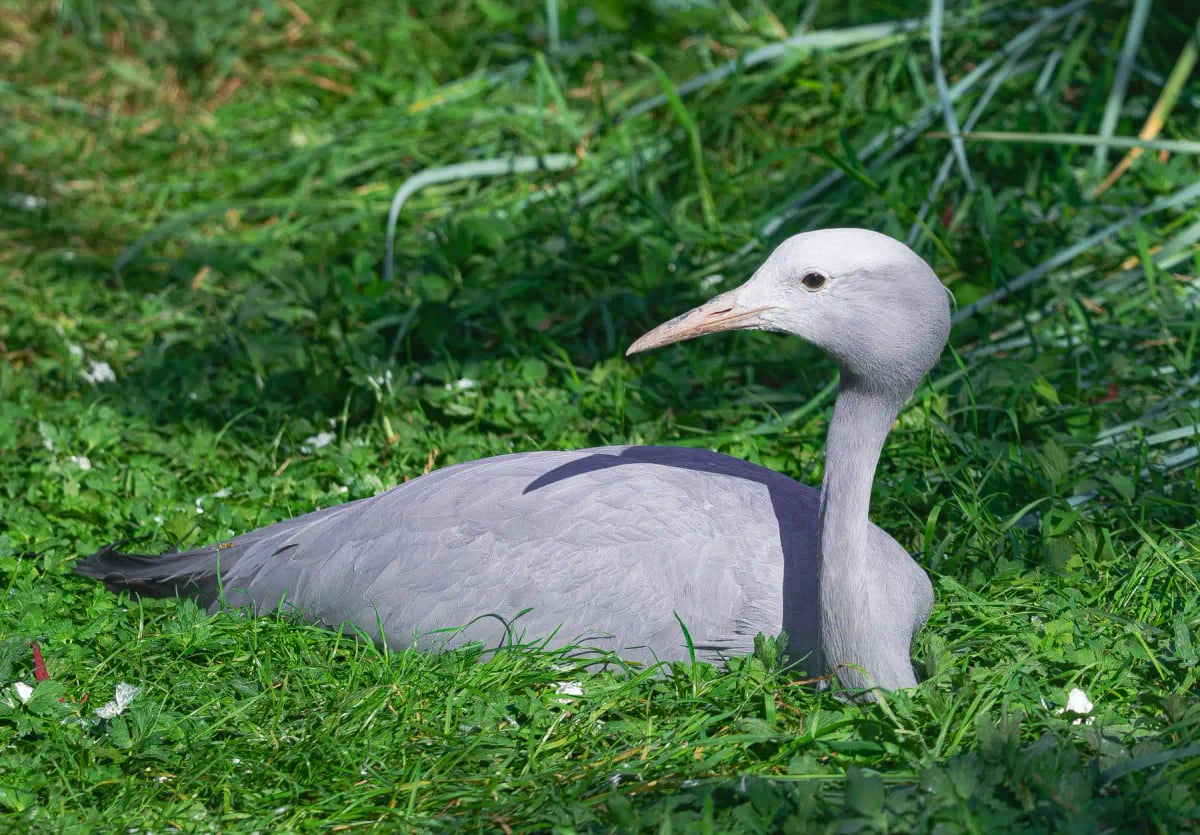
The blue crane is South Africa's national bird and one of the most restricted cranes in the world: more than 99 percent of the population lives in South Africa, with a tiny outpost of about 60 birds around Etosha Pan in northern Namibia. It stands roughly one meter tall, with pale blue grey plumage, a whitish crown, a slim neck and long, dark inner wing feathers that trail almost to the ground and are often mistaken for a tail. Unlike most cranes it prefers dry ground to wetlands, living in open grasslands, Karoo shrublands and wheat and pasture farmland, where it eats seeds, grain, insects, frogs and small reptiles. Pairs bond for years and perform lively courtship dances of leaping, running and tossing grass into the air. Outside the breeding season they gather in flocks of hundreds. The IUCN lists the species as Vulnerable, with power line collisions, poisoning and the loss of natural grassland among the main threats.
Habitat and distribution
The blue crane is almost entirely a South African bird: more than 99 percent of the population lives inside the country. Its strongholds are the grasslands of the Eastern Cape, KwaZulu-Natal, the Free State and Mpumalanga, the semi arid shrublands of the Karoo, and the wheat and pasture farmland of the Western Cape, where the Overberg region between Cape Town and Cape Agulhas has held roughly half of all blue cranes in recent decades. The only population outside South Africa is a small, isolated group of about 60 birds in and around Etosha Pan in northern Namibia, and it has been shrinking. Birds are occasionally seen in Lesotho and Eswatini, and very rarely wander into Botswana and Zimbabwe. Unlike many cranes, the blue crane prefers dry, open ground to wetlands. It nests directly on the ground among short grass or on bare patches, often within sight of water, and after the breeding season flocks move onto farmland to feed on waste grain. Its dependence on land used for farming makes its future closely tied to how that land is managed.
Size and appearance
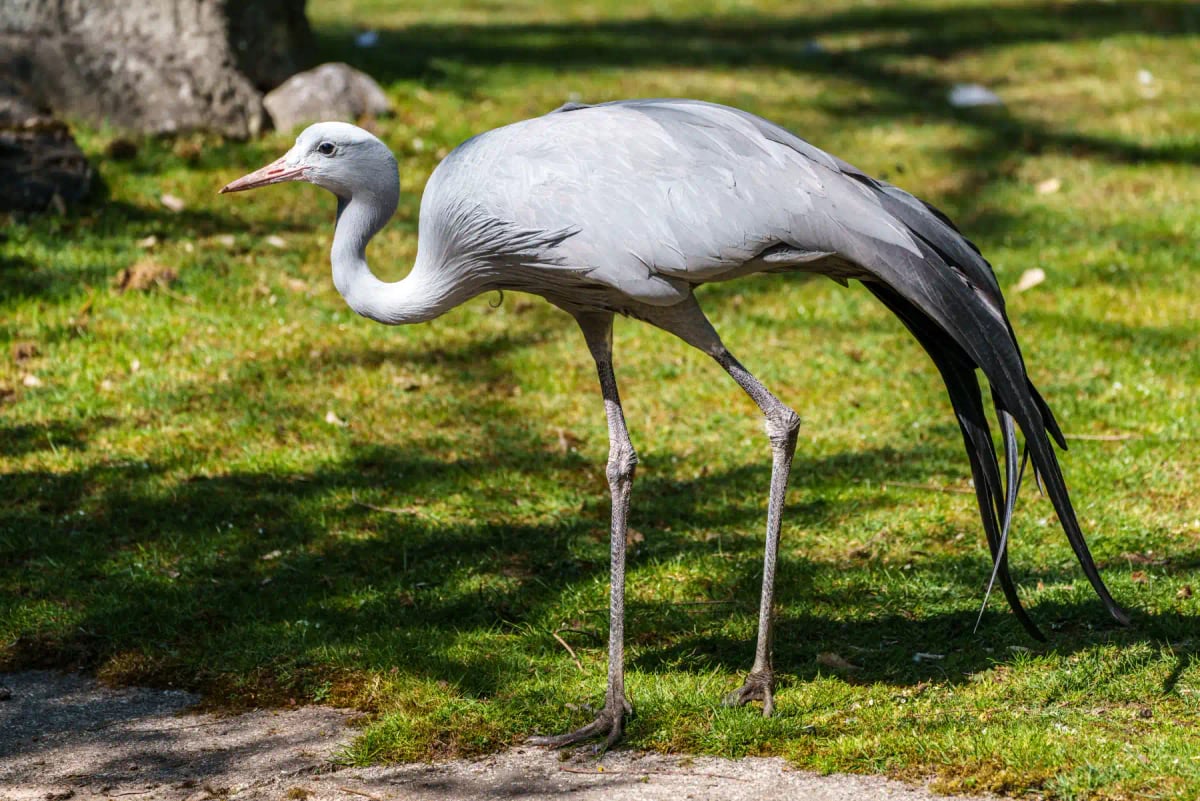
The blue crane stands 100 to 120 centimeters tall, weighs 3.6 to 6.2 kilograms and has a wingspan of about 180 to 200 centimeters. Males and females look alike, although males are slightly larger. The plumage is a soft, pale blue grey, with a whitish crown and a relatively large, rounded head that can puff out during displays, giving the bird a heavy headed look unusual among cranes. Its most striking feature is what looks like a long, dark tail sweeping to the ground. It is not a tail at all but a set of elongated inner wing feathers, called tertials, that drape over the real, short tail when the bird stands. They play a key role in courtship and threat displays. The pale blue grey color blends well with dry grassland and Karoo scrub, the long legs suit walking across open ground, and the short, sturdy bill can crack hard seeds or grab insects and small reptiles. Like other cranes it flies with its neck stretched forward and legs trailing behind, and its loud, rattling call carries far across open country.
Courtship dance and social life
Blue cranes are famous for their dancing. Pairs, and sometimes whole groups, run in circles, leap into the air with wings half open, bow, and pick up grass, sticks or small stones to toss upward before catching or chasing them. Both male and female take part, often calling loudly as they go. Dancing strengthens the bond between mates, but young birds dance too, and it seems to help relieve tension within flocks. Pairs are monogamous and usually stay together for many years. In the breeding season, mainly from October to March, each pair defends a territory and lays one or two eggs directly on the ground, sometimes in a scrape surrounded by small pebbles or dung. Both parents incubate for about a month and defend the nest by spreading their wings and charging at intruders, or by pretending to be injured to lead predators away. The chicks leave the nest within a day of hatching and follow their parents, but they need three to five months before they can fly. Outside the breeding season blue cranes become highly social, gathering in flocks of several hundred birds on farmland, where they spend the day walking steadily in search of seeds, grain, insects and small animals.
National bird of South Africa
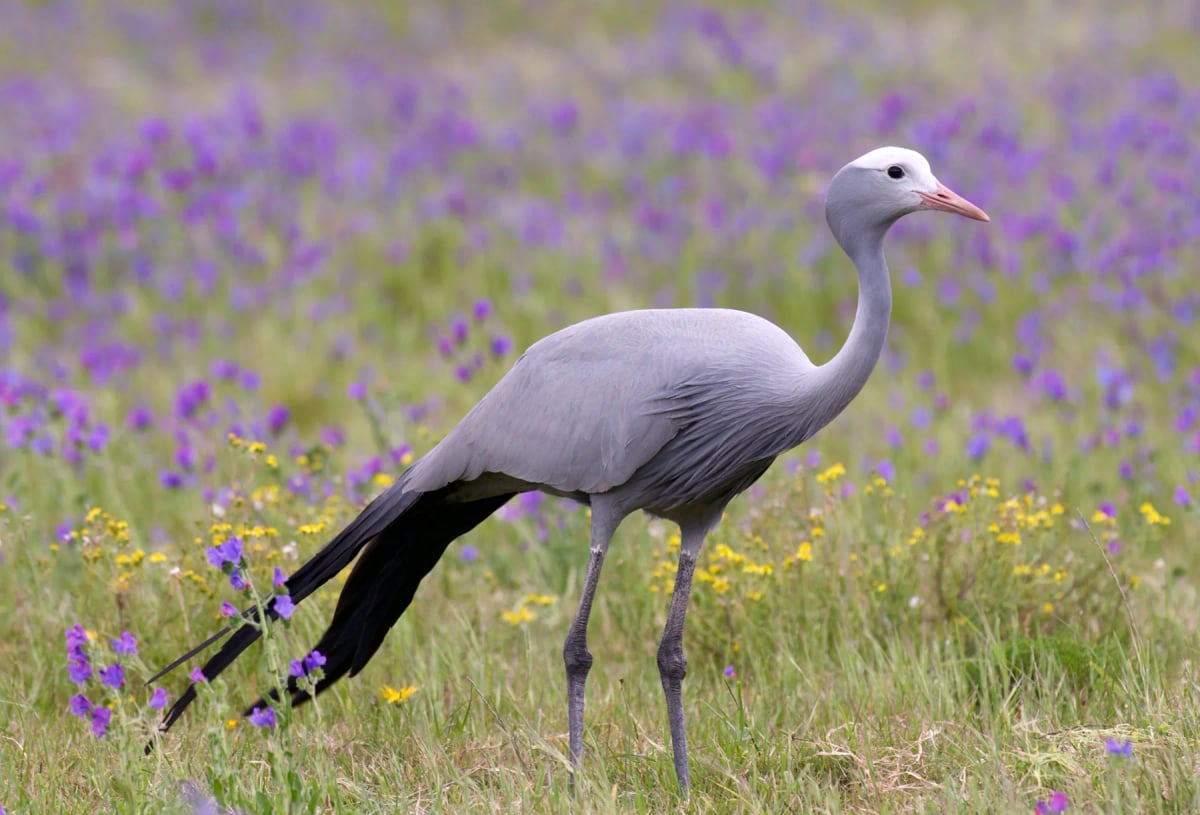
The blue crane is South Africa's national bird, and its place in the country's culture is much older than any official symbol. The Xhosa call it indwe, and in Xhosa tradition a man who had shown great bravery, especially in battle, could be honored by his chief with blue crane feathers, a ceremony known as ukundzabela. Those who received them wore the feathers in their headdress as a mark of distinction. Among the Zulu the feathers were also associated with royalty and honored warriors. The bird became part of daily life in a more modern way too. From 1965 South Africa's five cent coin carried a blue crane, and it remained on the coin until 2012, when production of five cent coins ended. In 2015 BirdLife South Africa named it Bird of the Year, using the title to draw attention to the threats it faces. Its elegance, its dances and the fact that almost the entire world population lives within the country's borders make it a fitting emblem, and its national status has helped conservation groups win support from farmers and the public.
Conservation
The IUCN lists the blue crane as Vulnerable, with an estimated 25,500 to 45,000 birds, of which about 17,000 to 30,000 are mature individuals, and a decreasing overall trend. The species crashed in the 1980s, when numbers in parts of its eastern range fell by as much as 90 percent. Some areas later recovered, and the move of cranes onto the wheat and pasture farmland of the Western Cape once seemed a success story, but counts in the Overberg dropped by about 44 percent between 2011 and 2025. Collisions with power lines are one of the biggest causes of death, because cranes fly low and cannot easily see the cables. Poisoning is another major threat, both accidental, from seed treated with pesticides, and deliberate, by farmers who see flocks as crop pests. In the east, natural grasslands have been lost to commercial tree plantations, farming and development, and chicks and eggs are sometimes taken illegally. Conservation work led by the Endangered Wildlife Trust and the International Crane Foundation includes marking power lines so birds can see them, working with farmers to make crane friendly farming practical, monitoring populations and supporting the small Namibian population. The blue crane's status as the national bird has helped raise awareness, but steady monitoring remains essential.
Researched and written by Juan Pablo. Sources: IUCN Red List, scientific literature and regional field guides. Last updated: .
Technical factsheet






Frequently Asked Questions
Is the blue crane the same as a blue heron?
No. The blue crane is a crane that lives almost only in South Africa, while the great blue heron is a heron of North and Central America. Both are tall, grey blue birds, which is why the names get mixed up. They are easy to tell apart in flight: cranes fly with the neck stretched straight out, while herons fold the neck into an S shape. Herons also hunt fish in shallow water with a long, dagger like bill, while the blue crane feeds on dry ground.
Where can you see blue cranes?
The easiest place is the Overberg in South Africa's Western Cape, a farming region a couple of hours from Cape Town where cranes are often seen walking in wheat fields and pastures. They are also found in the grasslands of KwaZulu-Natal, the Eastern Cape, the Free State and Mpumalanga, and across the Karoo. Outside South Africa, the only place to look is Etosha National Park in northern Namibia, home to a small group of about 60 birds.
Do blue cranes mate for life?
Blue cranes are monogamous and pairs usually stay together for many years, often for life. Partners strengthen their bond with dances and with unison calls, a duet in which male and female call together in a set pattern. Each breeding season the pair defends a territory, and both parents share incubation of the one or two eggs and care for the chicks. If one partner dies, the survivor can form a new pair.
How many blue cranes are left in the world?
The IUCN estimates that there are about 25,500 to 45,000 blue cranes, of which roughly 17,000 to 30,000 are mature adults. More than 99 percent live in South Africa, and the only other population, around Etosha Pan in Namibia, numbers only about 60 birds. The overall trend is downward: counts in the Overberg, long the species' stronghold, fell by about 44 percent between 2011 and 2025.
What does the blue crane symbolize?
In South Africa the blue crane stands for honor, bravery and national pride. The Xhosa, who call it indwe, traditionally honored brave men by giving them blue crane feathers to wear, and among the Zulu the feathers were linked to royalty and distinguished warriors. As the national bird it appeared on the five cent coin from 1965 to 2012. For many South Africans its graceful dancing has also made it a symbol of elegance and harmony.
What does the blue crane eat?
The blue crane is an opportunistic feeder that eats grass seeds, grains, insects, frogs and small vertebrates such as lizards. It forages almost entirely on foot, walking slowly across open ground to pick up food. On farmland, it takes advantage of crops like wheat and canola. Its sturdy bill handles both hard seeds and live prey with equal ease, making it well suited to the varied landscapes it inhabits.
Is the blue crane endangered?
The blue crane is listed as Vulnerable on the IUCN Red List, with an estimated 25,500 to 45,000 birds and a decreasing trend. Nearly all of them live in South Africa. It is not on the brink of extinction, but the pressures are serious: power line collisions, poisoning and the loss of natural grassland, and counts in the Western Cape's Overberg have fallen sharply since 2011. Because its range is so small, any major decline could quickly push it into a more threatened category.
How long do blue cranes live?
blue cranes are long lived birds. In the wild, individuals can reach 20 to 30 years of age, though survival depends heavily on avoiding the main threats they face. In captivity, some birds have lived beyond 30 years under ideal conditions. Their tendency to form lasting pair bonds and invest heavily in raising a small number of chicks each season reflects a reproductive strategy built around extended lifespans rather than high breeding output.
Can blue cranes fly?
Yes, blue cranes are fully capable of flight and use it regularly, particularly when traveling between feeding and roosting sites or during seasonal movements to agricultural areas. Their elongated inner wing feathers, sometimes mistaken for a tail, do not interfere with flight. When airborne, they extend their necks forward and trail their legs behind, much like other cranes. Flocks sometimes cover considerable distances as they shift between grassland and farmland areas.
What are the main threats to the blue crane?
Collisions with power lines rank among the most well documented causes of death for the blue crane. Poisoning is another major concern, whether from pesticides applied to crops or from deliberate poisoning by people who see the birds as agricultural pests. Egg collection and disturbance at nest sites add further pressure. These threats combine with the species' already narrow global range to make ongoing monitoring a priority for conservationists working in South Africa.