Arctic Wolf
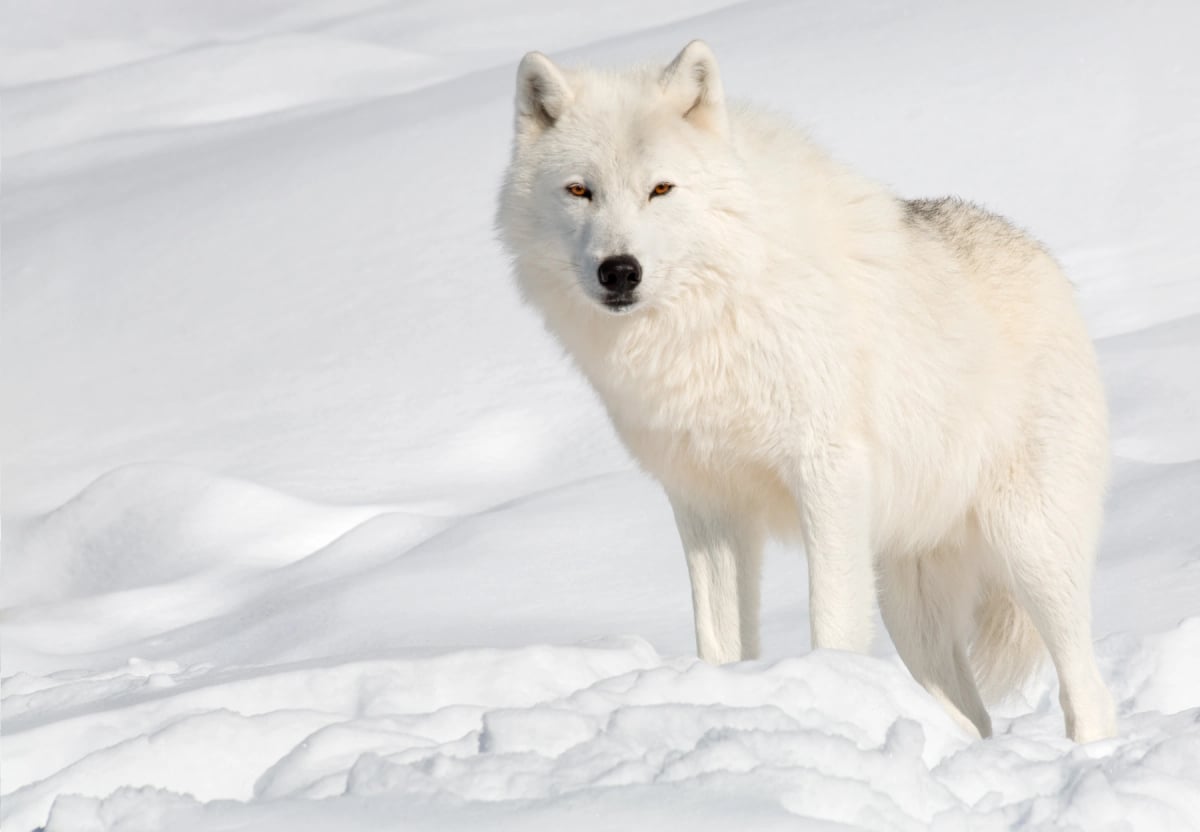
The Arctic wolf is a subspecies of the gray wolf found only in the High Arctic of Canada and Greenland, among the most remote and extreme environments on Earth. Its thick white coat, compact body, and small rounded ears are physical adaptations that limit heat loss in temperatures that can fall below −40 °C. Arctic wolves live in small family packs and cooperate to hunt large prey, primarily muskoxen and Arctic hares, across vast frozen tundra. Unlike most wolf populations, they have had little contact with humans and often show minimal fear when encountered in the wild.
Habitat and range
The Arctic wolf is restricted to the Canadian High Arctic and the northern and northeastern parts of Greenland, one of the most remote wildlife ranges on Earth. It inhabits open tundra, rocky uplands, and icy islands where almost no other large predator can survive year round. Its core territory includes Ellesmere Island and the Queen Elizabeth Islands in Canada, as well as the largely uninhabited northeastern coast of Greenland. The species tolerates months of complete darkness in winter and periods of continuous daylight in summer, with no fixed activity pattern tied to light conditions.
Is the Arctic wolf always white?
Mostly, but not exactly. The whitest animals are the ones farthest north, on Ellesmere and the Queen Elizabeth Islands, where the coat stays pale all year because the snow does too. Further south, at the edges of the range, the same subspecies turns up in cream, pale grey and even a dirty buff, and some individuals keep a grey saddle across the back through the summer. A genuinely black Arctic wolf is very rare: the mutation that makes black wolves common further south came from dogs, and it never spread into the High Arctic. Pups are the exception to everything. They are born a dark slate blue or charcoal, which makes them almost invisible against bare rock at the den, and they only turn white over their first year.
Adaptations
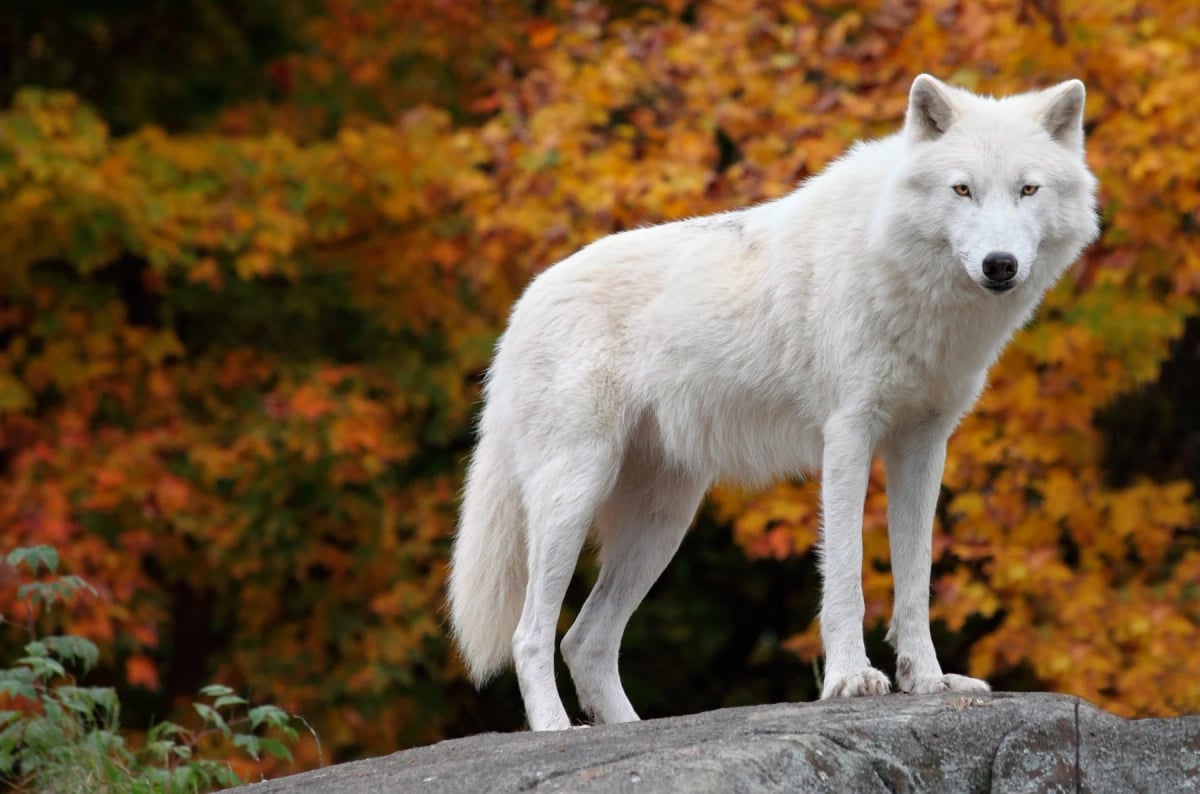
The Arctic wolf is physically built for extreme cold in ways that distinguish it from more southern wolf subspecies. Its coat has two layers: a dense, water-repellent undercoat and longer outer guard hairs that trap insulating air. The ears are smaller and more rounded than those of other gray wolves, reducing the surface area that loses heat. Its paws are large and padded with fur between the toes, functioning as natural snowshoes on ice and packed snow. The white coat provides camouflage in snow-covered landscapes throughout most of the year. Body fat reserves allow it to endure extended periods without prey.
Diet
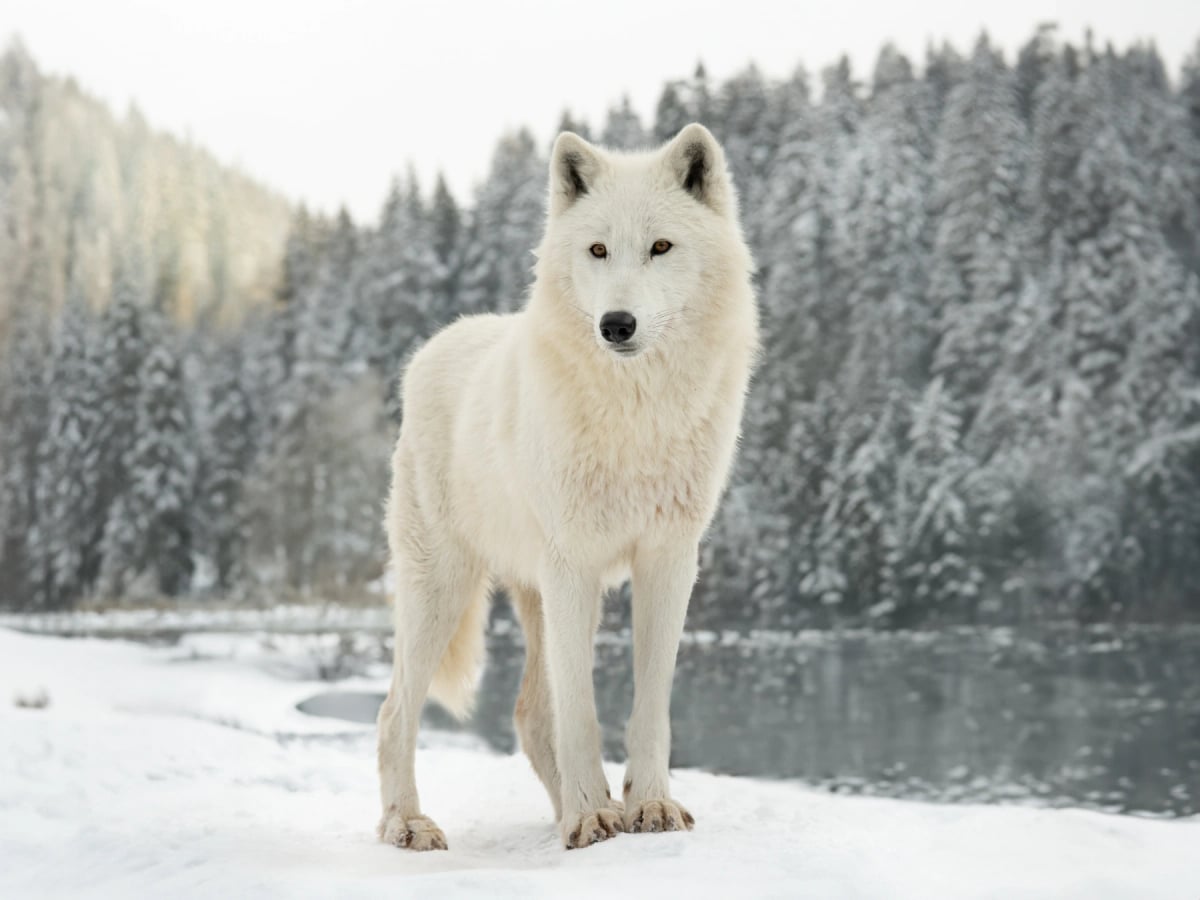
The Arctic wolf is a cooperative predator that depends primarily on muskoxen and Arctic hares, with caribou taken opportunistically in areas where their ranges overlap. Hunting muskoxen requires coordinated pack effort, as these animals are large and well defended by their herding behavior. When large prey is unavailable, the pack shifts to lemmings, ptarmigan, and carrion. Food scarcity is a regular feature of Arctic life, and packs may travel hundreds of kilometers between successful hunts. The wolf's digestive system allows it to consume and process large quantities of meat at once and then go days without eating.
Behavior
Arctic wolves live in small family packs typically consisting of a breeding pair and their offspring from one or more seasons. Pack size is generally smaller than in boreal wolf populations, reflecting the lower prey density of the High Arctic. The pack operates as a cooperative unit for hunting, pup rearing, and territorial defense. Territory sizes are enormous by wolf standards, sometimes exceeding 1,000 square kilometers, as prey is sparse and widely distributed. Unlike most gray wolf populations, Arctic wolves have had minimal contact with humans and often display curiosity rather than avoidance when researchers or visitors approach. That tolerance is why they matter to science out of all proportion to their numbers: it was on Ellesmere Island, watching a family of Arctic wolves over thirteen summers, that the biologist David Mech established that a wolf pack is a family and not a hierarchy ruled by an alpha.
Pups and dens in frozen ground
Most wolves dig a den. An Arctic wolf often cannot, because the ground is permafrost and a shovel would bounce off it, so packs use caves, rock crevices and shelters under boulders instead, and the good ones are reused for generations. Breeding runs late by wolf standards: pups arrive in late May or June, timed to the brief Arctic summer, and litters are small, usually two or three against the five or six a wolf further south might raise, because there is only so much food to go around. The whole pack feeds them. Adults return from a hunt and regurgitate meat for the pups, and the yearlings from last season babysit while the parents are away. Roughly half will not see their first birthday, which in the Arctic is a good survival rate.
Conservation
The Arctic wolf is classified as Least Concern by the IUCN as part of the gray wolf species assessment. Its remote habitat has largely protected it from the hunting, trapping, and habitat loss that decimated wolf populations across most of North America and Europe during the nineteenth and twentieth centuries. No large-scale persecution campaigns have targeted this subspecies. The primary threats are indirect: climate change is reducing sea ice, altering prey availability, and shifting the distribution of muskox and caribou populations on which the wolf depends. Monitoring is difficult given the extreme remoteness of its range.
Researched and written by Juan Pablo. Sources: IUCN Red List, scientific literature and regional field guides. Last updated: .
Technical factsheet




Frequently Asked Questions
How big is an Arctic wolf?
It stands 60 to 80 centimeters at the shoulder and weighs 32 to 55 kilograms, which makes it a medium sized gray wolf: shorter in the leg and stockier than a timber wolf, with a body shape that gives away less heat. Males run larger than females. The thick double coat makes the animal look considerably bigger than it is, and photographs taken in winter exaggerate it further, because in summer the same wolf sheds down to a surprisingly lean frame.
How many Arctic wolves are left?
Nobody knows with any precision, and the usual figure given is a few thousand. The subspecies has never been counted properly: its range covers some of the emptiest country on the planet, surveys mean flying over hundreds of thousands of square kilometers of ice and rock, and the wolves move constantly. What is known comes from long term study at a handful of sites, mainly on Ellesmere Island. The IUCN assesses the gray wolf as a whole, so the Arctic wolf has no conservation category of its own.
Do Arctic wolves live in Alaska or Siberia?
No. Despite the name, the Arctic wolf lives only in the Canadian High Arctic and in northern and northeastern Greenland. There are certainly wolves in Alaska, Siberia and northern Scandinavia, and some of them are white, but they belong to other subspecies and to populations that live alongside far more people. What makes Canis lupus arctos distinct is the isolation of the islands it lives on, which kept it separate from mainland wolves and kept hunters away from it.
Why do Arctic wolves howl?
For the same reasons any wolf does, but the Arctic makes it matter more. A howl regroups a pack spread out over a territory that can exceed 1,000 square kilometers, and it warns any neighboring pack to keep its distance without either side having to fight over prey that is already scarce. Sound carries exceptionally well over frozen open ground, so a howl can reach animals many kilometers away. Packs also howl together before and after a hunt, and the chorus works as a roll call for a family that spends much of its time apart.
How long do Arctic wolves live?
Around seven years in the wild, and up to eighteen in captivity, where there is no starving winter. The gap between the two figures says everything about Arctic life: adults rarely die of old age, they die of an injury taken from a muskox, of a season when the hares and lemmings crash, or of the long walk between one meal and the next. Pups are the most vulnerable, and roughly half do not reach their first birthday.
What does the Arctic wolf eat?
The Arctic wolf hunts primarily muskoxen and Arctic hares, with caribou taken opportunistically where ranges overlap. Taking down a muskox requires coordinated pack effort, as these animals are large and defend themselves in tight groups. When large prey is scarce, the pack shifts to lemmings, ptarmigan, and carrion. Food is often unpredictable in the High Arctic, and wolves may travel hundreds of kilometers between successful hunts, surviving on fat reserves built up during periods of abundance.
Where does the Arctic wolf live?
The Arctic wolf is found only in the Canadian High Arctic and the northern and northeastern parts of Greenland. Its core range includes Ellesmere Island and the Queen Elizabeth Islands in Canada, among the most isolated and extreme environments on Earth. It is the only wolf subspecies that lives year-round above 70 degrees north latitude, where it endures months of complete darkness in winter and continuous daylight in summer, hunting across open tundra and rocky uplands with very little human presence.
How does the Arctic wolf survive extreme cold?
The Arctic wolf has several physical adaptations that protect it from temperatures below −40 °C. Its coat has two layers: a dense, water-repellent undercoat and longer outer guard hairs that trap warm air. Its ears are smaller and more rounded than those of other gray wolves, reducing heat loss. Its paws are large and heavily furred between the toes, providing insulation against frozen ground. A compact body shape limits surface area relative to volume, helping retain body heat during prolonged exposure to Arctic conditions.
Is the Arctic wolf dangerous to humans?
The Arctic wolf is not considered a significant threat to humans. Unlike wolves in regions with a long history of human contact, Arctic wolves have had minimal exposure to people and often show curiosity rather than aggression when approached. There are no documented fatal attacks on humans by Arctic wolves. Like any large predator, it should be observed with caution and not approached closely in the wild, but the remote nature of its habitat means encounters are rare and usually uneventful.
How is the Arctic wolf different from other wolves?
The Arctic wolf is a subspecies of the gray wolf distinguished by its white coat, smaller ears, and more compact body, all adaptations to extreme cold. It lives in one of the few regions where wolves have never been heavily persecuted by humans, making it one of the most undisturbed wolf populations on Earth. Its territory sizes are among the largest of any wolf population, reflecting the sparse prey density of the High Arctic. It also tolerates complete winter darkness and continuous summer daylight, conditions that most other wolf subspecies never experience.
How do Arctic wolves hunt muskoxen?
Hunting muskoxen is a coordinated effort that requires the entire pack. When threatened, muskoxen form a defensive circle with adults facing outward and calves protected in the center, making a direct attack very dangerous. Wolves test the herd repeatedly, looking for vulnerable individuals: old, injured, or young animals that cannot keep pace with the group. A successful hunt may require hours of harassment before the pack can isolate a target. Despite the difficulty, a single muskox can provide enough food to sustain the entire pack for several days.