Hispaniolan Trogon
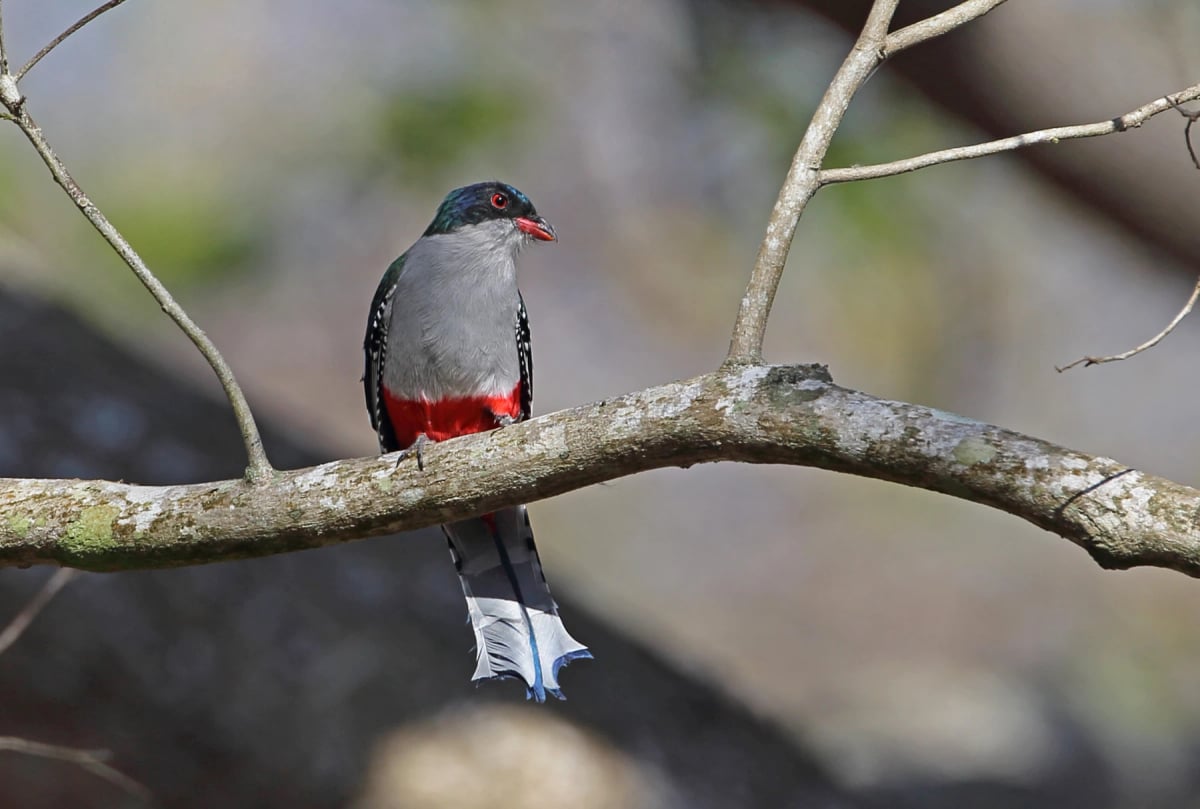
The Hispaniolan Trogon is a striking endemic bird found only on the island of Hispaniola, shared between Haiti and the Dominican Republic. It serves as the national bird of Haiti, a role that reflects its deep cultural importance. Adults display a vivid combination of green upperparts, blue wings, and a rich red belly, making them among the most colorful birds in the Caribbean. They inhabit mature montane forests, typically above 500 meters, where tall trees with natural cavities provide safe nesting sites. Their diet includes fruits and insects, which makes them useful seed dispersers and natural pest regulators. The species is classified as Near Threatened by the IUCN, largely due to ongoing deforestation, especially in Haiti, where forest cover has been reduced dramatically. Protecting remaining woodland across both countries is essential for the survival of this species over the long term.
National significance
Haiti has designated the Hispaniolan Trogon as its official national bird, a distinction that speaks to how deeply this species is woven into the country's identity. On an island where much of the original forest has disappeared, the trogon stands as a living reminder of what remains worth protecting. Haitians have long recognized the bird's beauty, and its image carries meaning well beyond ornithology. Across the border in the Dominican Republic, the species is equally admired as a jewel of the shared natural heritage of Hispaniola. Both nations benefit from what healthy trogon populations represent: intact forest, biodiversity, and ecological balance. Efforts to raise public awareness about the bird often serve a broader purpose, encouraging communities to see native forests not as resources to be cleared, but as living systems of genuine national value.
Habitat
Mature montane forests are the heartland of this species. The Hispaniolan Trogon is most commonly found at elevations above 500 meters, where tall, older trees form a closed canopy and natural cavities are plentiful enough for nesting. It also occurs in wooded valleys and humid forest patches at mid elevations, particularly where the vegetation remains relatively undisturbed. The species shows a clear preference for areas with structural complexity, meaning forests with multiple layers of growth rather than simplified secondary scrub. In the Dominican Republic, areas such as the Sierra de Bahoruco and Los Haitises support suitable habitat. In Haiti, suitable forest is increasingly scarce, confined mostly to isolated highland remnants. The trogon rarely ventures into open agricultural land, making its dependence on continuous forest cover one of its most important ecological traits.
Diet
Fruits and insects form the foundation of what the Hispaniolan Trogon eats, and this combination gives the bird a meaningful role in the health of the forest. By consuming small fruits and passing the seeds intact through its digestive system, it helps plants spread to new areas, a service that supports forest regeneration over time. Insects, including beetles and caterpillars, provide the protein the bird needs, particularly during the breeding season when the demands on adults are highest. Like other trogons in the Americas, it tends to snatch prey from leaves or branches while hovering briefly rather than pursuing it in flight. This foraging style suits the dense, layered forests it calls home. The trogon's appetite for both plant and animal matter places it at a productive intersection of the forest food web.
Behavior
Quiet forest patches come alive when a Hispaniolan Trogon is nearby. The species is known for its resonant, repetitive calls, which carry well through dense vegetation and serve as one of the most reliable ways to detect its presence. Pairs tend to stay close together, and the bond between mates appears to be maintained through regular vocal exchanges. Nesting takes place in cavities excavated in soft or rotting wood, with both parents sharing incubation duties. The vivid plumage of the male, combining green, blue, and red, makes it one of the most visually striking birds on the island, yet the bird can be surprisingly easy to overlook when perched quietly among foliage. Outside the breeding season, small groups may form as birds move through the canopy in search of food, following the availability of fruiting trees.
Conservation
Classified as Near Threatened on the IUCN Red List, the Hispaniolan Trogon faces a future shaped largely by what happens to the forests of Hispaniola. Deforestation is the primary threat, and nowhere is this more urgent than in Haiti, which has lost the vast majority of its original forest cover to charcoal production, agriculture, and urban expansion. The Dominican Republic retains more forest and hosts several protected areas where trogon populations are more stable, including Sierra de Bahoruco National Park. Across both countries, habitat fragmentation is a growing concern, as isolated forest patches make it harder for populations to remain connected. Conservation work tends to focus on strengthening protection for existing reserves, replanting native trees in degraded areas, and building local support for forest stewardship. The trogon's future depends on sustained commitment from both governments and communities.
Researched and written by Juan Pablo. Sources: IUCN Red List, scientific literature and regional field guides. Last updated: .
Technical factsheet

Frequently Asked Questions
What does the Hispaniolan Trogon eat?
The Hispaniolan Trogon feeds on a mix of fruits and insects. It plucks small fruits from branches and passes the seeds through its digestive system, helping plants spread across the forest. Insects such as beetles and caterpillars provide the protein it needs, especially during breeding season. Rather than chasing prey through the air, it hovers briefly near leaves or branches to snatch food. This diet makes it a valuable part of the forest ecosystem.
Where does the Hispaniolan Trogon live?
This bird is found only on the island of Hispaniola, which is shared between Haiti and the Dominican Republic. It prefers mature montane forests at elevations above 500 meters, where tall trees and natural cavities are common. In the Dominican Republic, areas like the Sierra de Bahoruco provide good habitat. In Haiti, suitable forest is now limited to a few highland remnants, as most of the original forest cover has been lost over the decades.
Is the Hispaniolan Trogon endangered?
The Hispaniolan Trogon is classified as Near Threatened by the IUCN. It is not yet endangered, but its population is declining due to deforestation, particularly in Haiti, where very little original forest remains. The Dominican Republic still has protected areas where the species is more stable. If forest loss continues at its current pace across both countries, the trogon's situation could worsen significantly in the coming years.
Why is the Hispaniolan Trogon the national bird of Haiti?
The Hispaniolan Trogon holds the title of national bird of Haiti because of its striking beauty and its deep connection to the island's natural heritage. Found nowhere else in the world, it represents something uniquely Haitian. Its vivid colors and its presence in the forests that once covered much of the island have made it a powerful symbol of what remains worth protecting. The bird carries cultural significance well beyond its role in the ecosystem.
How does the Hispaniolan Trogon nest?
The Hispaniolan Trogon nests inside cavities that it excavates in soft or rotting wood. Both the male and female share the work of incubating the eggs, which is a behavior common among trogons. The bird depends on older, mature trees for nesting, which is one of the reasons it struggles in degraded or heavily logged forests where suitable trees are scarce. The availability of natural cavities directly affects how successfully the species can breed.
What does the Hispaniolan Trogon look like?
The Hispaniolan Trogon is one of the most colorful birds in the Caribbean. Adults have bright green upperparts, blue wings, and a vivid red belly that makes them immediately recognizable. Despite such bold colors, the bird can be difficult to spot when it sits still among green foliage. Its long tail and upright posture are typical of trogons found throughout the Americas. The combination of colors in a single bird is genuinely striking even by tropical standards.
What is the biggest threat to the Hispaniolan Trogon?
Deforestation is by far the greatest threat this species faces. In Haiti, charcoal production, agriculture, and urban growth have removed most of the original forest, leaving the trogon with very little suitable habitat. Even where patches of forest survive, fragmentation makes it harder for bird populations to stay connected. The Dominican Republic offers more protection through national parks, but ongoing pressure on forests across the island means the trogon's future remains uncertain without continued conservation effort.