Monk Parakeet

Habitat and distribution
The monk parakeet originates from the open woodlands, grasslands, and scrublands of central and southern South America. Its native range covers Argentina, Uruguay, Paraguay, southern Brazil, and Bolivia, where it favors areas with scattered trees near farmland and rivers. Over the past several decades, populations have taken root far beyond those borders. Today, established colonies exist across the United States, Mexico, Puerto Rico, Spain, Belgium, Germany, France, Austria, Czechia, and Slovakia, among other countries. Most introduced populations settled first in cities, where the warmth of buildings and the steady supply of food from parks and gardens helped them survive winters. The species shows a remarkable ability to adapt to climates very different from its native one, which explains its success as one of the world's most widespread introduced parrots.
Nesting
What sets the monk parakeet apart from virtually every other parrot on Earth is its approach to nesting. Rather than using tree hollows or burrows, it constructs large communal nests from sticks and twigs, woven together into a structure that can grow to an impressive size over many years. A single nest may contain multiple chambers, each occupied by a different breeding pair, allowing dozens of birds to share one structure. These nests are built on tall trees, electricity pylons, and other elevated platforms, and the same nest is often used and expanded across many seasons. The largest recorded nests have weighed over 200 kilograms. This cooperative style of nesting is thought to help the colony stay warm in cooler climates and maintain a social bond throughout the year.
Diet
Monk parakeets are opportunistic feeders with a broad and flexible diet. Seeds form the core of what they eat, but they also consume fruits, berries, leaf buds, and flowers depending on what is available in each season. In agricultural areas, flocks regularly visit fields of sunflowers, maize, sorghum, and other crops, which has brought them into conflict with farmers in both their native range and introduced regions. In cities, they take advantage of garden plants, bird feeders, and fruit trees. Studies in Spain and the United States have shown that urban populations rely heavily on ornamental plants and food left by people. Despite their reputation as crop raiders, the full extent of agricultural damage they cause is still debated, and impacts vary considerably depending on the region and the time of year.
Behavior
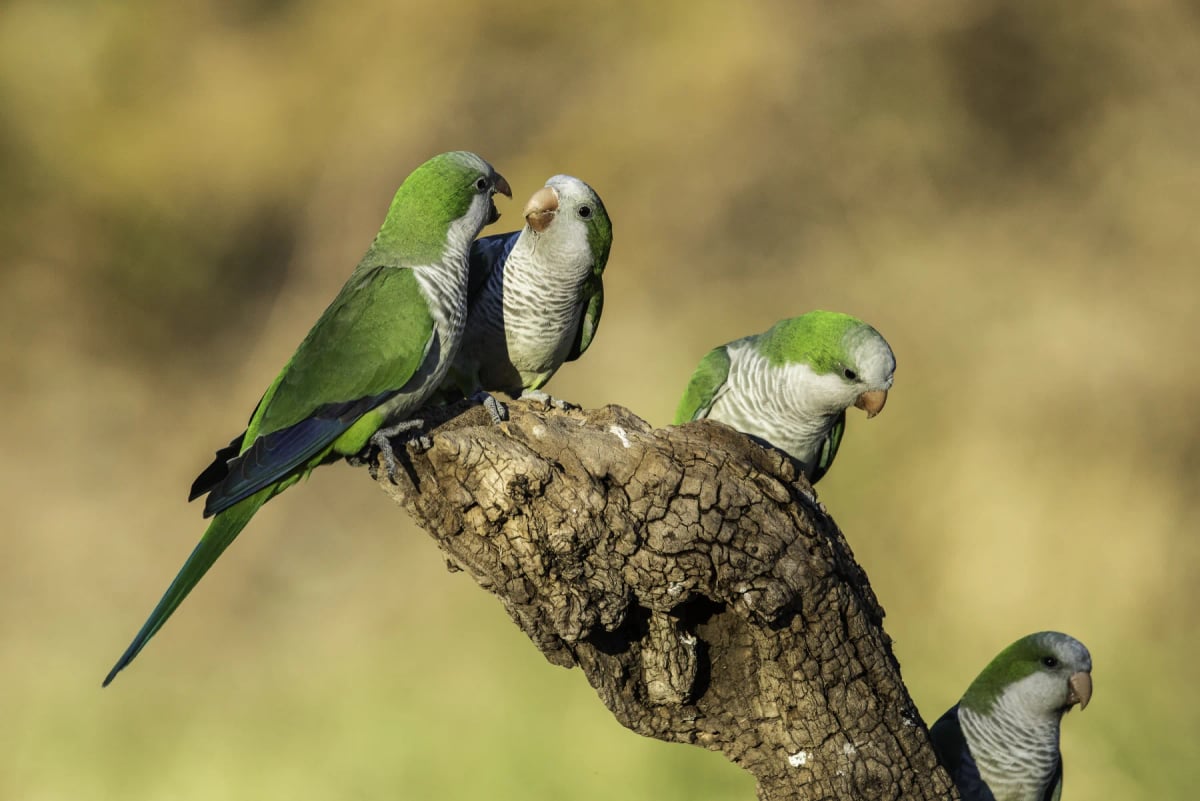
Few birds are as socially complex or as vocal as the monk parakeet. Flocks remain together throughout the year, and individuals form strong bonds with specific partners and neighbors within the group. Communication is constant: the birds use a wide range of calls to signal alarm, coordinate movement, and maintain contact with flock members. Their noise is one of the first things people notice about urban colonies. Monk parakeets are active during daylight hours, spending much of the day foraging in groups before returning to the communal nest in the evening. They are quick learners and show a level of curiosity that makes them highly adaptable to new environments. In captivity, they are known to mimic human speech, though wild birds focus their vocal skills almost entirely on communication within the flock.
Conservation
The IUCN currently classifies the monk parakeet as Least Concern, reflecting a population that is stable and growing across much of its range. In its native South American habitat, the species faces no significant threat of decline. Outside its native range, however, the picture is more complicated. Introduced populations in Europe and North America have expanded steadily since the 1970s, and several countries now manage them as invasive species. In Spain and Belgium, for example, authorities have carried out control programs to limit their spread. Concerns center on damage to crops and orchards, nesting on electricity infrastructure causing power outages, and potential competition with native birds for food and nesting sites. Research into their ecological impact is ongoing, and management approaches vary widely from one country to the next.
Where it is found
The Monk Parakeet can be found in places such as:
Researched and written by Juan Pablo. Sources: IUCN Red List, scientific literature and regional field guides. Last updated: .
Technical factsheet













Frequently Asked Questions
What do monk parakeets eat?
Monk parakeets eat mainly seeds, but they also go for fruits, berries, flowers, and leaf buds depending on the season. In farming areas, they often raid fields of sunflowers, maize, and sorghum. In cities, they feed on garden plants, fruit trees, and even food left out at bird feeders. Their ability to eat such a wide variety of things is a big part of why they thrive in so many different places around the world.
Are monk parakeets invasive species?
Outside their native South America, monk parakeets are considered invasive in several countries, including Spain, Belgium, and the United States. They can damage crops and orchards, their large nests on power lines cause outages, and there are concerns about competition with native birds. Because of this, some countries have launched control programs to manage their numbers. In their original home range, they are simply a native species with no such classification.
Can monk parakeets talk?
Yes, monk parakeets are capable of mimicking human speech, and they are considered one of the better talking parrots among smaller species. In captivity, they can learn words and short phrases with practice. Wild birds do not mimic human voices since they focus their vocal energy on communicating with their flock. Their natural range of calls is already quite broad, covering everything from alarm signals to sounds used to stay in contact while foraging.
Why do monk parakeets build such big nests?
Monk parakeets are the only parrots in the world that build their own stick nests instead of using tree hollows. Their nests grow over many years as the colony adds new chambers for different breeding pairs. This communal design helps the birds stay warm in cold weather and keeps the group together throughout the year. The largest nests ever recorded have weighed more than 200 kilograms, making them some of the most impressive bird structures on the planet.
Where do monk parakeets originally come from?
Monk parakeets are native to central and southern South America. Their original home range includes Argentina, Uruguay, Paraguay, southern Brazil, and Bolivia, where they live in open woodlands, grasslands, and scrublands near rivers and farmland. From the 1970s onward, escaped or released pet birds started forming wild colonies in North America and Europe, and those populations have been growing ever since.
How long do monk parakeets live?
In the wild, monk parakeets typically live around 15 years, though exact figures for wild populations are difficult to confirm. In captivity, with proper care, they can reach 20 to 30 years. Like many parrots, they are long lived compared to other birds of a similar size. Their lifespan in cities and introduced regions may vary depending on local conditions, food availability, and whether any population management programs are active in the area.
Are monk parakeets endangered?
No, monk parakeets are not endangered. The IUCN classifies them as Least Concern, which means their population is stable and not at risk of decline. In fact, their numbers have been increasing globally thanks to their spread into new regions. In some countries outside their native range, the opposite concern applies: populations have grown so large that authorities work to control them rather than protect them.