Armadillo
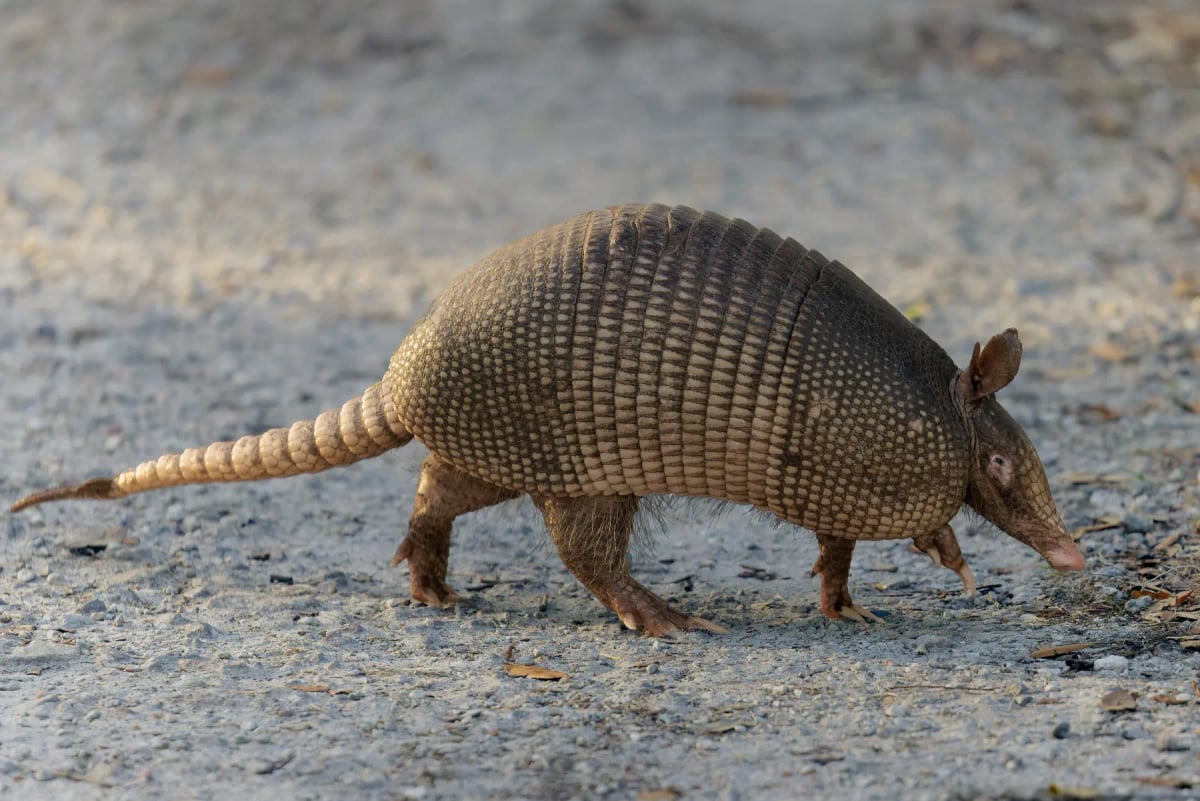
The nine banded armadillo is the most widespread armadillo and the one most people picture: a cat sized mammal covered in a bony shell, with movable bands across its middle, a long armored tail and powerful claws for digging. It ranges from the southern United States through Mexico and Central America to northern Argentina and Uruguay, and in 2024 a genetic study showed that this range actually holds four almost identical species. It eats mainly insects and grubs, which it sniffs out at night and digs from the soil. Its reproduction is unique: a single fertilized egg splits into four, so every litter is made up of identical quadruplets. It can hold its breath for about six minutes, walk underwater across streams, and leap straight up when startled. It is one of the few wild animals that can carry leprosy. Armadillos as a group include about 20 to 24 species, from the 50 kilogram giant armadillo to the tiny pink fairy armadillo, all found only in the Americas.
The nine banded armadillo, now four species
When people in the United States, Mexico or most of Latin America picture an armadillo, they picture the nine banded armadillo, the most widespread member of the family and the one in the photos on this page. For more than two centuries it was treated as a single species, Dasypus novemcinctus, ranging from the southern United States to northern Argentina. In 2024 a genetic study of museum specimens across its whole range showed that it is really four species that look almost identical. Dasypus mexicanus lives from the United States through Mexico and Central America to northern Costa Rica. Dasypus fenestratus lives from Costa Rica and Panama along the Pacific side of the Andes into Colombia, Ecuador and western Venezuela. Dasypus guianensis, newly described, lives in the Guianas and eastern Venezuela. Dasypus novemcinctus in the strict sense covers the rest of South America east of the Andes, from Colombia and Venezuela to Brazil, Paraguay, Uruguay and northern Argentina. This page covers all four under the name everyone still uses, and the country texts say which one lives where.
How big is a nine banded armadillo?
The nine banded armadillo is about the size of a house cat. Adults measure roughly 60 to 100 centimeters from nose to tail tip, including a long, armored tail, and weigh 2.5 to 6.5 kilograms, with males a little larger than females. Despite the name, the number of movable bands across the middle of the shell varies from seven to eleven, though eight or nine is most common. The shell is made of bony plates in the skin, called osteoderms, covered by a thin layer of keratin, and it covers the back, the head and the tail but not the belly, which is soft and hairy. Unlike the three banded armadillos, it cannot roll into a ball: its shell is too rigid at the front and back. Its ears are large, its snout is long and pointed, and its front feet carry four strong claws for digging.
Where do armadillos live?
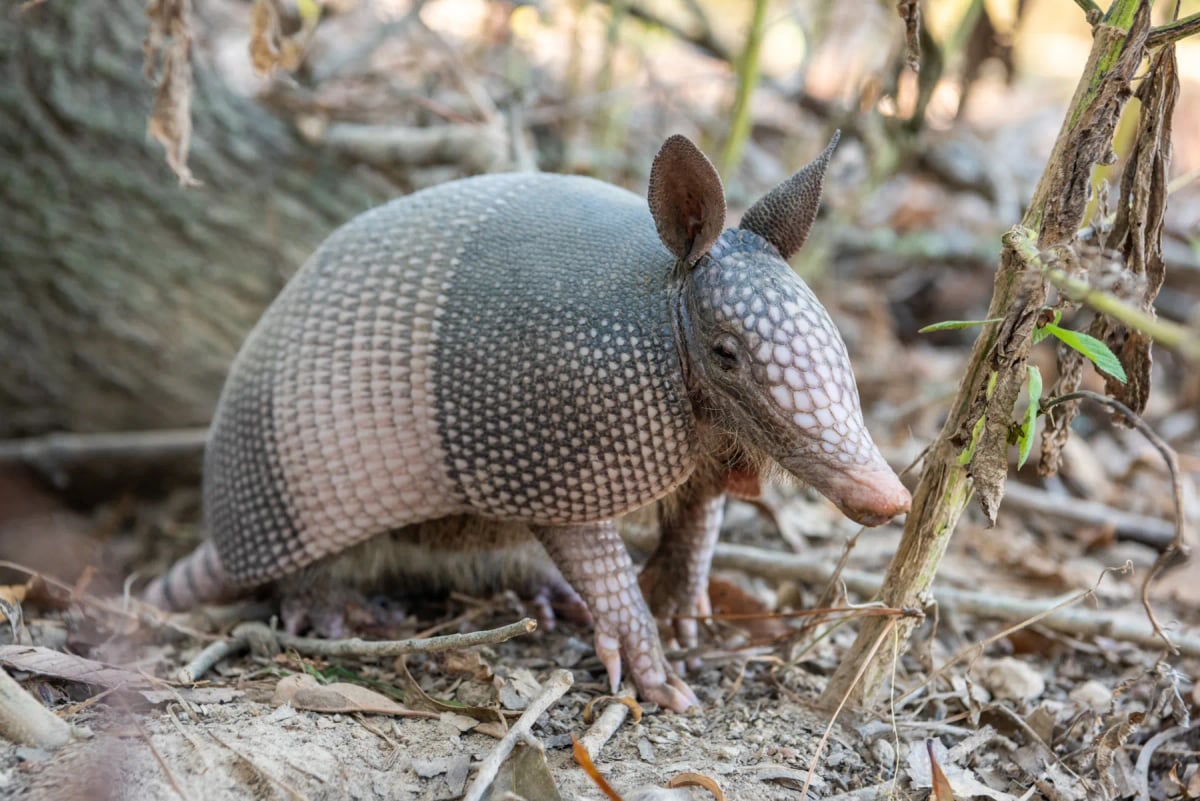
Armadillos live only in the Americas. The nine banded armadillo and its close relatives cover the widest range of any armadillo, from the southern United States through Mexico, Central America and most of South America east of the Andes, down to northern Argentina and Uruguay. They are habitat generalists, found in rainforest, dry forest, savanna, scrub, grassland, farmland and suburban yards, as long as the soil is soft enough to dig and winters are not too cold. In the United States their spread is one of the fastest of any mammal: they crossed the Rio Grande into Texas in the mid nineteenth century, were helped into Florida by escapes and releases in the 1920s and 1930s, and now reach Oklahoma, Missouri, Illinois, Indiana, Nebraska and the Carolinas. Cold limits them, because they have little fat and a low body temperature; long freezes kill many and mark the northern edge of the range. Other armadillo species live only in South America, from the Amazon to Patagonia.
What do armadillos eat?
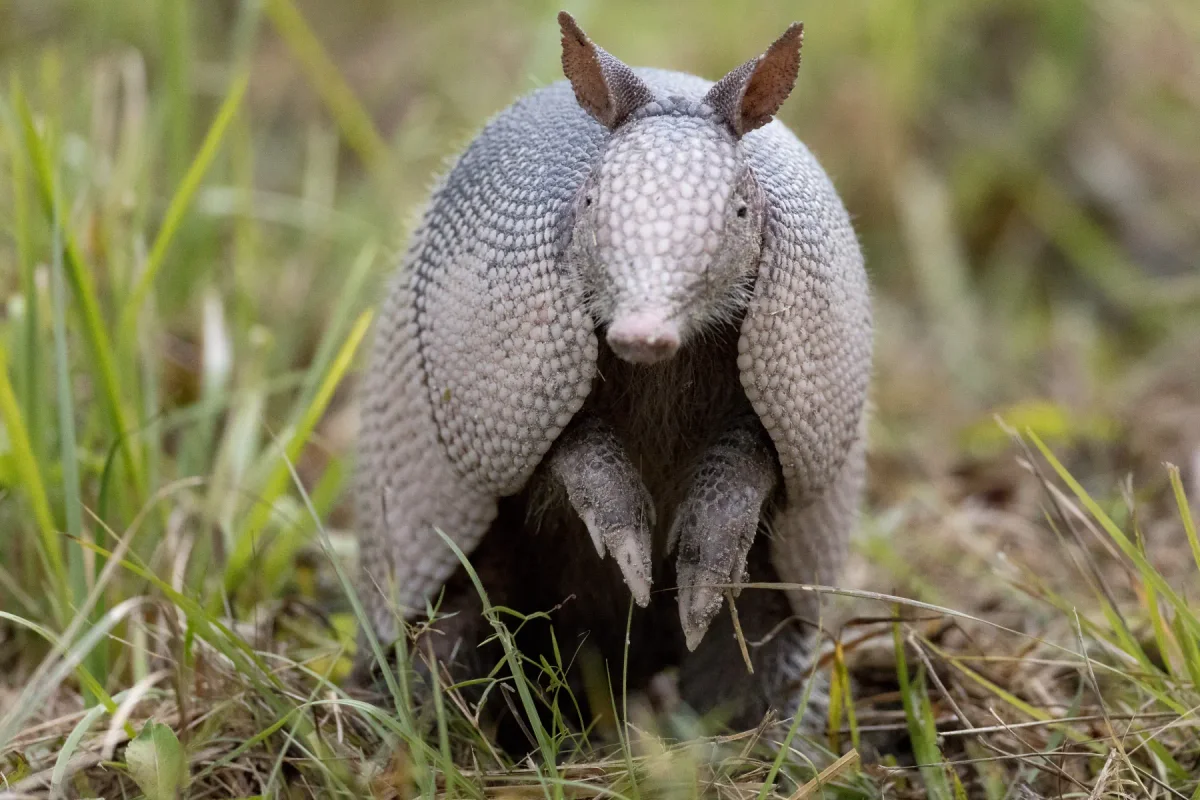
The nine banded armadillo is mostly an insect eater. Beetles and their larvae, ants, termites, caterpillars, grubs and other invertebrates make up the great majority of its diet, and it finds them with an excellent sense of smell, rooting through leaf litter and soft soil with its snout and digging small, cone shaped holes with its claws. A long, sticky tongue picks up the prey. When insects are scarce it also eats earthworms, snails, small frogs, lizards, bird and reptile eggs, fruit, fungi and carrion. In lawns and gardens of the southern United States those feeding holes make it unpopular, although it also eats many pest insects such as fire ants and grubs. Other species have their own specialties: the giant armadillo eats mainly ants and termites and can tear open a whole termite mound, while some hairy armadillos of Argentina eat almost anything. Armadillos have a low metabolic rate for their size, which reduces how much food they need each day.
Newborn armadillos: always identical quadruplets
The nine banded armadillo has one of the strangest ways of reproducing of any mammal. It mates in summer, but the fertilized egg does not attach to the womb right away; it waits for about three to four months, so the young are born in spring, when food is plentiful. Then the single embryo splits into four, and the female almost always gives birth to identical quadruplets of the same sex, all genetically the same. Newborn armadillos weigh about 50 to 100 grams, are born with their eyes open, and have a soft, leathery shell that hardens over the following weeks. They can walk within hours and follow their mother out of the burrow after a few weeks. They nurse for about two to three months and become independent during their first summer. Because the four siblings are clones, the armadillo has been used in medical research on genetics and on leprosy.
Behavior
Most armadillos are solitary and active mainly at night, spending the day in burrows and coming out after dark to forage, although the nine banded armadillo is often active in the daytime in cool weather. They rely on their sense of smell, as their eyesight is poor. A single armadillo may dig several burrows within its home range, each with one or more entrances, and abandoned burrows become shelter for snakes, rabbits, skunks and many other animals. When threatened, the nine banded armadillo runs for thick brush or its burrow, wedges itself in with its shell, or leaps straight up into the air, a startle reflex that can confuse a predator but often proves fatal on roads. Armadillos are also surprisingly good in water: they can hold their breath for about six minutes and walk along the bottom of a stream, or gulp air to inflate their stomach and intestines and swim across. Only the two three banded armadillos of South America can roll into a complete ball for defense.
Armor and other adaptations
The most distinctive feature of armadillos is their armor, formed by bony dermal plates called osteoderms, covered externally by scales of keratin. The arrangement of these plates, including flexible bands across the mid-body, allows a degree of movement while maintaining protection. Strong forelimbs and curved claws are adapted for digging, both to construct burrows and to extract buried prey. Armadillos can hold their breath for extended periods, allowing them to walk along stream beds or even cross rivers underwater. A low metabolic rate and reduced body temperature compared to most mammals help conserve energy in resource-limited environments.
Other armadillo species
There are around 20 to 24 living armadillo species, depending on how the nine banded complex is counted, and all live in the Americas. The giant armadillo of South America is the largest, at up to about 1.5 meters long and 50 kilograms, with a huge third front claw used to tear open termite mounds; it is rarely seen and listed as Vulnerable. The two three banded armadillos, the southern one of the Chaco and the Brazilian one of the Caatinga, are the only ones that roll into a ball; the Brazilian species was the model for Fuleco, the mascot of the 2014 World Cup. At the other extreme, the pink fairy armadillo of central Argentina is only about 9 to 12 centimeters long, with a pale pink shell, and lives almost entirely underground. Hairy armadillos, such as the large hairy armadillo and the pichi of Patagonia, have long hair between their plates and live in dry and cold country where few armadillos survive. Long nosed armadillos of the genus Dasypus, including the nine banded, the southern long nosed armadillo or mulita and the greater long nosed armadillo, form the most widespread group.
Are armadillos endangered?
The nine banded armadillo is not endangered. The IUCN lists Dasypus novemcinctus, the South American species, as Least Concern, and the other three species split from it in 2024 have not yet been assessed separately, but they are common across most of their ranges, and the northern one is still expanding in the United States. Their biggest killers are cars, since millions are hit on roads, along with hunting for meat in rural Latin America and, in the United States, people who see them as garden pests. Other armadillos are in much more trouble. The giant armadillo is listed as Vulnerable and has disappeared from large parts of its former range in Brazil and Argentina because of deforestation and hunting; long term projects in the Pantanal and the Cerrado now track and protect it. The Brazilian three banded armadillo is Vulnerable, the southern three banded armadillo and the pichi are Near Threatened, and the pink fairy armadillo is so rarely seen that the IUCN lacks the data to assess it. Loss of grassland and dry forest to soy and cattle is the main threat for these South American species.
Where it is found
The Armadillo can be found in places such as: