Amazon River Dolphin
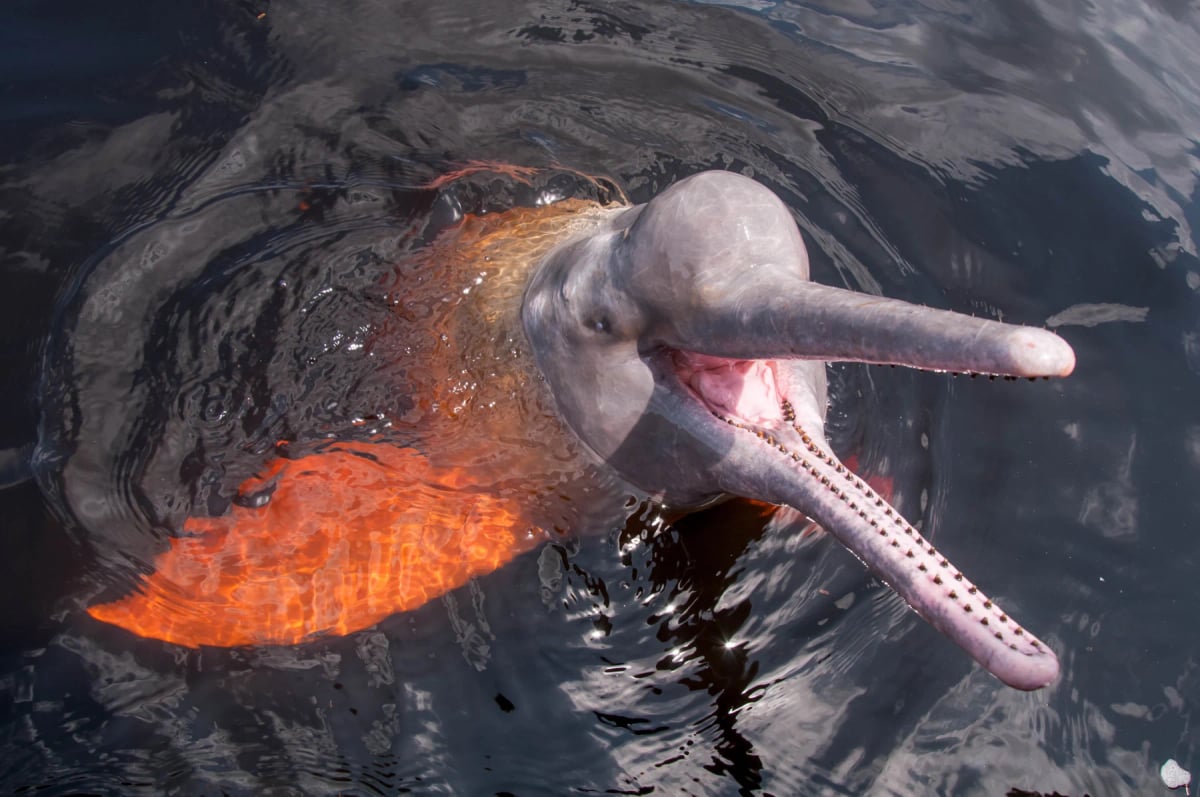
The Amazon river dolphin, also known as the pink river dolphin or boto, is a freshwater cetacean native to the Amazon and Orinoco river basins. Its long beak and flexible neck allow it to maneuver through flooded forests to catch fish, crustaceans, and small turtles. Adults often develop a pink coloration from blood vessels close to the skin surface. Classified as Endangered, it faces serious threats from mercury pollution, dam construction, accidental capture in fishing nets, and habitat loss.
Habitat and distribution
The Amazon river dolphin is native to the Amazon and Orinoco river basins, with populations in Bolivia, Brazil, Colombia, Ecuador, Peru, and Venezuela. It occupies main river channels, tributaries, lakes, and seasonally flooded forests known as várzea. During the wet season, dolphins follow rising waters into flooded plains and forest, where food is abundant. As levels drop in the dry season, they concentrate in main channels and permanent lakes. The species tolerates a wide range of water conditions, from clear and blackwater rivers to heavily turbid channels.
Appearance
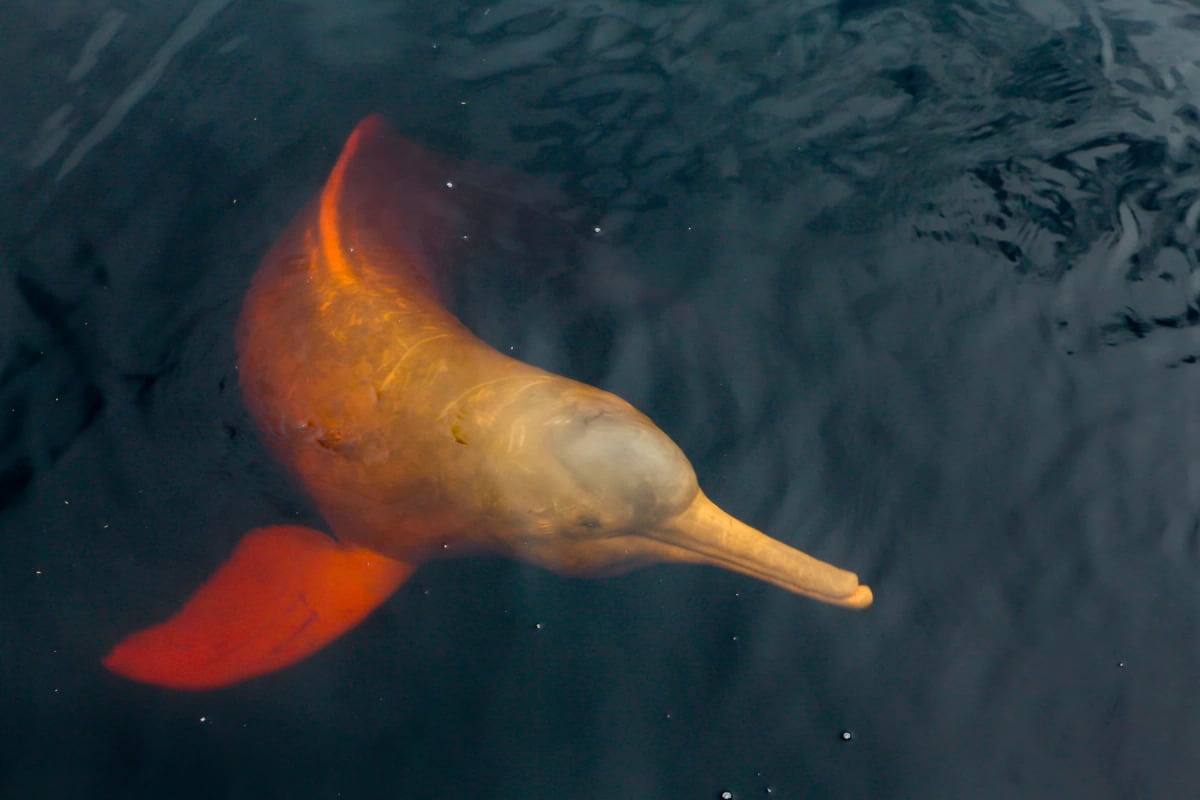
The Amazon river dolphin is the largest river dolphin in the world, with males reaching up to 2.5 meters and females around 1.7 meters. Coloration varies from gray in young animals to shades of pink in adults, a result of blood vessels near the skin surface and scar tissue from social contact. Intensity of pink coloring often increases with age and activity. The species has a long, narrow beak, a rounded forehead, and a flexible neck with exceptional mobility that allows it to navigate through submerged roots and dense vegetation.
Diet
The Amazon river dolphin feeds on more than 40 fish species, including piranhas, catfish, and characins. It also consumes crustaceans, small river turtles, and freshwater crabs. Its long beak is ideal for probing root tangles and flooded vegetation where prey hides. Sophisticated echolocation allows it to locate fish in dark, turbid water with high precision. Feeding activity intensifies during the dry season, when fish concentrate in shrinking pools and channels, making them easier to catch in shallower and more confined spaces.
Behavior
The Amazon river dolphin is usually seen alone or in pairs, though groups of ten or more gather at productive feeding sites during the dry season. Unlike oceanic dolphins, it rarely leaps from the water and tends to move slowly and deliberately. Males are noticeably larger than females and often show more intense pink coloration from accumulated scars. The species is known for its curiosity and sometimes approaches boats and swimmers. Seasonal water levels strongly influence movement patterns, with dolphins spreading into flooded forests during the high water period.
Conservation
Listed as Endangered on the IUCN Red List, the Amazon river dolphin faces mounting pressure across its range. Mercury from illegal gold mining accumulates in fish and enters dolphins through the food chain. Deliberate killing for use as bait to catch catfish remains a persistent problem in parts of the basin. Dam construction fragments habitat and blocks fish migrations. Accidental entanglement in fishing nets and propeller strikes from boat traffic also contribute to mortality. Conservation programs across Bolivia, Brazil, Colombia, Ecuador, Peru, and Venezuela focus on protected areas, community education, and bycatch reduction.
Where it is found
The Amazon River Dolphin can be found in places such as:
Researched and written by Juan Pablo. Sources: IUCN Red List, scientific literature and regional field guides. Last updated: .
Technical factsheet


Frequently Asked Questions
Why is the Amazon river dolphin pink?
The pink coloration of adult Amazon river dolphins comes from blood vessels located close to the skin surface and from scar tissue accumulated through social contact between individuals. Young dolphins are gray and gradually develop pink tones as they mature. Males tend to be pinker than females because they engage in more physical competition. The intensity of the color can increase with activity or excitement, since blood flow to the skin rises when the animal is stimulated.
Where does the Amazon river dolphin live?
The Amazon river dolphin lives in the Amazon and Orinoco river basins across Bolivia, Brazil, Colombia, Ecuador, Peru, and Venezuela. It inhabits main river channels, tributaries, lakes, and seasonally flooded forests. During the wet season it follows rising waters into flooded plains and forest where fish are abundant. In the dry season it concentrates in main channels and permanent lakes. It tolerates a wide range of water conditions, from clear rivers to heavily turbid channels.
What does the Amazon river dolphin eat?
The Amazon river dolphin feeds on more than 40 fish species, including piranhas, catfish, and characins. It also consumes crustaceans, small river turtles, and freshwater crabs. Its long beak is ideal for probing root tangles and flooded vegetation where prey hides. Sophisticated echolocation allows it to locate fish in dark, turbid water with precision. Feeding intensifies during the dry season when fish concentrate in shrinking pools and channels, making them easier to catch.
Why is the Amazon river dolphin endangered?
The Amazon river dolphin is listed as Endangered by the IUCN due to several combined pressures. Mercury from illegal gold mining accumulates in fish and enters dolphins through the food chain. Deliberate killing for use as bait to catch catfish remains a persistent problem in parts of the basin. Dam construction fragments habitat and blocks fish migrations. Accidental entanglement in fishing nets and boat propeller strikes also contribute to mortality. Deforestation further degrades the flooded forest ecosystems the species depends on.
Is the Amazon river dolphin the largest river dolphin in the world?
Yes. The Amazon river dolphin is the largest river dolphin species in the world. Males can reach up to 2.5 meters in length and weigh up to 185 kilograms, while females are smaller at around 1.7 meters. It is considerably larger than the tucuxi, the smaller dolphin it shares its rivers with, and larger than any of the river dolphin species found in Asia. Its size, flexibility, and long beak make it well adapted to navigating complex flooded forest environments.
What is special about the Amazon river dolphin's neck?
Unlike oceanic dolphins, the Amazon river dolphin has a flexible neck that allows it to turn its head up to 90 degrees. This mobility is essential for navigating through flooded forests, where submerged roots, branches, and dense vegetation require constant maneuvering. The vertebrae in its neck are not fused, as they are in most ocean dolphins, giving it a range of movement that makes it far more agile in confined river and forest environments.