Andean Condor
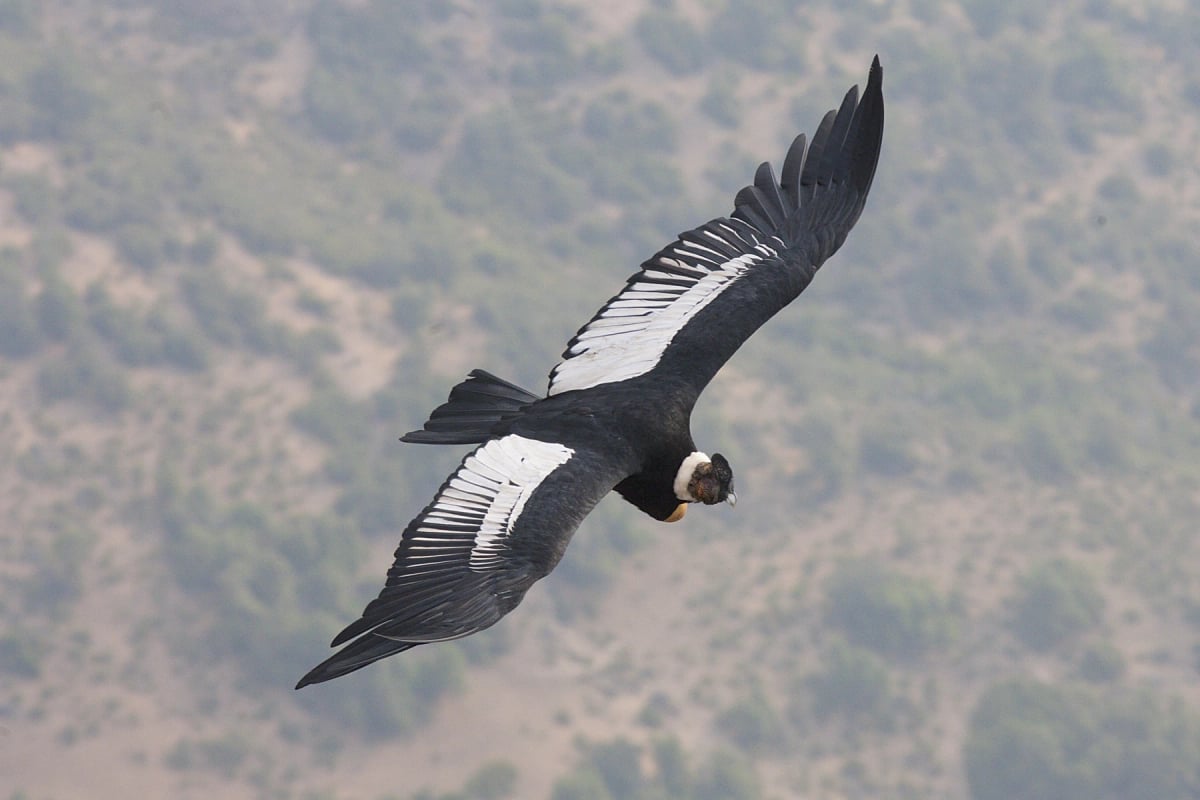
The Andean condor is the heaviest flying bird in the world on average and has the largest wing area of any living bird, with a wingspan that averages about 2.8 meters and can reach 3.3. A New World vulture, it lives along the Andes from Colombia and Ecuador to Tierra del Fuego, and down to the Pacific coast and the Patagonian steppe, from sea level to about 5,000 meters. Adults are black with a white ruff around the neck and big white patches on the wings, and the bare head is red to blackish. Males are larger than females and carry a dark red comb. The condor soars on rising air and mountain winds, flapping its wings only about 1% of the time it is in the air, and it feeds almost entirely on carrion, which it spots by sight. It is the national bird of Bolivia, Chile, Colombia, and Ecuador. Because a pair raises a single chick every two years, poisoning and lead from hunting ammunition hit it hard, and the IUCN lists it as Vulnerable, with about 6,700 mature individuals left.
Andean condor size and wingspan
The Andean condor is a true giant. Adults measure 100 to 130 centimeters from bill to tail, and the wingspan averages about 2.83 meters, with the largest birds reaching 3.3 meters. Only a few seabirds, such as the wandering albatross, have longer wings, but the condor's are much broader: they have the largest surface area of any living bird, built for riding columns of warm air rather than skimming over the sea. It is also the heaviest flying bird in the world on average. Males average about 12.5 kilograms and can reach 15, while females average about 10.1 kilograms. That makes the condor unusual among birds of prey, where females are normally the bigger sex. The sexes are easy to tell apart up close: males have a large, dark red fleshy comb on the head and brown eyes, while females have no comb and deep red eyes. Adults are black with a white ruff at the base of the neck and wide white patches on the upper wings, which flash when the bird banks. Young condors are olive brown with a dark head and take about six years to reach full adult colors.
Habitat and range
The Andean condor is found along the Andes mountain range, from Colombia and Ecuador in the north to Tierra del Fuego at the southern tip of Chile and Argentina. It needs open country, where it can spot carcasses from the air and find the rising air it depends on: high grasslands known as páramo and puna, rocky slopes and valleys, cliff faces used for nesting and roosting, and the windy Patagonian steppe. It also comes down to the dry Pacific coast of Peru and Chile, where sea lion colonies and stranded marine animals provide food, and its altitude range runs from sea level to about 5,000 meters. The species is far more common in the south than in the north. Most birds live in Argentina, Chile, Bolivia, and Peru, while in Ecuador and Colombia only small populations remain, many of them helped by reintroduction. In Venezuela, where the condor was once found in the Andes of Mérida, the IUCN considers it possibly extinct: birds released there in the 1990s disappeared, and today the country's only condors live in a captive breeding program. Brazil and Paraguay receive only rare wandering birds.
Diet
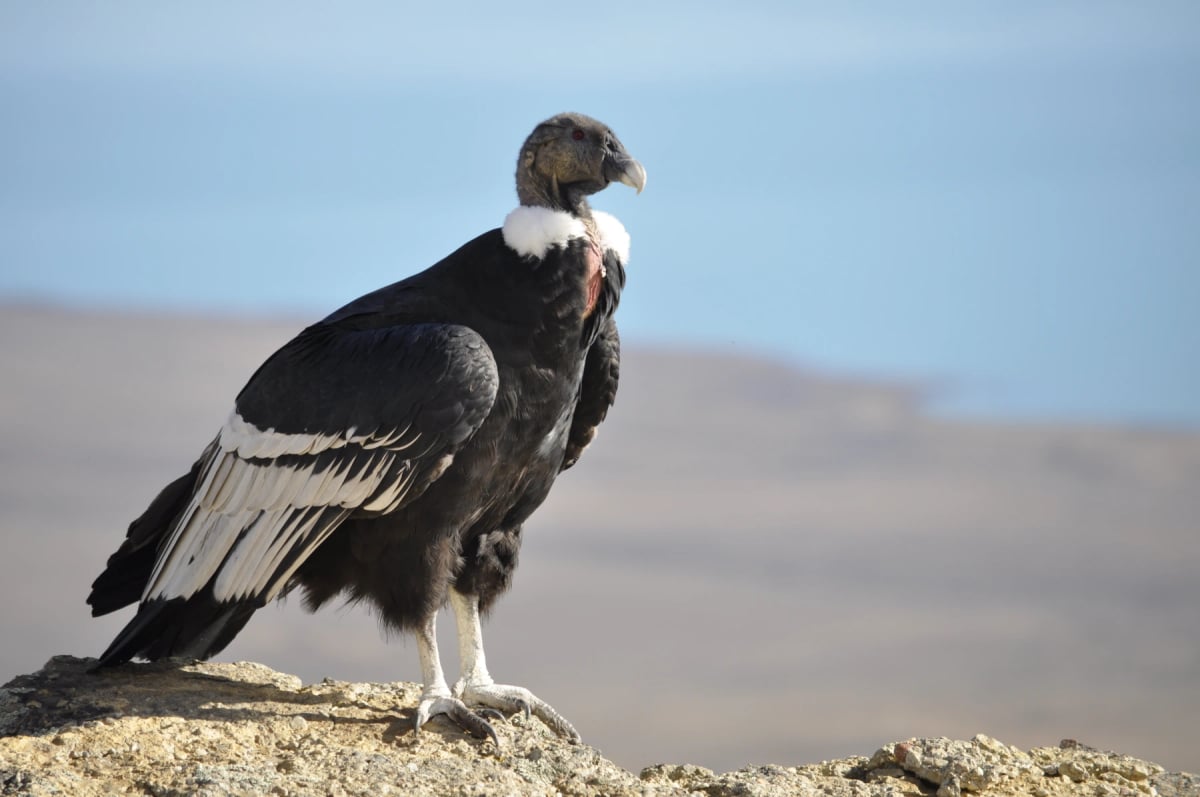
The Andean condor is a scavenger and feeds almost entirely on carrion. It finds food by soaring at great height and scanning huge areas of terrain, relying on keen eyesight rather than smell, and wild birds can travel more than 200 kilometers in a day in search of a meal. Its main food is the carcasses of large mammals: guanacos, deer, and, since the Spanish brought them, cattle, sheep, horses, and llamas, which are now a big part of its diet in many places. Along the Pacific coast it feeds on dead sea lions, whales, and fish, and it raids seabird colonies for eggs. Now and then it also kills small live animals, such as newborn or sick lambs and rodents, which has earned it a bad reputation among some ranchers. The condor's bare head is an adaptation for this diet: it stays cleaner when the bird feeds deep inside a carcass, and the skin is easy to clean and dry in the sun. A condor can eat several kilograms of meat at once, so much that it sometimes has trouble taking off, and then go for days without eating again.
Flight and behavior
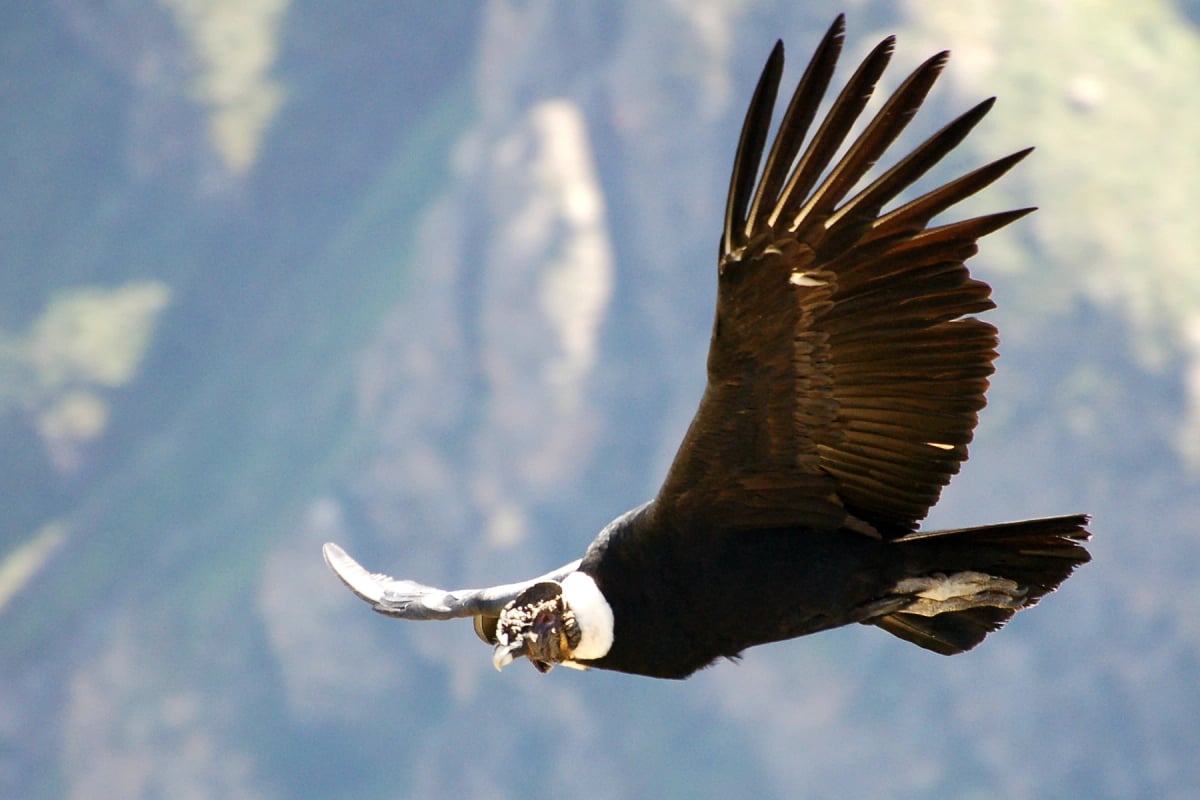
The Andean condor is one of the most efficient fliers on Earth. Instead of flapping, it rides thermals, the columns of warm air that rise from sunny slopes, and the updrafts created when wind hits a ridge. A study published in 2020 fitted condors in Patagonia with recorders and found that they flapped their wings only about 1% of the time they spent flying, mostly during takeoff. One bird flew for more than five hours and about 172 kilometers without a single wingbeat. Charles Darwin noticed the same thing in 1834, when he watched condors circle over Patagonia for half an hour without once seeing a flap of their wings. Because they depend on rising air, condors start flying only once thermals form in the morning and are grounded on still, cold days. They roost together on high cliff ledges, where groups gather at night and in bad weather. They are not aggressive, but at a carcass there is a clear pecking order: adult males feed first, then females, then young birds. Young condors take about six years to acquire full adult plumage.
Reproduction
The Andean condor has one of the slowest reproductive rates of any bird. It does not breed until it is five or six years old, and pairs form lasting bonds, often for life. Courtship includes displays in which the male spreads his wings, puffs up his neck, and clicks his tongue. The nest is nothing more than a bare ledge or a small cave on a high cliff, and the female lays a single bluish white egg weighing about 280 grams. Both parents share incubation for 54 to 58 days. The chick is covered in gray down and grows slowly: it takes about six months to fly, and it stays with its parents and depends on them for food until it is around two years old. Because of this long period of care, a pair normally breeds only every second year, and if an egg is lost, the female may lay a replacement. Over a lifetime a pair raises very few young, which is why losing even a few adults to poison or shooting can make a population shrink, and why captive breeding programs remove the first egg to make pairs lay a second one.
Andean condor vs California condor
There are only two condors in the world, and both are New World vultures, a family that only resembles the vultures of Africa and Asia because it evolved the same scavenging lifestyle. The Andean condor lives in South America; the California condor lives in North America, in California, Arizona, Utah, and Baja California in Mexico. They look alike at a distance, but they are easy to tell apart. The Andean condor is slightly heavier and has broader wings, and adults have a white ruff around the neck and, in males, a big fleshy comb. The California condor has no ruff or comb, its bare head is orange pink, and its white wing patches are on the underside of the wings rather than on top. Their stories are also different. The California condor came far closer to extinction: in 1987 the last 27 wild birds were captured for a breeding program, and today it survives thanks to releases and constant monitoring. The Andean condor has never fallen that low, with thousands still living in the southern Andes, but it is declining in the north of its range and is listed as Vulnerable.
Cultural importance
The Andean condor has been revered by Andean peoples for thousands of years. In Inca belief it was linked to the upper world, the realm of the sun and the gods, and it appears in pottery, textiles, and stone carvings from long before the Incas. Today it is the national bird of Bolivia, Chile, Colombia, and Ecuador, and it stands at the top of the coats of arms of all four countries. In Argentina it has no official status, but it is the emblem of Quebrada del Condorito National Park in Córdoba and a symbol of the Andes. Peru has its own famous tribute: "El Cóndor Pasa," a 1913 zarzuela by the Peruvian composer Daniel Alomía Robles, whose melody became known worldwide after Simon & Garfunkel recorded a version in 1970, and which Peru declared part of its national cultural heritage in 2004. The condor also appears in the Yawar Fiesta, a festival in some southern Peruvian communities in which a captured condor is tied to the back of a bull, a symbol of the Andean world against the Spanish one; the bird usually survives and is released, but the custom is criticized by conservationists. Across the region, its survival is widely seen as a measure of the health of Andean landscapes.
Conservation
The Andean condor is classified as Vulnerable on the IUCN Red List, up from Near Threatened in 2020, with an estimated 6,700 mature individuals. The greatest threat is poison. Some ranchers still leave poisoned carcasses to kill pumas and foxes, and condors that feed on them die too, sometimes dozens at a time. Lead from bullets and shot left in hunted animals causes slow poisoning, and collisions with power lines and direct persecution by people who wrongly blame condors for killing livestock add to the losses. Because a pair raises only one chick every two years, even a small rise in adult deaths can push a population into decline. The situation is worst in the north: Ecuador's national census counted 93 birds in 2015 and about 150 in 2018, and the species is critically endangered there and in Colombia, while in Venezuela no wild condors are known to remain. Conservation work has been going on for decades. Captive bred condors were first released in 1989, in Colombia, and Argentina's Andean Condor Conservation Program has released more than 200 birds across South America, raising chicks with condor shaped hand puppets so they do not get used to people. GPS tracking, rescue centers for poisoned birds, and work with rural communities are all part of the effort.
Where it is found
The Andean Condor can be found in places such as:
Researched and written by Juan Pablo. Sources: IUCN Red List, scientific literature and regional field guides. Last updated: .
Technical factsheet





Frequently Asked Questions
Where can you see Andean condors?
The best known place is the Colca Canyon in Peru, near Arequipa, where condors ride the morning thermals past the Cruz del Cóndor viewpoint, often at eye level. In Chile, Torres del Paine National Park and the mountains around Santiago are good places to see them, and in Argentina they are common over Patagonia and the Andes of Mendoza, and in Quebrada del Condorito National Park in Córdoba. In Bolivia they soar over the Altiplano and the valleys of the Andes. In Ecuador and Colombia they are much rarer, but they can be seen in páramo areas such as Antisana, Los Nevados, and Chingaza.
Does the Andean condor attack people or livestock?
It does not attack people. The Andean condor is a scavenger, and its feet are weak and not built for grabbing and killing prey the way an eagle's are. It feeds almost entirely on animals that are already dead, including livestock that died of other causes. Now and then it kills a newborn or very weak lamb or calf, and some ranchers blame it for losses caused by other predators. That reputation has led to condors being shot or poisoned, one of the main reasons for their decline. In reality, by eating carcasses quickly, condors help keep the countryside clean.
How many Andean condors are left?
The IUCN estimates about 6,700 mature individuals, and counting young birds, the total may be around 10,000. The numbers are very uneven. Most condors live in the southern Andes and Patagonia, in Argentina and Chile, with good numbers in Bolivia and Peru. In the north they are scarce: Ecuador's national census counted 93 birds in 2015 and about 150 in 2018, Colombia's population depends largely on reintroduced birds, and in Venezuela no wild condors are known to remain, only a few in a captive breeding program.
Why is the Andean condor's head bald?
Like other vultures, the Andean condor has a bare head and neck because of the way it eats. When it pushes its head deep into a carcass, feathers would get matted with blood and rotting flesh and would be hard to clean, while bare skin stays cleaner and is sanitized by sun and dry air. The bare skin also helps with temperature control: the condor can tuck its neck into its white ruff to keep warm on cold mountain mornings or stretch it out to lose heat. In males, the bare skin also carries the comb and wattles used in courtship displays.
How do condors find food if they can't smell it?
Unlike its relative the turkey vulture, the Andean condor has a poor sense of smell, so it finds food with its eyes. It patrols huge areas from high in the air and watches the ground for carcasses, but it also watches other animals. Smaller scavengers such as turkey vultures, which can smell carrion, and caracaras often find a carcass first, and the condors follow them down. Once one condor starts to descend, others that see it from kilometers away come too. Because condors are the largest and strongest, they can then push smaller birds aside and tear open tough hides that others cannot.
How big is the Andean condor?
The Andean condor has an average wingspan of about 2.8 meters, reaching 3.3 meters in the largest birds, and it is the heaviest flying bird in the world on average: males weigh about 12.5 kilograms and can reach 15, and females about 10 kilograms. Its body measures 100 to 130 centimeters long. Unusually for a bird of prey, males are larger than females. Despite its size, the condor is built for efficiency rather than power, relying almost entirely on rising air to stay aloft for hours without flapping its wings.
What does the Andean condor eat?
The Andean condor is a scavenger that feeds almost entirely on carrion. It locates food by soaring at great height and scanning vast areas with its keen eyesight, and it can travel more than 200 kilometers a day. Its main food sources are the carcasses of large mammals such as guanacos, deer, and livestock, as well as dead sea lions, whales, and fish along the Pacific coast. Occasionally it takes seabird eggs or small live animals. A single large meal can sustain a condor for several days, after which it may fast for extended periods.
Why is the Andean condor threatened?
The Andean condor is classified as Vulnerable by the IUCN, with around 6,700 mature individuals remaining. The greatest threat is poisoning: carcasses baited with poison to kill pumas and foxes, and lead from hunting ammunition left in dead animals. Power line collisions, habitat loss, and persecution by people who blame condors for killing livestock also cause deaths. Because the species reproduces very slowly, raising only one chick every two years, even small increases in adult mortality can push populations into decline, as has happened in Ecuador, Colombia, and Venezuela.
How far can the Andean condor fly?
The Andean condor is one of the most efficient long distance fliers in the world. Wild birds can travel more than 200 kilometers in a day in search of food, and a 2020 study in Patagonia recorded one condor flying for more than five hours and about 172 kilometers without flapping its wings once. They achieve this by riding thermals and wind currents generated by mountain terrain, gaining altitude and then gliding across the landscape, flapping only about 1% of their flight time, mostly at takeoff.
Which countries have the Andean condor as their national symbol?
The Andean condor is the national bird of four countries: Bolivia, Chile, Colombia, and Ecuador, and it stands at the top of the coat of arms of all four. In Chile it shares the coat of arms with the huemul deer. Argentina and Peru do not have it as an official national symbol, although it is an emblem of the Andes in both: in Peru the famous melody "El Cóndor Pasa" is part of the national cultural heritage. This widespread importance reflects centuries of reverence across Andean cultures, where the condor was linked to the upper world in Inca belief.
How long does the Andean condor live?
The Andean condor is one of the longest lived birds in the world. In the wild it is thought to live more than 50 years, and in captivity a male named Thaao lived at the Beardsley Zoo in Connecticut from 1930 until 2010, reaching 79 years, one of the greatest verified ages ever recorded for a bird. This long life is matched by an extremely slow reproductive rate: condors do not breed until they are five or six, and pairs raise only one chick every two years, so populations recover very slowly from any increase in adult deaths.