Bald Eagle
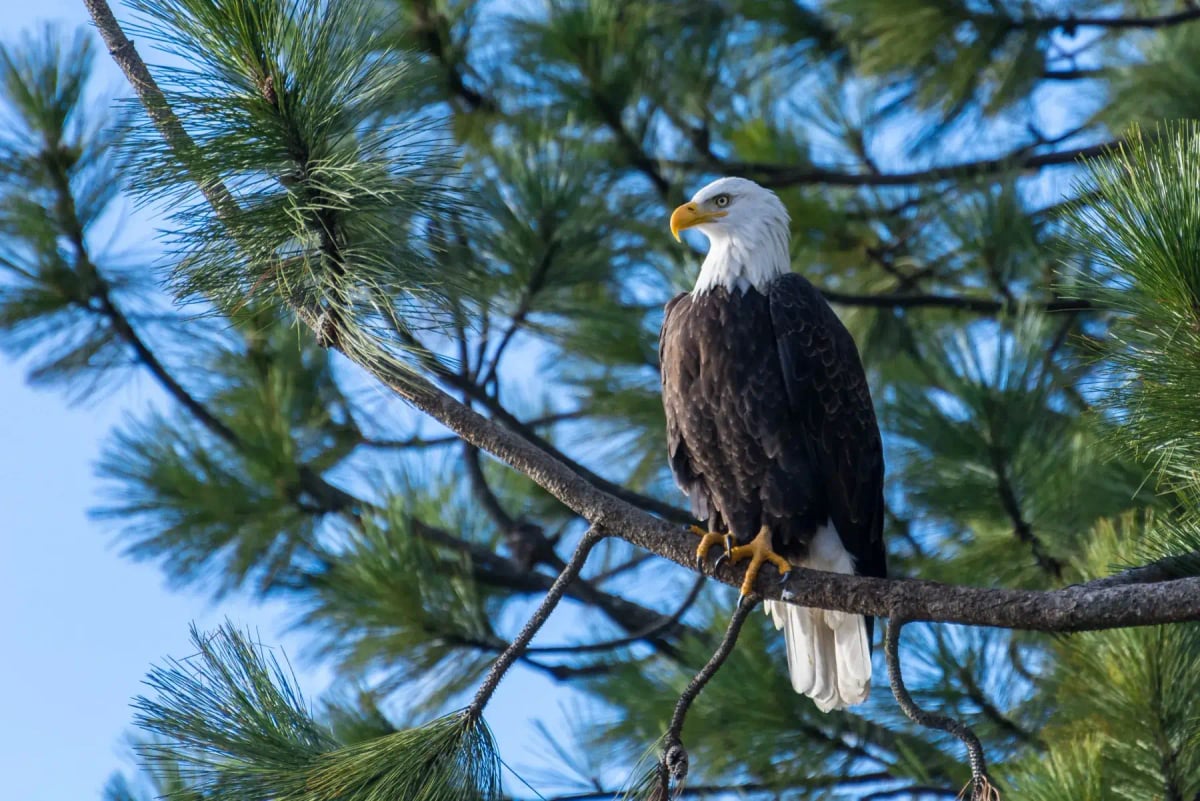
The bald eagle, the national bird of the United States, is recognized by its white head and tail contrasting with a dark brown body and wings, and by its big yellow bill. It is one of the largest birds of prey in North America, with a wingspan of up to about 2.3 meters. It soars above lakes, rivers and coasts in search of fish, and it is known to steal prey from ospreys or feed on carrion when the chance arises. Pairs build the largest nests of any North American bird. After coming close to extinction in the lower 48 states, with only 417 known nesting pairs in 1963, the ban on DDT and strict legal protection led to a strong recovery: by 2019 there were an estimated 316,700 bald eagles in the lower 48 alone.
How big is a bald eagle? Size and appearance
The bald eagle is one of the largest birds of prey in North America. Adults measure about 70 to 102 centimeters from bill to tail, have a wingspan of roughly 1.8 to 2.3 meters and weigh 3 to 6.3 kilograms. As in most raptors, females are about a quarter bigger than males, and eagles in the north are larger than those in the south: the biggest live in Alaska, while birds in Florida are noticeably smaller. Adults are easy to recognize. The head and tail are bright white, the body and wings dark chocolate brown, and the heavy hooked bill, the eyes and the feet are yellow. The name has nothing to do with baldness; it comes from an old meaning of the word, white headed. Young eagles look very different. They are mostly brown with white blotches on the body and under the wings, with a dark bill and brown eyes, and they are often confused with golden eagles. They gain the white head and tail little by little and only reach full adult plumage at around four to five years of age.
Where are bald eagles found?
The bald eagle is the only sea eagle native to North America. It ranges from Alaska and across most of Canada through all of the contiguous United States to northern Mexico, where a few pairs still nest around Magdalena Bay in Baja California Sur and along rivers in Sonora and Chihuahua. Alaska holds the largest population, and British Columbia also has very high numbers. It strongly favors habitats near water, including coastlines, large rivers, reservoirs and lakes where fish are plentiful. Nesting pairs need tall, mature trees close to water for their huge stick nests, although on treeless islands and in parts of the far north and Mexico they also nest on cliffs or even on the ground or on cactus. In winter, birds from the north move south to find open water, and large groups gather at salmon rivers, dams and lakes that do not freeze. Lone birds have strayed as far as Bermuda, Puerto Rico, Ireland and the Russian Far East, but these are only vagrants.
What does a bald eagle eat?
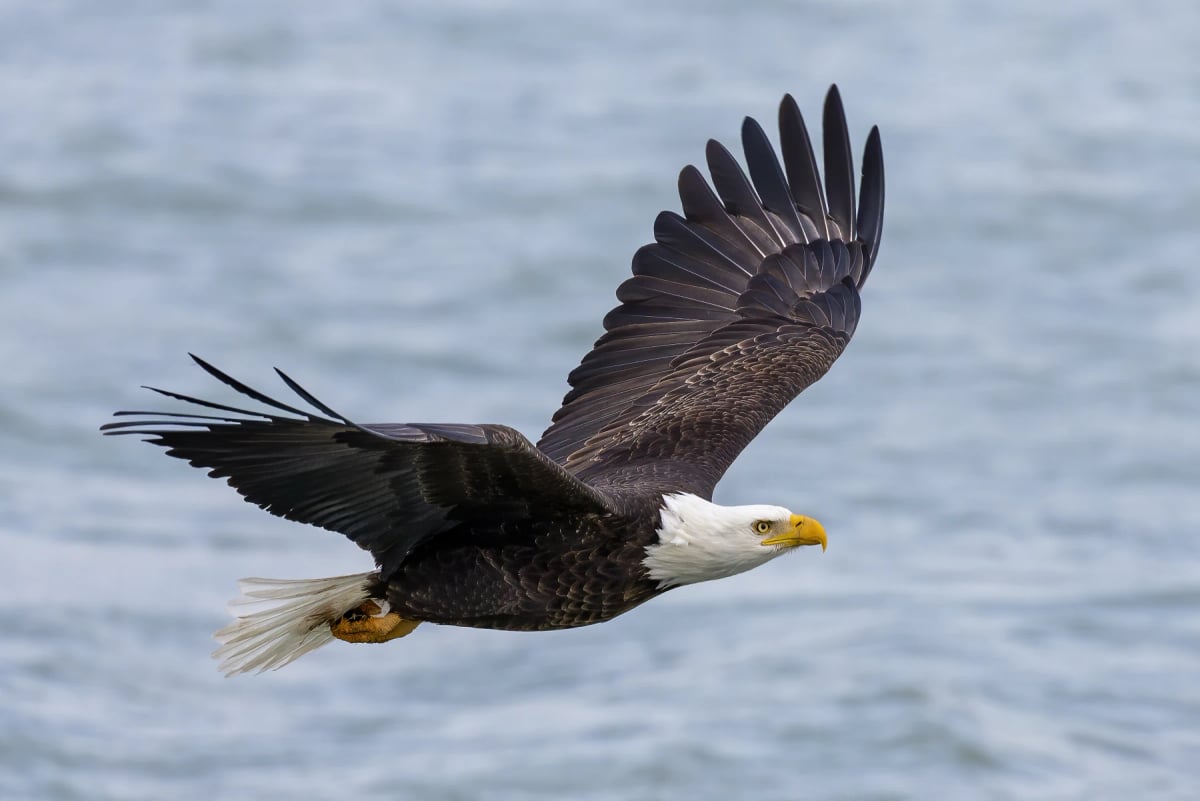
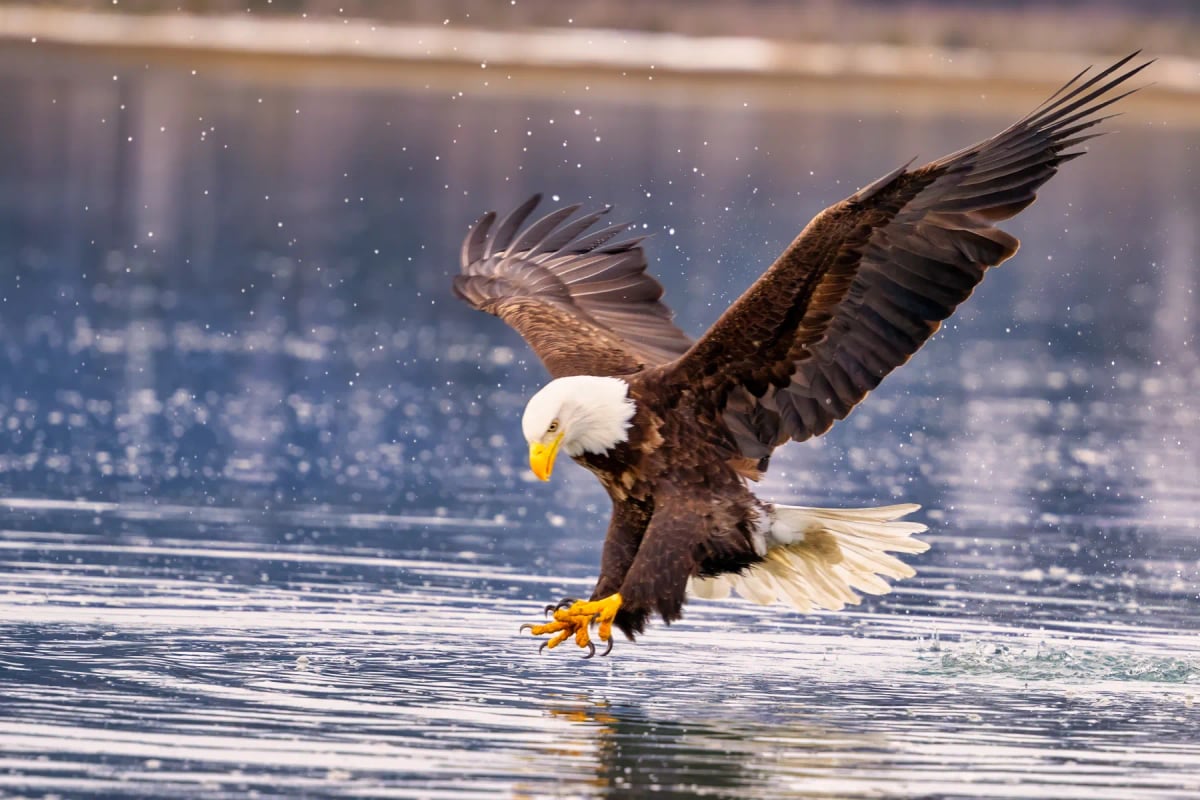
Fish make up the bulk of the bald eagle's diet, especially salmon, trout, catfish, herring and other species found near the surface or in shallow water. It hunts by gliding down from a perch or from the air and snatching prey from the surface with its powerful talons, and it rarely dives in fully. The species is also very opportunistic: it takes waterfowl such as ducks and coots, gulls, rabbits and other small mammals, and readily eats carrion, from dead salmon after spawning to deer carcasses and roadkill in winter. In places like Alaska, hundreds of eagles gather in autumn to feed on spawning salmon. It is well known for stealing fish from ospreys and other birds, a behavior called kleptoparasitism. Benjamin Franklin famously mocked the bald eagle for this in a 1784 letter to his daughter, calling it a bird of bad moral character that lives by robbing the fishing hawk.
Nest, eggs and breeding
Bald eagles are powerful fliers that can soar for hours on rising warm air and reach around 65 km/h in level flight. They usually pair for life, and courtship includes spectacular flights in which the two birds lock talons high in the air and cartwheel down together, letting go just before reaching the ground. They build the largest nests of any bird in North America, massive structures of sticks that the same pair adds to year after year. A typical nest is 1.5 to 1.8 meters wide, and the record, found near St. Petersburg, Florida, was about 2.9 meters wide, 6 meters deep and weighed around 2 tonnes. The female lays one to three eggs, most often two, and both parents share the incubation, which lasts about 35 days. The chicks grow fast and leave the nest at around 10 to 12 weeks old, but they stay near it for several weeks more while they learn to fly well and find food. Young eagles then wander widely and do not breed until they are four or five years old.
What does the bald eagle represent?
The bald eagle has stood for the United States since 1782, when Congress placed it at the center of the Great Seal, holding an olive branch for peace and arrows for war. Since then it has appeared on coins, banknotes, passports, the presidential seal and the emblems of many federal agencies, and it represents freedom, strength and independence in American culture. For more than two centuries it was treated as the national bird without any law saying so, until December 2024, when a law officially named it the national bird of the United States. Not everyone loved the choice: Benjamin Franklin joked that the wild turkey was a more respectable bird. The bald eagle also holds deep meaning in many Indigenous cultures across North America, where it is seen as a messenger between people and the Creator and its feathers are sacred and used in ceremonies. Because eagle feathers are protected by law, enrolled members of federally recognized tribes can obtain them for religious use through the National Eagle Repository.
Conservation: how many bald eagles are left?
The bald eagle faced serious decline through much of the twentieth century because of shooting, habitat loss and above all DDT, a pesticide that built up in fish and caused eggshells to become so thin that they broke under the weight of the parents. By 1963 only 417 known nesting pairs remained in the lower 48 states. The ban on DDT in 1972, protection under the Endangered Species Act and the Bald and Golden Eagle Protection Act, and release programs in states like New York turned things around. In 2007 the species was removed from the U.S. list of endangered and threatened species. The latest U.S. Fish and Wildlife Service report estimated about 316,700 bald eagles, including some 71,400 nesting pairs, in the lower 48 states in 2019, four times more than in 2009, and Alaska and Canada add many tens of thousands more. The IUCN lists it as Least Concern. Today the main threats are lead poisoning from bullet fragments in carcasses, collisions with vehicles, power lines and wind turbines, and outbreaks of bird flu.
Where it is found
The Bald Eagle can be found in places such as:
Researched and written by Juan Pablo. Sources: IUCN Red List, scientific literature and regional field guides. Last updated: .
Technical factsheet




Frequently Asked Questions
How many bald eagles are there in the US and in the world?
The U.S. Fish and Wildlife Service estimated about 316,700 bald eagles in the lower 48 states in 2019, including some 71,400 nesting pairs. That is a huge change from 1963, when only 417 nesting pairs were known there. Alaska has the largest population of any state, often put at around 30,000 birds, and Canada, especially British Columbia, holds many more. The numbers are still growing in most regions.
What does a bald eagle sound like?
Much weaker than most people expect. The bald eagle's call is a series of high, thin, chirping whistles and chattering notes, a bit like a gull or a squeaky toy. Because that sound does not match its powerful look, movies and TV shows usually dub over it with the loud, rasping scream of the red tailed hawk. So the fierce eagle cry heard in films is almost always a hawk.
How long do bald eagles live?
In the wild, bald eagles that survive their risky first years usually live around 20 years. The oldest known wild bald eagle was at least 38 years old: it had been banded in Michigan in 1977 and was found in New York in 2015 after being hit by a car. In captivity they can live even longer. Many young eagles die in their first year, while they are still learning to hunt.
What is the difference between a bald eagle and a golden eagle?
Adults are easy to tell apart: the bald eagle has a white head and tail, while the golden eagle is dark brown all over with a golden sheen on the back of the head and neck. Young bald eagles, which are brown, are the ones that cause confusion. Look at the legs: golden eagles have feathers all the way down to the toes, while bald eagles have bare yellow lower legs. Bald eagles also have a bigger head and bill and live near water, while golden eagles prefer open country and mountains and hunt mostly mammals.
Where is the best place to see bald eagles?
Alaska is the classic place. Every November, thousands of bald eagles gather along the Chilkat River near Haines to feed on late salmon, one of the largest gatherings of eagles in the world. In British Columbia, Brackendale near Squamish and the Harrison River draw big winter crowds too. In the lower 48, good spots include the Skagit River in Washington, the Klamath Basin in California and Oregon, and the dams and locks along the Mississippi River in winter. Florida has many nesting pairs that can be watched in winter and spring.
Is the bald eagle really bald?
No, the bald eagle is not bald. Its name comes from an older sense of the English word 'bald,' meaning white or having a white patch, similar to 'piebald.' Adult birds have bright white feathers covering the head and tail, contrasting with dark brown body plumage. Juveniles are mostly brown and only develop the distinctive white coloring once they reach sexual maturity, typically around four to five years of age.
When did the bald eagle become the national bird of the United States?
It has been the national emblem since 1782, when it was placed on the Great Seal, chosen because it is native to North America and seen as a symbol of strength and freedom. Surprisingly, no law named it the national bird until December 24, 2024, when the president signed a bill that made it official. Before that, the title was a tradition. Benjamin Franklin is often said to have wanted the wild turkey instead, but he never proposed it: he only joked in a 1784 letter to his daughter that the turkey was the more respectable bird.
Are bald eagles still endangered?
No. Bald eagles are no longer endangered. After nearly disappearing from the lower 48 states in the twentieth century because of hunting, habitat loss and DDT, they recovered thanks to legal protection and the 1972 ban on DDT, and they were removed from the U.S. list of endangered and threatened species in 2007. They are still protected by the Bald and Golden Eagle Protection Act and the Migratory Bird Treaty Act, so it is illegal to harm them or disturb their nests. The IUCN classifies the species as Least Concern.