Puffin
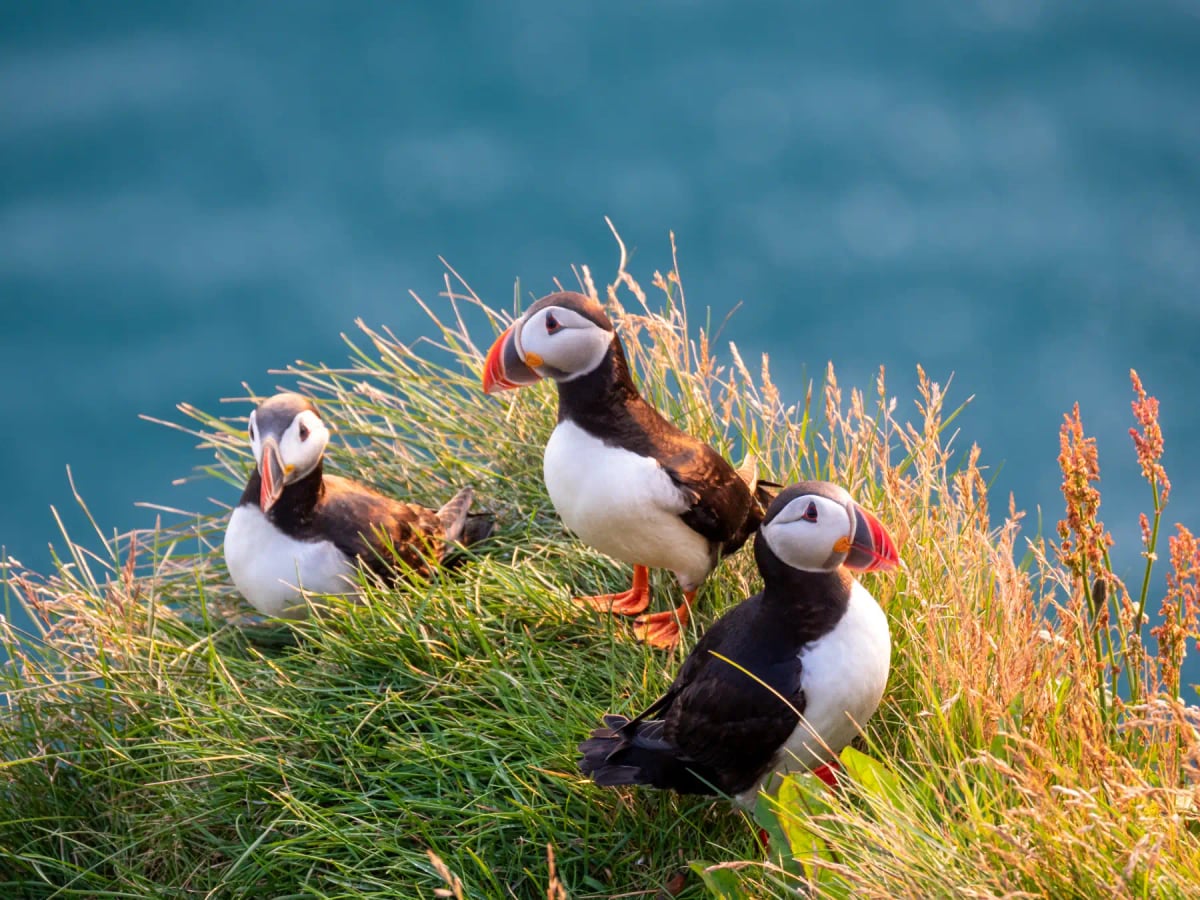
The Atlantic puffin is a compact seabird of the North Atlantic, only 28 to 30 centimeters long, best known for the bold orange, yellow, and blue gray bill it wears each breeding season. It breeds on rocky islands and cliffs from Maine and Newfoundland to Greenland, Iceland, the British Isles, Norway, and northwestern Russia, and Iceland alone holds about 60% of the world population. For most of the year it lives entirely at sea, riding out storms and diving for sand eels, capelin, herring, and sprat, which it can carry crosswise in its bill several at a time thanks to backward pointing spines on its tongue and palate. Each spring, adults return to the same colony and often to the same partner, and each pair raises a single chick, called a puffling, in a burrow. When the chick is ready, it heads out to sea alone at night and will not return to land for two or three years. Puffins fly fast, at up to 80 kilometers per hour, flapping several times a second. With about 12 to 14 million adults, the species is still numerous, but it has declined sharply in parts of its range as warming seas reduce its prey, and the IUCN has listed it as Vulnerable since 2015.
Types of puffin: Atlantic, tufted and horned
There are three species of puffin, all in the genus Fratercula, part of the auk family. This page is about the Atlantic puffin, the only one in the Atlantic Ocean and the smallest of the three. The other two live in the North Pacific. The tufted puffin is the largest, with a mostly black body, a heavy orange red bill, and, in the breeding season, a white face and long golden tufts that sweep back from the eyes like eyebrows. It nests from Alaska and the Aleutians to British Columbia, Washington, and California on the American side, and to the Kuril Islands and Japan on the Asian side. The horned puffin looks much more like the Atlantic puffin, with a white face and chest and a yellow and red bill, but it has a small black fleshy horn above each eye, and it nests mostly in rock crevices rather than earth burrows, around Alaska, the Bering Sea, and eastern Russia. Their closest relative is the rhinoceros auklet of the North Pacific, a grayer bird with a horn at the base of its bill, once called the unicorn puffin. So if you see a puffin in Alaska, it is a tufted or horned puffin, never an Atlantic one.
Habitat and range
Atlantic puffins breed on rocky islands, grassy clifftops, and steep coastal slopes around the North Atlantic and into the Arctic. Iceland is the heart of the species' world, holding about 60% of all Atlantic puffins, and the Westman Islands off its south coast host roughly half of Iceland's birds. Other major colonies are found in Norway, the Faroe Islands, Scotland and the rest of the United Kingdom, Ireland, and Newfoundland and Labrador in Canada, where Witless Bay holds the largest colonies in North America. Smaller numbers breed in Greenland, on Svalbard, along the Murman coast of Russia, in Brittany in France, and on islands off Maine in the United States. Outside the breeding season, puffins leave land entirely. They spend the winter far out at sea, scattered across the open North Atlantic, and some travel south to the waters off Spain, Portugal, and Morocco and into the western Mediterranean as far as Algeria, Tunisia, and Italy. The North Sea coasts of Belgium, the Netherlands, Germany, and Sweden also see wintering birds offshore. They ride out rough weather on the water and come ashore only when it is time to breed again, and young birds may stay at sea for two to three years before they first visit a colony.
Diet
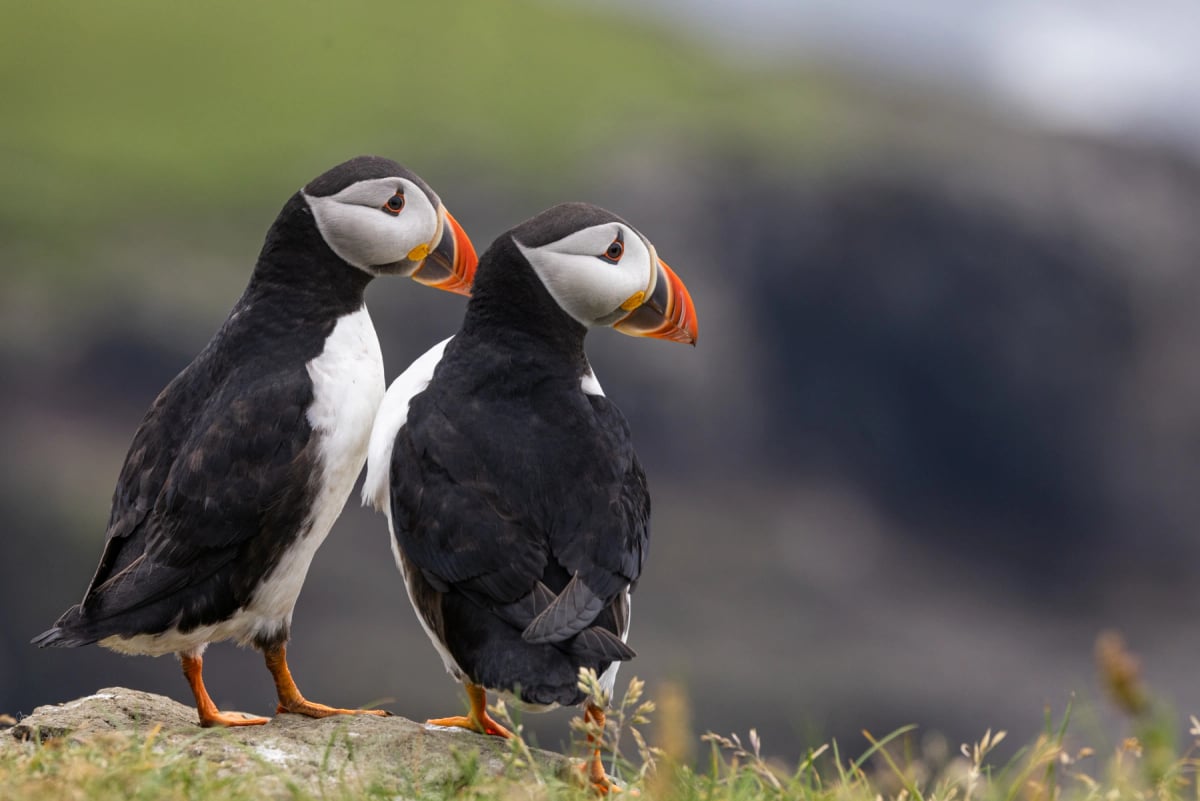
Fish make up almost the entire diet of the Atlantic puffin. Sand eels are by far the most important prey across much of its range, but puffins also hunt capelin, sprat, herring, and small amounts of squid and crustaceans, depending on what is available locally. An adult needs around 40 small fish a day. To catch them, a puffin dives beneath the surface and uses its wings to propel itself through the water, almost as if it were flying underwater, steering with its orange feet. Dives usually last 20 to 30 seconds, can reach a minute, and go down tens of meters. Its favorite prey are slim fish up to about 18 centimeters long. One of the most striking things about puffins is their ability to carry several fish in the bill at once, usually around ten when feeding a chick, and sometimes many more. Rows of backward pointing spines on the tongue and the roof of the mouth grip each fish, so the bird can open its bill to catch another without losing the ones it already holds. Because chicks depend on this steady delivery of small, fatty fish, a poor year for sand eels or capelin quickly shows up as starving pufflings.
Breeding
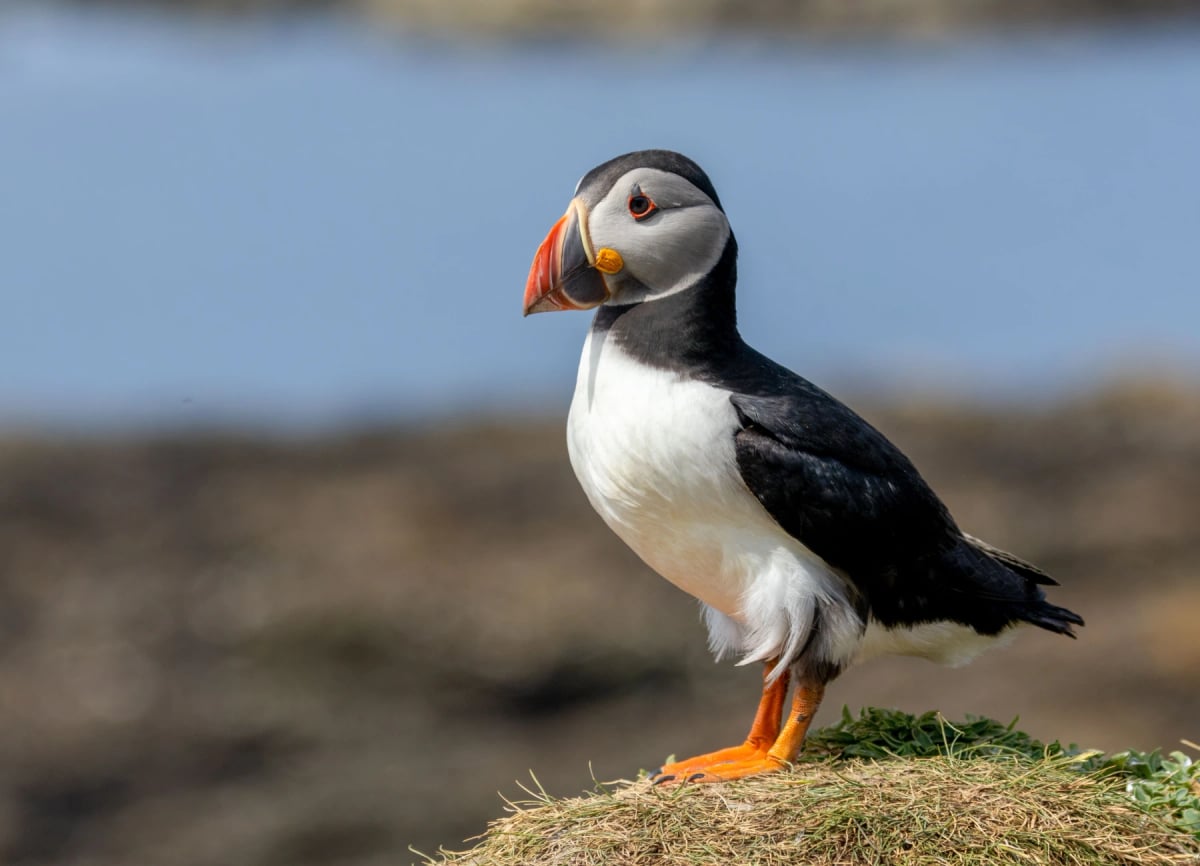
Each spring, adult puffins return to their breeding colonies, usually in April, and most reunite with the same partner from the previous year at the same burrow. Pairs nest in burrows up to about a meter long, which they dig into soft soil on clifftops with their bills and feet or take over from rabbits and shearwaters. On rockier ground, they tuck into crevices among boulders instead. Each pair raises just one chick per season. The single white egg is incubated by both parents for around 39 to 45 days, and once it hatches the adults take turns bringing fish to the burrow. The chick, called a puffling, grows quickly in the safety of the dark tunnel and is ready to leave after 34 to 50 days. It departs the colony alone, at night, and heads straight for the open sea, flying or fluttering down to the water. In towns near colonies, such as Heimaey in Iceland's Westman Islands, some pufflings are confused by street lights and land in the streets, and every August local children collect them in cardboard boxes and release them at sea. A young puffin will not return to land for two to three years and will not breed until it is four or five years old.
Behavior
For most of the year, puffins live entirely at sea and are rarely seen from land. They are strong swimmers, using their wings to power through the water and their webbed feet to steer, and on the surface they sit low in the water and are remarkably tolerant of rough seas. In the air, puffins look almost frantic, beating their short wings several times a second, but they are fast, reaching around 80 kilometers per hour. Landing is less elegant, and crash landings on the grassy slopes of a colony are common. During the breeding season they are sociable birds, gathering on the water near the colony in large groups called rafts and standing together at the entrances to their burrows. Pairs greet each other by tapping their bills together, a behavior called billing, which often draws a small crowd of neighbors. Their bold bill colors grow before each breeding season and are thought to help attract a mate, and in 2019 researchers discovered that the yellow parts of the bill also glow under ultraviolet light, which puffins can probably see. After the season, the bright outer plates of the bill are shed and the face turns darker gray, so a puffin at sea in winter looks much duller than the one on the postcards.
Puffin vs penguin: are they related?
Puffins and penguins are often confused, and both are black and white seabirds that swim with their wings, but they are not closely related and they live at opposite ends of the planet. Puffins belong to the auks, a family of the Northern Hemisphere that includes razorbills, guillemots, and murres. Penguins live almost entirely in the Southern Hemisphere, from Antarctica to South Africa, Australia, and South America, with only the Galápagos penguin reaching the equator, so the two never meet in the wild. The biggest difference is flight. Puffins fly, fast and far, while all penguins lost the ability to fly millions of years ago and use their wings only as flippers. Size is different too: an Atlantic puffin stands about 20 centimeters tall and weighs under half a kilo, much smaller than most penguins. Their resemblance is a classic case of convergent evolution, in which unrelated animals that live the same way end up looking alike. There is even a historical link: the word penguin was first used for the great auk, a large flightless relative of the puffin from the North Atlantic, which was hunted to extinction in 1844. When sailors later met similar birds in the south, they gave them the same name.
Conservation
The IUCN has listed the Atlantic puffin as Vulnerable since 2015, reflecting a steep decline across much of its range, even though an estimated 12 to 14 million adults remain. The main driver is food. Rising sea temperatures shift the plankton that sand eels, capelin, and herring depend on, and when these small fish become scarce or move, adults cannot feed their chicks and whole colonies fail to breed for years. Some of the most famous colonies have collapsed: at Røst in Norway's Lofoten Islands, breeding numbers have fallen dramatically since the 1970s, and parts of Iceland's population have declined sharply too. Overfishing of sand eels for fishmeal added pressure in the North Sea, and in 2024 the United Kingdom closed its sand eel fishery in English North Sea and Scottish waters, partly to protect seabirds such as puffins. Puffins also face oil spills, plastic pollution, accidental capture in fishing nets, and predation by rats, cats, and large gulls on some islands. Traditional hunting still takes place in Iceland and the Faroe Islands, though it has been reduced. There are also success stories: Project Puffin, started by Stephen Kress of the National Audubon Society in 1973, brought puffins back to islands off Maine where they had been wiped out, by moving chicks from Newfoundland and luring adults with decoys.
Where it is found
The Puffin can be found in places such as:
Researched and written by Juan Pablo. Sources: IUCN Red List, scientific literature and regional field guides. Last updated: .
Technical factsheet

Frequently Asked Questions
What is a baby puffin called?
A baby puffin is called a puffling. It hatches in a dark burrow covered in fluffy gray black down and spends five to seven weeks underground, fed with fish by both parents. When it is ready, it leaves alone at night and heads out to sea. In the Westman Islands of Iceland, many pufflings are attracted by the lights of the town of Heimaey and land in its streets, so every August local children go out on puffling patrol, collecting them in cardboard boxes and releasing them over the sea the next day.
Where can you see puffins?
The best time is from late April to early August, when puffins are at their colonies. Iceland is the top destination, especially the Westman Islands, Látrabjarg in the west, and Borgarfjörður Eystri in the east. In the United Kingdom, the Farne Islands, Skomer in Wales, the Isle of May, and the islands of Shetland and Orkney are famous, and in Ireland the Saltee Islands and Skellig Michael. In North America, Witless Bay in Newfoundland, where the puffin is the official provincial bird, and boat trips to islands off Maine are the best options.
What is Puffin Rock?
Puffin Rock is an Irish animated series for young children, first broadcast in 2015 and later popular on Netflix, about a young puffin called Oona, her little brother Baba, and their friends on a small island off the coast of Ireland. It is narrated by the actor Chris O'Dowd, and a feature film, Puffin Rock and the New Friends, followed in 2023. The show is praised for its gentle stories and for teaching children about real nature, from puffin burrows to the other animals of the island, such as seals, rabbits, and seabirds.
Do puffin beaks glow?
In a way, yes. In 2019, a researcher shining an ultraviolet light on a dead puffin found that the yellow ridges on its bill glowed brightly, a property called fluorescence. Since many birds can see ultraviolet light, puffins may see each other's bills glowing, which could play a role in courtship alongside the bright orange colors people can see. The colorful plates of the bill grow before each breeding season and are shed afterward, so the glow is probably strongest in spring and summer.
How big is a puffin?
Much smaller than most people expect. An Atlantic puffin is only 28 to 30 centimeters long, stands about 20 centimeters tall on land, and weighs around 310 to 550 grams, about the size of a pigeon. Its wingspan is 47 to 63 centimeters, short for its weight, which is why it has to flap so fast to stay in the air. Males are slightly larger than females. The two Pacific species are bigger, and the tufted puffin, the largest, can weigh close to a kilogram.
What do puffins eat?
Puffins feed almost entirely on small fish. Sand eels are their main prey, but they also catch capelin, sprat and herring depending on where they are. What makes them remarkable is how many fish they can carry at once. Spines on the tongue and the roof of the mouth grip each fish in place, so the bird can keep catching more without dropping the ones it already has.
Where do puffins live?
Atlantic puffins are found across the North Atlantic. During the breeding season they nest on rocky islands and coastal cliffs in Iceland, Norway, the Faroe Islands, the United Kingdom, Ireland, Canada, Greenland, and northern Russia, with smaller colonies in France and Maine. Iceland holds about 60% of the world population. For the rest of the year they live far out at sea, some reaching the waters off Spain, Portugal, and North Africa. The puffins of Alaska and the North Pacific are different species, the tufted and horned puffins.
Can puffins fly and swim?
Yes, puffins do both. In the air they beat their short wings several times a second, which gives them a frantic look, but they are fast fliers, reaching about 80 kilometers per hour. Underwater they are much more graceful, using their wings to swim and their webbed feet to steer, almost as if flying through the sea. Dives usually last 20 to 30 seconds and can reach a minute, going down tens of meters below the surface.
Why do puffins have colorful beaks?
The bright orange and yellow bill develops each spring, just before the breeding season begins. Scientists believe it plays a role in attracting a mate, since the intensity of the coloring may signal the health of the bird. Once the season ends, the colorful outer plates of the bill are shed and the beak becomes much duller. So the striking look people associate with puffins is really only on display for part of the year.
Are puffins endangered?
The Atlantic puffin has been listed as Vulnerable by the IUCN since 2015, which means it faces a high risk of decline, although about 12 to 14 million adults remain. Populations have dropped sharply in parts of its range, especially in Norway and Iceland. The biggest problem is the decline of small fish like sand eels and capelin, driven by warming seas and, in some areas, overfishing. Oil spills, plastic pollution, and accidental capture in fishing nets also add pressure.
Do puffins mate for life?
Puffins tend to return to the same partner year after year, though the bond is tied to the nesting site rather than being constant through the winter. Since both birds spend months apart at sea, they reunite at the colony each spring and usually pick up where they left off. It is not quite the same as mating for life in the strictest sense, but long partnerships are genuinely common among them.
How long do puffins live?
Atlantic puffins are long lived for their size. Many live more than 20 years, and ringed wild birds in Europe and North America have been recorded at more than 35 years old. They are slow to mature, not returning to a colony until they are two or three years old and not breeding until about age four or five. That slow start means a long life is important for the species, since each pair raises only one chick per year.