Fiji Crested Iguana
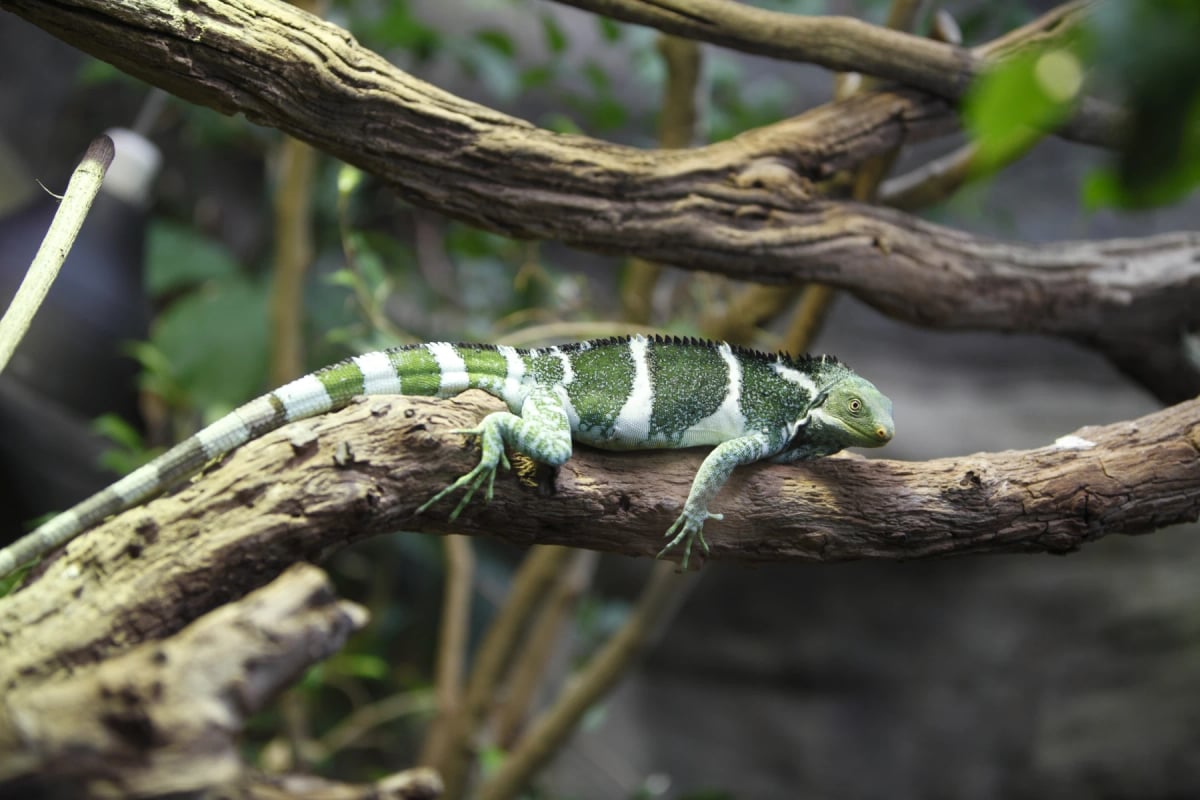
The Fiji crested iguana is one of the rarest reptiles on Earth, confined to a handful of dry forest islands in Fiji. Its vivid emerald green body is marked with two or three pale white bands, making it almost invisible among sun-dappled leaves. A row of spines runs along its back from neck to tail, giving the species its name. Males are especially territorial and will darken in color when threatened or competing for females. The iguana feeds on leaves, flowers, and fruit, helping spread seeds across its limited forest habitat. Feral cats, rats, and goats, along with widespread logging, have pushed wild populations to critically low numbers. Monuriki Island, known from the film Cast Away, hosts one of the most studied and protected populations. Captive breeding programs in Fiji are working to bring the species back from the edge.
Habitat and distribution
The Fiji crested iguana has one of the most restricted ranges of any lizard in the world. It lives only on a small number of islands in western and northern Fiji, including Yadua Taba, Monuriki, and a few other low-lying islands in the Mamanuca and yasawa groups. Its preferred habitat is dry coastal forest, where trees like Vonu and other native species still form a closed canopy. These forests receive far less rainfall than Fiji's interior, and the iguanas are well suited to the seasonal dry conditions there. Yadua Taba, a protected island reserve, holds the largest known wild population and has been a focus for conservation efforts since the 1980s. Where forest has been cleared or degraded by goats, the iguana simply cannot survive.
Appearance
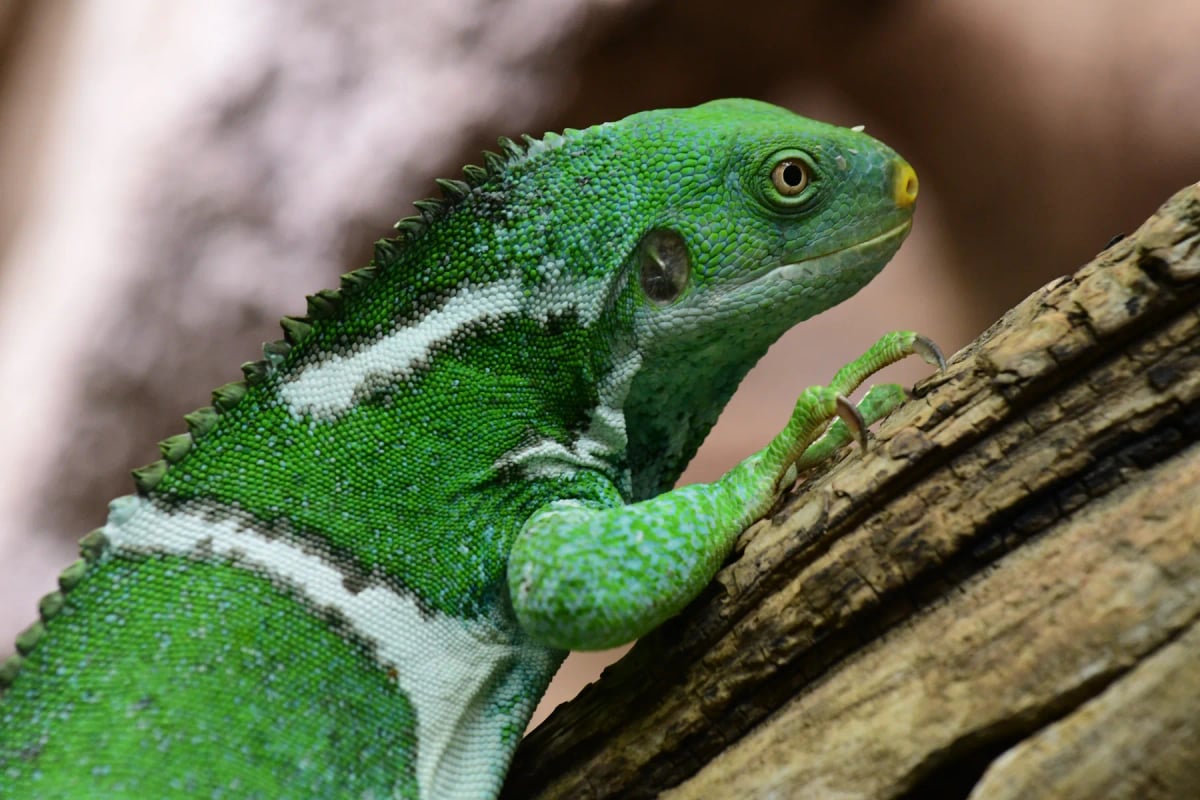
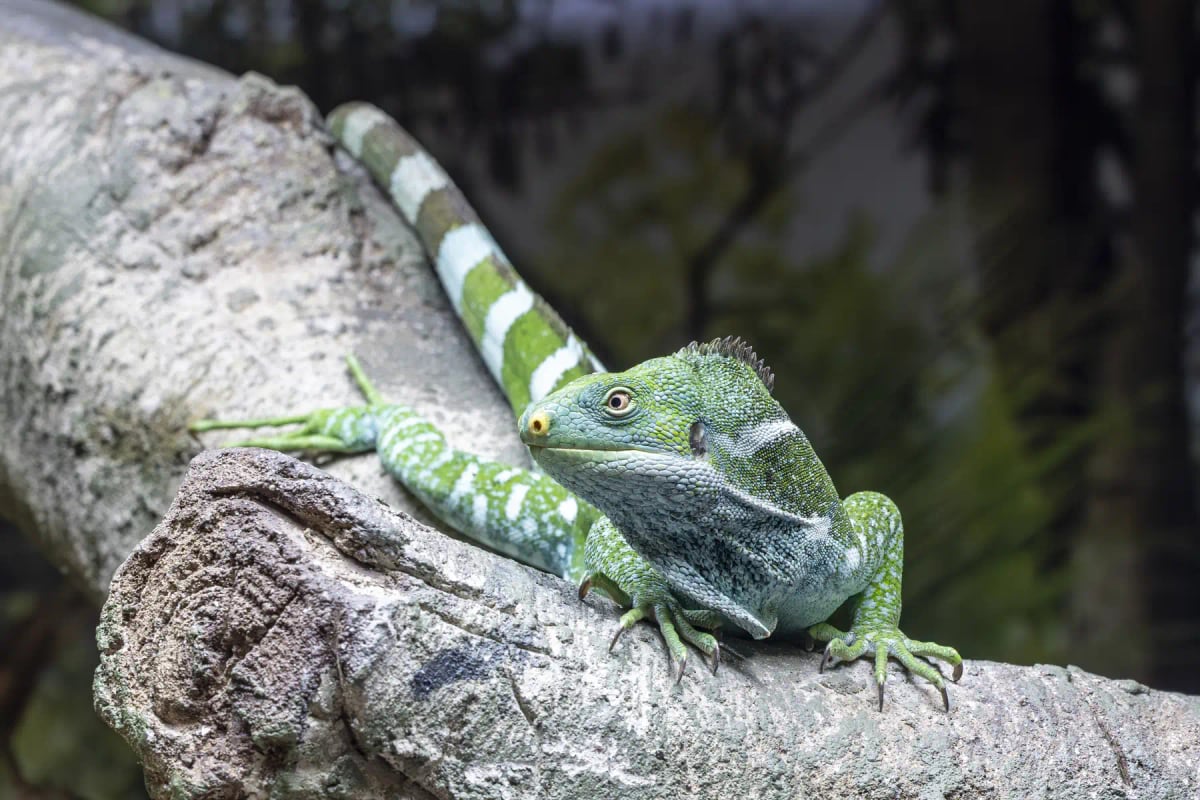
Few reptiles anywhere are as striking as this species. Adults display a bright emerald green body crossed by two or three narrow bands of pale white or cream, a pattern that blends surprisingly well into sunlit forest foliage. A row of spines runs from the back of the neck down to the tail, and it is these spines that give the iguana its common name. Males tend to be larger than females and can reach around 75 centimetres in total length, with much of that made up by the tail. When a male feels threatened or is competing with a rival, his green coloring can darken dramatically within seconds. Females are generally a more uniform green and lack the intense color change seen in males.
Diet
Leaves, flowers, and fruit make up almost all of what this iguana eats, placing it firmly among the most plant-dependent lizards on Earth. It browses through the canopy of dry forest trees, selecting young leaves and seasonal fruit as they become available throughout the year. This diet makes it an important part of its island ecosystem. Seeds from the fruit it consumes pass through its digestive system and are deposited elsewhere on the island, helping native plants to regenerate in areas where they might otherwise struggle to establish. Given that the iguana is now absent from many islands where it once lived, some plant species that relied on it for seed dispersal may also be in decline. The relationship between this reptile and its forest is far closer than it might first appear.
Behavior
Unlike the description sometimes given of it, the Fiji crested iguana is actually diurnal, meaning it is active during the day rather than at night. It spends much of its time in the tree canopy, basking in patches of sunlight to warm its body and retreating into shade when temperatures climb too high. Males are strongly territorial and will patrol and defend sections of forest against rival males, using their darkening skin color as a warning signal. Encounters between competing males can involve head bobbing and physical pushing. Females tend to have smaller territories that overlap with those of one or more males. Nesting takes place on the ground, where females lay small clutches of eggs in soil or leaf litter. The eggs take several months to hatch.
Conservation
Classified as Critically Endangered on the IUCN Red List, this iguana faces pressure from several directions at once. Feral goats have destroyed much of the dry forest it depends on by stripping vegetation down to bare ground. Rats and feral cats prey on eggs and young hatchlings, keeping wild populations from recovering naturally. Logging has removed habitat across many of the islands where the species once occurred. Yadua Taba Island Reserve was established specifically to protect the largest remaining population, and goats were removed from the island to allow the forest to recover. Captive breeding efforts at the Kula Eco Park in Fiji have produced animals that can potentially be used for restocking. Without continued action on invasive species and habitat protection, the survival of this iguana over the long term remains deeply uncertain.
Researched and written by Juan Pablo. Sources: IUCN Red List, scientific literature and regional field guides. Last updated: .
Technical factsheet

Frequently Asked Questions
What does the Fiji crested iguana eat?
This iguana is almost entirely plant-based in its diet. It feeds on leaves, flowers, and fruit found in the dry forest canopy. As it moves through the trees eating fruit, it swallows seeds that later pass through its system and fall elsewhere on the island. This makes it a natural seed spreader, helping native plants grow in spots they might not otherwise reach.
Where does the Fiji crested iguana live?
The Fiji crested iguana lives only on a small number of islands in western Fiji, such as Yadua Taba and Monuriki. It depends entirely on dry coastal forest with a closed canopy of native trees. Yadua Taba Island Reserve holds the largest known wild population. Outside of protected areas, habitat loss has made it nearly impossible to find this iguana in the wild.
Is the Fiji crested iguana endangered?
Yes, it is listed as Critically Endangered on the IUCN Red List, which is the category just before Extinct in the Wild. Feral goats have stripped away much of its forest habitat, while rats and cats prey on eggs and hatchlings. Logging has also taken a heavy toll. Conservation programs, including captive breeding at Kula Eco Park in Fiji, are working to prevent the species from disappearing entirely.
Why does the Fiji crested iguana change color?
Only males change color, and they do it fast. When a male feels threatened or is facing a rival, his vivid green skin can darken to a much deeper shade within seconds. This color shift works as a warning signal to other males and may also play a role in attracting females. It is one of the more dramatic behaviors seen in this species, and it happens entirely in response to stress or competition.
Is the Fiji crested iguana active during the day or at night?
The Fiji crested iguana is active during the day. It spends a good part of its time up in the tree canopy, basking in sunlight to warm up and moving into shade when it gets too hot. Like all reptiles, it relies on outside heat sources to regulate its body temperature. Nighttime finds it resting in the trees, where it is safer from ground-dwelling predators.
How big does the Fiji crested iguana get?
Males are the larger of the two sexes and can reach around 75 centimetres in total length, though a significant portion of that is tail. Females are somewhat smaller and tend to be a more uniform green without the dramatic color shifts seen in males. Despite their size, these iguanas are agile climbers and spend most of their lives moving through the branches of dry forest trees.
Was the Fiji crested iguana in the movie Cast Away?
Not exactly in the film, but the island where Cast Away was filmed, Monuriki, is one of the real homes of the Fiji crested iguana. Monuriki hosts one of the more studied wild populations of this species. The attention the film brought to the island has actually helped raise awareness about the iguana and the fragile dry forest ecosystem it depends on for survival.