Nightingale
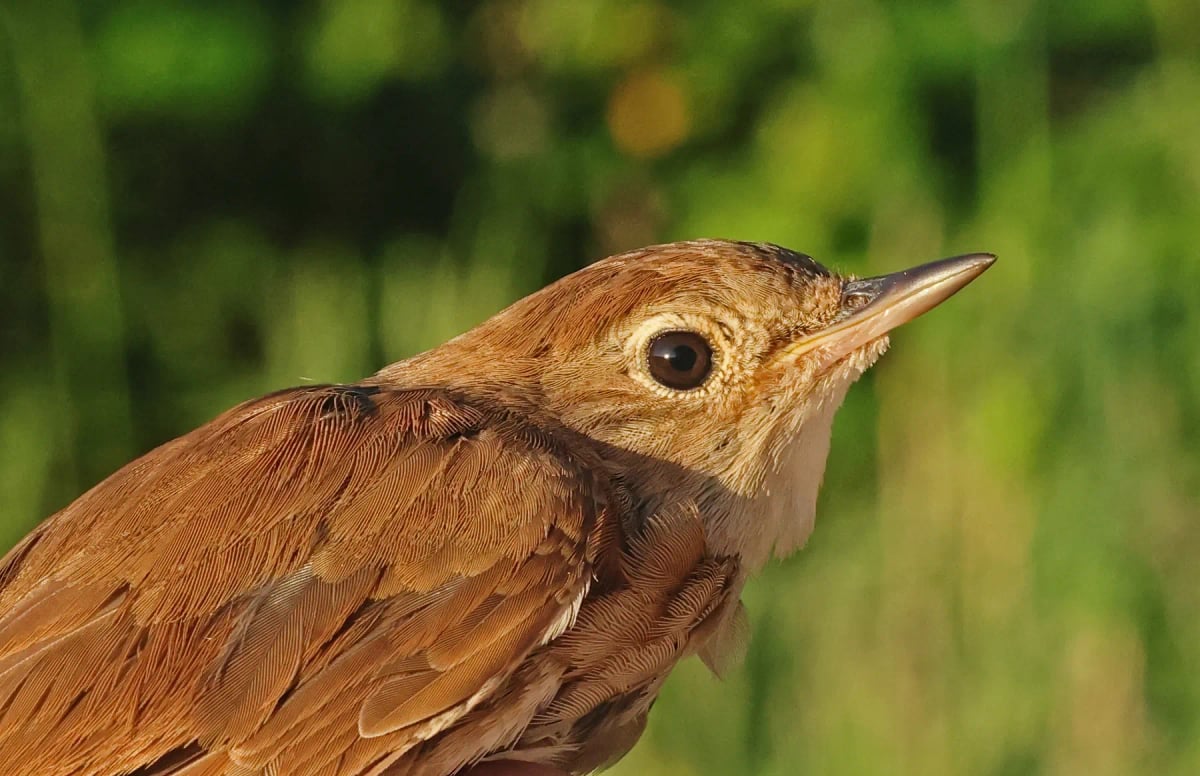
The common nightingale is a small, plain looking bird dressed in warm brown above and pale buff below, with a distinctly rusty orange tail that it often cocks upward. What it lacks in color it more than makes up for in voice. Males produce one of the most complex and powerful songs of any bird in the world, a torrent of whistles, trills, gurgles and slow fluting phrases that can carry through a still night for a considerable distance. The species breeds across southern and central Europe, northwest Africa, the Middle East and central Asia as far as western China and Mongolia, nesting low in dense shrubs and thickets close to woodland edges. Each autumn it makes a long journey to sub-Saharan Africa, where it spends the winter months quietly foraging in scrub and savanna. Despite a wide range and a European population of roughly 3 to 7 million pairs, numbers in northern and western Europe have been falling steadily, and in the United Kingdom they dropped by about 90 percent between 1967 and 2022.
Habitat and distribution
Nightingales breed across a broad sweep of territory stretching from Portugal and Morocco in the west through southern and central Europe, the Middle East, and into central Asia, where it reaches Kazakhstan, Kyrgyzstan, Tajikistan and the far west of China and Mongolia. Within this range they favor dense, low vegetation: thickets of bramble and hawthorn, woodland edges with heavy undergrowth, and riverbank scrub where shade and cover are plentiful. They are not birds of open fields or high canopy. Come late summer, they leave their breeding grounds entirely and travel south to spend the winter in sub-Saharan Africa, from West Africa across to the Great Rift Valley. The journey covers thousands of kilometers and takes them across the Sahara Desert. On the way, birds from the eastern populations cross the Arabian Peninsula, where they are seen only on passage in spring and autumn. In the far north of Europe, from Denmark to the Baltic states, the nightingale is replaced by its close relative, the thrush nightingale. They tend to return to the same breeding sites each spring.
What does a nightingale sound like?
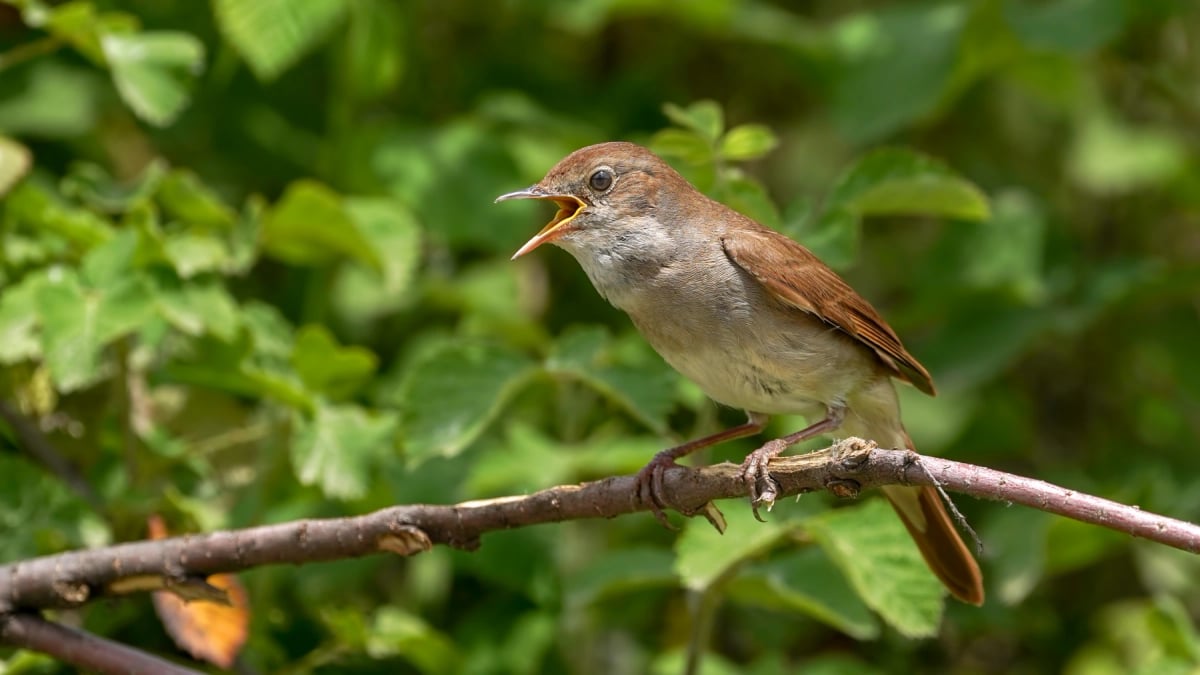
Few sounds in nature rival the song of a male nightingale. It is one of the most powerful and varied of any bird in the world, built from a wide repertoire of phrases that includes slow, deep fluting notes, rapid bubbling trills, sharp whistles and sudden crescendos. A male usually has between about 180 and 260 different song types, around 190 on average, and exceptional birds go beyond 300; he strings them together in ever changing order, rarely repeating the same sequence. Older males have bigger repertoires than first year birds, and females seem to prefer them. Singing happens both day and night, but the night performances are the ones that capture most attention, carrying clearly through still air when other birds are silent. The song serves two purposes: it draws in females and warns rival males to keep their distance. Studies show that the famous night song comes mostly from unpaired males trying to attract a female migrating overhead in the dark; once a male finds a partner, he sings far less at night and mostly by day. Newly arrived males begin singing almost immediately after reaching their breeding grounds in April.
Diet
On their breeding grounds, nightingales feed mainly on invertebrates. Beetles, ants, flies, spiders and earthworms make up a large part of their daily intake, along with caterpillars and other small larvae found among leaf litter and low vegetation. They forage mostly on or near the ground, picking through fallen leaves and loose soil with quick, deliberate movements. Their cryptic brown plumage makes them easy to miss even when they are feeding in the open. As summer draws to a close and insects become less available, they shift toward soft fruits and berries to build up the fat reserves needed for their long journey south. Elderberries and other small fruits are particularly important during this period. On their wintering grounds in Africa they return largely to an insect diet.
Breeding
Nightingales arrive on their European breeding grounds between late April and early May. The nest is built by the female alone, placed low in a dense shrub or sometimes directly on the ground among thick vegetation. She constructs it from dead leaves, grass and fine plant fibers, creating a deep cup that blends into the surrounding leaf litter almost perfectly. A typical clutch contains four or five eggs, which she incubates for around thirteen to fourteen days. The male continues to sing throughout incubation but takes little part in sitting on the eggs. Once the chicks hatch, both parents bring food to the nest. The young leave after about eleven days, though they remain dependent on their parents for a short time before becoming fully independent.
The nightingale in poems, stories and names
Few birds have inspired as much art as the nightingale. Its English name comes from Old English nihtegale, which means "night singer", and in many languages the bird stands for love, longing and the beauty of song. A classical myth retold by Ovid turns Philomela into a nightingale, and the bird sings through the work of poets from Sappho and Ovid to Shakespeare, whose Juliet insists "it was the nightingale, and not the lark". John Keats wrote his Ode to a Nightingale in 1819 after hearing one in a London garden, and Hans Christian Andersen's fairy tale The Nightingale, from 1843, tells of a Chinese emperor who prefers a jeweled mechanical bird until the real one saves his life. In Persian and Turkish poetry the nightingale, called bulbul, is the lover of the rose, an image that traveled across Iran, Central Asia and India. The bird also gave its name to people and things: the surname Nightingale, made world famous by Florence Nightingale, the founder of modern nursing, comes from it, and so do countless books, songs, ships and even a video game. When people search for the nightingale, many are looking for one of these, but they all trace back to this small brown bird singing in the dark.
Conservation
Globally, the nightingale is assessed by the IUCN as Least Concern, thanks to its wide range and large overall population. Europe alone holds roughly 3.2 to 7 million breeding pairs. The picture is less reassuring in the northwest of its range, particularly in the United Kingdom and the Netherlands. In the UK, numbers fell by about 90 percent between 1967 and 2022, one of the steepest declines of any breeding bird there, and the remaining birds are concentrated in the southeast of England. The main driver is the loss of the dense, scrubby undergrowth the species depends on for nesting and shelter. Changes in how woodland and farmland are managed have reduced the availability of suitable habitat. Deer browsing, which strips away low shrub cover across large areas of woodland, has been identified as a particular problem in Britain. Problems on the other end of the journey matter too: research published in 2025 linked the British decline to the quality of the birds' wintering habitat in West Africa. Climate shifts may also be affecting the timing of insect availability on the breeding grounds. Conservation efforts focus on restoring and maintaining thicket habitat, and on encouraging land management practices that allow dense undergrowth to regenerate.
Where it is found
The Nightingale can be found in places such as:
Researched and written by Juan Pablo. Sources: IUCN Red List, scientific literature and regional field guides. Last updated: .
Technical factsheet








Frequently Asked Questions
Why is it called a nightingale?
The name comes from Old English nihtegale, built from niht, night, and galan, to sing, so it simply means "night singer". Many other languages also name it after its voice rather than its looks. Its scientific name, Luscinia megarhynchos, mixes the Latin word for nightingale with Greek words meaning "big bill". It is often called the common nightingale, or the rufous nightingale, to tell it apart from its close relative, the thrush nightingale of northern and eastern Europe.
Do female nightingales sing?
No, the famous song belongs to the males. Females make short calls, such as a croaking alarm note and soft contact calls, but they do not perform the long, complex song. Instead, they listen: females seem to choose partners partly by the quality of their song, and males with bigger repertoires, usually older birds, tend to be preferred. Males and females look almost the same, so in the field the song is the easiest way to know you are hearing a male.
When do nightingales sing?
Nightingales sing mainly from mid April to June, right after they return from Africa. Males sing both by day and by night, but the night song is strongest in the first weeks, when unpaired males try to attract females migrating in the dark. Once a male has a partner, his night singing drops sharply and he sings mostly in the early morning and during the day. By late June the song fades, and on their wintering grounds in Africa nightingales are mostly silent.
What is the difference between the nightingale and the thrush nightingale?
They are close relatives that look very much alike. The common nightingale is warmer brown above with a brighter rusty tail, while the thrush nightingale is a colder, grayer brown with faint mottling on the chest. Their songs differ too: the thrush nightingale's is louder and harsher, with fewer of the slow, fluting crescendos. Their ranges meet in a band across central and eastern Europe; north and east of it, in Denmark, the Baltic states and much of Russia, the nightingale people hear is usually the thrush nightingale.
Is the nightingale the same as the bulbul?
In poetry, yes; in biology, no. In Persian, Turkish and Urdu, the word bulbul means nightingale, and the bulbul of classic poems, in love with the rose, is this same singing bird. But in English the name bulbul is also used for a separate family of birds, common across Africa and southern Asia, that are not closely related to the nightingale. So the bulbul of Hafez and Rumi is the nightingale, while the bulbuls of a field guide are different birds.
What does a nightingale look like?
The nightingale is a small, fairly plain bird, about 15 to 16.5 cm long and weighing roughly 16 to 27 grams, a little bigger than a robin. Its back and wings are warm brown, its underparts are pale buff, and its tail is a distinctive rusty orange that it often flicks upward. It has no bold markings or bright colors, so it can be surprisingly hard to spot among leaves and undergrowth. The male and female look almost identical, which means the famous song is really the easiest way to know one is nearby.
Why does the nightingale sing at night?
Male nightingales sing at night mainly to attract females and to signal their presence to rival males. Singing after dark has a practical advantage: the air is usually calmer and quieter, so the song travels farther. Newly arrived males in spring are particularly active at night because competition for mates is intense. The night song is so striking partly because no other bird is making noise at the same time, letting the nightingale's voice carry without competition.
Where do nightingales migrate to in winter?
Every autumn, nightingales leave their breeding grounds and fly to sub-Saharan Africa. They spend the winter months in a broad band stretching from West Africa eastward to the Great Rift Valley, living quietly in scrub and savanna. To get there, they cross the Sahara Desert, a journey of thousands of kilometers. Come spring, most individuals return to the very same patch of breeding habitat they used the previous year.
Are nightingales in decline?
Globally the species is listed as Least Concern by the IUCN, meaning it is not considered at risk of extinction. However, in countries like the United Kingdom and the Netherlands, populations have fallen sharply over recent decades; in the UK the drop was about 90 percent between 1967 and 2022. The main reason is the loss of dense scrubby undergrowth used for nesting. Deer browsing, changes in land management and shifts in climate have all reduced the availability of suitable habitat in these areas.
What do nightingales eat?
On their breeding grounds, nightingales eat mainly insects and other invertebrates: beetles, ants, flies, spiders, earthworms and caterpillars are all regular prey. They forage close to or on the ground, working through leaf litter with careful, quick movements. Before migrating south in late summer, they switch to soft fruits and berries, such as elderberries, to build up the fat reserves needed for the long journey ahead. In Africa during winter, they return to feeding on insects.
Where do nightingales build their nests?
The female builds the nest on her own, placing it very low in a dense shrub or directly on the ground among thick vegetation. She uses dead leaves, grass and fine plant fibers to construct a deep cup that blends almost perfectly into the surrounding leaf litter. This hidden location and the plain brown plumage of the sitting female make the nest extremely difficult to find, which offers strong protection against predators during incubation.