Boa Constrictor
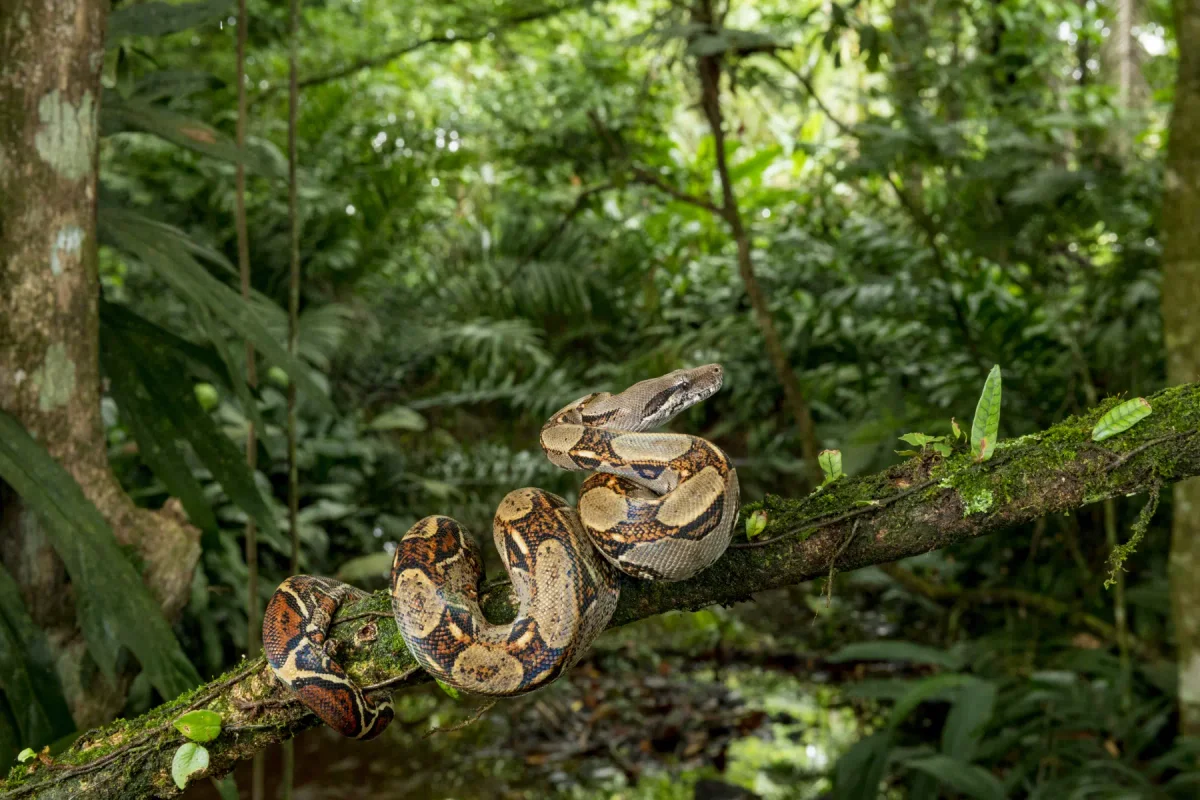
The boa constrictor (Boa constrictor) is one of the largest snakes in the Americas and relies entirely on constriction rather than venom to subdue its prey. It is found across a vast range of habitats, from tropical rainforests and gallery forests to dry scrublands, savannas, and farmland edges, at elevations from sea level up to around 1,000 meters. Its diet shifts with age: juveniles target lizards and small birds, while adults pursue larger mammals such as opossums, monkeys, and deer. The snake is viviparous, giving birth to live young in litters that commonly number between 10 and 65. Adults typically measure between 2 and 3 meters, though females regularly exceed 3 meters. Primarily active after dark, it hunts by ambush, remaining motionless until prey moves within striking range. The species is listed as Least Concern by the IUCN but faces pressure from habitat loss and commercial collection.
Habitat and distribution
The boa constrictor occupies one of the broadest ranges of any large snake in the Western Hemisphere, stretching from northern Mexico through Central America and into South America as far south as northern Argentina. Across this territory it thrives in an impressive variety of environments, including tropical rainforests, dry scrublands, savannas, gallery forests, and the edges of farmland. It is generally a lowland species, most common at elevations below 1,000 meters, though individuals have been recorded at higher altitudes in some Andean foothills. The snake also colonizes offshore islands, including Trinidad and Tobago. It tends to favor areas near water and with dense vegetation that provides cover for ambush. Its ability to tolerate disturbed habitats, such as agricultural land and forest margins, has helped it persist across much of its original range.
Built to squeeze: physical and sensory adaptations
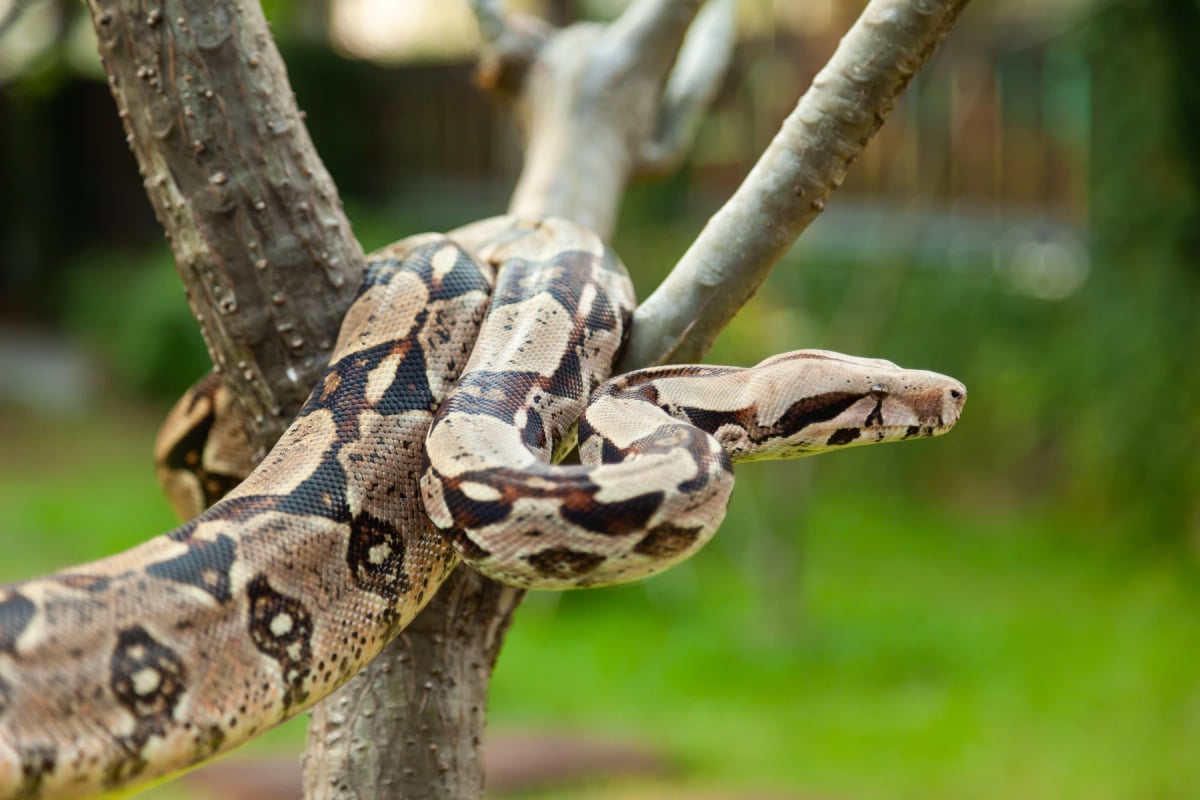
The boa constrictor's most defining feature is its muscular body, which can exert enough pressure to stop the blood flow of prey rather than simply suffocating it. This makes constriction a fast and efficient method of predation. Along the upper and lower lips sit heat-sensitive pits that detect infrared radiation, allowing the snake to locate warm-blooded animals in complete darkness. Its flexible jaw, supported by ligaments rather than a fused bone structure, lets it swallow prey far wider than its own head. Coloration, typically a pattern of brown saddles against a tan or gray base, provides camouflage across both leaf litter and dappled forest light. Females are notably larger than males, a form of size difference linked to the high energetic demands of producing live young.
Behavior and social life
Boa constrictors are largely solitary and most active at night, spending daylight hours sheltering in hollow logs, rock crevices, or dense vegetation. They are ambush predators, relying on patience and camouflage rather than pursuit. When prey passes within range, the snake strikes rapidly, coils around the animal, and tightens its grip with each exhaled breath of the prey until blood flow stops. Juveniles are more arboreal than adults, spending considerable time in trees where they hunt lizards and small birds. As body size increases, individuals shift toward ground-level hunting of larger mammals. Boa constrictors are viviparous, giving birth to live young after a gestation period of around five to eight months, with litters typically ranging from 10 to 65 neonates. Beyond mating season, there is little social interaction between individuals.
Conservation
The IUCN classifies the boa constrictor as Least Concern, reflecting its wide distribution and ability to persist in disturbed habitats. However, the species faces real and ongoing pressures. Deforestation driven by agricultural expansion continues to reduce the quality and connectivity of its habitat across much of South and Central America. Commercial collection for the international pet trade has historically been substantial, and the species appears on Appendix II of CITES, meaning international trade is monitored and regulated, though not banned outright. In some regions, boas are also killed out of fear or for their skin. Local populations on certain islands and in heavily hunted areas may be more vulnerable than the species as a whole. Continued monitoring and enforcement of trade regulations remain important tools for ensuring that current population levels are maintained across its range.
Where it is found
The Boa Constrictor can be found in places such as:
Researched and written by Juan Pablo. Sources: IUCN Red List, scientific literature and regional field guides. Last updated: .
Technical factsheet

Frequently Asked Questions
How large do boa constrictors get?
Most adults measure between 2 and 3 meters, but females regularly grow beyond 3 meters since they tend to be substantially larger than males. Exceptionally large individuals have been recorded approaching 4 meters, though this is uncommon. Body mass can reach 27 kilograms in the biggest specimens. Size varies across the species' range, with some regional populations consistently producing smaller or larger animals than the average.
Are boa constrictors venomous or dangerous to humans?
Boa constrictors produce no venom at all. They subdue prey entirely through constriction. For humans, a bite from a large individual can cause puncture wounds and bleeding, but it is not life-threatening. A full-grown adult is strong enough to be handled with caution, yet documented attacks on people are extremely rare. The snake is generally more interested in avoiding confrontation than initiating one.
What do boa constrictors eat?
Their diet changes considerably as they grow. Juveniles feed mainly on lizards and small birds, while adults shift to larger prey such as opossums, monkeys, bats, and occasionally deer. After a large meal, a boa can go weeks or even months without eating again, as its slow metabolism allows it to extract a great deal of energy from a single prey item. They are opportunistic hunters and will take what is available.
Do boa constrictors lay eggs?
Unlike many other snakes, boa constrictors do not lay eggs. They are viviparous, meaning the young develop inside the mother and are born live. Litters commonly range from 10 to 65 neonates, making them one of the more prolific live-bearing snakes in the Americas. Newborns are fully independent from birth and receive no parental care, immediately beginning to hunt on their own.
How long do boa constrictors live?
In the wild, boa constrictors are believed to live around 20 to 30 years, though precise data from free-living populations is limited. In human care, individuals have been documented living beyond 30 years, with some records approaching 40. Lifespan is influenced by factors such as food availability, predation pressure, and disease. Young boas face the highest mortality, as they are vulnerable to a wider range of predators than adults.
What are the main predators of the boa constrictor?
Young boa constrictors face threats from large birds of prey, carnivorous mammals, and other snakes. As adults, their size offers significant protection, but large caimans, crocodiles, and big cats such as jaguars and pumas are known to prey on them on occasion. Humans represent one of the most significant sources of mortality across the species' range, through hunting, road kills, and deliberate killing out of fear.
Is the boa constrictor kept as a pet?
Yes, the boa constrictor is one of the most commonly kept large snakes in the world. Captive breeding programs supply much of the pet trade today, though collection from the wild has historically been a concern significant enough to place the species on CITES Appendix II. Prospective owners should be aware that adults are powerful animals requiring spacious enclosures, specialized diets, and a commitment spanning several decades given the animal's potential lifespan.