Panamanian Golden Frog
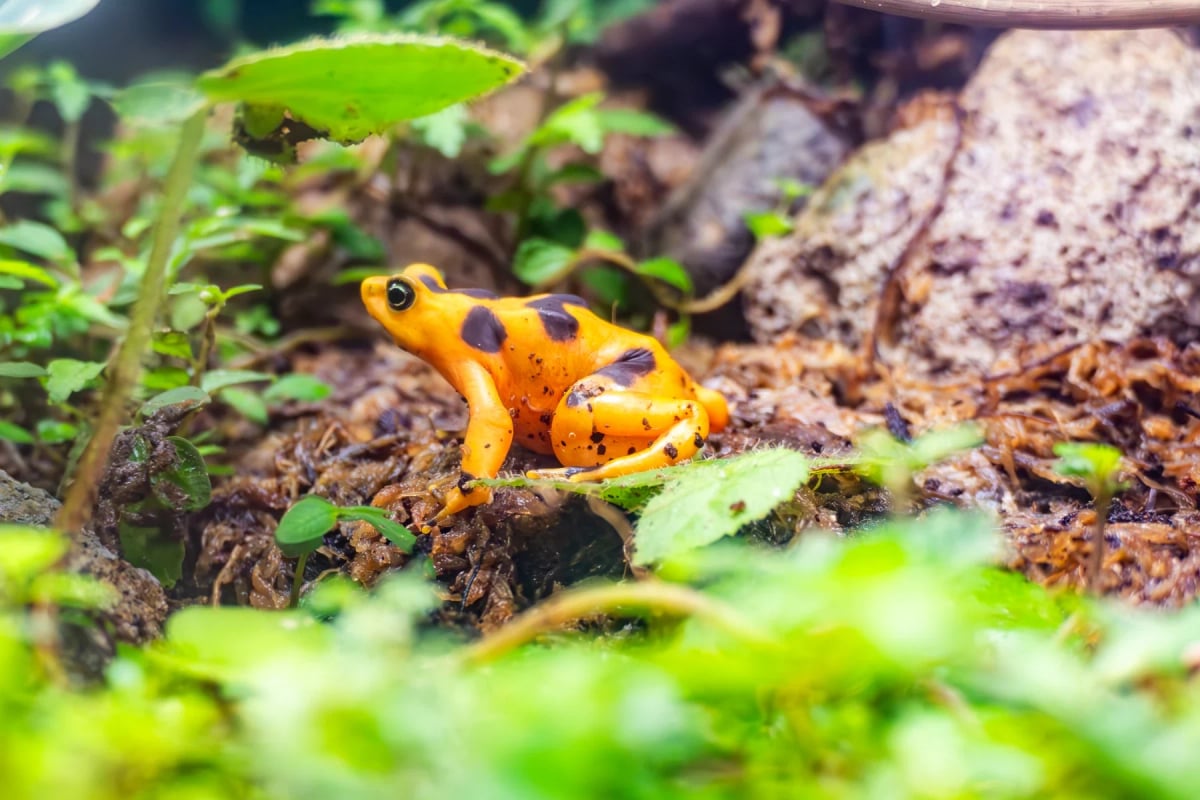
The Panamanian golden frog is a small toad dressed in vivid yellow with bold black markings, a color pattern that warns predators of its toxic skin secretions. It once lived along cool, fast streams inside the cloud forests and humid foothills of central Panama, hunting small invertebrates by day. One of its most remarkable traits is semaphoring: individuals wave their forelimbs slowly to signal rivals or mates across the noise of rushing water, a form of visual communication rare among amphibians. A wave of chytridiomycosis, a fungal disease caused by Batrachochytrium dendrobatidis, swept through its range in the early 2000s and effectively wiped out wild populations, with the last confirmed sighting in 2009. Today the species survives almost entirely in carefully managed captive breeding programs run by zoos and Panamanian institutions, while researchers work toward reintroduction to habitats where the disease can be managed.
Habitat and distribution
Found only in Panama, the Panamanian golden frog was restricted to a surprisingly small area in the central part of the country, particularly in the valleys and foothills around El Valle de Antón and the Tonosí river drainage. It favored the banks of streams that move fast and stay cool year round, tucked inside cloud forests and humid lower slopes of the Cordillera Central. Clean, well oxygenated water was essential: the frogs spent much of their time on wet rocks beside the rushing current, where the spray kept their skin damp. Historical records show the species was never widespread, with populations scattered across a handful of known localities. Elevation played a key role, as most sightings fell between roughly 300 and 1,000 meters above sea level. Wild populations are now considered functionally extinct across the entire range, and the last confirmed sighting of a frog in the wild dates from 2009.
Appearance
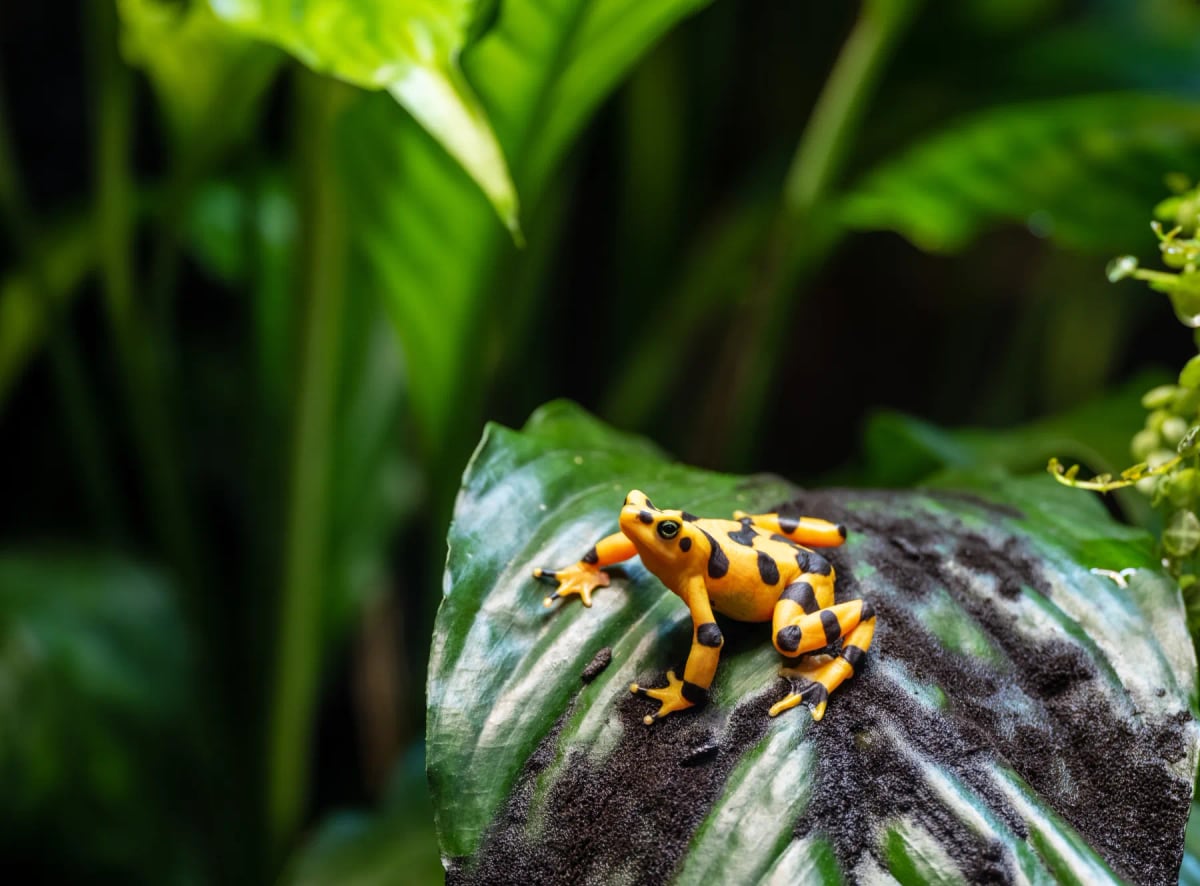
Few amphibians anywhere in the world are as immediately recognizable as this species. The body is small and slender, with smooth skin that glows in shades ranging from pale lemon to deep golden yellow, broken up by irregular black blotches and spots. Males are noticeably smaller than females, typically reaching around 35 to 45 mm in length, while females can grow closer to 63 mm. The gold is not there from the start: juveniles are green and black, and the yellow spreads as they mature. The coloration is aposematic, meaning it serves as a clear warning to potential predators that the skin contains toxic secretions. Those secretions include potent alkaloids called zetekitoxins, which are among the most powerful natural toxins documented in any toad. The long, slender limbs give the frog an almost delicate look, quite different from the stockier build seen in many other toad species.
Communication
What makes the Panamanian golden frog stand out even among unusual animals is its use of visual signals to communicate. Living beside streams that rush loudly over rocks, sound alone is not a reliable way to get a message across, and this species has no eardrum at all. So individuals wave one foreleg slowly and deliberately, a behavior scientists call semaphoring. This gesture is used to signal territorial boundaries to rivals and to attract the attention of potential mates. The waving motion is deliberate enough that observers can spot it easily from a short distance. While some other frog species also produce visual displays, the semaphoring of this species is particularly well documented and consistent. Soft vocalizations do occur, but the forelimb wave appears to be the primary channel of communication in noisy stream environments.
Breeding and tadpoles
Pairing in this species is unusually drawn out. A male climbs onto a female's back in a grip called amplexus and simply stays there, sometimes for a few days and in extreme cases for weeks, until she is ready to lay. She then deposits a long string of eggs in shallow, fast moving water, usually wedged under a rock where the current cannot wash it away. The tadpoles that hatch are built for life in a torrent: each one carries a large sucker across the front of its belly that clamps it onto wet stone while it grazes algae with rows of tiny teeth. Biologists call that body plan gastromyzophorous, and it is found only in this group of stream toads. The froglets that finally leave the water are green and black, and the famous gold arrives later, with age.
Main threats
The collapse of wild populations was swift and devastating. The primary driver was chytridiomycosis, a disease caused by the fungus Batrachochytrium dendrobatidis, which spread through Central American amphibian communities during the late 1990s and early 2000s. The fungus attacks the skin, and since amphibians breathe and regulate salts through it, infected frogs die of heart failure. The golden frog proved extremely vulnerable, and by the mid 2000s observers could no longer find individuals at sites where hundreds had previously lived. Habitat loss from agriculture and human settlement reduced the available forest cover around streams, compounding the pressure on already stressed populations. Collection for the pet trade and for local cultural practices added further strain. Localized water pollution from agricultural runoff also degraded the clean stream conditions the species depends on. Together these pressures left no known self sustaining wild population anywhere in the species' historic range.
Conservation
Saving this species now depends almost entirely on coordinated work carried out away from the wild. Zoos in the United States and institutions inside Panama, including the Smithsonian Tropical Research Institute and the El Valle Amphibian Conservation Center at El Níspero zoo, maintain carefully managed breeding colonies. These programs focus on keeping the animals healthy, maintaining genetic diversity and learning as much as possible about the biology of the species in controlled conditions. Researchers are also investigating whether certain amphibian populations show natural resistance to Batrachochytrium dendrobatidis. The first real test came in late 2025, when about 100 captive bred frogs were moved into mesh pens in the forest: roughly 70 died of chytrid, but the survivors were released and the trial gave scientists their first hard data on how these frogs cope with the fungus outdoors. Conservation bodies classify the species as Critically Endangered on the IUCN Red List.
Cultural significance
To many Panamanians, this small frog carries a meaning far greater than its size would suggest. It has been celebrated as a national symbol for generations, appearing in pre Columbian gold figurines made by indigenous peoples and later adopted in modern imagery connected to Panamanian identity. A law passed on 3 August 2010 made that official, declaring the golden frog a cultural and ecological symbol of the country and setting aside 14 August as National Golden Frog Day, marked every year with parades and school events in El Valle de Antón. The frog appears on lottery tickets and on commemorative coins, and its image is widely used in tourism materials. In some communities near its historic range it was considered a bearer of good fortune, and its disappearance from the wild has been felt as a genuine cultural loss.
Researched and written by Juan Pablo. Sources: IUCN Red List, scientific literature and regional field guides. Last updated: .
Technical factsheet



Frequently Asked Questions
How big is the Panamanian golden frog?
It is small. Males measure roughly 35 to 45 millimeters from snout to vent and females reach about 63 millimeters, so an adult sits comfortably on a person's palm. Weight runs between 3 and 12 grams. Females are clearly the larger sex, which is common among toads, and the body is slender and long limbed rather than squat like most other members of its family.
How poisonous is the Panamanian golden frog?
Very. Its skin carries zetekitoxin, a guanidinium alkaloid named after the species itself and one of the most potent natural toxins found in any toad. It blocks the sodium channels that nerves use to fire, so a predator that bites one gets an immediate and severe lesson. The frog does not inject anything and is harmless unless handled or eaten, which is exactly what the bright yellow is advertising.
How do Panamanian golden frogs breed?
The male climbs onto the female's back in a grip called amplexus and holds on for days, and in extreme cases for weeks, until she lays. The eggs go into shallow, fast moving water in a long string, usually tucked under a rock. The tadpoles hatch with a large sucker on the belly that grips wet stone against the current while they graze algae. The froglets that emerge are green and black; the gold comes later.
Is the Panamanian golden frog the same as the golden poison frog?
No, they are different animals from different countries. The golden poison frog (Phyllobates terribilis) is a dart frog from the Pacific forests of Colombia and carries batrachotoxin. The Panamanian golden frog is a toad, Atelopus zeteki, endemic to central Panama, and its toxin is zetekitoxin. Both are yellow and both are dangerous to eat, but they are not close relatives and they never shared a range.
Why is the golden frog a symbol of Panama?
Because it has been part of the country's imagery since long before it had a scientific name. Indigenous peoples cast it in gold figurines, and in some communities finding one was taken as a sign of good luck. A law passed on 3 August 2010 made the frog an official cultural and ecological symbol of Panama and declared 14 August National Golden Frog Day, which is celebrated with parades in El Valle de Antón. It also appears on lottery tickets and commemorative coins.
What does the Panamanian golden frog eat?
Panamanian golden frogs are active hunters during the day. They feed on small invertebrates such as insects, spiders, and other tiny arthropods they find near the stream banks where they live. Like most toads, they rely on a quick strike of the tongue to catch prey. Their diet is fairly typical for a small toad of their size, and they tend to hunt in the moist areas close to the water's edge.
Why is the Panamanian golden frog so colorful?
That brilliant yellow and black coloring is actually a warning signal. The skin of this frog produces powerful toxic substances called zetekitoxins, and the bold colors tell predators to stay away. This type of coloring is known as aposematic coloration, and it is common in animals that carry venom or toxins. The more eye catching the pattern, the better the chance a predator will remember the lesson after one bad experience.
How does the Panamanian golden frog communicate?
This frog communicates by waving its front legs, a behavior called semaphoring. Because it lives beside streams that are very loud, calling out like most frogs do simply would not work well. Instead, individuals wave one foreleg slowly and deliberately to signal rivals or attract mates. It is one of the few amphibians known to rely on this kind of visual communication as its main way of sending messages.
Are there any Panamanian golden frogs left in the wild?
Wild populations are considered functionally extinct, and the last confirmed sighting dates from 2009. A fungal disease called chytridiomycosis swept through their range in the early 2000s and wiped out virtually every known group. The species survives in captive breeding programs run by zoos and research institutions in Panama and the United States. In late 2025 about 100 captive bred frogs were moved into forest pens as a first reintroduction trial: most died of the fungus, but the survivors were released and the attempt produced the first real data on the problem.
Where did the Panamanian golden frog originally live?
This species was found only in a small part of central Panama. It lived along the banks of streams that move fast and stay cool, inside cloud forests and humid foothills of the Cordillera Central. Most individuals were spotted at elevations between roughly 300 and 1,000 meters. The species was never widespread, and populations were limited to a handful of known areas, including the valleys around El Valle de Antón.
Is the Panamanian golden frog a toad or a frog?
Technically it is a toad, belonging to the family Bufonidae. However, Panamanians and scientists alike commonly refer to it as a frog, and that name has stuck culturally and in everyday use. Toads and frogs are both amphibians, and the line between them is less rigid than many people think. What sets this species apart is not so much its classification but its striking appearance, unique behaviors, and deep cultural importance to Panama.
What is being done to save the Panamanian golden frog?
Several zoos and research institutions in Panama and the United States maintain captive breeding colonies to keep the species alive and preserve its genetic diversity. Scientists are also studying whether some individual frogs carry a natural resistance to the fungal disease that devastated wild populations. The goal is to eventually release frogs back into carefully chosen sites in Panama where the disease can be managed. It is a slow process, but real progress is being made.