Cassowary
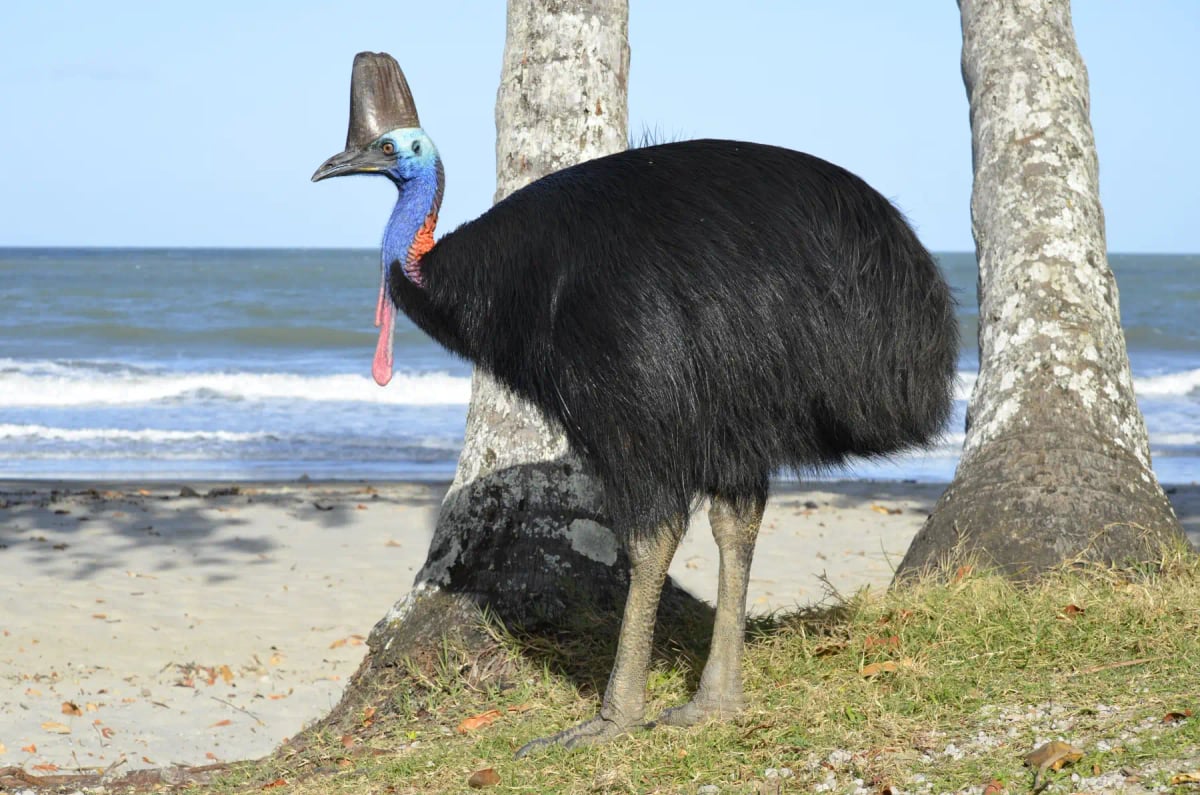
The southern cassowary (Casuarius casuarius) is one of the heaviest birds on Earth and a vital presence in the tropical rainforests of northeastern Australia, southern New Guinea, and the Aru Islands. Females are larger than males, usually standing 1.5 to 1.8 meters tall and weighing up to 76 kilograms, and they carry a tall casque on the head whose exact function is still debated. The vivid blue and red skin of the neck makes this bird instantly recognizable. Although generally shy, cassowaries will defend themselves if cornered, kicking with the inner toe claw, which can reach 12 centimeters in length. As fruit eaters, they swallow large fruits that few other animals can handle, and the seeds pass through intact, making them some of the most important seed dispersers in their forests. The IUCN has listed the species as Least Concern since 2018, but in Australia it is legally classed as Endangered because of habitat loss, road traffic, and dog attacks.
Size and appearance
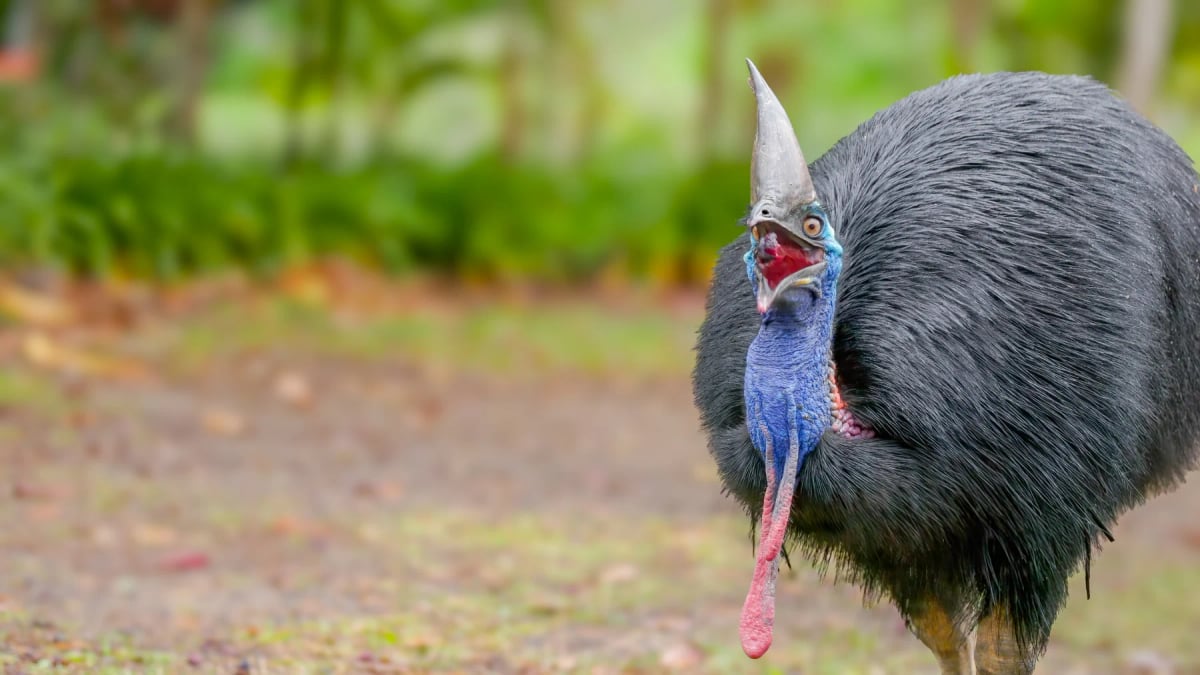
Among the heaviest birds on Earth, the southern cassowary is the fourth tallest and third heaviest living bird. It usually stands 1.5 to 1.8 meters tall, with some females reaching 2 meters. Females are consistently larger, weighing 47 to 76 kilograms, while males weigh 29 to 55. The body is covered in coarse, black feathers that hang loosely, almost like fur, and the tiny wings carry a few bare, stiff quills. Bare skin on the face and neck blazes in vivid shades of blue and red, and two red wattles up to 18 centimeters long hang from the neck. On top of the head sits a hollow casque, 13 to 20 centimeters high, made of keratin over a spongy core. Researchers still debate its purpose, with theories ranging from sound and display to helping the bird shed heat. The legs are exceptionally thick and muscular, and the inner toe on each foot carries a straight claw that can reach 12 centimeters. Despite its bulk, it can run at up to 50 kilometers per hour and jump high.
Southern, northern and dwarf cassowary
There are three living species of cassowary, and this page is about the largest and best known, the southern cassowary, which is also the only one found in Australia. The northern cassowary (Casuarius unappendiculatus) lives in the swamp and lowland forests of northern and western New Guinea and nearby islands. It is almost as large as the southern cassowary, but it usually has a single red or yellow wattle instead of two, which gives it its scientific name. The dwarf cassowary (Casuarius bennetti) is much smaller and lives in the mountains of New Guinea, higher up than its two relatives, and it has a shorter, flatter casque. All three are shy birds of dense forest with the same dagger like inner claw, and all three are now listed as Least Concern by the IUCN, although local hunting and forest loss affect them in parts of their range. Their closest living relative is the emu of Australia. The name cassowary comes from the Malay word kasuari, which traces back to a language of New Guinea.
Diet and ecological role
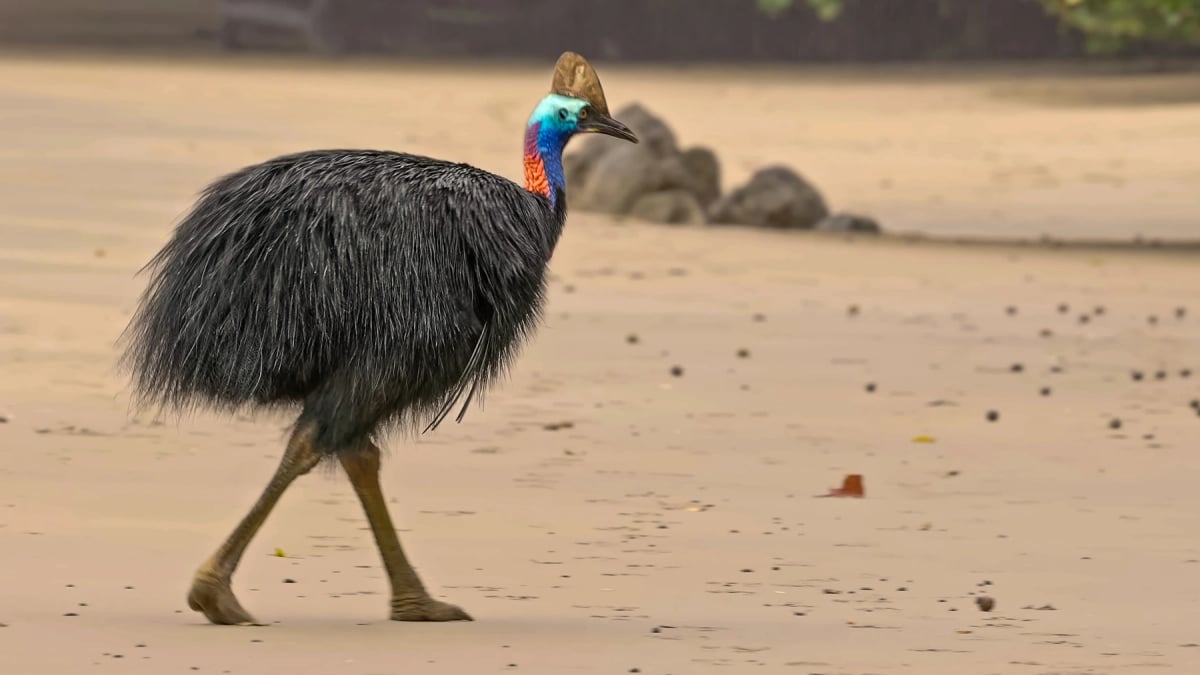
Fruit forms the backbone of the cassowary's diet, and this bird is capable of swallowing whole fruits that are far too large for most other animals to consume. Seeds pass through the digestive system largely intact and are deposited considerable distances from the parent plant, making the cassowary one of the most effective seed dispersers in the rainforests of the Asia Pacific region. Some plant species, including the large seeded cassowary plum, appear to depend heavily on this process for regeneration. Beyond fruit, cassowaries will also eat fungi, insects, small vertebrates, and carrion when the opportunity arises. Their role in maintaining the structure and diversity of tropical forest communities is well recognized by ecologists, and the loss of cassowaries from an area can measurably reduce the recruitment of large seeded tree species over time.
Behavior
Cassowaries are solitary animals for most of the year, coming together only briefly during the breeding season. They are naturally shy and will usually slip away into dense vegetation at the first sign of people. They are active by day, walking slowly along forest trails between fruiting trees, and they make very deep, booming calls, some so low that people feel them more than hear them. Each bird knows its patch of forest well and returns to favorite fruiting trees in season. Despite their size, they move with surprising speed when needed, running at up to 50 kilometers per hour through the undergrowth, and they are strong swimmers. Individuals that have grown used to being fed by people can become bold and pushy, and that is when most incidents with humans happen. When genuinely threatened and unable to escape, a cassowary defends itself by leaping and kicking forward with its powerful legs.
Is the cassowary dangerous? The claw and the attacks
The cassowary is often called the world's most dangerous bird, and its weapon is real: the inner toe of each foot carries a straight claw up to 12 centimeters long, driven by legs strong enough to launch the bird almost two meters into the air. A cornered cassowary jumps and kicks forward with both feet, and the claw can cause deep wounds. The actual record, though, shows how rare serious attacks are. A study of 221 cassowary attacks found that 150 were against people, and most of those involved birds that had been fed by humans and had come to expect food: they chased, kicked, or pecked people carrying snacks. Only two human deaths have been confirmed since 1900. The first was in 1926 in Queensland, when a 16 year old boy was kicked in the neck after he and his brother attacked the bird with clubs. The second was in 2019 in Florida, where a man who kept cassowaries as private animals was attacked after he fell near one. The lesson is simple: never feed a wild cassowary, keep your distance, and if one approaches, back away slowly and put something like a backpack or a tree between you.
Cassowary eggs and chicks
Cassowary eggs are among the most striking in the bird world: large, glossy, and bright green or pale greenish, measuring about 12 to 16 centimeters long and weighing around 570 to 630 grams, roughly the weight of ten chicken eggs. The female lays three to five of them on a simple bed of leaves on the forest floor, and then her work is done. She leaves the male in charge and may go on to mate and lay eggs with another male in the same season. The male incubates the clutch for about 50 days, barely eating during that time. The chicks hatch with cream and brown stripes that help hide them among leaf litter, and they follow their father closely, learning which fruits to eat. He defends them fiercely, and he is at his most dangerous when he has young chicks. The stripes fade to a plain brown in the first months, the young stay with the male for nine to twelve months, and they reach breeding age at around four to five years, when they grow the black plumage and bright neck colors of the adults.
Distribution
The southern cassowary occupies a range of about 396,000 square kilometers across three countries. In Australia, its presence is concentrated in the wet tropics of far north Queensland, from around Cooktown south to near Townsville, including Mission Beach and the Daintree, with a separate population on Cape York Peninsula. Across the Torres Strait, it lives through much of the southern lowlands of New Guinea, on both the Papua New Guinea and the Indonesian side of the island, and on the Aru Islands of Indonesia. Within this range, cassowaries favor dense lowland rainforest but will move into adjacent woodland, swamp forest, and secondary growth, particularly when fruiting trees are scarce. They generally stay below about 1,100 meters. They are also good swimmers and can cross rivers and even short stretches of sea. The other two cassowary species, the northern and the dwarf, live in the north of New Guinea and in its highlands.
Conservation
The IUCN moved the southern cassowary from Vulnerable to Least Concern in 2018, because across New Guinea it still has a large range and much of its forest remains. In Australia, however, the picture is very different: the species is listed as Endangered under national law, with an estimated 1,500 to 2,500 birds left. Clearing of tropical rainforest for agriculture and housing is the most significant threat there, shrinking and splitting up the habitat cassowaries need. Vehicle strikes on roads that cut through cassowary territory are a leading cause of death for adults, and dog attacks are a serious risk for chicks and young birds. Feral pigs compete for fruit and damage nests. In Papua New Guinea and Indonesia, hunting for meat and feathers and the capture of chicks to raise in villages continue to affect populations. Conservation efforts in Queensland include road signs, lower speed limits in key areas, and replanting forest corridors, since the species needs large areas of connected forest to survive over the long term.
Researched and written by Juan Pablo. Sources: IUCN Red List, scientific literature and regional field guides. Last updated: .
Technical factsheet



Frequently Asked Questions
How fast can a cassowary run?
A cassowary can run at up to 50 kilometers per hour, even through dense forest, which is faster than any human sprinter. It can also jump high, close to two meters according to some reports, and it is a strong swimmer that crosses rivers and even short stretches of sea. That combination of speed, power, and agility is why running away from an angry cassowary is not a good idea: backing off slowly and putting an obstacle in between works better.
How much does a cassowary weigh?
Female southern cassowaries weigh 47 to 76 kilograms and males 29 to 55 kilograms, which makes the species the third heaviest living bird after the two ostriches. Females are clearly bigger than males in height too, usually 1.5 to 1.8 meters tall, with some reaching 2 meters. Old museum specimens collected in the late 1800s were recorded at even higher weights, but those figures are considered unusual.
Can cassowaries fly?
No. Cassowaries are flightless birds, part of the group called ratites, together with emus, ostriches, rheas, and kiwis. Their wings are tiny and hidden under the body feathers, with a few thick, bare quills that look like black spines. Instead of flying, they rely on powerful legs to walk long distances through the forest, run fast, jump, and swim. Their heavy body and strong bones are built for life on the ground.
Is the cassowary related to dinosaurs?
All birds descend from small feathered dinosaurs, so in that sense the cassowary is a living dinosaur just like a sparrow. It gets the comparison more than most birds because of its size, its scaly legs, the dagger like claw, and the casque on its head, which recalls the crests of some dinosaurs. But it is not a leftover from that age: it is a modern bird whose closest living relative is the emu.
Where can you see a cassowary in Australia?
The best places are in the wet tropics of far north Queensland. Mission Beach is famous as the cassowary coast, and the Daintree rainforest, including the area around Cape Tribulation, is another reliable spot. Cassowaries are often seen crossing roads or walking along forest edges early in the morning. If you meet one, stay well back, do not feed it, and follow local signs, since road deaths and feeding by people are two of the biggest problems for the species there.
What do cassowaries eat?
Cassowaries are primarily fruit eaters and can swallow whole fruits far too large for most other animals to handle. They also eat fungi, insects, small vertebrates, and occasionally carrion. Their ability to digest large seeds and deposit them intact across wide distances makes them critical for forest health. Some tree species, like the cassowary plum, depend heavily on cassowaries to spread their seeds and regenerate.
Where do cassowaries live?
Cassowaries live in the tropical and subtropical rainforests of northern Australia, Papua New Guinea, and Indonesia. In Australia, they are found in the wet tropics of far north Queensland, including the Daintree region and Mission Beach. They favor dense lowland rainforest but will move into woodland and secondary growth when food is scarce. They generally stay below 1,100 meters in elevation across their range.
Why do cassowaries have a casque on their head?
The exact purpose of the cassowary's casque, the tall structure on top of the head, is still debated. Leading theories suggest it may play a role in display and in producing or sensing very deep calls, protect the head when pushing through dense vegetation, or help the bird lose heat in the hot, humid forest. It is made of keratin over a spongy core and is 13 to 20 centimeters high, growing larger as the bird ages.
Why is the cassowary important for the rainforest?
Cassowaries are considered a keystone species in the rainforests they inhabit. By consuming large fruits and passing the seeds intact through their digestive system, they disperse seeds across distances that no other animal in the ecosystem can match. Some tree species rely almost entirely on this process to reproduce successfully. Without cassowaries, the recruitment of large seeded trees would decline noticeably, altering the structure of the entire forest over time.
What are the main threats to cassowaries?
Habitat loss from clearing of tropical rainforest is the biggest threat facing cassowaries, especially in Australia, where the species is listed as Endangered under national law with only 1,500 to 2,500 birds. There, vehicle strikes on roads through cassowary territory are a leading cause of adult deaths, while dog attacks put chicks and young birds at serious risk. In Papua New Guinea and Indonesia, hunting for meat and feathers continues to pressure wild populations, although globally the IUCN rates it as Least Concern.