Cougar
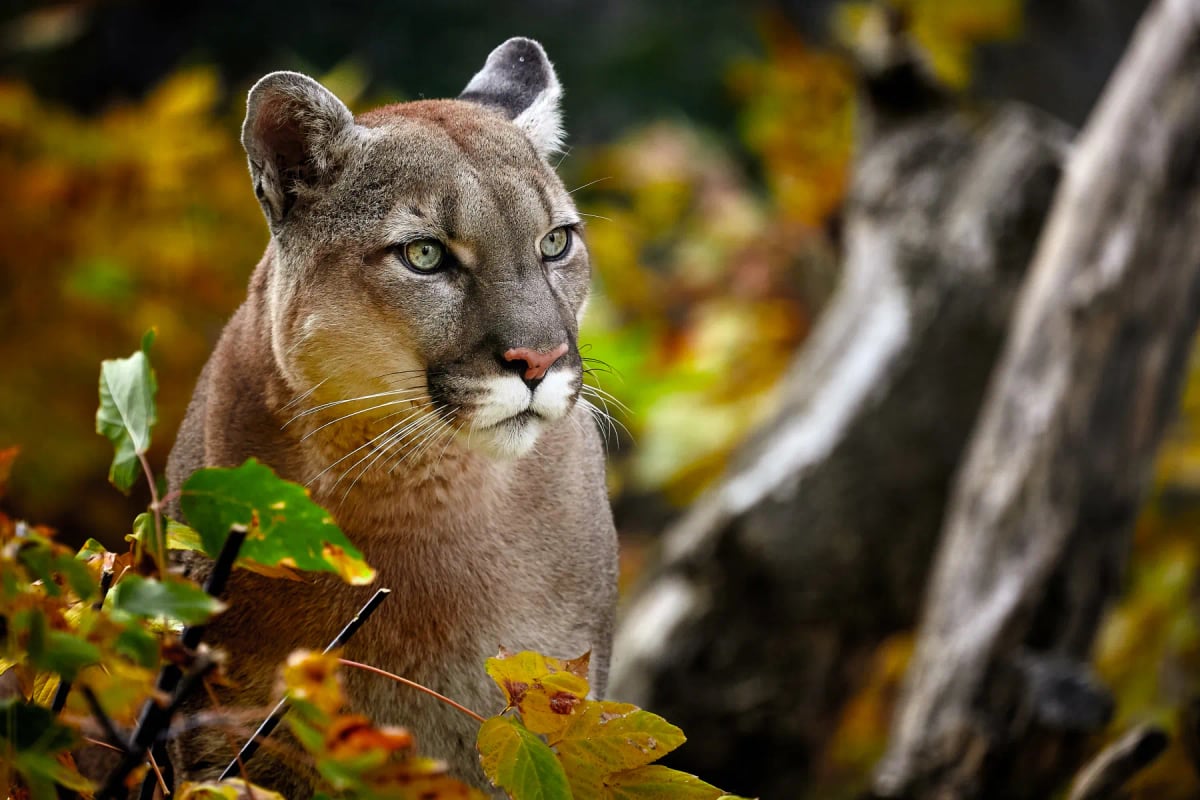
The cougar (Puma concolor), also known as the mountain lion, puma or panther, holds the record for the widest natural range of any wild land mammal in the Americas, reaching from the Canadian Rockies all the way down to the tip of Patagonia. Adults wear a plain tawny coat with a pale belly and a long, thick tail that helps them balance on rocky slopes. Males are considerably larger than females, with the heaviest individuals recorded in the far north and south of the range. Using powerful back legs, a cougar can leap forward more than six meters in a single bound and spring up to nearly five meters vertically, making it an exceptionally capable ambush hunter. Deer make up the bulk of its diet across most of its range, though it adjusts readily to whatever prey is available. Despite its size it cannot roar, because it is the largest member of the small cat subfamily: instead of roaring it purrs, chirps and lets out a piercing scream.
Habitat and range
No wild land mammal in the Americas claims a broader natural range than the cougar. It lives from the forests and foothills of western Canada all the way to the windswept plains of Patagonia, covering an extraordinary variety of environments along the way. Cougars are at home in coniferous forests, tropical rainforests, grasslands, swamps, deserts and high Andean terrain above 4,000 meters. What they need above all else is adequate cover for stalking prey and enough territory to support a reliable food source. In North America their range has shrunk considerably since European settlement, and today the mountain lion is largely confined to the western United States, though a small breeding population persists in southern Florida. Central America holds the thinnest thread of the chain: in El Salvador the species went seventy two years without a confirmed record until camera traps photographed pumas in Montecristo National Park and the Río Sapo basin between 2018 and 2020.
Cougar, puma or mountain lion?
They are all the same animal. Puma concolor holds the Guinness World Record as the mammal with the most names: more than forty in English alone, without counting some twenty five indigenous names from North America and eighteen from South America. Which one you hear depends on where you are standing. Mountain lion and cougar dominate in the western United States and in Canada, panther is the everyday word in Florida, catamount and painter survive in the eastern states, and puma is standard across Latin America and in most scientific writing. None of these names points to a different species or even to a different subspecies: they are simply the traces left by settlers, travellers and naturalists who each named the same cat independently, in different corners of a range that stretches across two continents.
Size and appearance
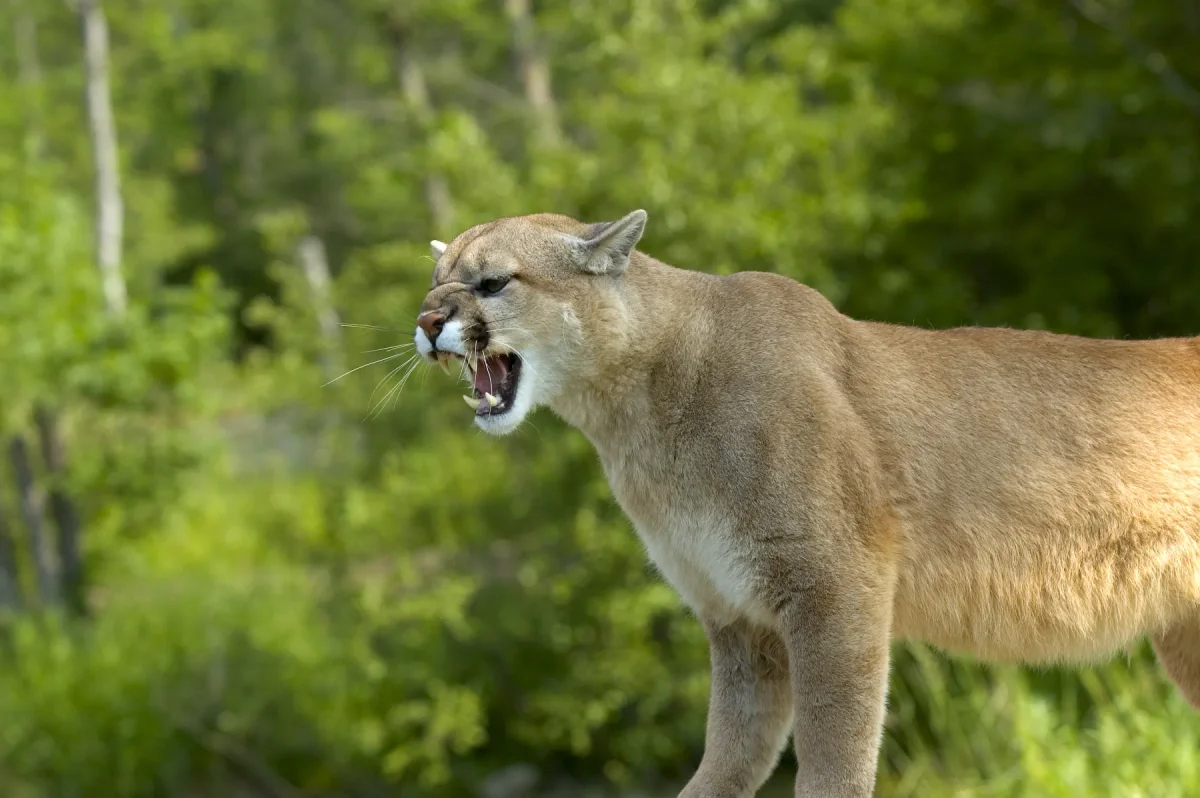
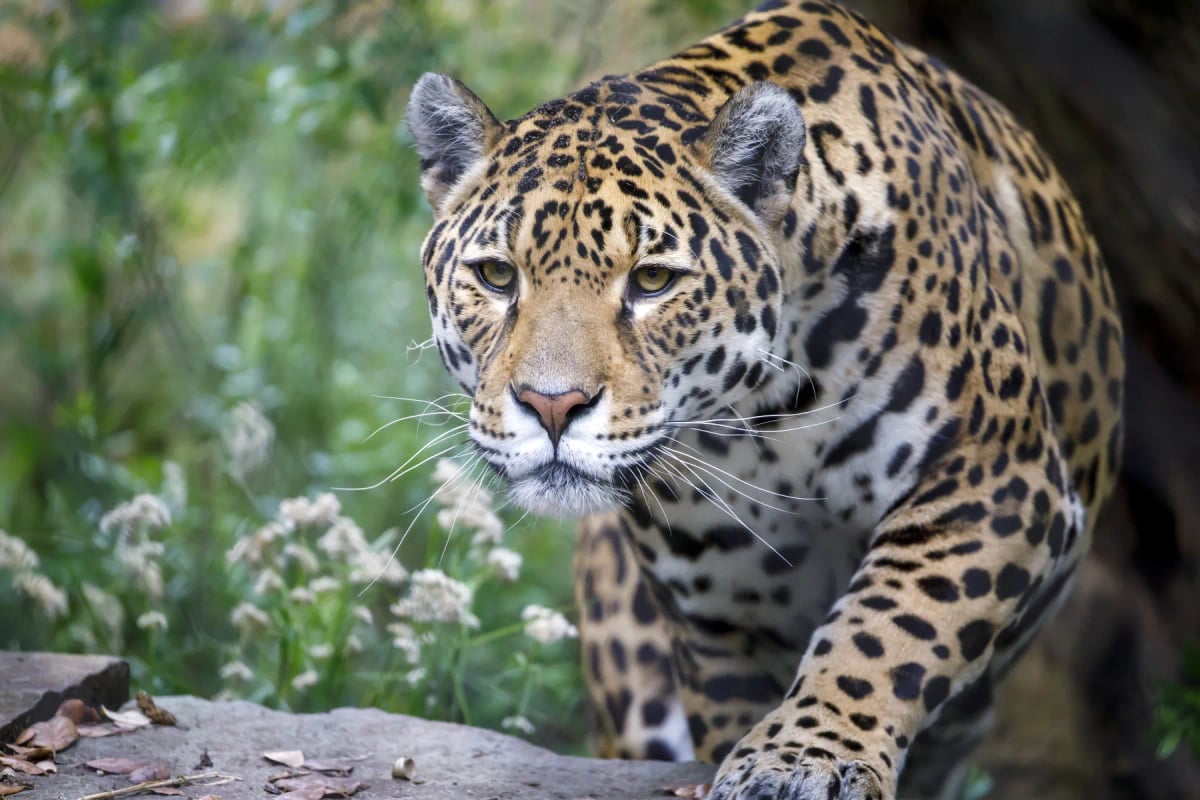
A cougar looks like an oversized house cat built for power. Adults stand roughly 60 to 90 centimeters at the shoulder and can reach about two and a half meters from the nose to the tip of the tail, with the tail alone accounting for close to a third of that length. Weight varies enormously with latitude: females often sit near 35 kilograms, while large males in Canada and in Patagonia can pass 100. Animals living close to the equator are noticeably smaller than those at the northern and southern extremes of the range. The coat is a uniform tawny to grayish brown with a pale belly, a dark tip on the tail and black markings around the muzzle and behind the ears. Cubs break the pattern completely: they are born with dark spots and a ringed tail that fade over their first year. Only the lion, the tiger and the jaguar are bigger cats.
Diet
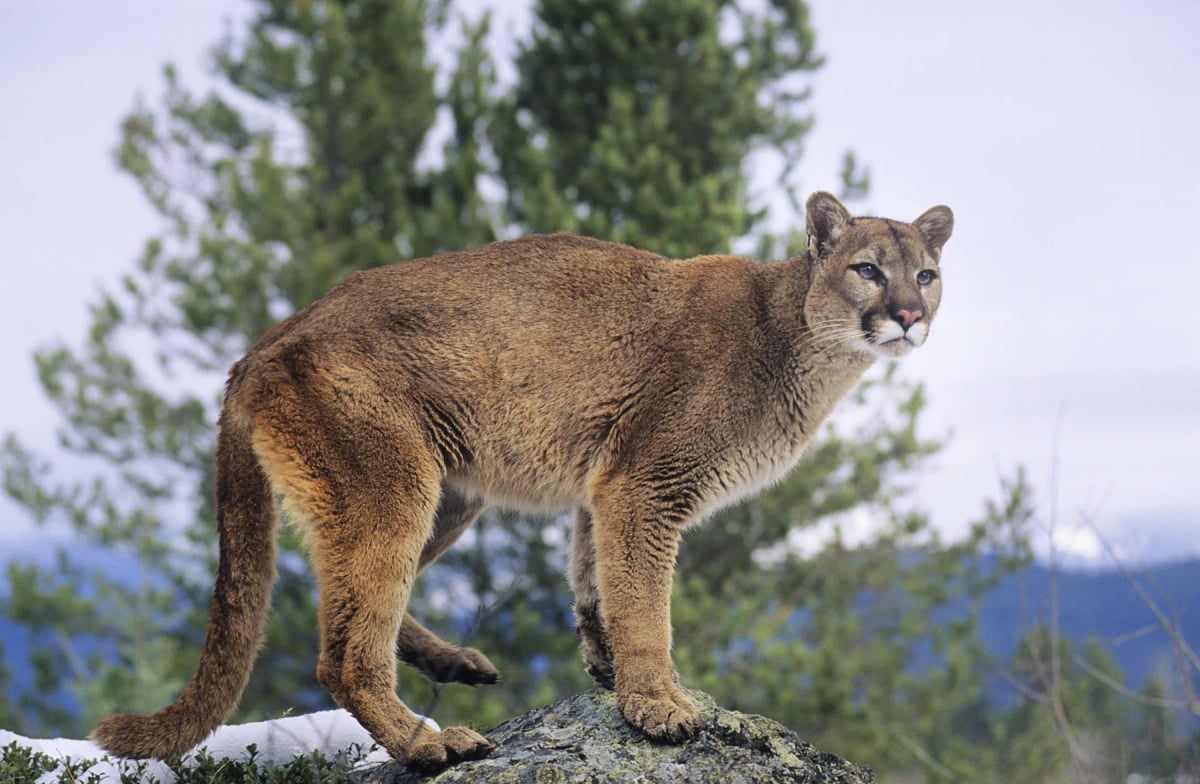
Deer are the backbone of the cougar's diet across most of its range, with white tailed deer and mule deer topping the menu in North America and several deer species filling that role further south. Yet cougars are remarkably flexible feeders. Depending on where they live, they also take guanacos, peccaries, capybaras, armadillos, hares and even porcupines, and the populations of Chilean and Argentine Patagonia will scavenge carcasses washed up on the coast. An adult needs the equivalent of one large kill a week. A single carcass can sustain it for several days, and the cat returns to feed again and again, covering the remains with leaves and branches between visits to hide them from condors and other scavengers. Cougars hunt by creeping as close to their quarry as possible before launching a short, explosive charge, usually aiming for the neck or the base of the skull for a swift kill.
Behavior and activity
Cougars are solitary animals for most of their lives, coming together only to mate or, in the case of females, to raise cubs. Each adult holds a home range that it marks with scrapes in the soil and scent deposits. Male ranges are large, sometimes exceeding 1,000 square kilometers, and they overlap with the smaller ranges of several females. Although cougars can be active at any hour, they tend to concentrate their hunting around dawn and dusk. They are remarkably secretive and will generally go out of their way to avoid contact with people, which is why most of what is known about their movements comes from radio collars and camera traps rather than from direct sightings. Cubs stay with their mother for roughly 18 months, learning to hunt before they strike out on their own, and young males are the ones that travel farthest in search of a territory of their own.
Human interaction and safety
Considering how widely cougars and people overlap in the Americas, actual encounters are surprisingly uncommon, and attacks are rarer still. Most documented attacks have involved young or injured animals, or individuals in areas where natural prey has become scarce. Children and people who are alone or crouching are at greater risk, as these situations can trigger a predatory response. Wildlife authorities consistently recommend the same set of precautions: never run, make yourself appear as large as possible, speak firmly, and back away without turning your back on the animal. If attacked, fight back. Keeping pets and livestock secured at night significantly reduces the chance of drawing a cougar close to a home, and so does avoiding solo runs or rides at dawn and dusk in mountain lion country, the two hours of the day when the cat is most likely to be hunting.
Conservation
The IUCN rates the cougar as Least Concern overall, a reflection of its broad distribution and its ability to thrive in a wide variety of habitats, although it also estimates fewer than 50,000 mature individuals worldwide and a declining trend. The picture varies greatly from place to place. The Florida panther, a subspecies confined to southern Florida, is down to an estimated 120 to 230 adults and subadults and remains one of the most endangered mammals in North America. Elsewhere, the main pressures are habitat loss, roads that fragment populations and cut off movement corridors, and retaliatory killing by livestock farmers. Legal hunting is permitted in several parts of the western United States. Maintaining connected wild landscapes is considered the most important factor for the survival of cougar populations over the long term, because a cougar that cannot travel cannot find a mate.
5 Curiosities
Five things worth knowing about the cougar: • It holds the Guinness World Record for the mammal with the most names, more than forty in English alone, among them cougar, puma, mountain lion, panther and catamount. • Despite being one of the largest cats in the Americas, it cannot roar. Instead it communicates through purrs, chirps, whistles and a piercing scream that can carry far through the night. • Those powerful back legs allow it to leap more than six meters forward in a single bound and spring nearly five meters straight up. • A cougar can bring down prey several times its own weight, including adult elk and horses. • In June 2011 a male killed by a car in Milford, Connecticut turned out, through DNA, to have walked more than 2,400 kilometers from the Black Hills of South Dakota, one of the longest journeys ever recorded for a land mammal.
Where it is found
The Cougar can be found in places such as:
Researched and written by Juan Pablo. Sources: IUCN Red List, scientific literature and regional field guides. Last updated: .
Technical factsheet



Frequently Asked Questions
What is a cougar?
The cougar (Puma concolor) is a large wild cat native to the Americas, also known as the mountain lion, the puma and, in Florida, the panther. It is the wild land mammal with the widest natural range on the continent, living from western Canada down to Patagonia. It is a solitary ambush hunter that feeds mainly on deer, hunts around dawn and dusk, and avoids people whenever it can.
Is a cougar the same as a mountain lion?
Yes. Cougar, mountain lion, puma, panther and catamount are all names for the same species, Puma concolor. There is no difference in the animal, only in the region where the name is used: mountain lion and cougar are the usual words in the western United States and Canada, panther is used in Florida, and puma is the standard name throughout Latin America and in scientific writing.
What does the word cougar mean?
As the name of an animal it means exactly this cat, and nothing else. The word reached English by a long route: Portuguese settlers in Brazil wrote down a Tupi name for the species, which has been read as false deer, and in the eighteenth century the French naturalist Buffon reshaped it into couguar, the form English borrowed. Puma, the other common name, comes from Quechua and passed into Spanish unchanged.
How big is a cougar?
Adults stand about 60 to 90 centimeters at the shoulder and reach some two and a half meters from nose to tail tip, with the tail making up close to a third of that. Females often weigh around 35 kilograms and large males can pass 100, with the heaviest animals living at the northern and southern ends of the range and the smallest near the equator. Only the lion, the tiger and the jaguar are bigger cats.
How long do cougars live?
In the wild a cougar normally lives 8 to 13 years, while animals in captivity can reach twenty or more. Very few die of old age. Most deaths come from collisions with vehicles, legal and illegal hunting, retaliatory killing after livestock losses, and fights between males over territory. Cubs are the most vulnerable of all, and a good share of them do not survive their first year.
What do cougars eat?
Deer are the foundation of the cougar's diet, particularly white tailed deer and mule deer in North America. They also hunt guanacos, peccaries, capybaras, hares and armadillos depending on where they live. Cougars are patient, stalking hunters that get as close as possible before launching a short, explosive charge. A large kill can keep one fed for several days, and they return to the carcass multiple times.
Where do cougars live?
Cougars have the widest range of any wild land mammal in the Americas, stretching from the forests of western Canada all the way to Patagonia at the southern tip of South America. They adapt to a remarkable variety of environments, including coniferous forests, tropical rainforests, grasslands and high mountain terrain. In the United States, they are now largely limited to the western states, with a small population surviving in southern Florida.
How high and far can a cougar jump?
Cougars are extraordinary jumpers thanks to their powerful back legs. They can leap more than six meters forward in a single bound and spring nearly five meters straight up from a standing position. This ability makes them highly effective ambush hunters, allowing them to close the gap on prey in an instant or navigate rocky and uneven terrain with ease.
Are cougars dangerous to humans?
Attacks on people are genuinely rare, especially considering how much their territory overlaps with human activity. Most incidents have involved young or weakened animals, or places where prey is scarce. If you encounter one, never run. Stand tall, speak in a firm voice, and back away slowly. If attacked, fight back aggressively. Keeping pets and livestock secured at night also reduces the risk of drawing one close to your home.
Is the cougar endangered?
Overall, the IUCN classifies the cougar as Least Concern, which reflects how adaptable and widespread it is, although it also estimates fewer than 50,000 mature individuals worldwide. The situation varies greatly by region. The Florida panther, found only in southern Florida, is down to an estimated 120 to 230 adults and subadults and is one of the most endangered mammals in North America. Elsewhere, the biggest threats are habitat loss, roads that cut populations off from one another, and killing by farmers protecting their livestock.
Can cougars roar like lions or tigers?
No, cougars cannot roar. Despite being one of the largest cats in the Americas, they lack the specialized voice box that allows lions and tigers to produce that iconic sound. Instead, they communicate through purrs, chirps, whistles and a loud, piercing scream that can travel a long distance through the night. That scream is often startling to people who hear it for the first time in the wild.