Mute Swan
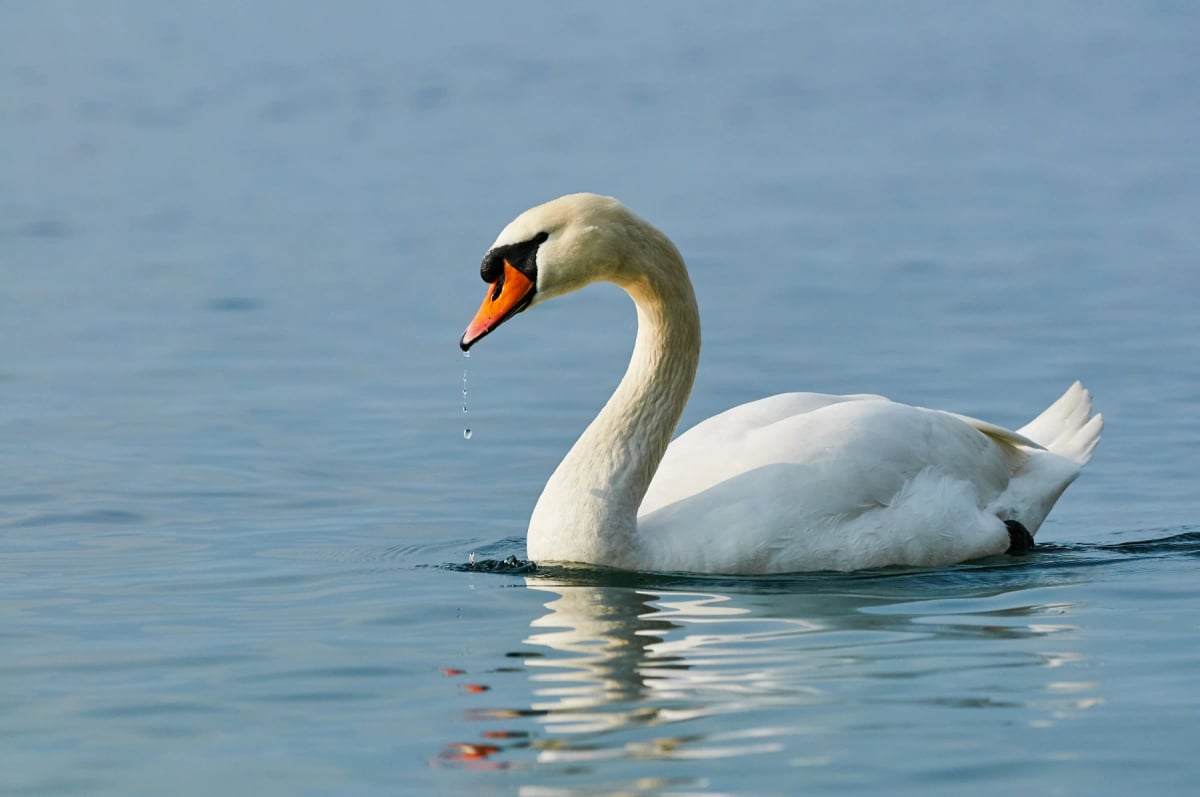
The mute swan is one of the heaviest flying birds in the world and one of the largest waterbirds in Europe, instantly recognizable by its entirely white plumage, long neck held in a graceful S curve, and orange bill with a black knob at the base. It breeds across a wide arc of Europe and Asia, from Ireland and Scandinavia to Mongolia and northeastern China, favoring lakes, slow rivers, coastal lagoons, and wetlands with plenty of underwater plants. Despite its name, it is not completely silent: it hisses, grunts, and snorts, especially when defending a nest, and its wings make a loud throbbing sound in flight. Pairs usually stay together for many years, and both parents guard the nest and the cygnets. The species was also taken to North America, Japan, Australia, and New Zealand, and in the United States its feral populations are managed as invasive. With roughly 500,000 to 600,000 birds, the IUCN lists it as Least Concern.
Mute swan size and appearance
The mute swan is one of the heaviest flying birds on Earth. Adults usually measure 140 to 160 centimeters from bill to tail, with extremes of 125 to 170, and the wingspan reaches 200 to 240 centimeters. Males, called cobs, are clearly larger than females, called pens: cobs weigh 9.2 to 14.3 kilograms, averaging around 11, while pens weigh 7.6 to 10.6 kilograms, averaging around 9. One Polish cob was reported at almost 23 kilograms, although birds that heavy may have trouble getting off the ground. Adults are pure white, and the head sometimes shows rusty stains from iron in the water. The orange bill has a black knob at its base, which is larger in males and swells during the breeding season, so it helps tell the sexes apart. Cygnets hatch covered in gray brown down and keep a grayish plumage for most of their first year. A white form known as the Polish swan is different: its cygnets are born white and have pale gray legs, and it is especially common in the Baltic region.
Habitat and range
The native range of the mute swan stretches across Europe and Asia, from Ireland, Britain, and Scandinavia east through Russia and Central Asia to Mongolia, northeastern China, and the Russian Far East. Russia alone may hold up to 350,000 birds, and the Volga Delta has the largest single concentration, with around 11,000 breeding pairs. Within that range the swans live on shallow lakes, slow rivers, canals, gravel pits, sheltered estuaries, and coastal lagoons, anywhere with calm, fertile water, muddy bottoms, and plenty of submerged plants. Northern and inland populations move south or to coasts that stay free of ice in winter, reaching the Mediterranean, the Caspian Sea, Iraq, and Korea, while birds in milder regions such as Britain or the Netherlands often stay put all year. Outside its native range the species was released as an ornamental bird. It now breeds wild in the eastern United States and the Great Lakes, in Hokkaido in Japan, on the Avon River in Western Australia, and in parts of New Zealand.
Diet
Food for mute swans comes almost entirely from water. They feed mainly on submerged aquatic plants, reaching down with their long necks to pull up vegetation from the riverbed or lakebed, a technique known as upending. Stoneworts, pondweeds, and other water plants make up the bulk of their diet, though they also graze on grasses and other low vegetation along the water's edge. Small invertebrates such as aquatic insects, worms, and mollusks are eaten occasionally, usually while foraging among plants rather than being actively hunted. Cygnets eat more invertebrates than adults in their first weeks of life, as the extra protein supports rapid growth. An adult mute swan can consume several kilograms of plant material in a single day.
Behavior
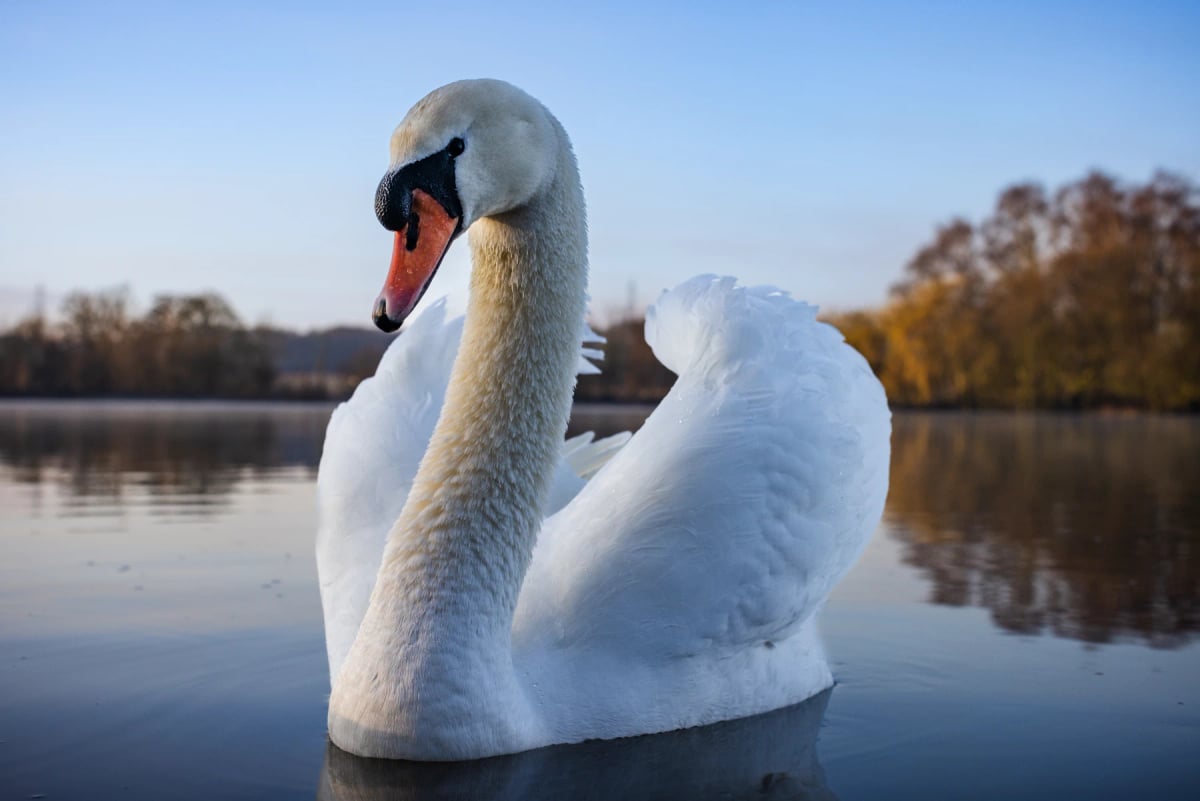
Despite the name, mute swans are far from silent. They hiss loudly, grunt, and snort, particularly when a rival or predator strays too close to the nest or the young. Outside the breeding season, they can be sociable birds, sometimes gathering in flocks of hundreds on sheltered bays and reservoirs. Pairs are strongly territorial during nesting and will charge at intruders with wings arched and neck pulled back, a posture called busking. In flight, the wingbeats produce a distinctive rhythmic sound that carries over long distances. Bonds between partners tend to last for many years. If one bird of a pair dies, the survivor will sometimes remain alone for a period before eventually pairing again.
Reproduction
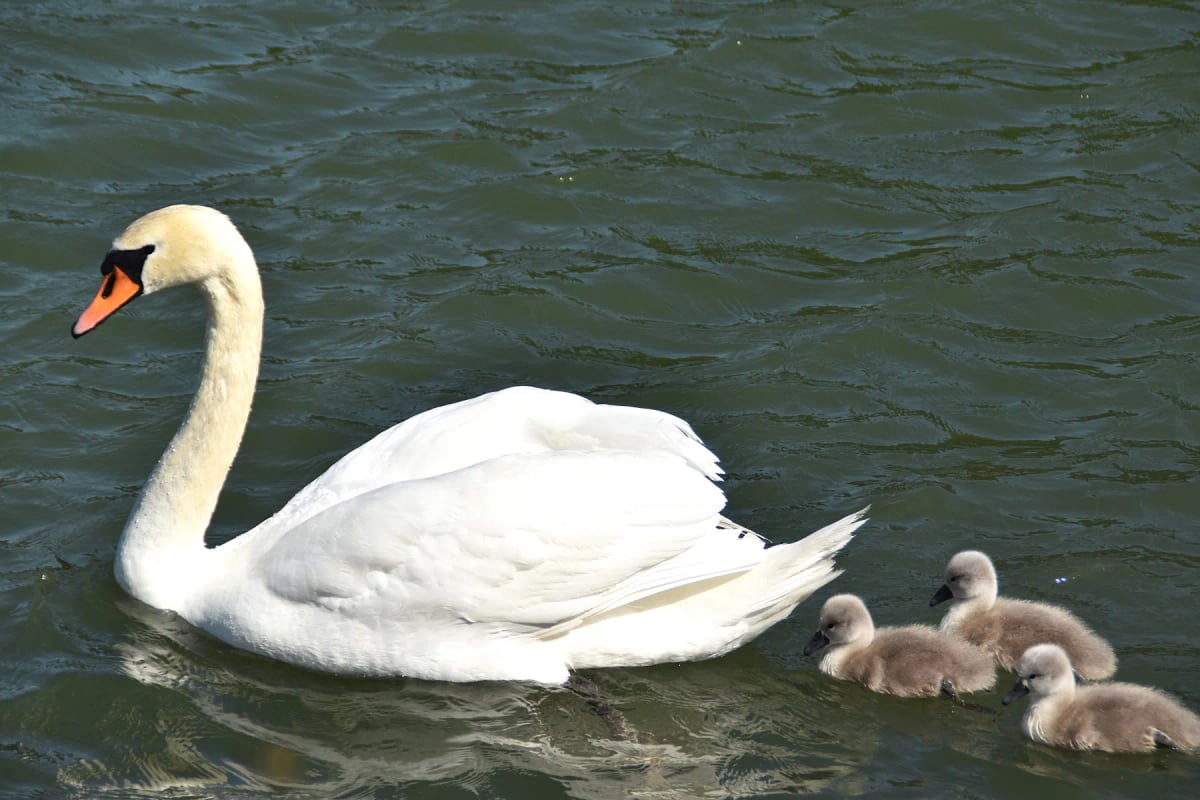
Nesting begins in spring, with pairs selecting a site close to the water's edge or sometimes right on the water among reeds. The nest is a large mound of plant material, built mainly by the female but with the male bringing much of the material. Clutches typically contain five to eight eggs, which the female incubates for around 35 to 38 days. The male stands guard nearby throughout incubation. Once the cygnets hatch, they are covered in gray down and can swim within a day or two. Both parents shepherd the young closely, and cygnets are sometimes seen riding on a parent's back for warmth and protection. The young become fully independent at around four to five months of age.
Why mute swans are invasive in North America
From the late 1800s, mute swans were brought from Europe to decorate parks, zoos, and private estates in the United States, and some escaped or were set free. With few natural enemies and plenty of food, the feral flocks grew fast, by at least 10% a year in some areas. In Maryland, five birds that escaped during a storm on the Miles River in 1962 became 3,955 swans by 1999. In Michigan, a single pair brought to Charlevoix County in 1919 grew into about 15,500 birds by 2010. The problem is what they eat and how they behave. An adult can pull up around 3.5 kilograms of underwater plants a day, and in the Chesapeake Bay the swans were eating about 10% of all the submerged vegetation, the same beds that shelter crabs and young fish. Territorial pairs also chase native ducks, geese, and trumpeter swans off nesting sites, and big summer flocks pushed terns and skimmers off their island colonies. For that reason several states control them: Maryland cut its population to fewer than 500 birds after 2005, and Michigan, down to about 8,000 in 2019, aims for fewer than 2,000 by 2030. The culls remain controversial with people who love the birds.
Conservation
Across its native range the mute swan is doing well. The world population is estimated at about 500,000 to 600,000 birds, the trend is stable or rising in much of Europe, and the IUCN lists the species as Least Concern. It was not always so. Hunting and the drainage of wetlands cut numbers in many countries before the twentieth century, and protection laws allowed the recovery, for example in Sweden and Denmark, where Hans Christian Andersen's Ugly Duckling helped make it the national bird in 1984. In Britain the main modern threat was lead: from around 1960 to the early 1980s, swans swallowing lost fishing weights and spent shot suffered deadly poisoning, and numbers fell sharply along rivers like the Thames. The ban on lead fishing weights in England and Wales in 1987 turned that around, and the British population reached about 22,000 birds in 2006. Collisions with power lines, oil spills, pollution, and outbreaks of bird flu still kill many swans, and wetland loss remains a concern in parts of Asia.
Where it is found
The Mute Swan can be found in places such as:
Researched and written by Juan Pablo. Sources: IUCN Red List, scientific literature and regional field guides. Last updated: .
Technical factsheet



Frequently Asked Questions
Does the King own all the swans in England?
Not quite. Since the Middle Ages the Crown has claimed ownership of unmarked mute swans on open water, but today that right is only exercised on certain stretches of the River Thames and its tributaries. The Crown shares those swans with two old London livery companies, the Vintners and the Dyers, which were granted rights in the fifteenth century. Every July, in a ceremony called Swan Upping, the King's Swan Marker and the companies' swan uppers row up the Thames in wooden skiffs to catch, weigh, and check the year's cygnets. Today it works as a count and a health check rather than a claim on a food supply.
How long do mute swans live?
Most mute swans live around 10 years, because many die young from collisions, predators, and harsh winters. Birds that survive their first years can live much longer, often into their twenties. The oldest known wild mute swan was ringed in February 1970 at Heikendorf, near Kiel in northern Germany, and was found dead in Denmark in 2009, at about 40 years of age, well above the previous record of 28 years. In captivity, with steady food and no predators, swans can also live for decades.
How can you tell a mute swan from other swans?
Look at the bill first. The mute swan is the only white swan with an orange bill and a black knob at its base. The whooper swan and Bewick's swan have black bills with a yellow patch, and the trumpeter swan of North America has an all black bill. Posture helps too: mute swans often swim with the neck curved in an S and the wings raised over the back like sails, while the other swans usually hold the neck straight. And while the others call loudly, the mute swan is mostly quiet, apart from hissing and the throbbing sound of its wings in flight.
Can mute swans fly?
Yes, and very well for such a heavy bird. To take off, a mute swan runs across the water, beating its wings and slapping the surface with its feet until it reaches about 48 kilometers per hour. Once in the air it can fly at up to about 88 kilometers per hour with its long neck stretched out. Its wings make a loud, rhythmic throbbing noise that can be heard more than a kilometer away, which may help flock members keep in touch, since the species rarely calls in flight. Young birds first fly at about four to five months old.
Is the mute swan the national bird of Denmark?
Yes. Denmark chose the mute swan as its national bird in 1984, replacing the skylark. The choice owes a lot to Hans Christian Andersen, whose fairy tale The Ugly Duckling, published in 1843, tells of a gray, clumsy cygnet mocked by the other farmyard birds until it grows into a beautiful white swan. Many readers see it as a portrait of Andersen himself. Mute swans are common across Denmark, on shallow fjords, lakes, and city harbors, and the national bird fits a country where wetlands and coasts are never far away.
Are mute swans actually mute?
Not at all. Mute swans hiss, grunt, and snort quite loudly, especially when protecting their nest or young. The name comes from the fact that they are quieter than other swan species, such as the whooper swan, which calls frequently. In flight, their wingbeats produce a rhythmic, carrying sound that you can hear from a good distance away.
What do mute swans eat?
Mute swans feed mostly on aquatic plants such as pondweeds and stoneworts, which they pull up by plunging their long necks underwater. They also graze on grasses at the water's edge and occasionally eat small invertebrates like insects and mollusks. An adult can get through several kilograms of plant material in a single day. Young cygnets eat more insects early on, as the protein helps them grow quickly.
Where do mute swans live?
Mute swans are native to Europe and Asia, breeding from the British Isles and Scandinavia all the way east to China and Mongolia. They prefer calm, shallow water bodies such as lakes, slow rivers, and coastal lagoons with plenty of aquatic vegetation. They have also been introduced to parts of North America, Japan, Australia, and New Zealand, where feral populations now breed in the wild.
Do mute swans mate for life?
Mute swans form bonds that often last for many years, and in many cases for life. Both partners share the duties of nesting and raising the cygnets together. If one bird of a pair dies, the survivor may spend some time alone before eventually finding a new mate. These lasting partnerships are one of the reasons swans have become such a widespread symbol of loyalty and love.
Are mute swans dangerous to humans?
Mute swans are generally not a threat to people, but they can be aggressive during the nesting season. A swan defending its nest will arch its wings, pull back its neck, and charge at anyone who comes too close. They are powerful birds and a strike from a wing can cause a bruise or knock a person off balance. Giving nesting swans plenty of space is the best way to avoid any trouble.
Why were mute swans poisoned by fishing weights?
From around 1960 to the early 1980s, mute swan numbers in Britain dropped sharply, especially on busy rivers like the Thames, because the birds were swallowing lost lead fishing weights along with the grit they eat to help grind their food. Lead is highly toxic, and even small amounts cause paralysis and death. After lead fishing weights were banned in England and Wales in 1987, poisoning fell and populations recovered well. It remains one of the clearest examples of how a simple change in regulation can bring a species back from serious decline.