Gyrfalcon
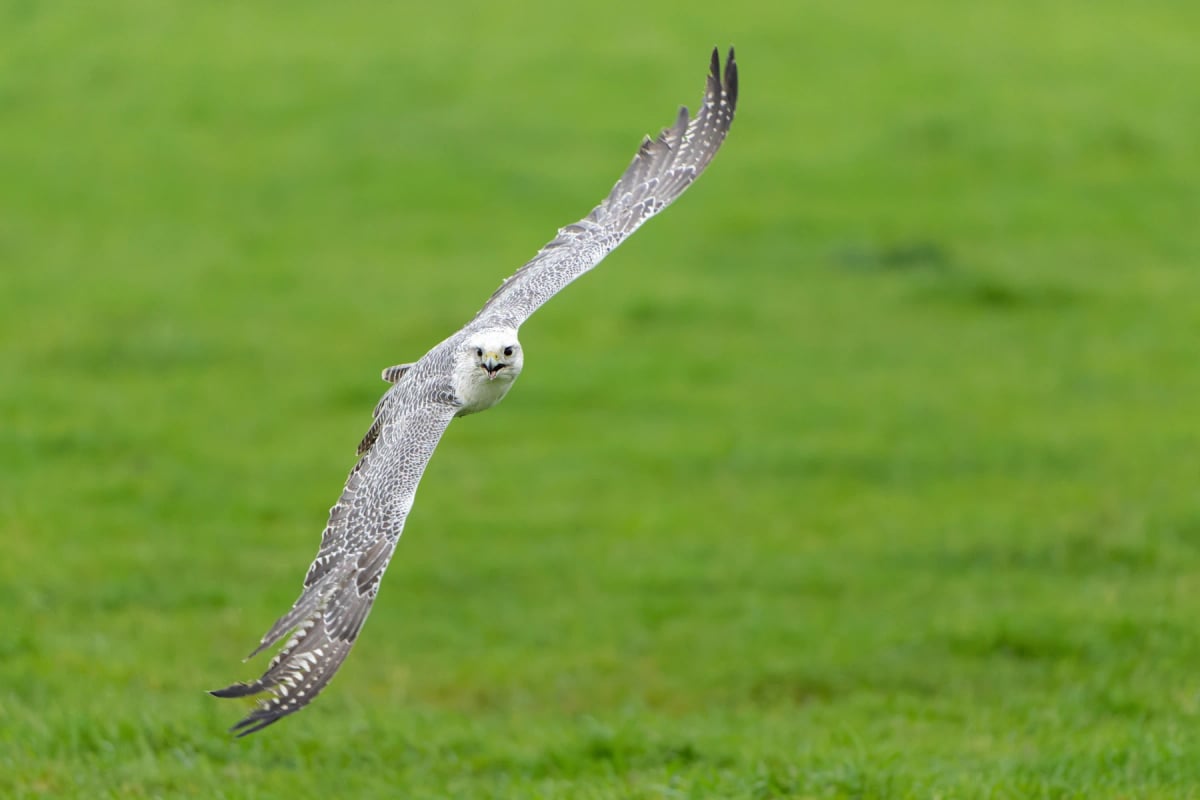
The gyrfalcon is the largest falcon on Earth, a bird of the Arctic and sub-Arctic tundra of North America, Greenland, Iceland, northern Europe and Russia. It is a powerful, broad-winged hunter that lives mainly on ptarmigan, though it also takes ducks, seabirds, Arctic hares and the occasional lemming or ground squirrel. Its plumage ranges from almost pure white in the high Arctic through silver grey to very dark brown, and white gyrfalcons were the most prized birds in medieval falconry. Females are much larger than males, a pattern common in birds of prey. Gyrfalcons nest on bare cliff ledges or in old raven nests, often returning to the same site for years. Outside the breeding season young birds wander south, reaching the northern United States, northeastern China and Hokkaido. It is the national bird of Iceland.
Habitat and distribution
Few birds call the high Arctic home all year, but the gyrfalcon thrives there. It breeds across a circumpolar belt that takes in Alaska, northern Canada, Greenland, Iceland, northern Norway, Sweden and Finland, and the Arctic north of Russia from the Kola Peninsula to Chukotka. Greenland, Iceland and Norway hold some of the densest populations. Within this range gyrfalcons favor open tundra, coastal cliffs, mountain slopes and rocky river gorges, where sheer ledges offer safe nest sites and wide views for hunting. Most adults stay near their territories through the winter, but young birds wander south: they reach the northern prairies and coasts of Canada and the United States, northeastern China along the Amur River, and Hokkaido in Japan, in numbers that change from year to year with the supply of prey. Large falcons in the mountains of Central Asia were once called Altai gyrfalcons, but today they are considered a form of the saker falcon.
Size and colors: the white gyrfalcon and other morphs
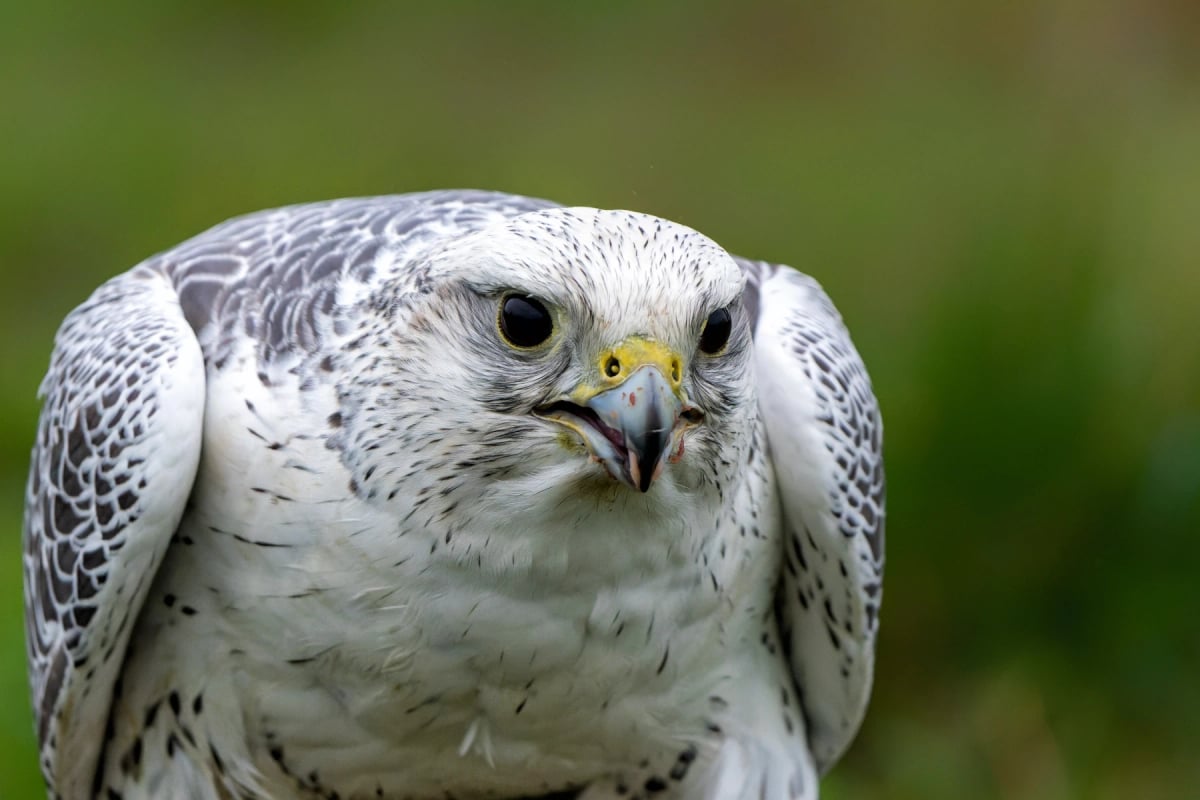
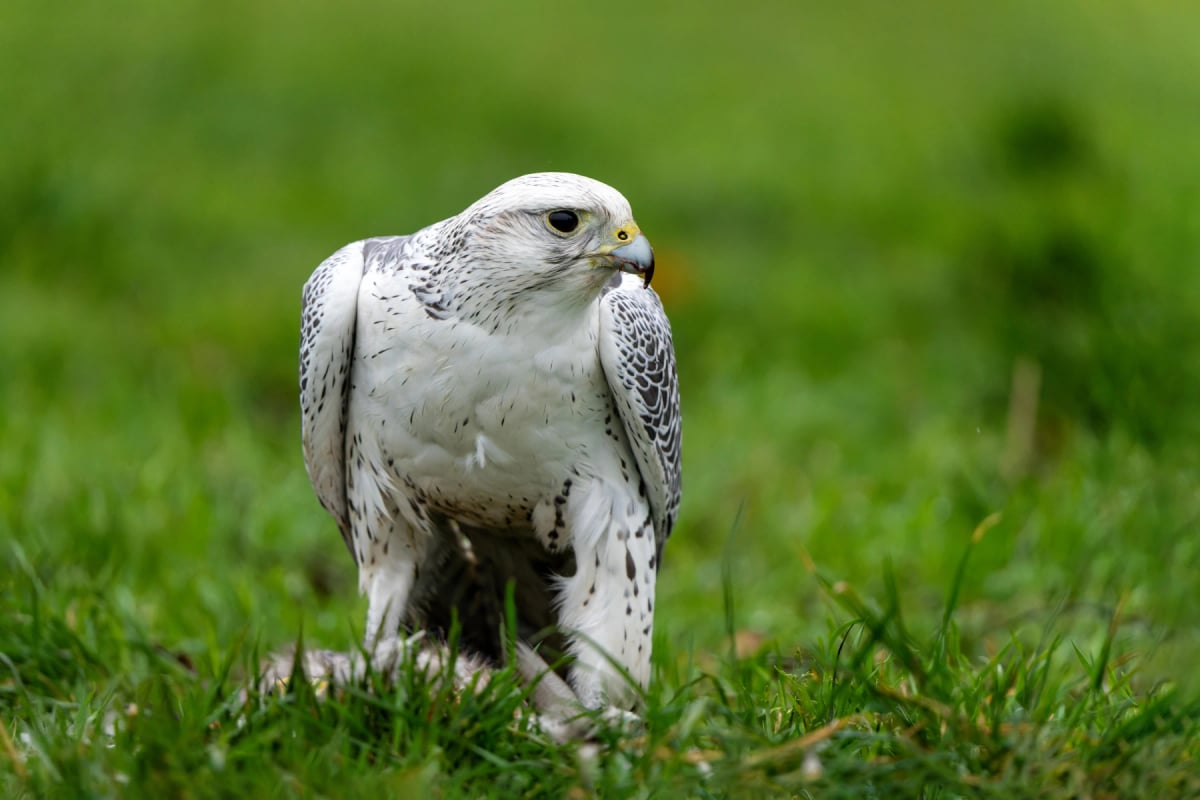
No other falcon shows the range of color that the gyrfalcon does. Birds are usually grouped into three morphs: white, silver grey and dark. White gyrfalcons, almost pure white with a few dark flecks on the back and wings, are most common in Greenland and the high Arctic islands of Canada, where they blend into snow and ice. Grey birds are the most widespread overall, and the darkest, nearly chocolate brown birds are typical of Labrador and parts of northern Quebec. Every shade in between exists, and siblings in the same nest can differ noticeably. The gyrfalcon is also the largest falcon in the world. It measures 48 to 65 centimeters long with a wingspan of about 110 to 160 centimeters. Males weigh roughly 0.8 to 1.3 kilograms and females 1.1 to 2.1 kilograms, a gap so large that in falconry the smaller male has its own name, the gyrkin. Compared with a peregrine, a gyrfalcon has broader wings, a longer tail and a heavier body, a silhouette that can look almost hawk like in flight.
Diet
Ptarmigan form the backbone of the gyrfalcon's diet throughout the year. In areas where ptarmigan are plentiful, a single family of gyrfalcons can depend on them almost exclusively during the breeding season. When ptarmigan numbers drop, as they do cyclically, the birds shift their attention to ducks, geese, shorebirds, and seabirds. Small mammals such as lemmings and Arctic ground squirrels are taken on occasion as well. Unlike the peregrine falcon, which relies heavily on steep power dives, the gyrfalcon often pursues prey in low, fast flight close to the ground, using terrain and surprise to its advantage. Its large body size gives it the strength to overpower birds considerably bigger than those most other falcons would attempt.
Behavior
Gyrfalcons are strongly attached to their nesting sites, and pairs return to the same cliff ledge year after year, sometimes for decades. They do not build their own nests but instead use bare rock ledges or take over old stick nests left by ravens or rough-legged hawks. Outside the breeding season, males and females tend to live apart, each defending their own territory. Juveniles are more likely to wander widely before settling into territories of their own. The species is not migratory in the strict sense, though some individuals move south in winters when prey becomes scarce. Gyrfalcons are bold hunters and will harass much larger birds, including golden eagles, to drive them away from a hunting area or a nest site.
The gyrfalcon in falconry
For more than a thousand years the gyrfalcon sat at the top of falconry. A fifteenth century English list that matched hawks to social rank gave the gyrfalcon to kings, and white birds from Greenland and Iceland were the most valuable of all. Medieval Norse traders carried them south, and for centuries the Danish crown controlled the export of Icelandic falcons, sending them as diplomatic gifts to royal courts across Europe. The birds were valuable enough to serve as ransom. According to chroniclers, after the Battle of Nicopolis in 1396 the Duke of Burgundy included white gyrfalcons among the gifts sent to Sultan Bayezid I to free his son. Today most gyrfalcons used in falconry are bred in captivity, often as hybrids with peregrine or saker falcons, above all for the falconry tradition of the Arabian Peninsula. International trade is regulated under CITES, but wild birds and eggs are still taken illegally in parts of the Arctic, and escaped hybrids can mix with wild falcons, so demand for these birds remains a conservation problem.
National bird of Iceland
The gyrfalcon is Iceland's national bird, and its place in Icelandic history goes back to the Middle Ages, when falcons caught on the island's cliffs were among its most valuable exports. Their worth was recognized in early Icelandic law, and for centuries the birds were shipped to Copenhagen and from there to royal courts across Europe. In 1903 a decree of the Danish king, who then ruled Iceland, made a white Icelandic gyrfalcon on a blue field the country's coat of arms. The falcon was replaced in 1919, when the current arms with the four guardian spirits of the land were adopted, but in 1921 it became the emblem of the Order of the Falcon, still Iceland's only order of chivalry and its highest honor. Up to about 400 pairs breed in Iceland today. Most feed on rock ptarmigan, whose numbers rise and fall in cycles of about ten years, and gyrfalcon breeding success follows those swings closely.
Conservation
The IUCN lists the gyrfalcon as Least Concern, with an estimated 20,000 to 49,999 mature individuals worldwide. North American populations appear stable, but numbers have declined in parts of Arctic Europe, and at the national level the picture is very different: Finland, with only 22 to 29 pairs, lists the species as critically endangered, and Sweden lists it as endangered. Climate change is the main long term worry. The Arctic is warming faster than almost anywhere else on Earth, which alters the boom and bust cycles of ptarmigan, the gyrfalcon's key prey, and cold, wet springs can ruin breeding at exposed cliff nests. Warmer conditions may also let the peregrine falcon move farther north into gyrfalcon territory. Illegal capture of wild birds and eggs for the falconry trade remains a concern in parts of its range, and disturbance at nest sites from tourism, mining and other activity can cause pairs to abandon their eggs. Conservation efforts focus on monitoring populations, protecting key nesting cliffs, keeping nest locations secret and controlling illegal trade.
Where it is found
The Gyrfalcon can be found in places such as:
Researched and written by Juan Pablo. Sources: IUCN Red List, scientific literature and regional field guides. Last updated: .
Technical factsheet

Frequently Asked Questions
Are white gyrfalcons rare?
White gyrfalcons are the least common of the three color morphs worldwide, but in some places they are the norm. They are most frequent in northern Greenland and the high Arctic islands of Canada, where white plumage blends into snow and ice. Farther south, in Iceland, Scandinavia and Alaska, most gyrfalcons are grey, and dark birds dominate in Labrador. The rarity of white birds is one reason medieval kings valued them so highly.
Is the gyrfalcon the national bird of Iceland?
Yes. The gyrfalcon is Iceland's national bird. A white gyrfalcon on a blue field was the country's coat of arms from 1903 to 1919, and since 1921 the bird has been the emblem of the Order of the Falcon, Iceland's only order of chivalry. The link goes back to the Middle Ages, when Icelandic falcons were among the island's most valuable exports and were sent as gifts to royal courts across Europe.
What is the difference between a gyrfalcon and a peregrine falcon?
The gyrfalcon is bigger and heavier: a female can weigh twice as much as a female peregrine. It has broader wings, a longer tail and lacks the peregrine's bold dark helmet on the head. The two also hunt differently. The peregrine is famous for steep, extremely fast dives from high above, while the gyrfalcon usually chases prey in low, powerful flight close to the ground. The gyrfalcon lives in the Arctic, while the peregrine is found on every continent except Antarctica.
How long do gyrfalcons live?
Most wild gyrfalcons that survive their first year live around 12 to 16 years. The oldest known wild bird was a male identified by its leg band in Wisconsin in 2016, at least 15 years and 9 months old, after being banded in the same state in 2003. The first year is the hardest: many young birds die while learning to hunt or during their first Arctic winter. In captivity, gyrfalcons can live past 20 years.
How many gyrfalcons are left in the world?
The IUCN estimates that there are about 20,000 to 49,999 mature gyrfalcons in the world. Europe holds roughly 1,300 to 2,300 breeding pairs, mostly in Iceland and Norway, while the largest numbers live in Greenland, Canada, Alaska and Arctic Russia. Because much of its range is remote, these figures are rough estimates. The species is listed as Least Concern globally, although it is endangered at the national level in Finland and Sweden.
What does a gyrfalcon eat?
Ptarmigan are the gyrfalcon's main food source, and a breeding pair can survive almost entirely on them when numbers are high. When ptarmigan populations dip, gyrfalcons switch to ducks, geese, shorebirds, and occasionally lemmings or ground squirrels. They often chase prey in low, fast flight close to the ground rather than diving from great heights, using rocks and ridges to stay hidden until the last moment.
Where do gyrfalcons live?
Gyrfalcons are birds of the Arctic and sub-Arctic. They breed across Alaska, northern Canada, Greenland, Iceland, northern Scandinavia and Arctic Russia, favoring open tundra, coastal cliffs and rocky gorges. Most adults stay on their territories all year, but young birds wander south in winter, into the northern prairies and coasts of Canada and the United States, northeastern China and Hokkaido in Japan. How far they go depends on the supply of prey each year.
How fast can a gyrfalcon fly?
Gyrfalcons are among the fastest birds in level flight, capable of reaching speeds of around 130 km/h (80 mph) when chasing prey. Unlike the peregrine falcon, which is famous for its steep dive, the gyrfalcon relies on raw speed and endurance in horizontal pursuit. Its large, broad wings give it the power to sustain that speed over long distances across open Arctic terrain.
Is the gyrfalcon endangered?
No. The gyrfalcon is listed as Least Concern by the IUCN, with an estimated 20,000 to 49,999 mature individuals. North American populations appear stable, but numbers have fallen in parts of Arctic Europe, and Finland and Sweden list it as endangered at the national level. Scientists watch climate change closely, since it disrupts ptarmigan cycles and brings cold, wet springs that ruin nests. Illegal capture for falconry and disturbance at nest sites are also ongoing concerns.
Why is the gyrfalcon so prized in falconry?
For centuries the gyrfalcon sat at the top of the falconry world. Its size, power and endurance let it take large prey that smaller falcons cannot handle, and a fifteenth century English list that matched hawks to social rank reserved it for kings. White birds from Greenland and Iceland were the most valuable of all. Today it is still among the most sought after falconry birds, which unfortunately also makes wild gyrfalcons a target for illegal capture and trade.