Lesser Kiskadee
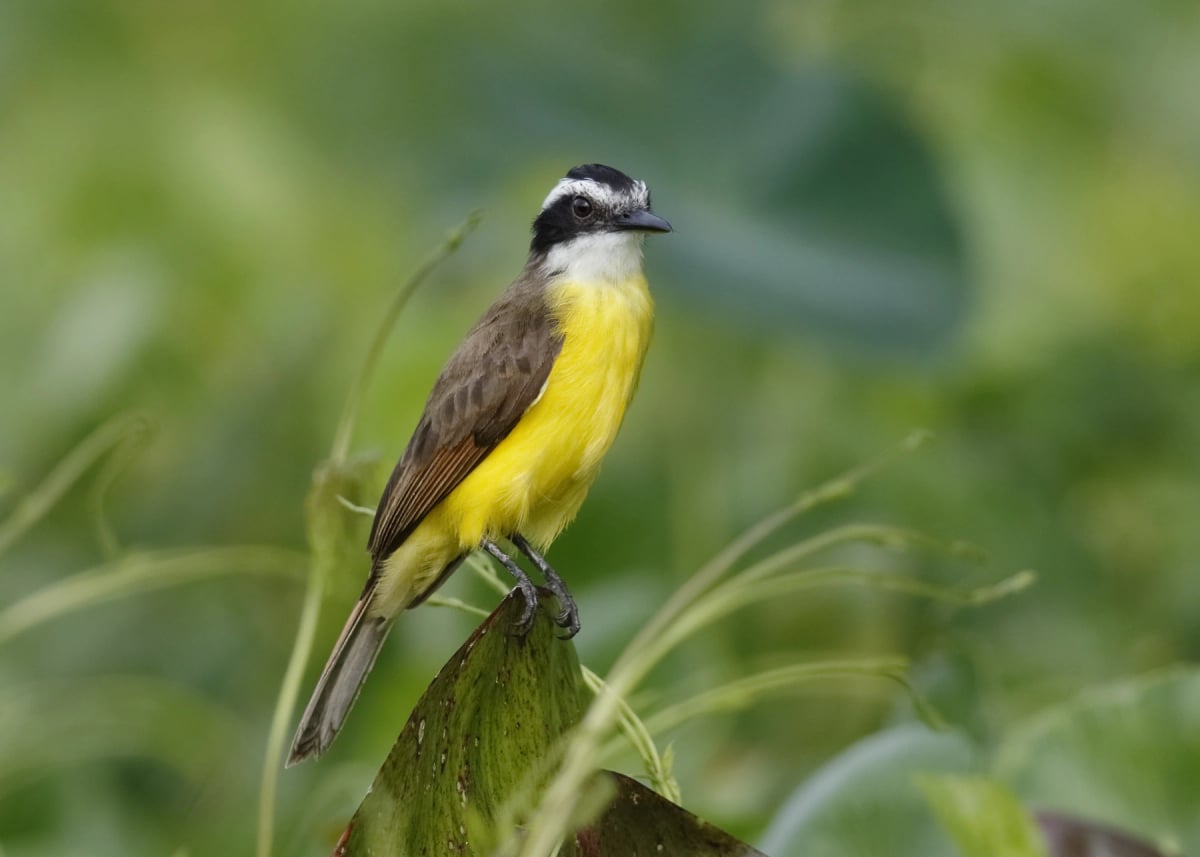
The lesser kiskadee is a small tyrant flycatcher that lives along rivers, lakes, and swamps from eastern Panama south through Venezuela, the Guianas, and the Amazon basin to northern Bolivia, with a separate population on the Atlantic coast of Brazil and a few birds at the southern edge of its range in Argentina. It is closely tied to water and almost never strays far from the shoreline. From a low perch, usually no more than three meters up, it watches for insects and sallies out to snatch them from leaves or from the surface of still water. Its bright yellow belly, olive back, and boldly patterned black and white head make it easy to spot, though it is noticeably smaller and slimmer than the great kiskadee and has a long, thin bill. Pairs hold territories along waterways and greet each other with buzzy, nasal calls. The IUCN lists it as Least Concern, with more than five million adults, although the population is thought to be slowly declining.
Habitat and distribution
The lesser kiskadee has a strong and consistent relationship with water. Its range starts in eastern Panama, east of the Canal, and runs along the Caribbean coast of Colombia into Venezuela, where it is found across much of the lowlands. From there it spreads through the Guianas, eastern Ecuador, eastern Peru, and the Amazon basin of Brazil, reaching south into northern Bolivia as far as Cochabamba and Santa Cruz. The IUCN also lists it as resident in Argentina, where it is scarce and sits at the southern edge of its range. A second, separate population lives along the Atlantic side of Brazil, from Pernambuco to the state of Rio de Janeiro. Wherever it appears, it stays below about 500 meters and keeps close to the water's edge, in shrubby growth along slow rivers and oxbow lakes, around swamps, and in grasslands that flood for part of the year. It shows a clear preference for spots where low branches reach out above the surface, giving it a ready perch from which to hunt, and it rarely wanders away from the shoreline.
Lesser kiskadee, great kiskadee and its many names
The word kiskadee comes from the great kiskadee, whose loud three note call sounds like kis ka dee, and the lesser kiskadee got its name simply for being the smaller of the two look alike birds. For a long time both were placed in the same genus, Pitangus, and the lesser kiskadee was known as Pitangus lictor. As early as 1957, researchers argued that it was different enough to deserve a genus of its own, and in 1984 the ornithologist Wesley Lanyon created Philohydor for it, a name built from Greek words meaning water lover. The major bird lists adopted the change between 2016 and 2023, and the South American Classification Committee approved it in early 2023, so older field guides may still show the old name. In Spanish it goes by several names depending on the country: bienteveo chico in many guides, bienteveo menor in Peru, bichofué chico in Colombia, pecho amarillo orillero in Venezuela, and benteveo pico fino in Argentina. Two subspecies are recognized: panamensis, the smaller one, from eastern Panama to northwestern Venezuela, and lictor across the rest of the range.
Size and appearance
At first glance, the lesser kiskadee can be mistaken for its larger relative, the great kiskadee, but a closer look reveals clear differences. It measures 15 to 18 centimeters and weighs about 25 grams, so it is smaller and slimmer, and females are a little smaller than males even though both sexes look the same. The belly and chest are a bright, clean yellow, while the chin and throat are white. The back is olive, the dark wings show cinnamon edges on the flight feathers, and the tail is grayish brown with rusty outer edges. The head carries a bold pattern: a black crown and face contrast sharply with a white stripe that runs from the forehead almost all the way around the back of the head. A yellow patch sits hidden in the middle of the crown and is rarely seen in the field. The bill is long, slender, and blackish, finer than that of the great kiskadee. Young birds are paler, with less yellow on the crown.
Diet
The lesser kiskadee feeds on insects, and it hunts them with remarkable precision. It usually works in pairs, taking up a low perch no more than about three meters above the ground or the water, and watches with patience for any movement nearby. When prey is spotted, it makes a short, quick flight and snatches the insect from the leaves of the vegetation or from the surface of standing water, then returns to a perch to eat it. This is a more water focused version of the sally hunting seen in many flycatchers, and it explains why the bird is so tied to places where plants lean out over calm water. Older texts sometimes say it catches small fish, but that is a habit of the great kiskadee, which has a heavier bill and a much wider diet. The lesser kiskadee rarely forages on open ground or high in the canopy, keeping almost all of its feeding activity low and close to the shoreline.
Behavior
Pairs of lesser kiskadees hold territories along stretches of waterway and are quick to announce their presence. The usual call is a vigorous, buzzy, rather nasal dzay or dzweey, which can run into a longer phrase like dzay dzwey dzee zwee. When the two members of a pair meet, they greet each other with a chattering ca dede, and they call together when a rival or predator comes too close, which makes the species hard to miss even when the vegetation is thick. All of this sounds quite different from the loud, three note kis ka dee of the great kiskadee. Outside of these exchanges, the bird moves with purpose, shifting between low perches over the water in short, direct flights. It tends to stay at low height rather than climbing into the canopy, and it spends much of the day in the company of its mate. The species is not migratory and stays within its territory throughout the year.
Nest and breeding
The nest of the lesser kiskadee is one of the easiest ways to tell it apart from the great kiskadee. Instead of the big, bulky ball of grass that its larger relative builds, it makes a simple open cup of small twigs and coarse grass, lined with finer grass, leaves, and rootlets. The cup is placed between about 1.2 and 2.4 meters up, on a dead stump or a low bush, and almost always near or right over the water, which gives the chicks some protection from predators that move on the ground. The female lays two or three eggs and does almost all of the incubation and the brooding of the young nestlings, while both parents bring food once the chicks hatch. The breeding season changes from one country to another, following the local rains and water levels: it runs roughly from March to April in Panama, June to July in Colombia, June to October in Venezuela, and October to January in Peru.
Conservation
The IUCN currently lists the lesser kiskadee as Least Concern. Its population is estimated at more than five million mature individuals, although the trend is believed to be slowly downward. The species benefits from its wide distribution across eleven countries, from Panama to Argentina, and from the fact that much of its habitat, especially in the Amazon and the Guianas, is still in pristine or near pristine condition. It also occurs in many national parks and other protected areas. That said, it is not immune to pressure. Clearing of vegetation along river banks removes the low branches it depends on for hunting and nesting, and the draining of swamps and flooded grasslands takes away the places where it lives. Pollution of freshwater systems can reduce the insects it feeds on. Where riparian corridors are protected and water quality is maintained, the bird continues to do well, and its long term prospects are tied to how tropical freshwater ecosystems are managed across South America and eastern Panama.
Where it is found
The Lesser Kiskadee can be found in places such as:
Researched and written by Juan Pablo. Sources: IUCN Red List, scientific literature and regional field guides. Last updated: .
Technical factsheet

















Frequently Asked Questions
How big is the lesser kiskadee?
The lesser kiskadee measures 15 to 18 centimeters from bill to tail and weighs about 25 grams, roughly the weight of five sugar cubes. Females are a little smaller than males, although both look the same. It is easy to judge its size next to its common neighbor, the great kiskadee, which is around 22 centimeters long and more than twice as heavy. The lesser kiskadee also looks slimmer, with a longer and much thinner bill.
What does the lesser kiskadee sound like?
Its most common call is a vigorous, buzzy, rather nasal dzay or dzweey, often stretched into a longer phrase like dzay dzwey dzee zwee. Members of a pair greet each other with a chattering ca dede and call together when an intruder shows up. None of this sounds like the loud kis ka dee of the great kiskadee, so the voice is one of the best ways to tell the two apart when they share the same riverbank.
Does the lesser kiskadee eat fish?
No. The lesser kiskadee feeds on insects, which it snatches from leaves or from the surface of still water after a short flight from a low perch. The idea that it catches fish comes from its larger relative, the great kiskadee, which does take small fish and tadpoles along with lizards, fruit, and many other foods. The lesser kiskadee has a thin, delicate bill and a much narrower diet, built almost entirely around the insects that gather near the water.
How many lesser kiskadees are there?
The IUCN estimates the population at more than five million mature individuals, spread across eleven countries from Panama to Argentina. That large number is why the species is listed as Least Concern. Even so, the trend is thought to be slowly going down, mainly because vegetation along rivers is being cleared and wetlands are being drained. Much of its habitat in the Amazon and the Guianas is still in very good condition, and it lives in many protected areas.
Where can you see a lesser kiskadee?
The best places are slow rivers, oxbow lakes, and swamps in the lowlands, below about 500 meters. Boat trips along Amazonian rivers in Brazil, Peru, Ecuador, and Bolivia are a classic way to find it, since the bird perches on low branches right at the water's edge. It is also found in the Guianas, across much of Venezuela, along the Caribbean coast of Colombia, in eastern Panama, and on the Atlantic side of Brazil. Listen for its buzzy call and look low, not up in the trees.
What does the lesser kiskadee eat?
The lesser kiskadee eats insects. It hunts from a low perch, usually no more than three meters above the ground or the water, and makes short flights to snatch its prey from leaves or from the surface of still water before returning to a branch. It often hunts in pairs. Almost all of its feeding happens right beside open water, and it rarely forages on bare ground or high in the trees, which is why it is so closely tied to shorelines.
Where does the lesser kiskadee live?
This bird is found from eastern Panama along the Caribbean coast of Colombia into Venezuela, then through the Guianas, eastern Ecuador, eastern Peru, and the Amazon basin of Brazil to northern Bolivia, and it is scarce in Argentina, at the southern edge of its range. A separate population lives on the Atlantic side of Brazil, from Pernambuco to Rio de Janeiro. It sticks to shrubby riverbanks, oxbow lakes, swamps, and flooded grasslands below about 500 meters and almost never moves far from water, using low branches over the surface as hunting perches.
What is the difference between the lesser kiskadee and the great kiskadee?
The lesser kiskadee is noticeably smaller and slimmer, with a finer bill suited to hunting at the water's surface. Both species share the yellow belly and the black and white head pattern, which makes them easy to confuse at a distance. The great kiskadee is larger, has a heavier bill, and uses a wider range of habitats. The lesser kiskadee also has a sharper, simpler call compared to the loud three-syllable shout of its relative.
Is the lesser kiskadee endangered?
No, the lesser kiskadee is listed as Least Concern by the IUCN, with a population of more than five million mature individuals. It benefits from a wide range across eleven countries of South America and eastern Panama, and much of its habitat is still in good condition. The population is thought to be slowly declining, though, because trees and shrubs along river banks are being cleared and wetlands drained. Where riparian vegetation is protected, the species continues to do well.
Why is the lesser kiskadee always found near water?
Water is central to almost everything this bird does. It hunts the insects that gather over calm water and along the plants at its edge, watching from branches that lean out over the surface. It also builds its nest on stumps and low bushes near or right over the water, which helps keep the eggs and chicks away from predators on the ground. Without a nearby river, lake, or swamp and the shrubby vegetation that grows along its banks, the lesser kiskadee simply cannot settle in an area.
Does the lesser kiskadee migrate?
No, the lesser kiskadee is a resident species and does not migrate. It stays within its territory along waterways throughout the year. Pairs hold and defend their stretch of riverbank or lakeshore together, calling loudly to warn off rivals. Because its food sources are tied to the water and remain relatively available year round in tropical climates, there is no need for the bird to travel long distances between seasons.
How does the lesser kiskadee hunt?
It sits on a low branch, often hanging just above the water, and scans its surroundings with patience. The moment it spots an insect, it makes a short, fast flight and snatches the prey from a leaf or from the surface of still water, then returns to a perch and starts again. This style is called sallying, and the lesser kiskadee does it lower and closer to the water than most flycatchers. Pairs often hunt near each other, keeping in touch with short calls.